Edward H. Hon, MD (1917–2006)
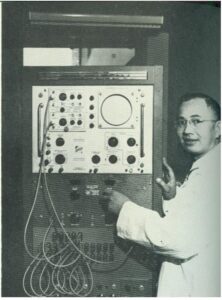
Pioneer of Electronic Fetal Heart Rate Monitoring
Edward “Ted” Hon was born on January 12, 1917, in Shekki, China, a village near Guangzhou, the fifth of eleven children of Harry Gee Hon and Cecilia Wong See, an Australian-Chinese family, while his mother was visiting relatives. He grew up in the small town of Tenterfield, Australia, became fascinated by electronics, and received a disploma from the Marconi School of Wireless in Sydney in 1942. After the war, he began to think about a career in medicine. Hon completed his pre-med requirements at Union College in Nebraska and then received his MD at what is now Loma Linda University Medical School in California.
After serving a rotating internship at Loma Linda Hospital, Hon was offered a residency by Dr. Herbert Toms, Professor and Chair of the Department of Ob/Gyn at Yale University School of Medicine. When C. Lee Buxton, chair of Yale’s OB/Gyn program, read preliminary reports about fetal monitoring from Johns Hopkins and asked Hon to evaluate the work there, Hon was unimpressed with what he found but was intrigued by the underlying concept. He proposed that a new electronics laboratory would be needed to do the work properly, and Yale funded the effort through a Markle Scholar in Medical Science award.
In 1958, Hon was the first to describe a system for continuously capturing the fetal ECG — a landmark contribution that set the foundation for modern intrapartum surveillance. His fetal monitor enabled obstetricians to determine fetal heart rate continuously even during labor contractions, and also to measure the strength and frequency of uterine contractions simultaneously — together providing a continuous window into fetal condition and tolerance of labor. His work, alongside that of Roberto Caldeyro-Barcia and Konrad Hammacher, ultimately led to the development of the first commercial fetal monitor in 1968.
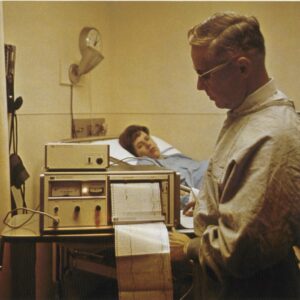
The HP 8020A cardiotocograph was the world’s first non-invasive electronic fetal heart monitor, developed in a partnership between the HP Division in Böblingen, Germany, and Dr. Konrad Hammacher, a German OB-GYN and professor of medicine. Though it was originally available in 1968 only in the European market, around 1970 it became the first major Hewlett-Packard project to be imported to the United States after being developed overseas.
Hon went on to define the clinical significance of specific fetal heart rate patterns — early, late, and variable decelerations — through meticulous correlation with fetal acid-base status. His studies correlating fetal heart rate deceleration patterns with fetal pH established that late decelerations and severe variable decelerations are definitively associated with disturbances in acid-base balance. This interpretive framework remains the basis of EFM classification to this day.
Hon subsequently joined the faculty at the University of Southern California, where Edward Quilligan recruited him to a department that handled approximately 15,000 deliveries annually at Los Angeles County Hospital — an ideal environment for large-scale clinical investigation. He worked there for thirteen years, before retiring at age 65. The retirement was shortlived, however, because Ezra Davidson, MD, chief of OB/Gyn at Martin Luther King/Drew Medical Center in Los Angeles recruited him to take a post as a research scientist at Drew Postgraduate School in Los Angeles.
Dr. Hon published widely and was the recipient of many honors and awards, including the Distinguished Service Award (American College of OB/Gyn), Fellow ad eundem (Royal College of OB/Gyn, London England), Virginia Apgar Award in Perinatal Pediatrics, President’s Distinguished Achievement Award (The Society for Gynecologic Investigation), and Lifetime Achievement Award (Los Angeles OB/Gyn Society). In 1999 the Governor-General of Australia, Sir William Deane, summoned Dr. Hon to receive the Order of Australia Gold Medal, an award approved by Queen Elizabeth II.
Hon’s legacy is both celebrated and debated. The electronic fetal monitor he pioneered became one of the most widely used technologies in obstetrics worldwide, and its continuous use in labor and delivery settings became standard of care. At the same time, subsequent clinical trials raised important questions about its impact on cesarean section rates and its limitations in predicting neurologic injury — a tension that continues to inform perinatal medicine and patient safety research.
Dr. Hon advanced not only the technology itself but the entire framework for interpreting fetal heart rate patterns based on years of clinical observation — a body of work whose influence on the safety of childbirth is difficult to overstate. He died in Bradbury, California, on November 6, 2006, at age 89.
- Hon, Edward H: “The electronic evaluation of the fetal heart rate: Preliminary report.” American Journal of Obstetrics and Gynecology, Volume 75, Issue 6, 1958, Pages 1215-1230, ISSN 0002-9378, https://doi.org/10.1016/0002-9378(58)90707-5.
- Modanlou HD: “Edward H. Hon, MD (1917-2006): A scientist, inventor, academician and the pioneer for the development of electronic fetal heart rate monitoring.” J Obstet Gynaecol Res. 2019 Dec;45(12):2364-2368. doi: 10.1111/jog.14123. Epub 2019 Sep 29. PMID: 31565824.
Portions of this page were drafted with machine assistance; the final text was reviewed, verified, and edited by the author. Click here to learn more.
Last Updated on 07/20/26