Evelyn Lundeen, RN (1900–1963)
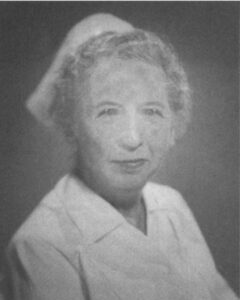
Pioneer of Premature Infant Nursing
Evelyn Lundeen was born in Rockford, Illinois, on February 15, 1900. She earned her undergraduate degree at Augustana College in Rock Island, Illinois, and completed her nursing training at Lutheran Hospital in Moline, Illinois. Even early in her career she demonstrated an independent professional voice: she presented a paper before the Illinois State Association of Graduate Nurses arguing that private duty nurses were too well-educated to limit themselves to cases involving incurable patients — a position subsequently published in the American Journal of Nursing. That assertiveness would define the decades to come.
In 1922, pediatrician Julius Hess received a substantial gift from the Infants’ Aid Society to establish the Premature Infant Care Station at Sarah Morris Children’s Hospital in Chicago — the first dedicated station of its kind in the United States. He soon hired Lundeen as its head nurse, beginning a three-decade professional partnership. Hess recognized clearly that the demanding, unrelenting work of keeping premature infants alive was above all a nursing task, and in Lundeen he found someone equal to it.
When Lundeen began the work that would become her life’s calling, neonatology as we know it today was barely practiced in the United States. In fact, the term “neonatology” did not even exist until much later. Premature infants were poorly understood, often refused admission by hospitals, and incubators were widely dismissed as carnival novelties rather than legitimate medical tools. Lundeen helped change all of that.
Lundeen brought rigor and discipline to the premature nursery at a time when almost no formal protocols existed. She and Hess found that preterm and low birth weight infants fed human milk had dramatically better outcomes than those given formula, and they encouraged new mothers to breastfeed after discharge, offering guidance on breast pumping and maternal diet. To minimize infection risk, nurses scrubbed as though entering surgery and wore full masks and gowns for all patient contact — practices that anticipated principles of aseptic technique that would not become universal for many years.
Although Lundeen strove to be as rigorous and methodical as possible, her work often relied as much on instinct as science. Formal clinical evidence was still limited, and some things she recognized from experience — such as the observation that sunlight exposure helped reduce jaundice — were not scientifically validated until years later. Many of the pragmatic aspects of premature infant care were transmitted from Martin Couney’s sideshow exhibitions to mainstream medicine partly through the influence of Louise Recht, Couney’s nursing director, who taught Lundeen French techniques of gavage feeding. Lundeen refined and standardized these methods; gavage feeding became the dominant premature infant feeding technique for decades.
The influence Lundeen exercised in the premature nursery was remarkable for its era. According to American Nursing: A Biographical Dictionary, because premature infants required such constant and labor-intensive care, neonatal nursing as Lundeen developed it became one of the rare settings in a hospital where all medical personnel regarded nurses as at least as important as physicians, if not more so. Historian Jeffrey P. Baker described her as a tireless worker who developed standards and detailed protocols covering virtually every clinical scenario, and whose nurses assumed practical authority over the nursery — sometimes to the frustration of residents who found that Lundeen’s judgment outranked their orders.
By 1940, Lundeen had overseen the nursing care of more than 4,000 infants. As premature nurseries began to appear in other cities, she traveled extensively to teach other nurses the principles of premature infant care. The Cook County Board of Health, which in 1935 enacted new regulations for preterm births, required county-funded home health nurses to be trained by Lundeen and her staff. She created the template for what specialized neonatal nursing would become. In an era when nursing was frequently subordinated to physician authority, she built a domain of clinical expertise that earned unconditional respect across professional boundaries — and in doing so, helped lay the foundation for the modern NICU.
Lundeen was a prolific contributor to the professional literature. She co-authored The Premature Infant, it’s Medical and Nursing Care with Hess, and later wrote Care of the Premature Infant (1958) with Ralph Kunstadter. Her 1939 article “Feeding the Premature Baby,” published in the American Journal of Nursing, became a foundational reference for generations of practitioners.
When the premature nursery at Sarah Morris opened, the average survival rate for preterm infants was roughly one in five. Under Lundeen’s direction, more than 70 percent of her patients survived. William Oh, MD, who worked with Lundeen as a resident, later remembered her as “a marvelous person” and credited her as “the inspiration and the stimulus that made me go into research.” Lundeen devoted her entire life to the premature nursery — she lived in the hospital nurses’ dormitory and never married. She died on January 29, 1963, eight years after the death of Julius Hess. She was posthumously inducted into the Neonatal Nursing Hall of Fame in 2019.
- Evelyn Lundeen – Wikipedia
- Evelyn Lundeen (1900-1963) Neonatal Nurse who Redefined Premature Infant Care, Working Nurse, January 13, 2020.
- Sentz, Lilli, ed. (2000). American Nursing: A Biographical Dictionary, Volume 3. Springer Publishing. pp. 183–186. ISBN 978-0826117472.
- MacMullen NJ, Bruckner MC. Evelyn Lundeen: perinatal pioneer. Neonatal Netw. 1986 Feb;4(4):20-3. PMID: 3512973.
- Lundeen, Evelyn C. R.N.. Feeding the Premature Baby. AJN, American Journal of Nursing 39(6):p 596-604, June 1939.
- Hess, Julius H. and Lundeen, Evelyn C.: The Premature Infant, it’s Medical and Nursing Care, J. B. Lippincott Company, Philadelphia, 1941.
- Lundeen, Evelyn C. R.N. and Kunstadter, Ralph H, M.D. Care of the Premature Infant. J. B. Lippincott Company, Philadelphia, 1958.
Last Updated on 04/05/26