Frederiksberg Incubator Institute 1898
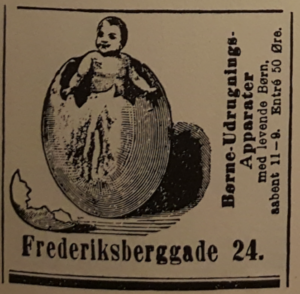
by Louise Lis Nielsen, Danish historian
Originally published in Danish at Lille Kleos Historieblog
In January 1898, Albert Leotardi — described as both director and doctor — arrived in Copenhagen to open a public exhibition of infant incubators at Frederiksberggade 24 in Frederiksberg, charging 50 øre admission. Leotardi had been establishing similar institutes since 1891 in cities across France, Switzerland, and Germany, making Copenhagen part of a pan-European circuit. The specific devices on display were the “Lion couveuse,” patented in 1889 by Frenchman Alexandre Lion, who had actively traveled Europe promoting the invention.
Day-to-day management fell to Miss Sandberg, a nurse from the local maternity foundation, with medical oversight provided by Dr. Le Maire, also from the foundation, who handled daily supervision. The stated mission was twofold: to demonstrate the technology publicly and to raise funds to establish a permanent department in Copenhagen offering free treatment to premature newborns from poor families. For families with means, the cost was 40 kroner per month. The institute owned 12 incubators valued at 500 kroner each, though only four were actually installed and in use.
The Socialdemokraten gave readers a detailed technical description on January 22, 1898. Each apparatus consisted of two large metal boxes roughly two cubits high and one cubit wide, constructed from sheet iron and fitted with observation windows so that the infants could be watched at all times. The internal temperature was maintained at a constant 31–33°C. Heating was accomplished by a kerosene lamp positioned outside the box, which heated water to produce vapor that circulated through an internal pipe system. A regulating mechanism kept the temperature stable. Fresh cold air was continuously supplied from outside, but before entering through a valve at the bottom of the apparatus it was both warmed and humidified. Spent air was exhausted through a pipe at the top of the box, with the outflow rate adjustable. It was, for 1898, a remarkably sophisticated piece of engineering.
The first infant admitted was a boy named Viggo, born ten weeks prematurely at one of the city’s maternity hospitals. Contemporary accounts described him as having a sallow complexion — possibly indicating jaundice — and appearing so “wretched and emaciated” that he was not expected to survive many more hours, particularly as he was refusing all nourishment. Within a few weeks the transformation was dramatic: Viggo was feeding, had gained a healthier color, and had more than doubled his weight from 3 pounds to 5¾ pounds.
Viggo was soon joined by a premature girl born six weeks early, and then by a pair of twins born seven weeks prematurely. The twins came from a poor working-class family in Christianshavn and were the 10th and 11th children in the household. They weighed approximately 2,000g and 1,700g at admission. Within just 11 days in the incubators they had grown to 2,200g and 1,910g respectively, and by the time the institute closed they weighed 5 and 5¾ pounds (roughly 2.27kg and 2.6kg).
The medical staff were deliberate in their approach. Feeding was done exclusively by breastfeeding — either by the mother or by the attached nurse — as bottle feeding was considered too risky at the time given the dangers of bacterial contamination and infection. Infants were only removed from their incubators for feeding, then returned immediately. Mothers were encouraged to stay: free accommodation and lodging were provided at the institute for as long as their child remained admitted. Each child was weighed daily, and the weights were recorded on a board visible to visiting members of the public, allowing them to follow the infants’ progress directly.
The exhibition was a sensation. Crowds gathered not only inside but outside the building, with one newspaper describing the scene as nearly riotous. Daily attendance exceeded 800 in late January and climbed to 1,200 by late February. Visitors included Police Chief Eugen Petersen and various officials, and the exhibition drew particular interest from women and philanthropic associations.
The terminology, however, generated a minor press controversy. A journalist writing as “Jeppe” in the newspaper Copenhagen objected that calling the process “child incubation” was misleading and potentially damaging to the invention’s reputation, arguing that the children were not being incubated from eggs but rather warmed after an early birth — a significant conceptual difference. A physician writing as Dr. C in Dannebrog agreed, finding the word both ugly and zoologically inapt, since incubation properly referred to the period before hatching. He proposed retaining the French term couveuse — meaning “brooding hen” — as preferable, even if equally barnyard in origin.
On March 6, 1898, the Institute for Child Incubators closed, the premises having become unavailable. The closure came just six weeks after opening. The institute was declared to have achieved satisfactory results, and all of the small patients were discharged and returned to their families — a quietly remarkable outcome for 1898 medicine.
Content adapted with thanks and apologies from Louise Lis Nielsen’s Danish history blog Lille Kleos Historieblog at https://lillekleo.wordpress.com/2020/04/25/en-underlig-attraktion/
Danish primary source was machine translated then reviewed and edited by the author.
Last Updated on 07/20/26