Australian Federal International Exhibition, 1902–1903
The Australian Federal International Exhibition opened at the Royal Exhibition Building in Carlton Gardens, Melbourne, on October 31, 1902, and ran through January 1903. Managed by Jules Joubert and funded by a private consortium, it was opened by the State Governor, Sir George Clarke, with an orchestral and choral ceremony. The exhibition was conceived as a celebration of Australian industry, innovation, and culture, though it took place against the backdrop of a deepening economic depression — a circumstance the Governor acknowledged directly in his opening address, noting that local resources “required stimulation.”
The exhibition combined industrial displays, fine arts, and popular entertainment. The main hall floor was given over to industrial exhibits including furniture, carriages, Remington typewriters, Mauser firearms, stained glass, and goods manufactured by prisoners at Pentridge Jail. The art galleries featured a large representative collection of British paintings and sculpture assembled by E. W. Christmas, with contributors drawn largely from the Royal Academy, alongside displays by the Victorian Artists Society and the Yarra Sculptors Society. Side attractions included a militarama, a pantoscope, a palmist’s parlour, a German Bier Halle, a Parisian dining room, trick cyclists on the Velodrome – and baby incubators.
Albert Leotardi, who had previously managed incubator exhibits in France, Switzerland, and Germany, journeyed all the way to Melbourne to mount what appears to have been the first public exhibition of baby incubators in Australia, staging the display at the Federal International Exhibition in Melbourne’s Exhibition Building. The event was novel enough to generate news coverage across multiple Australian cities within days.
The first wave of coverage appeared almost simultaneously in Melbourne (the Argus, December 8; the Australian Star picking up the Age‘s account, December 9) and Adelaide (the Evening Journal, December 10, which reprinted the Argus piece nearly verbatim). All described the apparatus with curiosity and moderate enthusiasm, the Australian Star‘s correspondent mildly dissenting from the name — calling “Baby Incubator” a “rather inappropriate title” for what was essentially a temperature-controlled cot.
At the opening of the exhibition, three infants were housed in the incubators. Two were twin girls, born the preceding Friday, admitted from the Women’s Hospital, and weighing barely over two pounds each. Both Leotardi’s letter to the Argus (December 26, 1902) and the fuller account in the Australasian (January 10, 1903) acknowledge these twins candidly: at such gestational age and weight, they were in Leotardi’s own words “forlorn cases from the start.”
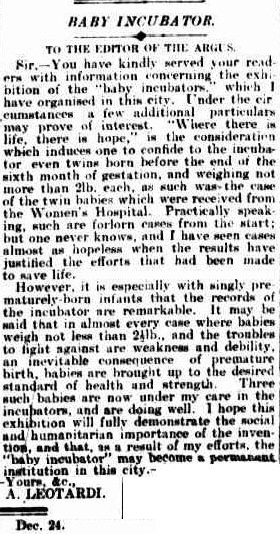
The Australasian version — the more complete text — records that they died. The third infant, a fortnight old and more than double their weight, appeared comparatively robust. By the time of the Australasian feature in early January, three additional single premature infants had been admitted and were reportedly doing well.
Infants were fed every two hours. For this purpose they were briefly removed, wrapped in a heated blanket, and taken to a separately warmed feeding room. Nourishment was administered by spoon through the nostrils for very young or weak newborns, or by more conventional means for stronger infants. Bathing was infrequent for the frailest cases; those slightly more robust were unwrapped each morning and dusted with rice powder. Bottle feeding was generally withheld for the first forty days.
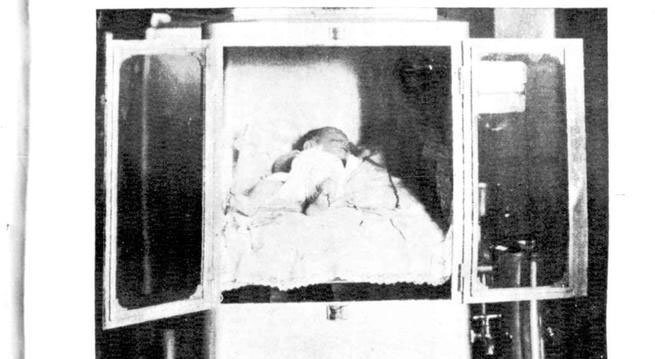
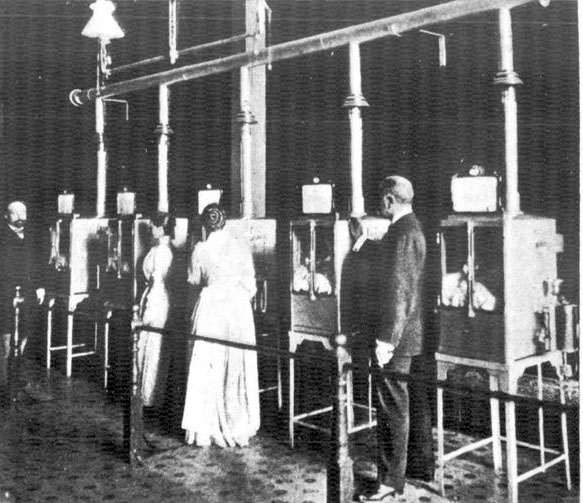
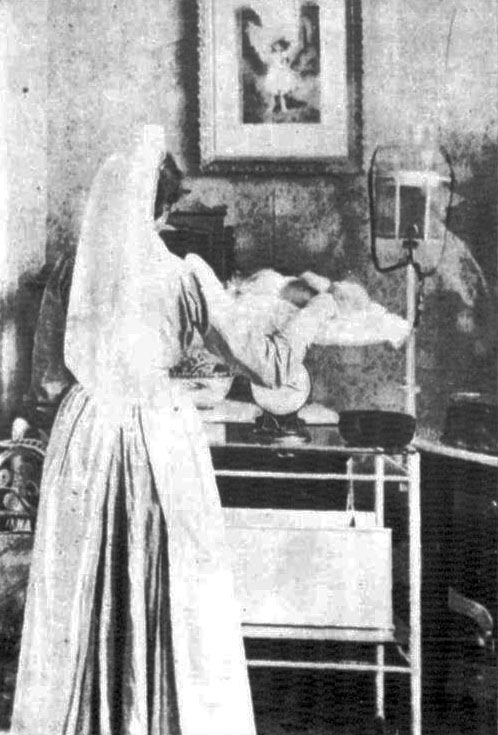
The Weekly Times of January 17 offered the most substantial treatment, with a technical description that quoted extensively from the Lancet, and including a endorsement letter signed by four honorary midwifery surgeons at the Women’s Hospital and illustrations of the exhibit. The Australasian of 10 January published what appear to be three photographs: a nurse weighing an infant, a view of the incubators and their attendants in the exhibition hall, and a close-up of an incubator with doors open showing an infant inside — among the earliest photographic documentation of incubator care in Australia.
A brief dispatch from the Evening Star (Boulder, West Australia) of January 31, 1903, noted that Leotardi was planning to tour all the Australian states with the apparatus — an ambition confirmed by the Sydney customs entry of April 1903 showing additional units being imported. It does appear that he moved on to at least one city, as there is a September 16 1903 news story in the Junee Democrat documenting an incubator baby exhibit in Sydney.
Attendance at the Federal International Exhibition fell well short of expectations. Most visitors came for entertainment rather than commerce, and art sales were disappointing. A commemorative 15-carat gold medal was struck for the occasion, but the exhibition is generally remembered as an ambitious enterprise undermined by economic depression and a mismatch between its commercial aspirations and the holiday spirit of its audience. However, it motivated Leotardi to journey halfway around the world to introduce incubators to the Australian public and healthcare system, so it had lasting effects on newborn care Down Under.
- Australian Federal International Exhibition – Opening Ceremony – The Argus, Nov. 1, 1902 (via Trove)
- The Australian Federal International Exhibition 1902-3 – Why did it fail – Freemanart
Portions of this page were drafted with machine assistance; the final text was reviewed, verified, and edited by the author.
Last Updated on 07/20/26