Alexandre Lion’s First Incubator Exhibit in Marseille
In 1889 Alexandre Lion, an engineer in Marseille, invented an egg incubator for 5000 eggs, including a sophisticated system to keep a stable temperature inside. He put it on display in a pavilion in Marseille and for a small entrance fee people could see chicks hatching.
In 1890 Lion developed a smaller version of this incubator, especially for infants. In May 1890 he received his first prematurely born baby, thus expanding the exhibit in Marseille with a living human child. (All translations below by Google Translate)
Un Bébé en Couveuse.- Nous avons eu l’occasion de parler dernierement d’une tres intéressante application de la couveuse, au développement des enfants nés avant terme. Les plus distingués praticiens de notre ville, et toutes les personnes que les progres de la science intéressent suivent avec attention les progres que fait le petit enfant de M. Piana. élevé dans la couveuse de M. Lion, avenue du Prado, depuis dix jours environ. Sonicorps s’est formé peu à peu et selon les lois-de la nature. On peut donc dire, dés maintenant, que l’expérience est conciuante et qu’elle fait le plus grand honneur à M. Lion, qui en a eu l’initiative.
A Baby in an Incubator.—We recently had occasion to discuss a highly interesting application of the incubator: the development of premature infants.
The most distinguished medical practitioners in our city—along with all those interested in the advancement of science—are closely following the progress of Mr. Piana’s infant, who has been nurtured in Mr. Lion’s incubator on the Avenue du Prado for approximately ten days. The child’s body has developed gradually, in accordance with the laws of nature. It can therefore be stated, even at this early stage, that the experiment is conclusive and reflects the greatest credit upon Mr. Lion, who took the initiative in undertaking it.
— Le Petit Marseillais, May 21, 1890
The show was a success, and he received quite a bit of coverage (and free publicity) in the local press.
The baby raised in Mr. Lion’s electro-automatic incubator at 101 Avenue du Prado is on view every day, at any hour.
— Le Petit Marseillais, June 22, 1890
Brief Notes: At its most recent meeting, the Society for the Protection of Childhood appointed Mr. A. Lion — inventor of the incubator for premature infants — as a full member, and awarded him a diploma as a “Benefactor of Humanity.”
— Le Petit Marseillais, October 26, 1890
By early 1891, coverage was getting more serious. Here we see the glimmerings of Lion’s bigger enterprise ahead.
LA COUVEUSE D’ENFANTS
Repopulation – Infant Mortality – Artificial Incubators – The FIrst Attempts – Mr. Lion’s System – Wonderful Results – Opinion of the Medical Profession – Necessary Intervention
If our mentor, Jules Simon, were to come to Marseille, he would certainly dedicate a visit—he, the gentle and powerful apostle of childhood—to the establishment of Mr. A. Lion Jr., on Avenue du Prado, 101; a veritable maternity ward whose admirable system is destined to become the most powerful aid in repopulation, by putting a strong brake on the considerable mortality of the small children of all ages whom the whims of nature have prematurely brought into the world, thus condemning them, almost inevitably, to death… These factors come into play—in a city like Marseille—accounting, on average, for a certain proportion of total births. In Paris, statistics indicate that the proportion is even higher: they account for between 30 and 35 percent!
The question of artificially supplementing the work of nature has been posed for a long time, but no one before M.A. Lion had resolved it conclusively. The method is an electro-automatic incubator, replacing—and this is not an exaggeration—the mother’s womb; providing the newborn with the regulated and consistent warmth necessary for life.
As early as 1857, Dr. Denucé had designed the first incubator in Bordeaux. It was a double-walled zinc cradle with a hot water circulation system. A six-month-old child was placed there and lived for seven days.
The experiment was courageously pursued, and from 1866 to 1884, Crédé employed an identical system at the Leipzig maternity hospital, without yet achieving significant results. In 1880, an incubator quite similar to the one used for hatching eggs was installed by Tarnier at the Paris maternity hospital: improvements had been introduced, but without, however, managing to precisely regulate the temperature. At the Charité hospital, it was Mr. Baudin [sic], we believe, an attempt was made to overcome this drawback by having an electric alarm fitted to the incubator to indicate if the temperature limits were exceeded. Yet, a certain consistency, some practical experience, and a measure of skill were still required to properly ensure the smooth operation of the apparatus.
The Lion incubator combines all the advantages of these systems and complements them with improvements that neither Tarnier nor Baudin could achieve.
Heating is continuous; the flow of heat is constant and regular, not subjecting the child to the temperature provided by the apparatus, but rather regulating it on its own.
The child is placed in a comfortable cradle, in the center of a kind of wooden box whose front face is closed at the bottom by a hinged panel and at the top by a flap sliding in vertical grooves. The tubes of a thermosiphon wind around the lower part of the box, following its walls like a kind of coil. They terminate externally in a container—which can be heated with kerosene or gas—from which the hot water that travels through the coils of the thermosiphon escapes and into which it returns.
Inside the box are placed two metal thermometers whose settings can be adjusted to maintain the temperature within suitable limits. The infant thus receives warmth from all sides. As an added precaution, a thermometer, — clearly visible from the outside — is suspended near the glass enclosure. A most ingenious automatic regulator maintains a uniform atmosphere by lowering or raising the flame of the gas burner that heats the apparatus.
We visited, in detail, the maternity unit established by Mr. Lion, and we were delighted by it. But our admiration knew no bounds when confronted with the results achieved in the mere few months it has been in operation. Indeed, thirteen infants have been admitted there, brought in as a last resort by distraught parents— by mothers who know that, while some hope of recovery may await a patient on the threshold of a hospital, one must harbor no such hope for those who enter life prematurely— as if in haste to leave it all the sooner!
Of these thirteen infants, however, twelve have emerged—resurrected by a new lease on life—vigorous and strong! But then again, with what care were these dear little ones not surrounded by two true Sisters of Charity—with a devotion evident in every passing minute,and unceasing vigilance! These are Mesdames Lion (mother) and Copain.These two brave women are there, day and night, watching over the faintest whimpers of each child; dispensing to each the nourishment that is no less essential to them than the warmth itself. The infants are bottle-fed with donkey’s milk; however, for those whose frailty makes this method unsuitable a robust wet nurse is on hand to nurse them at the breast.
Currently, three little girls are in the incubator.
The first arrived on November 27th; she was 6 months and 3 weeks old, and suffering from a generalized swelling of the body. She was a sort of tiny, half-cold corpse—over which [her mother] had wept. She went two days without taking any food; however, thanks to the beneficial effects of the vitality being infused into her, the infant was soon able to feed. At that time, she weighed 2 kilos and 25 grams; in perfect health today, she is about to be discharged, having gained over 3 kilos in weight!The second was 8 months old when she became Mr. Lion’s charge on December 5th. A beginning of a debilitating condition left little hope of saving her. She is currently strong and, from 2.510 kg, her weight has increased to 3.355 kg.
The third was 7 months old at the time of her discharge on December 16th. Her weight was 1.176 kg. The poor child’s arrival into the world had been difficult and had required the assistance of Doctors Millou and Jourdan, as well as a midwife, Ms. Chiapint. Each of them considered her lost and, by the time they decided to put her in an incubator, they could hardly diagnose anything else… This does not prevent her from weighing 2.227 kilos. The most rigorous accuracy of this information is guaranteed. Dr. Millou did not hesitate to proclaim it in a certificate full of praise, which would be a sufficient guarantee. If, to his esteemed name, others were not added, honored and very duly appreciated by the authority of their own merits as practitioners. Messrs. Chapplain, Doctors Villard, Magail, Queirel, Simon-Pirondi, Fanton, etc., agree. Indeed. Mr. Lion can victoriously wrest from rigid death the small lives it reaps at random according to its macabre whims.
Dr. Mazade himself, the distinguished inspector of children in care in the Bouches-du-Rhône, holds the method in high esteem. It could not be otherwise.
Unfortunately, Mr. Lion is flying on his own wings, and the pompous praise bestowed upon him, while the medical profession applauds his work, cannot allow him to spread very far. Saving children is just as meritorious as protecting the elderly, and the attempt, at least, deserves less platonic support.
Public assistance, the department, the city, and the medical profession must intervene to give Mr. Lion’s maternity ward all the support it requires in the name of humanity itself. For every day of waiting, there are lives lost, and we have no right to disregard them under the guise of indifference, which would make us guilty when it is actually intentional! This is unacceptable.
But, if Mr. Lion’s work is of the kind that cannot be abandoned, his selflessness deserves to be publicly acknowledged, for—whether they come from the rich or the poor—the little children brought to him receive, in his home, the very same care and consideration. The only trouble is that one ruins oneself in this vocation of a philanthropist—and we are not aware that the esteem one might earn from it is accepted as legal tender…
It belongs to the State, if not to the city, to multiply the number of Lion incubators—whether by utilizing them within hospital maternity wards or by establishing specialized facilities. We are certain, in any case, that even if the State and the City were to turn a deaf ear, mothers would prove numerous enough to step in and take their place.
Children—are they not life itself? The very future? Who does not love them?
The cradle—it is the great dream!
It is the sacred, eternal poem.
It is Eve’s very first smile,
After she had lost her Heaven!
LAROUAIRE.
— Le Petit Marseillais, January 22, 1891
And Lion began to run advertisements, at his own expense:
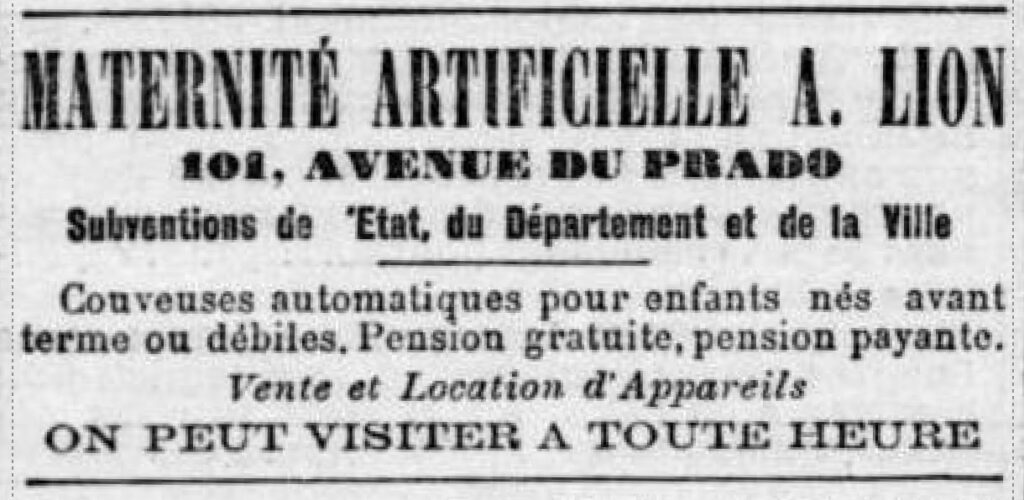
Later that year, Lion received recognition from the medical establishment and civic administration, and for the first time, some financial support, that encouraged him to expand beyond Marseille.
THE INFANT INCUBATOR
A Visit from Mr. H. Monod, Director of Public Assistance — The Medical Profession’s Opinion — Mr. Monod’s Administration — His Views on Mr. Lion’s System — Official Endorsement — Let Us Save the Children
Mr. Henri Monod, the eminent Director of Public Assistance, visited Mr. A. Lion Jr.’s Infant Incubator at 101 Avenue du Prado yesterday morning; he was accompanied by Dr. Mazade, Inspector of Assisted Children for the Bouches-du-Rhône department, and by the Honorable Dr. Millou.We have previously described, in this very column, the nature of the Lion incubator system and wherein lies its superiority over all other models tested to date—including those developed in 1857 by Dr. Denucé in Bordeaux; between 1866 and 1884 by Credé at the Leipzig Maternity Hospital; in 1880 by Tarnier at the Paris Maternity Hospital; and, more recently, by Baudin [sic] at the Hôpital de la Charité in Paris.
The latter came closest of all to achieving perfection by fitting the device with an electric alarm designed to indicate whether the prescribed temperature limits for the infant had been exceeded. However, ensuring the proper functioning of this mechanism required constant vigilance and a certain degree of technical skill.
Mr. Monod was certainly not unaware of Mr. Lion’s discovery; indeed, the honorable Dr. Mazade had reportedly made no secret to him of the marvelous results to be expected once it was widely adopted. Moreover, this opinion is by no means unique to him; it is shared by other figures among the most distinguished members of the Marseille medical community. Prominent among them are Dr. Chapplain—Director of the School of Medicine—as well as Drs. Magail, Mireur, Villard, Boy-Teissier, Pirondi, Miliou, Queirel, Fanton, and others.
His initial attempts met with success; and although Mr. Lion—left to rely entirely on his own resources—was unable to persuade the administrative authorities to open their coffers in his support, these early successes spared him from the discouragement to which less resolute individuals might well have succumbed.Such praiseworthy efforts were bound to receive their reward. It was all the more gratifying for having come from on high.
Mr. H. Monod, a wise and astute administrator, does not hesitate to undertake arduous journeys—not only to assess the functioning of the Public Assistance services, but also to determine what improvements they are capable of. Yesterday’s visit had no other purpose.
For nearly two hours, he questioned Mr. Lion about his system and, under his watchful eye, had him conduct a series of experiments that left him absolutely convinced.“It is marvelous,” he remarked repeatedly, addressing Doctors Mazade and Millou.
What appealed to him most was the mechanism’s simplicity—combined with its ingenuity—which automatically ensures the precise temperature selected for the infant. The alarm bell, which sounds whenever the device malfunctions, nearly roused him to a pitch of enthusiasm. Indeed, the constant supervision required by the incubators attempted thus far is, in effect, the primary reason for the difficulty encountered in their practical application.
In this regard, Mr. Lion cited an example that we are pleased to highlight: It occurred during the severe cold spell of recent times; one night, the gas pipes froze, and all the heaters went out. The temperature inside the incubators dropped rapidly; however, as soon as the minimum threshold established for their internal atmosphere was reached, the alarm bells rang out loudly. Kerosene lamps were immediately substituted, and the infants were spared the harmful effects of a sudden transition.
“It is marvelous,” Mr. H. Monod could not help but repeat once again.
The honorable Director of Public Assistance continued by offering Mr. Lion some advice regarding general hygiene.
“One must ruthlessly ban feeding bottles fitted with tubes; they constitute a veritable form of poisoning, and their very manufacture ought to be prohibited by law. Only the use of a glass feeding bottle is safe, and one should not hesitate to substitute it for all others.”
Before taking his leave—and as if to lend official sanction to his visit—Mr. Monod presented Mr. Lion with a letter that serves as the finest of testimonials. Its contents are as follows:
“I have the honor to inform you that, upon my recommendation, the Minister of the Interior has granted a subsidy of 500 francs to the establishment you direct in Marseille—an institution dedicated to the care of premature infants, as well as those born at term who are too frail to withstand fluctuations in temperature. I take great satisfaction in having been able, by initiating this decision, to support the valuable work you have undertaken. Signed: MONOD, Director of Public Assistance.”
It was nearly noon when Mr. Monod and Dr. Mazade took their leave to head to the Prefecture, where Mr. Lagarde had invited them to lunch.
We understand that, following this visit, a Lion incubator will be placed at the disposal of the medical staff at the Marseille Maternity Hospital; furthermore, the system is soon to undergo official trials in Paris.
And rightly so, for—as Mr. Monod stated yesterday—”all of society’s efforts must be directed toward wresting from death the thousands of children whose lives it prematurely cuts short.”
Mr. A. Lion’s infant incubator will prove to be one of the most powerful aids in these endeavors.
GASPART GALY
— Le Petit Marseillais, March 17 1891
In 1891, Lion embarked on his next phase, founding a charity organization in Nice named “Oeuvre Maternelle des Couveuses d’Enfants” in Nice. He then established branches of “Oeuvre Maternelle des Couveuses d’Enfants” in other cities in France (his most famous was the storefront at Boulevard Poissonnière 26 in Paris) and abroad (for example, in New York and Barcelona). Additionally, he exhibited baby incubators in numerous national and international expositions in Europe beginnign in 1894, and remained very active in promoting his incubators until the outbreak of the First World War in 1914.
Lion patented his incubator designs in 1889 and 1892. He manufactured and sold or rented out the incubators directly in France, and the incubators of his design were also manufactured by Paul Altmann in Germany and Kny-Scheerer in the United States. Long after Lion disappeared from history, Couney and other exhibitors in the United States were still using Lion-type incubators at fairs and amusement parks in the United States until the 1940s.
French primary sources were machine-translated, then checked against the originals and edited by the author.
More Information about Alexandre Lion
- General Information
- Alexandre Lion
- The Lion Incubator
- The Engineer and the Newborns, by W. A. Nelson and Paul L. Toubas
- Lion Patents (France)
- Patent 201550, 1889, Couveuse électro-automatique
- Patent 221716, 1892, Couveuse automatique
- Patent 262090, 1896, Chambre vivifiante
- Patent 281687, 1898, Système de filtration de l’air
- Patent 287557, 1899, Système de filtration des fumées, de l’air et de toutes masses gazeuses avec tirage et ventilation
- Patent 189989, 1899, Appareil pour le filtrage et la purification de l’air et des fumées
- Maternité Lion Institutes
- Alexandre Lion’s first incubator baby exhibit in Marseille, 1890.
- Oeuvre Maternelle des Couveuses d’Enfants, Nice
- Oeuvre Maternelle des Couveuses d’Enfants, Lyon
- Oeuvre Maternelle des Couveuses d’Enfants, Paris
- Oeuvre Maternelle des Couveuses d’Enfants, New York
- Oeuvre Maternelle des Couveuses d’Enfants, Barcelona
- Ouevre Maternelle des Couveuses d’Enfants, Brussels
- Maternité Lion Souvenir Booklets
- Oeuvre Maternelle des Couveuses d’Enfants , Paris Institute, Booklet Version #1 (appears to be ~1896)
- Oeuvre Maternelle des Couveuses d’Enfants , Paris Institute, Booklet Version #2 (appears to be ~1901)
- Pamphlet from Alexander Lion’s exhibit at the 1898 exhibition in Torino, Italy. (PDF supplied by Dr. Thijs Gras, Amsterdam)
- Press Coverage
- La Maternité “Lion de Nice” pour Enfants Nés Avant Terme ou Débiles, by Dr. Ciaudo, 1895. Source: gallica.bnf.fr.

- Presentation d’Appareil, by M. A. Pinard, Bulletin de l’Académie nationale de médecine, 1893. Source: gallica.bnf.fr.
- Les couveuses d’enfant et le gavage, by César-A Queirolo, Includes discussion of Lion incubator and comparison to other types. Thèse de doctorat: Univ. Genève, 1897.
- Les Couveuses pour Enfants, Gazette Médicale de Paris, No. 40, October 6, 1900
- Couveuses d’Enfants, La Maternité Lion, Paris, La Patrie, 1897
- Paris Letter: An Improved System of Incubators, by O. Jennings, Pediatrics 1:427-428, 1896
- Baby Incubators, The Strand Magazine, 1896, by James Walter Smith
- Human Infant Incubation: A True Fairy-Tale of Modern Science from Leslie’s Weekly, 1897
- The Saving of Human Life, Maternité Lion in NYC, The Literary Digest, 1898
- Immature Infants in France, from The Lancet, January 16, 1897, page 196.
- Alexandre Lion’s Incubator Charities in Europe (1894–1898) (The Embryo Project)
- La Maternité “Lion de Nice” pour Enfants Nés Avant Terme ou Débiles, by Dr. Ciaudo, 1895. Source: gallica.bnf.fr.
- Worlds Fairs and Expositions
- Maternité Lion at the Lyon Exposition Universelle et Coloniale, 1894
- Maternité Lion at the Bordeaux Exposition of 1895.
- “La Maternité Lion,” by Louis Énault, Journal of the Bordeaux Exposition, 1895
- Maternité Lion at the Amsterdam World Exposition, 1895
- Maternité Lion at the Berliner Gewerbeausstellung, 1896
- “Bericht ǔber die Couveuse (Lion) oder Kinderbrutanstalt” [Report about the Lion Incubator] from Berlin und seine Arbeit – Amtlicher Bericht der Berliner Gewerbe-Ausstellung 1896. English Translation.
- Maternité Lion at the Exposition National Suisse, Geneva, Switzerland, 1896
- “Quelques Réflexions sur le Fonctionnement et les Résultats des Couveuses Lion pendant l’Exposition Nationale,” by Dr. Hector Maillart, Revue Médicale de La Suisse Romande, 1896. English translation.
- Maternité Lion at the Tennessee Centennial Exposition, 1897
- Maternité Lion at the Brussels International Exposition, 1897
- Maternité Lion at the Turin L’Esposizione Generale Italiana, 1898
- Maternite Lion at the Ghent Provincial Exposition of 1899
- Maternité Lion at the Greater Britain Exhibition of 1899
- Maternité Lion at the Paris Exposition Universelle of 1900
- Maternité Lion at the Woman’s Exhibition in Earls Court, London, 1900
- Maternité Lion at the Lille Exposition of 1902
- Maternité Lion at the Exposition Internationale de Reims, 1903
- Maternité Lion at the Nantes Exposition of 1904
- Maternité Lion at the Exposition du Nord de la France, 1904
- Maternité Lion at the Liège Exposition Universelle et Internationale, 1905.
- Maternité Lion at the Marseille Colonial Exposition of 1906
- Maternite Lion at the Bordeaux International Maritime Exposition of 1907
- Maternité Lion at the Marseille Exposition Internationale d’Électricité, 1908
- Maternité Lion at the Exposition Internationale de l’Est de la France, Nancy, France, 1909
- Maternité Lion at the Brussels Exposition Universelle et Internationale, 1910
- Maternite Lion at the Exposition du Centre de la France, Clermont-Ferrand, 1910
- Maternité Liion at the Rome International Exposition of 1911
- Maternité Lion at the Turin International Exposition of 1911
- Maternité Lion at the Exposition Internationale de Dunkerque, 1912
- Maternité Lion at the Ghent International Exposition of 1913
- Maternité Lion at the Exposition Internationale Urbaine de Lyon, 1914
Last Updated on 07/23/26