Imperial Baby Incubator Exhibition 1897-1898
Background
In the summer of 1897, the Victorian Era Exhibition at Earl’s Court introduced London to the spectacle of premature infants being kept alive in incubators on public display. Run by the showmen Martin Couney and Samuel Schenkein, with nurse Mme. Louise Recht, the exhibit drew as many as 3,600 visitors per day and over 207,000 by the end of the season. It was a sensation — and it did not go unnoticed by other entrepreneurs looking to capitalise on the public’s fascination.
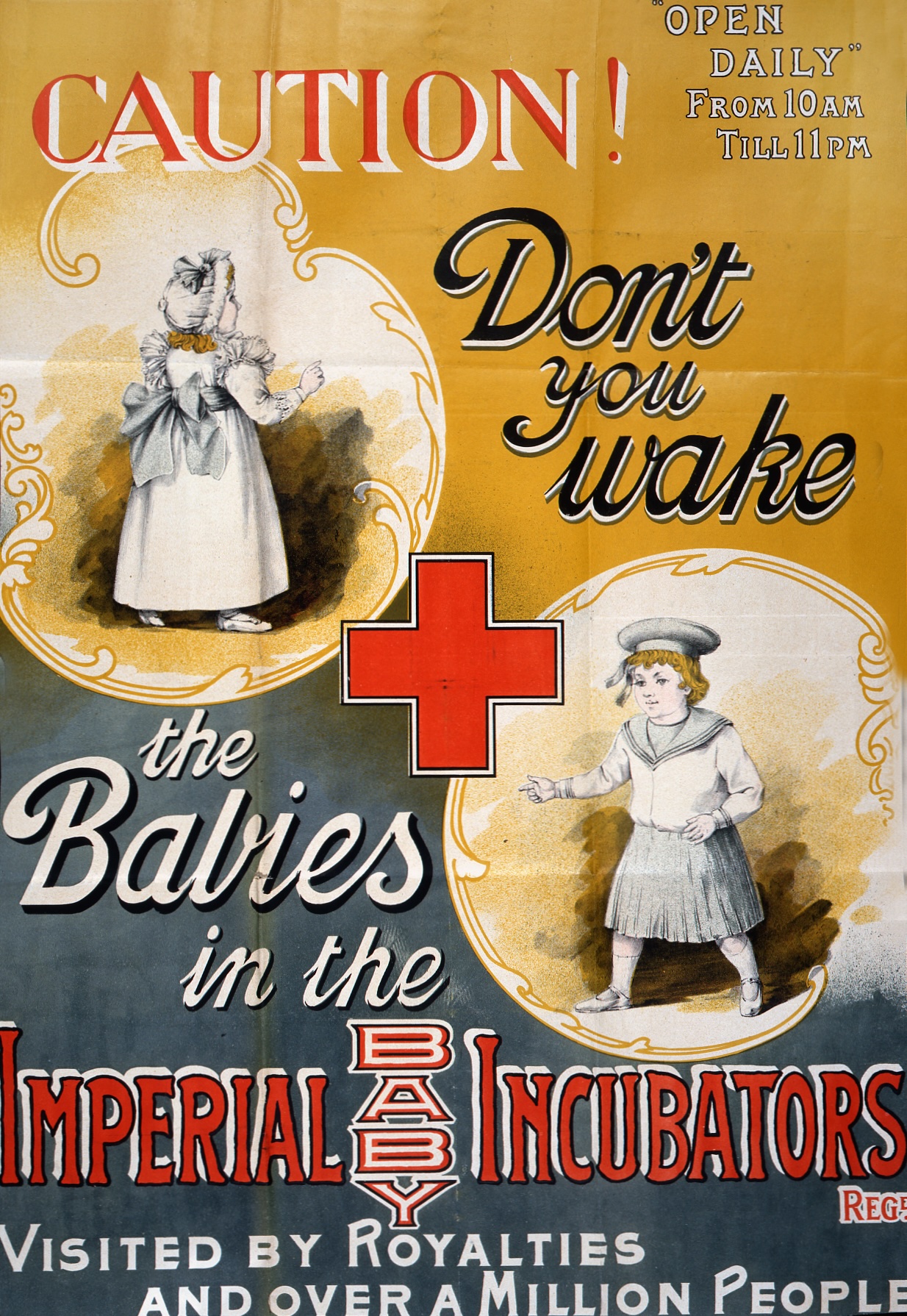
One of those entrepreneurs was Adolph Lowenstein, a commission agent who was not a medical man. Lowenstein saw in the incubator baby exhibition a commercial opportunity and moved quickly to establish his own independent operation, entirely unrelated to Couney’s exhibits or those of the French incubator pioneer Alexandre Lion. He called it the Imperial Baby Incubator Exhibition — the name carrying a deliberate resonance with the patriotic fervour of Queen Victoria’s Diamond Jubilee year. He registered the name and an associated image at Stationers’ Hall under the Copyright Acts in May 1898, at what proved to be the peak of his commercial confidence.
Lowenstein ran the business in the name of his wife rather than his own — a deliberate legal arrangement designed to shield him personally from liability. He was, in the language of the court that would later hear his case, a commission agent who did not carry on business in his own name.
The Touring Circuit
The Imperial Baby Incubator Exhibition was active for approximately eleven months, from September 1897 to August 1898. In that time it appeared at a remarkable range of venues across Britain, operated partly through bookings with established impresarios and partly through a long-running arrangement with the Crystal Palace at Sydenham.
The first confirmed advertisement appeared in the Blackpool Herald of September 3, 1897, placing the show at the Winter Gardens, Blackpool, under General Manager Mr. Chas. B. Brighten, just weeks after the Earl’s Court exhibition had captivated London.
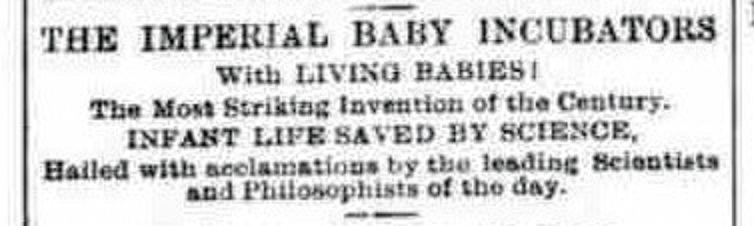
By December 1897, the show had travelled north to Edinburgh, where it was booked into H.E. Moss’s Thirteenth Christmas and New Year Carnival at the Waverley Market on Princes Street. Moss’s advertising billed it as “The Most Striking Invention of the Century. Infant Life Saved by Science.” It shared the bill with the strongman Eugen Sandow, engaged at £200 per week, along with Rontgen X-Rays, Indian Liliputians, and a hundred other attractions. The Edinburgh Evening News of December 21, 1897 noted that the incubators “were much inspected” on the opening evening and described the apparatus as “one of the wonders to many people.”
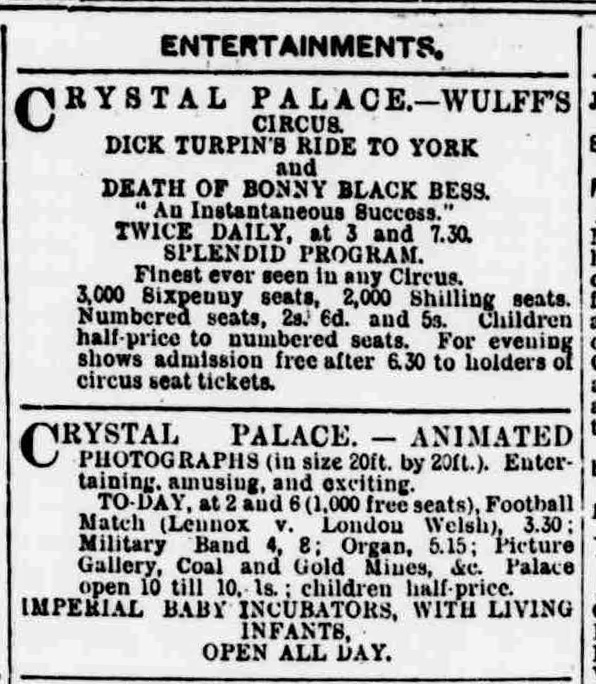
In November 1897, Lowenstein had signed a formal arrangement with the Crystal Palace Company at Sydenham, South London. Under its terms, Lowenstein received two-thirds of the takings and the Crystal Palace Company one-third. The Morning Leader of February 19, 1898 carried a Crystal Palace advertisement listing “IMPERIAL BABY INCUBATORS, WITH LIVING INFANTS, OPEN ALL DAY” alongside Wulff’s Circus and Animated Photographs, with the Palace open from 10am to 10pm.
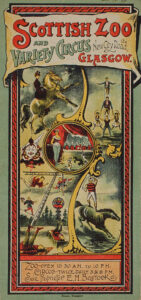
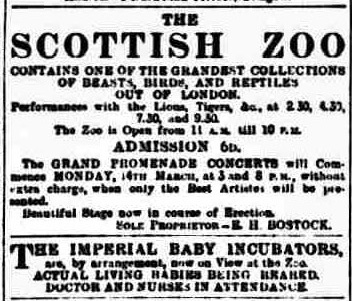
In February and March 1898, the show — or a unit of it — also appeared at the Scottish Zoo and Variety Circus in Glasgow, operated by the showman E.H. Bostock. The North British Daily Mail of March 8, 1898 carried the advertisement: “THE IMPERIAL BABY INCUBATORS, are, by arrangement, now on view at the Zoo. ACTUAL LIVING BABIES BEING REARED. DOCTOR AND NURSES IN ATTENDANCE.” Bostock, an experienced and progressive showman and Fellow of the Royal Zoological Society, booked the attraction in good faith as part of his regular policy of varying exhibits with scientific and educational novelties. He had no involvement in the ownership or operation of the enterprise.
Medical Arrangements
Lowenstein contracted Dr. Thomas F. Devane, a medical gentleman practising at Norwood near the Crystal Palace, to provide medical attendance to the babies and nurses, visiting the exhibition at least once daily, for a guinea a week. This fee Lowenstein subsequently attempted to reduce to fifteen shillings.
The pipe that was supposed to supply fresh air to the incubators was not carried outside the Palace building. In high summer, the Crystal Palace — a vast glass structure — absorbed and held the heat of the sun, its air breathed and rebeathed by thousands of visitors daily. These were the conditions in which premature infants were being exhibited.
Fatal Closure and Trial
On August 11, 1898, a baby named Grace Roberts was brought to the Crystal Palace exhibition for treatment in an incubator. She died two days later, on August 13, 1898. The Crystal Palace manager, Mr. Gilman, who had already written to Lowenstein warning that the place was too hot for babies, ordered the show closed permanently. He had been informed that the only baby remaining in the incubators that night was more dead than alive. Other babies had died before the crisis came to a head, though Lowenstein later claimed he could not say how many.
No advertisement for the Imperial Baby Incubator Exhibition appeared in any British newspaper after August 13, 1898. The business was finished.
In May 1899 Lowenstein brought a civil action — Lowenstein v. Devane — before Mr. Justice Day and a special jury in the Queen’s Bench Division, claiming damages against Dr. Devane for breach of contract in failing to attend the exhibition as agreed. He was not alleging want of skill; he was claiming money.
The case collapsed under the weight of Lowenstein’s own testimony. He admitted that other babies had died before Grace Roberts and could not say how many. He had refused to pay the undertaker for one of the two confirmed dead babies; the undertaker had sued him and won. He had failed to pay his nurses’ wages; they had sued him for four weeks and recovered one. Mr. Justice Day, observing that Lowenstein had thought he had a perfect right to complain if in the interests of humanity the children ought to be cleared out of the Palace, remarked: “Of course it stopped his profits.” When Lowenstein insisted the exhibition had not been a nuisance, Justice Day replied: “What! Dying children at a Palace not a nuisance?”
The jury stopped the case before the defence had fully presented its evidence and returned a verdict for the defendant. Judgment was entered for Dr. Devane accordingly, on May 8, 1899. The Critic of May 13, 1899 published a scathing editorial calling Lowenstein a “scoundrel” and a “brute,” and asked: “Is there no civilised law competent to deal with these atrocities?”
Summary
The Imperial Baby Incubator Exhibition operated for approximately eleven months — September 1897 to August 13, 1898. It was a purely commercial enterprise, run by a non-medical showman with inadequate medical oversight, in conditions that were demonstrably lethal to the premature infants in its care. It toured successfully through Blackpool, Edinburgh, and Glasgow, and maintained a semi-permanent presence at the Crystal Palace, before being shut down following the death of baby Grace Roberts. The subsequent trial revealed an operation characterised by penny-pinching, evasion of financial obligations, and a complete indifference to the welfare of the infants on display. The reputational damage from the court case, combined with the finality of the Crystal Palace closure, ended the enterprise permanently.
- Blackpool Herald, September 3, 1897 — first confirmed advertisement, Winter Gardens, Blackpool.
- Edinburgh Evening News, December 20, 1897 — advertisement for H.E. Moss’s Christmas and New Year Carnival, Waverley Market, Edinburgh.
- Edinburgh Evening News, December 21, 1897 — review of opening night of Moss’s Carnival.
- The Dundee Advertiser, December 24, 1897 — advertisement for Moss’s Carnival.
- The Herald (Glasgow), December 25, 1897 — advertisement for Moss’s Carnival.
- The Morning Leader (London), February 19, 1898 — Crystal Palace advertisement.
- North British Daily Mail (Glasgow), March 8, 1898 — Bostock’s Scottish Zoo advertisement.
- Glasgow Herald, February 26, 1898 — earliest confirmed Bostock advertisement; cited in Steve Ward, “Credit to any Country: E.H. Bostock and Scotland’s first Zoo & Variety Circus,” Journal of Victorian Culture Online, November 26, 2020.
- The Daily Graphic, May 9, 1899 — court report, Lowenstein v. Devane.
- Worcester News, May 9, 1899 — court report, Lowenstein v. Devane.
- South Wales Daily News, May 10, 1899 — court report, Lowenstein v. Devane.
- The Kentish Mail, May 12, 1899 — court report, Lowenstein v. Devane.
- The Critic, May 13, 1899, pp. 5–6 — editorial on Lowenstein v. Devane.
- Edward Robinson Squibb diary, 1897 — tipped-in Crystal Palace programme for December 7, listing “the Imperial baby incubators.” Online Archive of California, ark:/13030/c8st7x16/.
- Steve Ward, “Credit to any Country: E.H. Bostock and Scotland’s first Zoo & Variety Circus,” Journal of Victorian Culture Online, November 26, 2020. https://jvc.oup.com/2020/11/26/e-h-bostock/
Portions of this page were drafted with machine assistance; the final text was reviewed, verified, and edited by the author.
Last Updated on 09/01/26