La Goutte de Lait
At the end of the nineteenth century a child born in a French working-class town stood a worse chance of seeing its first birthday than an octogenarian had of seeing out the year — a comparison the Académie de médecine’s secretary Bergeron actually drew, and which the local press at Fécamp reprinted in June 1894. The leading cause was not epidemic disease but l’alimentation vicieuse des nouveau-nés: artificial feeding with cow’s milk, fouled in transport and storage, delivered through the notorious long-tube biberon Robert, an apparatus impossible to clean and aptly called by physicians “the bottle that kills.” Into this problem stepped a provincial doctor whose response would name and pattern an entire movement.
The founding, Fécamp, 1894
Léon Dufour (Saint-Lô, 1856 – 1928) settled in Fécamp in 1881 and founded l’Œuvre de la Goutte de Lait in June 1894. The constitutive public meeting was held on 16 June and reported approvingly by both of the town’s mutually hostile newspapers. The idea was simple and, in its combination, new. Where the mother could not nurse, the œuvre would prepare and distribute sterilized, “humanized” cow’s milk in ready-to-use bottles — a daily basket of nine, one per feed — in exchange for a single, binding obligation: that the child be brought once a week to be weighed and examined. Milk depot and infant consultation were welded into one institution, sited deliberately near the poor quarters, outside the hospital and the maternity, and following each child for at least a year.
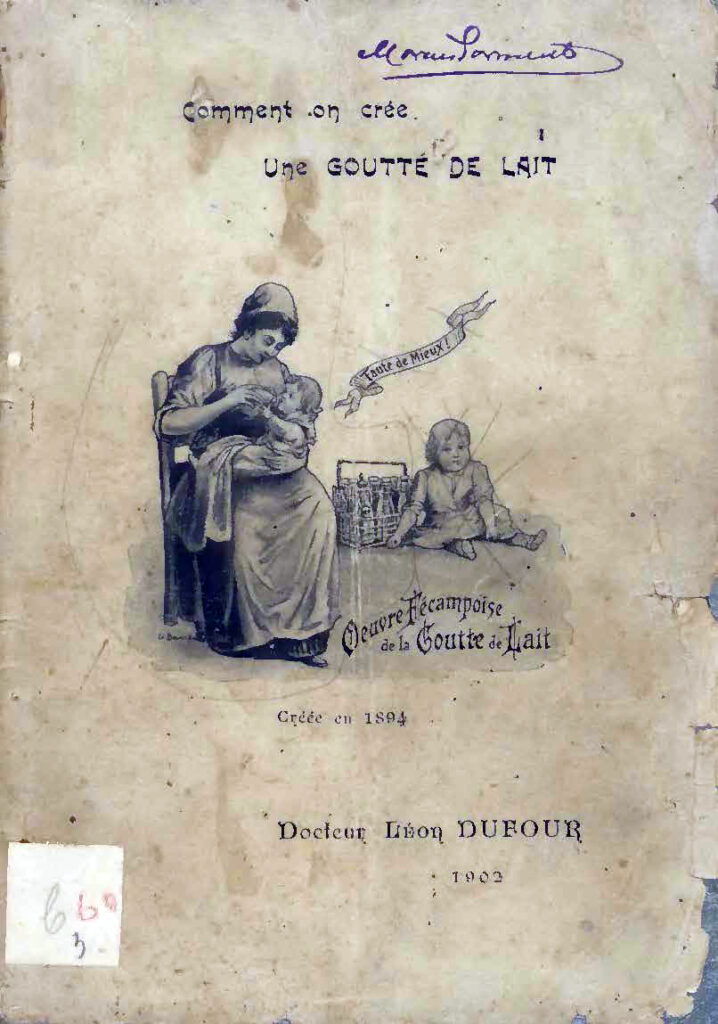
Dufour insisted that this was a second-best. The work’s motto, printed on the cover of his manual beneath a nursing mother, was “Faute de mieux” — for want of anything better. Breastfeeding remained the ideal; the bottle was, in his own words, an unfortunate social necessity that would persist as long as women held their place in industry. The framing mattered, because it positioned the physician permanently between mother and infant — the conceptual core of what would soon be called puériculture.
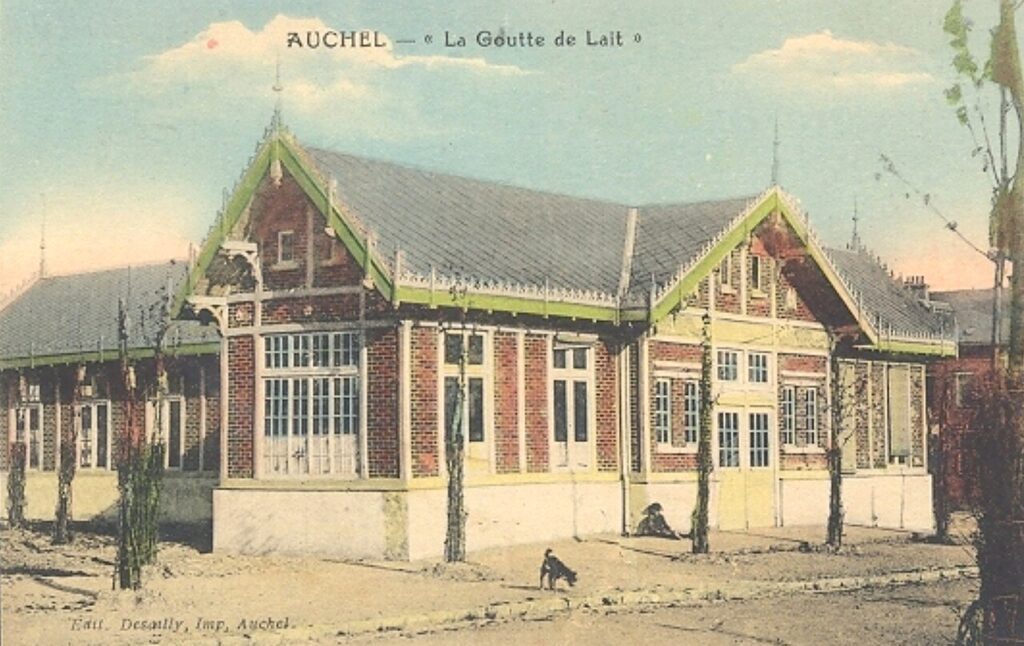
The primary document, Dufour’s Comment on crée une Goutte de lait (Fécamp, Durand, 1902) is a how-to manual written for the doctors and town councillors who kept asking him what the work actually was, and it lays the operation bare. Three fee sections — gratuite, demi-payante, payante — received identical milk; mothers bought tokens (10 centimes to 1 franc) at the town’s pharmacies and exchanged them at a courtyard window for the day’s basket, returning the previous day’s empties. Inside, a single gérante and a girl assistant ran a laboratory built around a centrifuge for “humanizing” the milk and a gas autoclave (the Hignette sterilizer) that brought it to 102 °C. The milk’s freshness was policed by an almost theatrical chemical test, a few drops of indigotine that should hold their blue for a set number of hours depending on room temperature — a method Dufour credited to the chemist Vaudin and to Duclaux. The manual even prints the installation budget (3,000 francs) and the 1900–01 operating accounts. By the time he signed it on 1 January 1902, Dufour could count 110 Gouttes de Lait established across the five continents.
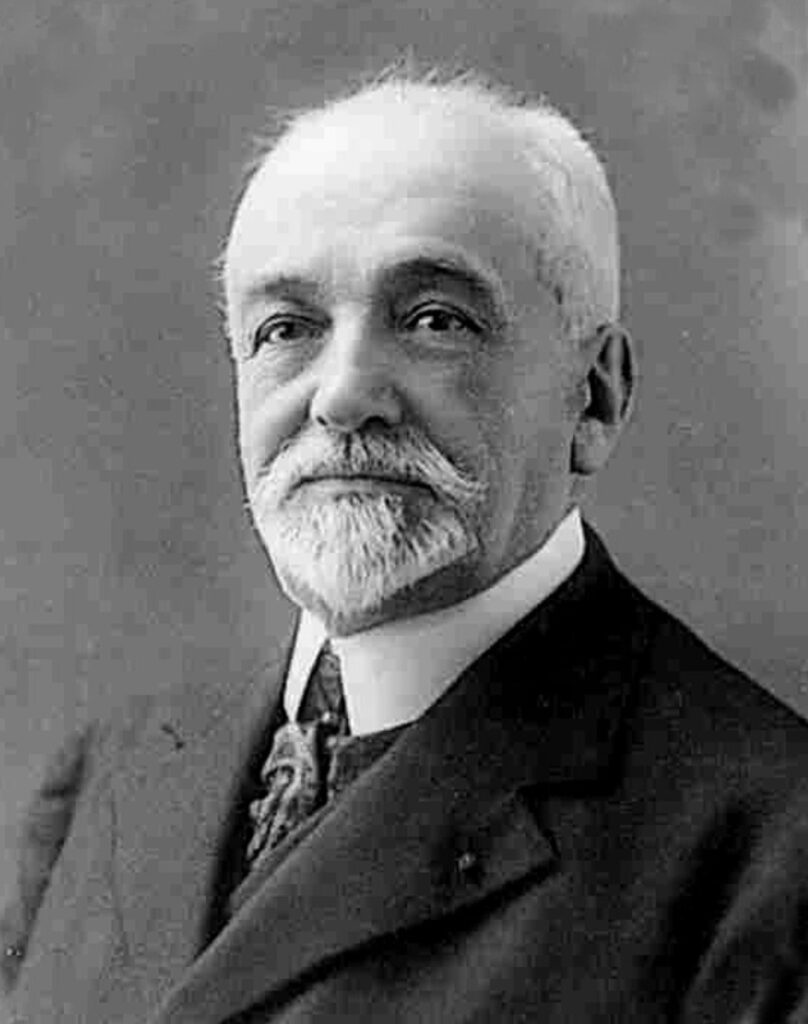
Although the secondary literature has occasionally blurred it, the weighing was weekly, not daily. The consultation room stood open every day from eleven to noon, and its communicating door was kept permanently ajar so that waiting mothers overheard the advice given to others — surveillance and instruction folded together — but each child’s formal weigh-in came once a week.
Did it work?
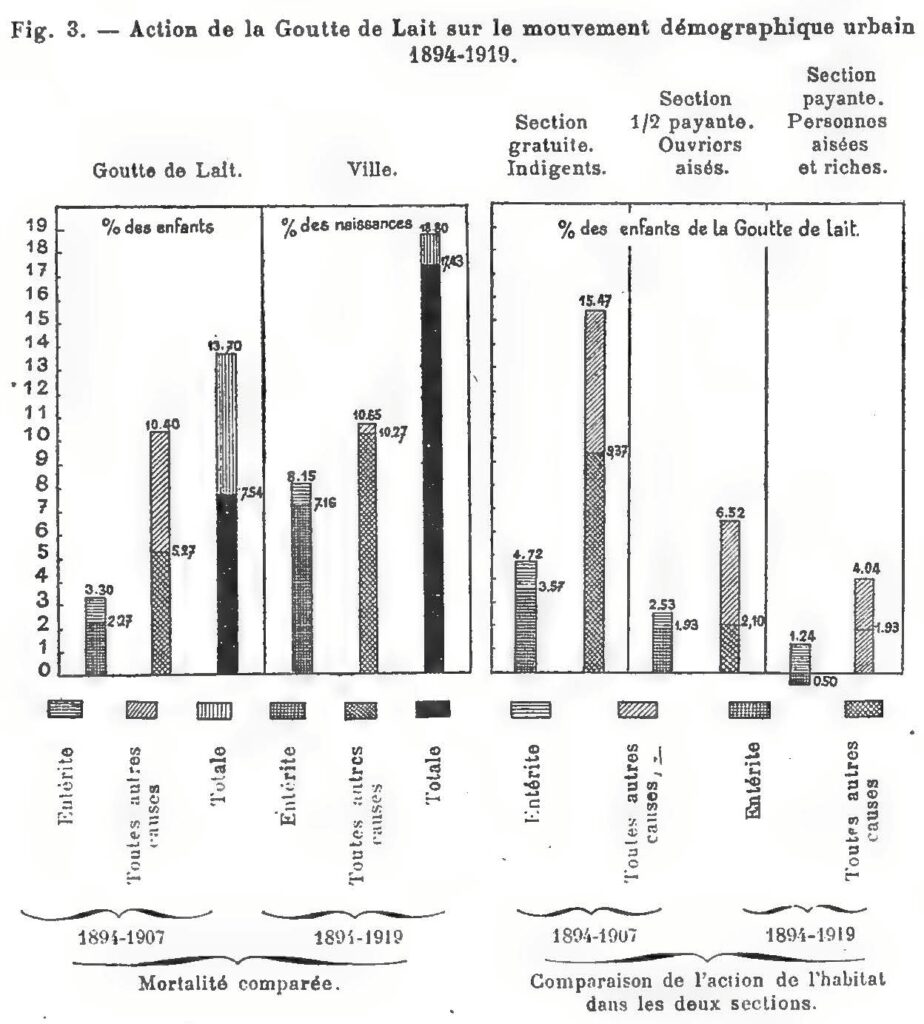
Dufour’s own retrospective, published in La Presse médicale in April 1921 to mark forty years of effort, supplies the summary figures in his own hand. Since the work’s founding, 4,270 infants between one day and one year old had been entrusted to it; it had distributed some 623,000 litres of milk and given more than 100,000 free consultations — about 4,000 a year — drawn overwhelmingly from the poorest quarters of the town. He dated his first campaign — advice, aphorisms, and the lending of Soxhlet sterilizers — to 1881–1894, and framed its disappointments as precisely what drove him, in June 1894, to “preach by example” and prepare the milk himself.
The mortality data, drawn from his reporting and the municipal archives, are striking. In 1895 infant mortality in the town ran near 21 percent against roughly 12 percent among the Goutte de Lait’s children; by 1901 the gap had widened to about 26 against 7 percent. From 1901 onward, Dufour reported, infant deaths among his charges fell to 11.2 percent of births, against a prior best French average of 16 percent, and the town’s general mortality followed infant mortality downward to 14.95 per thousand by 1919. The historian Manuelle Sautereau, working from the Archives municipales de Fécamp, traces uptake from five infants in 1894 to a third or more of the town’s newborns within a decade, and as high as 89 percent by 1937.
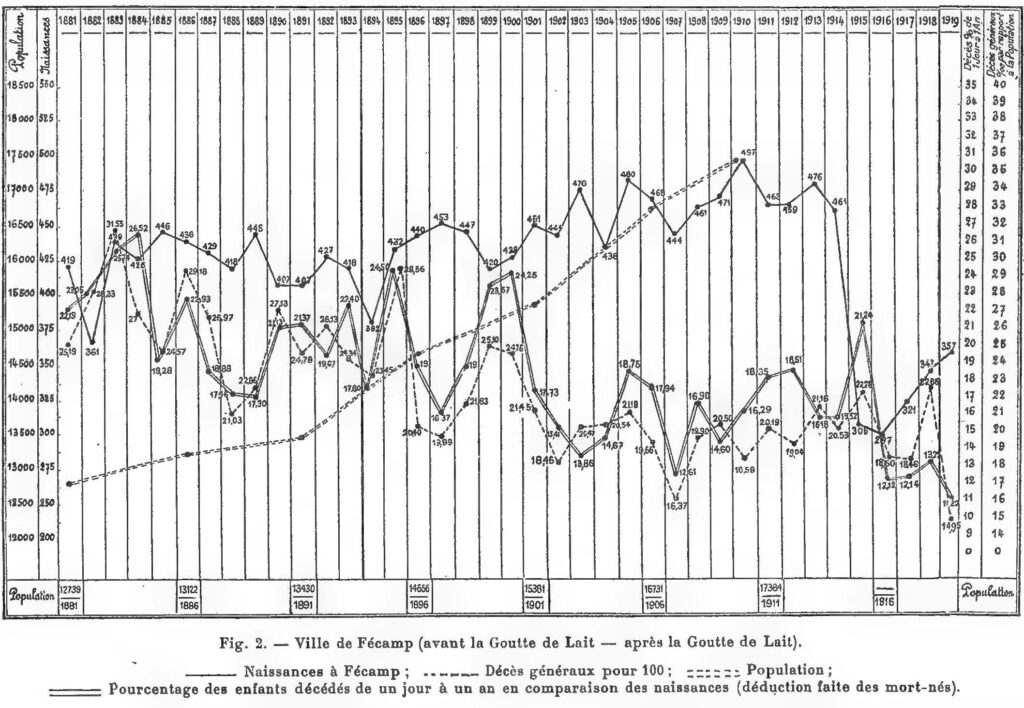
The decline had begun before 1894 and owed much to converging factors — a maternity opened in 1900, improved urban hygiene — but the persistent advantage of the Goutte de Lait’s children over the town as a whole is hard to argue away. Tellingly, that advantage tracked social class: mortality among the paying section’s children was lower still, a reminder, as Florence Levert observes, that the work’s reach was bounded by the very poverty it addressed.
The name, and the movement
Dufour did not invent the infant consultation. The recognized antecedents are Parisian and slightly earlier. A commemorative marble plaque now held by the Musée de l’Assistance Publique – Hôpitaux de Paris (https://www.aphp.fr/musee) records that Pierre Budin created the first consultation de nourrissons at the Hôpital de la Charité in June 1892; in the same year Gaston Variot opened his dispensary at Belleville. These are best read as the hospital- and dispensary-based forerunners. What Dufour added in 1894 was the freestanding, extra-hospital model that fed as well as followed its children — and the resonant name. (The plaque’s “première” is a commemorative attribution by the Comité National de l’Enfance, not a contemporaneous record.)
That name, Goutte de Lait, was a clever and memorable coinage by Dufour. The historian Levert reads it as deliberately layered: the medicalizing “drop” of milk-as-medicine; a riposte to the goutte of the eau-de-vie glass in an alcohol-soaked region; and, at Fécamp specifically, an echo of the Précieux-Sang relic cult whose sacred spring stood near the work’s address at 3, rue du Précieux-Sang.
From Fécamp the model spread fast — more than a hundred French Gouttes de Lait existed by the time of the first international congress (Paris, 21–22 October 1905). There was a national congress at Fécamp itself in May 1912, with subsequent international congresses in Brussels in 1907 and Berlin in 1911. The Paris work continued until 1957, Fécamp’s until 1972, after which the protection maternelle et infantile (PMI) services took up the task.
An image and a museum
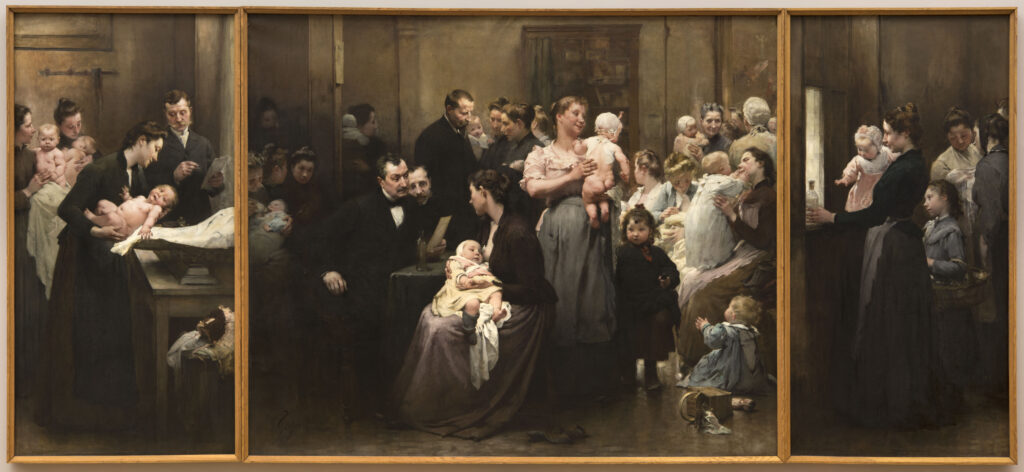
The movement’s enduring image is Jean Geoffroy’s triptych L’Œuvre de la Goutte de lait au dispensaire de Belleville (at the top of this page) — painted in 1901, shown at the Salon of 1903, and now in the Petit Palais (inv. PPP61), with a postcard version that carried it across France. It is worth being precise about what it depicts: the central figure is Variot, and the setting is the Belleville dispensary, not Dufour’s Fécamp œuvre. The triptych form, more usual for altarpieces, lends the scene of weighing, consultation, and milk distribution a quasi-sacred cast — the saintly character of modern pediatric medicine saving the poor child.
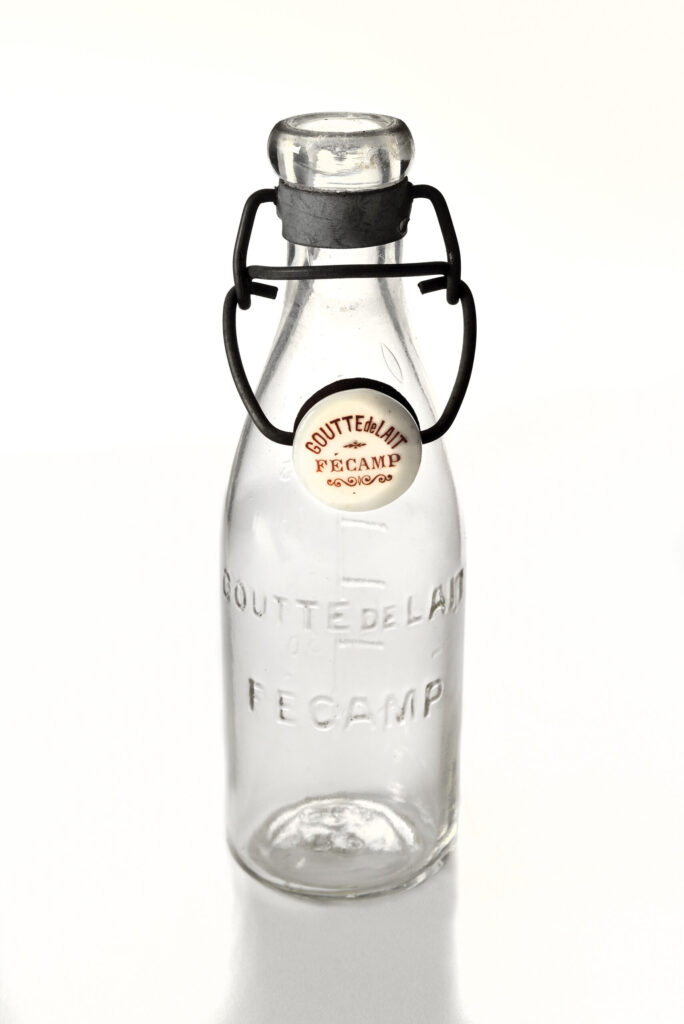
The material record of the work itself survives largely at Fécamp. Dufour was a collector as well as a clinician; the objects he gathered on infant care became his Musée de l’Enfance, opened in 1918 within the œuvre’s own premises and given to the city in 1926. Damaged in the 1944 dynamiting of the port and rediscovered in the 1980s, the collection is now a section of Les Pêcheries, Musée de Fécamp, and holds the sterilizing biberons, the 1921 edition of Dufour’s manual, the 1910 Allard portrait of him, and the wider ethnographic holdings of cradles and feeding vessels through which Dufour reflected on the cultural shaping of the infant body. (Part of the childhood collection currently travels in a touring exhibition, so individual objects may not always be on display.)
Legacy
The Goutte de Lait sits in the grey zone between charity and medicine. It carried the outward forms of the older œuvre de bienfaisance — dames patronnesses, milk-siblings, the rich paying for the poor — while introducing the instruments that would define twentieth-century infant care: the standardized sterilized feed, the weighing scale, the printed weight curve, the individual health record. In doing so it helped constitute puériculture as a discipline and the figure of the medically supervised mother as its object. For the history of neonatal medicine specifically, it represents the moment when the systematic, longitudinal medical surveillance of the well infant — not the sick or the premature, but the ordinary nursling — became a public institution. The protection maternelle et infantile (PMI) clinics, and arguably the modern well-baby visit, descend directly from a courtyard window in Fécamp.
Primary sources
Dufour, Léon. Comment on crée une Goutte de lait. Fécamp: Imprimeries réunies M.-L. Durand, 1902. Source: Biblioteca Online of the Fundação Aboim Sande Lemos, Lisbon, from the collection of the Associação Protectora da Primeira Infância.
Dufour, Léon. “À Fécamp : quarante ans de lutte contre la mortalité infantile, 1881–1921. La Goutte de lait, 1894–1921. Résultats.” La Presse médicale 29 (XXIXe année), no. 28, 6 avril 1921 (supplément), pp. 489–494, 3 fig. Paris: Masson et Cie. Source: BIU Santé / Internet Archive
Secondary sources
La Goutte de Lait – Wikipedia (French)
Levert, Florence. “L’« élevage » des bébés à Fécamp (1894–1928).” Ethnologie française XXXIX, 2009/1, pp. 141–149. DOI: 10.3917/ethn.091.0141.
Sautereau, Manuelle (with Bernard Le Luyer). “Aux origines de la pédiatrie moderne: le Docteur Léon Dufour et l’œuvre de la « Goutte de lait » (1894–1928).” Annales de Normandie 41/3, 1991, pp. 217–233. DOI: 10.3406/annor.1991.1889.
Renout, Francis. “Le docteur Dufour et l’œuvre de « la goutte de lait ».” CGPCSM / Généacaux, 25 May 2020.
French primary sources were machine-translated, then checked against the originals and edited by the author. Portions of this page were drafted with machine assistance; the final text was reviewed, verified, and edited by the author.
Last Updated on 07/20/26