Bradford Exhibition of 1904
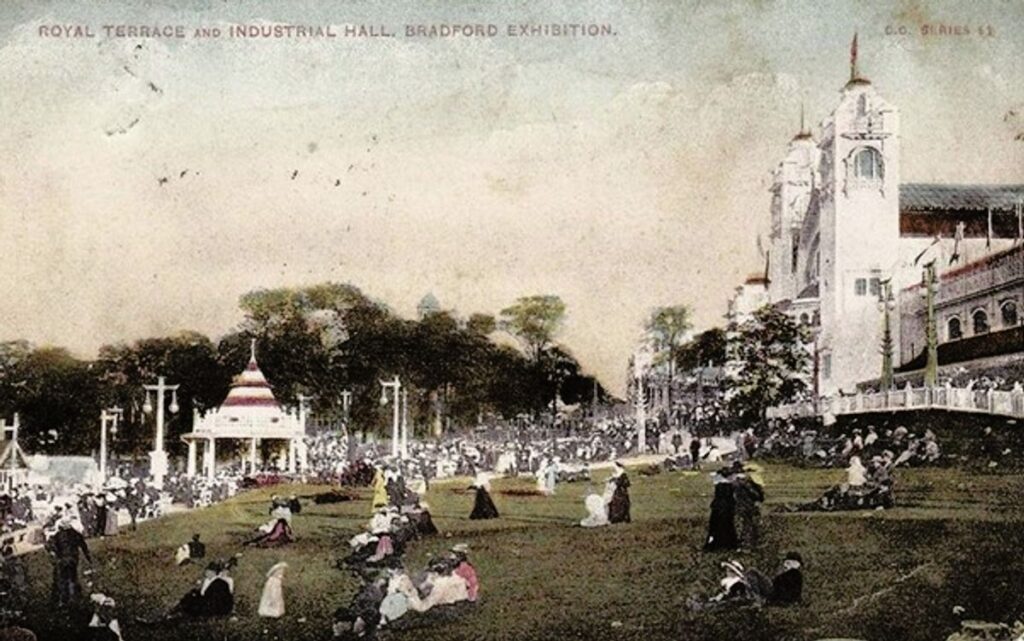
The City of Bradford Exhibition of 1904 was a large-scale industrial and cultural exposition held in Lister Park, Manningham, from May 4 to October 29, 1904. The exhibition was intended to promote Bradford’s industry and occupied 23 acres — roughly 70% of the total park area. It drew approximately 2.4 million visitors over its six-month run.
The exhibition was closely tied to the opening of Cartwright Memorial Hall, a new art gallery funded largely by Lord Masham (Samuel Cunliffe Lister) in honor of Edmund Cartwright, the inventor of the power loom. The ceremonial opening was performed on 4 May 1904 by the Prince and Princess of Wales — the future King George V and Queen Mary — who were in residence at Harewood House. The Princess opened the exhibition buildings with a golden key.
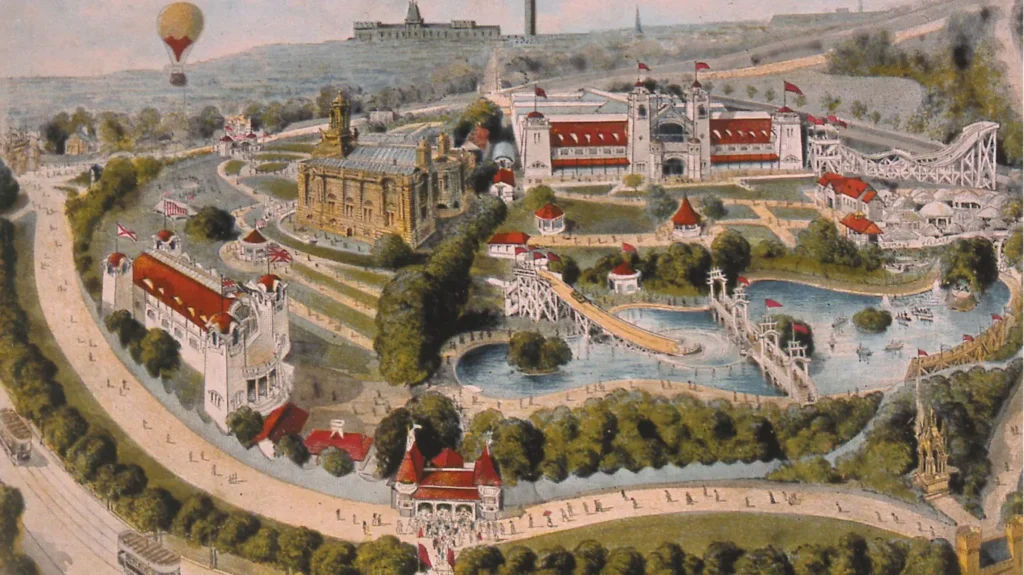
The exhibition was based on the model of the Great Exhibition of 1851 and featured two enormous temporary structures: an Industrial Hall celebrating Bradford’s textile and manufacturing prowess, and a Concert Hall that hosted brass band performances. These buildings, made of timber and sheet metal, were covered in plaster to look like proper buildings. Cartwright Hall itself housed a significant fine arts exhibition, with paintings loaned from galleries and private collections across England.
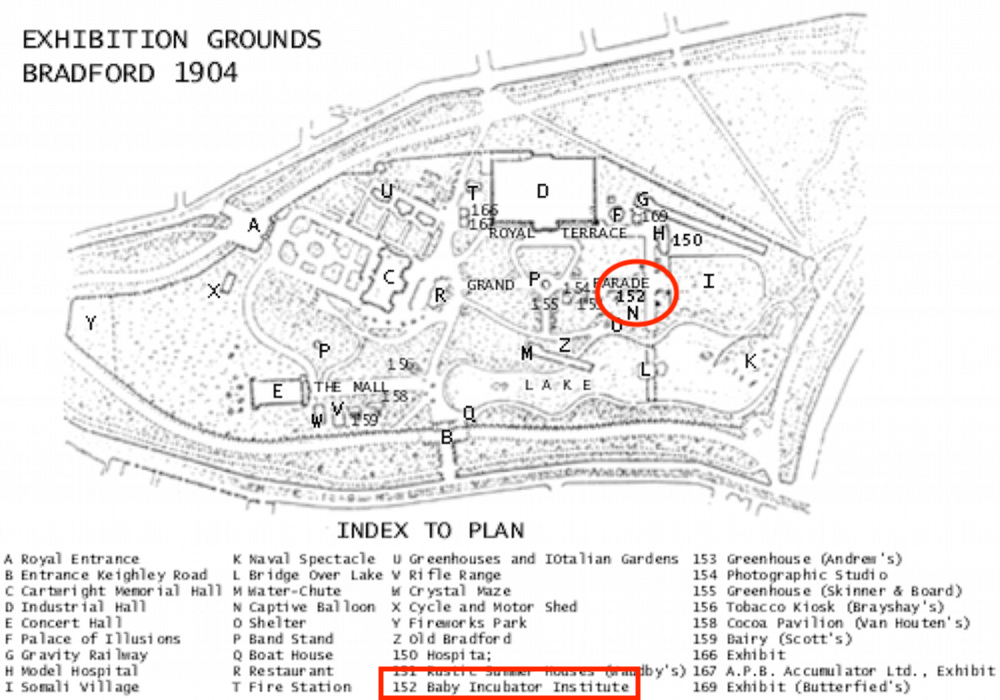
Other exhibits, sideshows, and amusements included a rifle range, a water chute (similar to a log flume) at Lister Park’s lake, a crystal maze, a gravity railway, a model hospital, a working dairy, a kiosk for smokers, a Somali village, and a baby incubator exhibit under the management of Moritz Ehrlich,* which people could visit. A contemporary periodical, The Jackdaw, observed with some acidity that “for every four people who pay 6d to see black men in the Somali village or brown babies in the incubator, only one will go into the free exhibition of pictures.” The rest of the local press portrayed the incubator institute and Ehrlich in glowing terms:
A VISIT TO A BABY INCUBATOR. tew dave ago a representative of this journal paid a vigit to M. Ehrlich’s Baby Incubator Institute, which is situated in the grounds of the Bradford Exhibition.
This building has been the subject of not a little curiosity, especially among the rising generation, and if all we hear be true, many a materfamilias has been placed in some awkward cornera by the pointed questions of the little folk, one of whom almost insisted, in the prolonged absence of the little sister she had so long expected at home, that her mother should buy one direct from the incubator and take it back home as the best possible present from the Exhibition!
For the information of those who have not seen it, we may say that the baby incubator is a nearly square box of silvery metal, with glass sides, so that every movement of its little occupant can be seen. It is air-tight, except for a ventilating pipe, which admits a constant stream of filtered air from outside the building, and it is kept at a uniform temperature of 90 degrees by means of an ingenious and reliable apparatus. An exhaust pipe placed in the centre of the roof of the incubator carries away the impure air, and in doing so maintains a constant current in the box, on the front of which is a chart on which are daily registered the weight, size, temperature, pulse, respiration, and general physical conditions of the occupant of the nest.
The average fledgling is fed every two hours at least, oftener if considered necessary by the doctor, and in doing this every care is taken that tbe little speck of humanity does not take cold, the feeding-room being kept at the same temperature as the incubator.
The babies are rarely given milk from a bottle until they have been in the incubator at least forty days, by which time they “begin to acquire the habit of living, show forth some faint resemblance to the human race with which we are familiar, and recognise mealtime with the precision and regularity of a grown up boarder.” Of the 10 babies which had been admitted up to the time of our first visit to the Incubator institute, all had increased in weight. One admitted from Leeds weighed 2 lb. 1oz.; another from Huddersfield was only half-an-ounce heavier; yet these diminutive, partially developed creatures, only faintly resembling the human form divine, were making satisfactory progress: while one which turned the scale at 4 lbs. 3oz. when admitted, was sent out weighing 8 lbs., and 7 others had gone back to the arms of anxious and thankful mothers quite recovered.
Our representative was assured that fully 90 out of every 100 infants treated were restored, and if those in the incubators at the time of our visit may be considered a fair sample of the material dealt with, we can only say that the results attained are really wonderful, and show unmistakeably that the scientific principles
upon which Dr Ebrlich conducts the institute are the correct ones, and have a useful future in store. An attendant explains to visitors the various appliances, the doctor is in frequent attendance, together with an obliging matron and attentive nurses, who watch their little charges both day and night, and it is unquestionable that many children upon whose lives hang weighty considerations, and whom it would be impossible to rear under ordinary conditions, are preserved to anxious parents.
— The Shipley Times, Friday, August 5, 1904
THE INCUBATOR INSTITUTE
In connection with the Exhibition, the Baby Incubator Institute will always be remembered as one of the principal educational attractions. SInce its establishment it has effectually demonstrated its use in saving the lives and making healthy citizens of those who at best could only have survived as weaklings. Altogether 38 prematurely-born children have been treated in the Institute, and of these only one or two of the worst cases have not been successful. A word of praise in this connection should be given to Dr. Ehrlich, whose skill has assisted in saving a great number of lives, and whose courtesy has made for him heaps of friends. The charge nurse (Nurse Clark) has done much for the successful working of the institution.
A pleasant function took place on Tuesday, when Dr. Ehrlich entertained a large number of friends to dinner at the Exhibition Restaurant in the Cartwright Memorial Hall. The Mayor (Ald. David Wade) presided, and the company included the Rev. G. W. Allen (vicar of St. James’s), Drs. Evan, Logan, Lodge, Hamilton, Higgins, Miall, H. E. Taylor, White and Lister, Ald. J Toothill, Mr. Jacob Moser, Mr. C. R. Hindley, Mr. James Watson, Mr. R. Bramhall, Mr. J. Farndale (Chief Constable), Mr. G. W. Purnell, and Mr. W. Firth.
In proposing the toast of “The Mayor and the City of Bradford,” Mr. Jacob Moser said Ald. Wade had filled the position of Mayor with credit and tact and to the satisfaction of the community. The toast was drunk with musical honors.
The Mayor, replying, said it was a great pleasure to know that the Exhibition was a success, socially and financially.
The toast of “The Medical Profession” was submitted by the Rev. G. W. Allen.
Dr. Evans, who replied, alluded to the effect of the Exhibition upon the public life and the sociology of Bradford. Its educational influence had been great, and of not the least value had been the Baby Incubator. (Applause.)
Dr. P. Lodge (hon. surgeon to the St. John’s Ambulance Brigade) proposed the toast of “Our Host.” Dr. Ehrlich, he said, was a splendid fellow, and had extended to them the hand of friendship and given them assistance when required. Such institutes as the incubator might be of very great value in a large city where so many infant lives must be lost for want of proper care and medical treatment. He saw a great future for the incubator, and he wished that they had some of the instruments permanently in Bradford.
Dr. Ehrlich, in reply, said he was pleased to see so many medical men there, and would cary away pleasant recollections of the evening spent among them.
Mr. G. W. Parnell proposed “The Executive Committee,” and Mr. J. Gill replied.
Songs were rendered during the evening by Mr. Harry Horner, of Bradford, and Master Rhodes, of Leeds Parish Church.
— Bradford Weekly Telegraph October 29 1904
Evidently Ehrlich was a entrepreneur of many talents, including public relations.
The exhibition as a whole generated £14,965 in profits. After the exhibition closed, the temporary buildings were dismantled, although the site of the Concert Hall has survived as a roller skating rink.
- Bradford Historical and Antiquarian Society — “Cartwright Memorial Hall and the Great Bradford Exhibition of 1904” https://www.bradfordhistorical.org.uk/cartwright.html
- Flickr / Bradford Timeline — Bradford Exhibition 1904 album (souvenir postcards and photographs) https://www.flickr.com/photos/bradford_timeline/albums/72157632128178141/
- Exhibition Study Group – The Bradford Exhibition – 1904 (retrieved from Wayback Machine)
Editorial Note: The Somali Village is now one of the most studied features of the exhibition. The troupe, managed by a showman named Bamberger, comprised 57 men, women, and children who lived on-site for the full six months. The members of the troupe worked under contract and were paid wages roughly equivalent to women mill workers. They had arrived in Marseilles from Aden aboard the SS Polynesien in February 1904, spending time in Nice and Marseilles before coming to Bradford. During the exhibition, members of the touring group made pottery, worked in ironmongery, and gave demonstrations of traditional Somali dancing. They supplemented their income by selling handicrafts and posing for photographs. For more information, see “The Somali Village Project.“
* Moritz Ehrlich, referred to in most news accounts as M. Ehrlich, is a somewhat mysterious figure. I have not been able to find much information about him other than his claimed origin in Vienna and a later residence address at Lothringerstraße 59 in Berlin. He used Lion incubators, and his exhibits usually were named “Baby Incubator Institute” or some variation on that in the local language. He is known to have exhibited at Manchester in 1902 and 1903, Glasgow in 1903-1904, Bradford in 1904, Liege in 1905, Birmingham in 1905, Bucharest in 1906, Dublin in 1907, Edinburgh in 1908, Motherwell Scotland in 1934, Brussels in 1910, and Brussels in 1935. Undoubtedly there were others as yet unidentified. He also had some connection with Albert Leotardi, another entrepreneur on the incubator exhibit circuits, as evidenced by a lawsuit between them filed in Berlin on September 12th, 1899.
Last Updated on 09/16/26