Exposition Universelle et Internationale de Liège, 1905
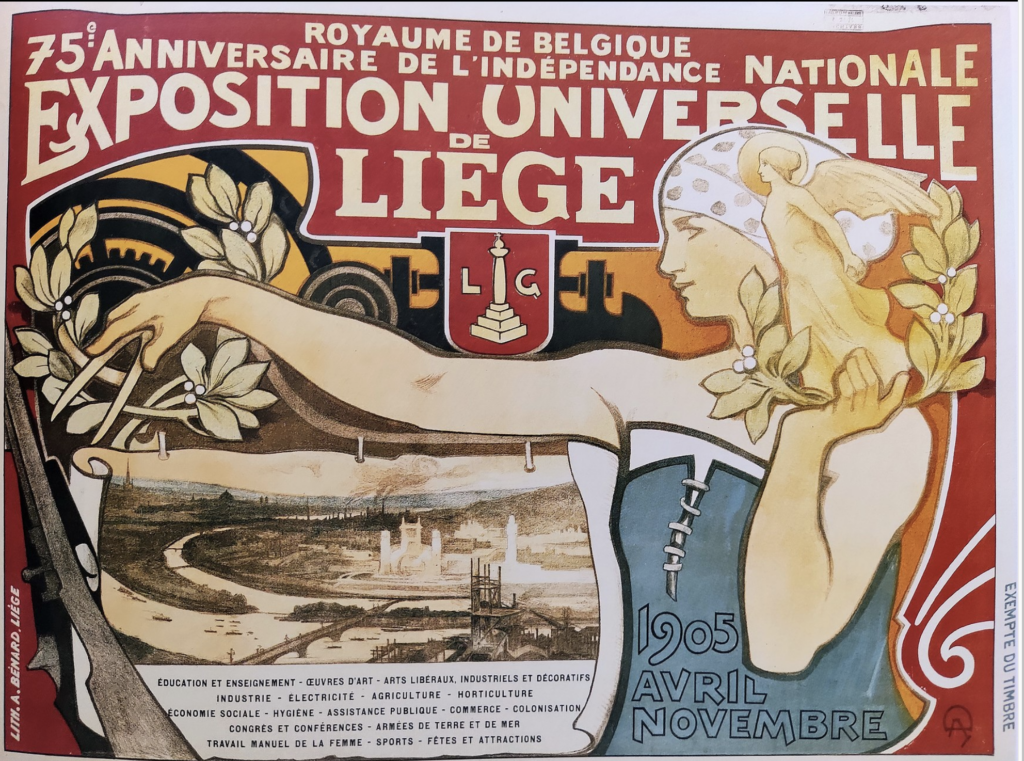
The Exposition Universelle et Internationale de Liège opened on 27 April 1905 to mark the seventy-fifth anniversary of Belgian independence, and, according to Findling and Pelle, the fortieth year of Leopold II’s reign. Its declared industrial purpose was to demonstrate the economic weight of Belgium and of Wallonia in particular — Liège being, as one English visitor put it, the industrial capital of the country though not its political one. The project originated with the Cercle privé du Commerce liégeois in 1897, though sources differ on the body’s name and on the date. The Comité de Propagande was founded in 1898 and raised about 1,800,000 francs, deliberately through many small subscriptions rather than few large ones; the Société anonyme de l’Exposition de Liège was constituted under Belgian law on 15 July 1899, with some 2,300 subscribers. Governance was delegated to a nine-member Comité Exécutif whose senior personnel served unpaid.
The site occupied both banks of the Meuse at its confluence with the Ourthe: the former Jardin d’Acclimatation and the Parc de la Boverie formed the Quartier des Palais; the plaine des Vennes, also called the plaine des Aguesses, carried the great halls; the reconstructed Vieux-Liège was located between the Meuse and the new course of the Ourthe; and an annex at Cointe housed horticulture, sports and model workers’ housing. The ground was flood-prone alluvium, and preparation required rectifying the river and raising the marshy plain — one contemporary account puts the fill at four metres of earth. The works produced the ponts de Fragnée, de Fétinne and des Vennes, the passerelle Mativa in Hennebique reinforced concrete, and a viaduct over the boulevard de Laveleye. Available sources differ on the area of the Exposition: the BIE and Lozé give 70 hectares, French Wikipedia about 66 broken down as 33 at the Vennes, 10 at the Boverie, 4 at Fragnée and 19 at Cointe, americasbesthistory says173 acres and Councillor Lupton 170.
Sources also differ on the participation figures — the BIE records 35 participants, worldfairs.info 38, French Wikipedia about forty, americasbesthistory 39 nations and colonies, and English Wikipedia 29 official participants with Germany and Spain unofficial, a list that is internally inconsistent since Germany appears in both categories. Seventeen countries limited themselves to a stand in the Vennes hall rather than building a pavilion. The BIE reports more than 80 pavilions and 17,004 exhibitors; americasbesthistory gives over ninety pavilions and 16,119 exhibits, a different unit that may not be in direct conflict. France dominated: Lozé counts 8,090 French exhibitors, some 6,000 of them in the industrial groups, which would make France nearly half the entire exhibitor body The BIE and English Wikipedia give 7,000,000 visitors; americasbesthistory gives 6,143,157 while acknowledging the higher figure.
The Exposition closed on November 6, 1905. Permanent works left behind for the city by the Exposition included the Palais des Beaux-Arts, the monumental entrance to the Jardin d’Acclimatation and the terraces toward the Meuse, the raising of the Parc de la Boverie, the appropriation of the Parc de Cointe, the Pont Hennebique and the Laveleye viaduct.
Incubator Exhibits
As additional French and Belgian resources have been digitalized and made available online, it has become evident that two separate infant-incubator exhibits operated at Liège in 1905, in different quarters, under different operators, on opposite sides of the Meuse. I have spent many hours searching Gallica, HathiTrust, Internet Archive, retronews.fr, belgicapress.be, and other historical sources to dredge up the few surviving details. No single source describes both, and the fragmented record for each is almost entirely disjoint from the other’s,
Moritz Ehrlich, Jardin d’Acclimatation
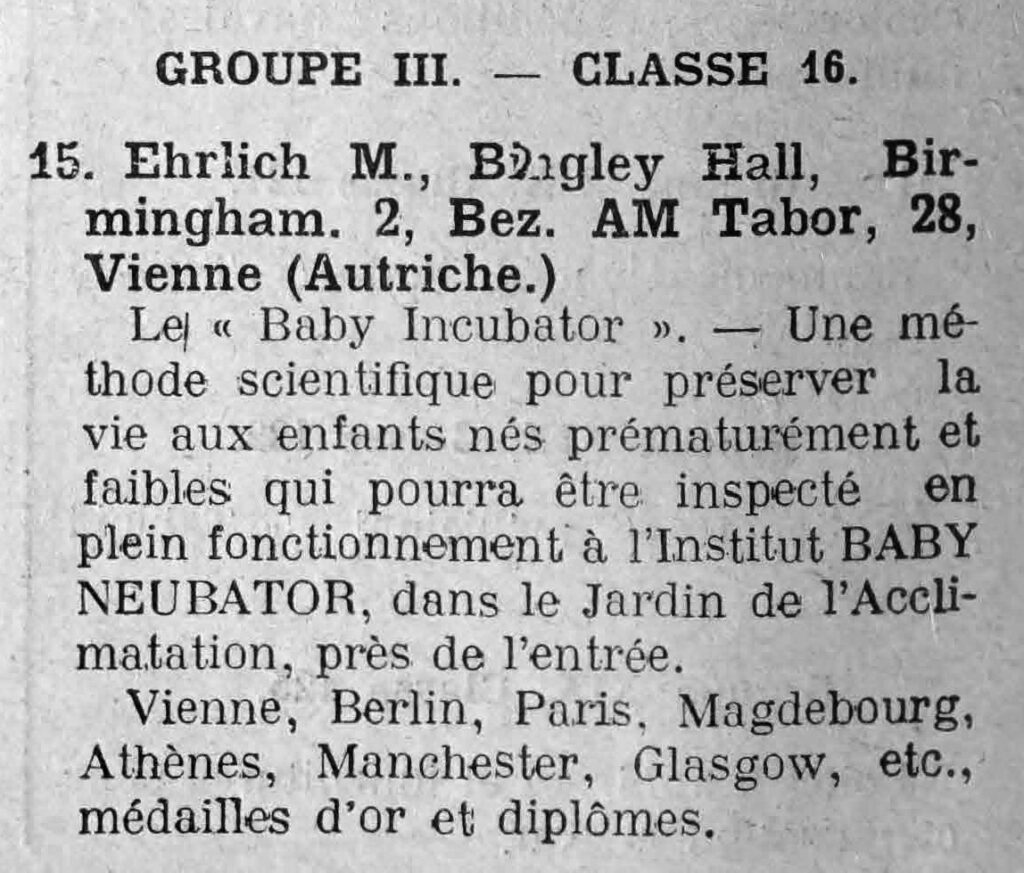
Ehrlich’s was the registered exhibit. The Catalogue général officiel, Sections étrangères lists him at p. 52 in the England section, Groupe III, Classe 16, as entry 15: “Ehrlich M., Bingley Hall, Birmingham. 2, Bez. Am Tabor, 28, Vienne (Autriche.)” The entry describes “Le « Baby Incubator ». — Une méthode scientifique pour préserver la vie aux enfants nés prématurément et faibles qui pourra être inspecté en plein fonctionnement à l’Institut BABY NEUBATOR [sic], dans le Jardin de l’Acclimatation, près de l’entrée,” and lists [claimed] prior awards — gold medals and diplomas at Vienna, Berlin, Paris, Magdeburg, Athens, Manchester and Glasgow. The catalogue’s inverted form gives only the initial M.; we know his forename Moritz from other work. His two addresses are a Birmingham exhibition hall and a residence in Vienna’s Leopoldstadt — so an Austrian operator, working the British circuit, registered under the English section of a Belgian exposition.
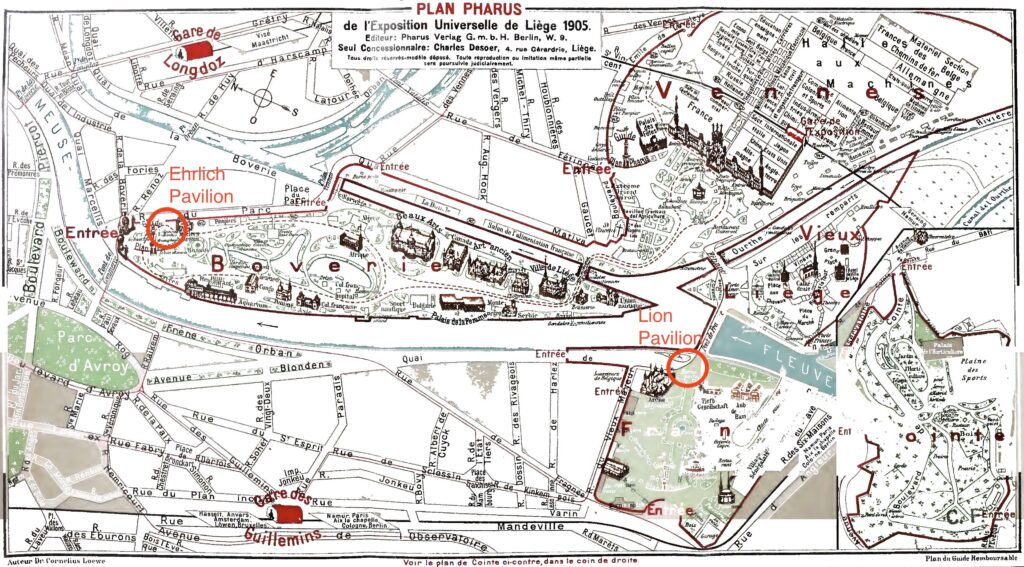
The Ehrlich pavilion stood inside the Boverie enclosure, close to the monumental entrance to the Jardin d’Acclimatation, among a cluster of small concessions rather than in the Belgian hygiene or assistance classes across the water. Drèze’s itinerary in the Livre d’or passes the Guide Remboursable and Great Eastern Railway pavilions, then M. Meyer Leuter’s, then a square kiosk of the Régie ottomane, and then: “Après avoir laissé à sa gauche le pavillon bas, peinturluré de bleu des Couveuses d’Enfants, on remarquait l’Office colonial français; on y accédait par une allée bordée d’une double rangée de bustes d’amiraux célèbres.” [After passing the low, blue-daubed Infant Incubators pavilion on the left, one noticed the French Colonial Office; it was approached via a walkway lined with a double row of busts of famous admirals.]
The Guide Remboursable gives the same neighbours in a slightly different order, placing the couveuses before the Régie ottomane, and describes “l’Institut des Couveuses d’enfants, avec bébés vivants, une exposition scientifique des plus intéressantes à la portée de tous. L’Institut sous la direction de M. Ehrlich, est recommandé par nombre de célébrités médicales et au point de vue de l’hygiène de l’enfance, l’installation à elle seule mérite une visite.” [The Infant Incubator Institute—featuring live babies—is a fascinating scientific exhibition accessible to everyone. Directed by Mr. Ehrlich, the Institute is endorsed by numerous medical authorities; from the standpoint of infant hygiene, the facility alone is worth a visit.]
Both publications illustrate the building: a photographic plate captioned “Le Pavillon des Couveuses d’Enfants” faces the text in the Livre d’or, and the Guide Remboursable carries a frontal view whose façade signage reads COUVEUSES D’ENFANTS across the front with BÉBÉS VIVANTS flanking the entrance arch. Two further postcard views appear on the chokier.com compilation, one of them framing the mechanical-piano pavilion, the couveuses and the Ottoman kiosk together and so independently confirming the adjacency the two itineraries describe. The photographs show a substantial two-storey half-timbered structure with a first-floor gallery.
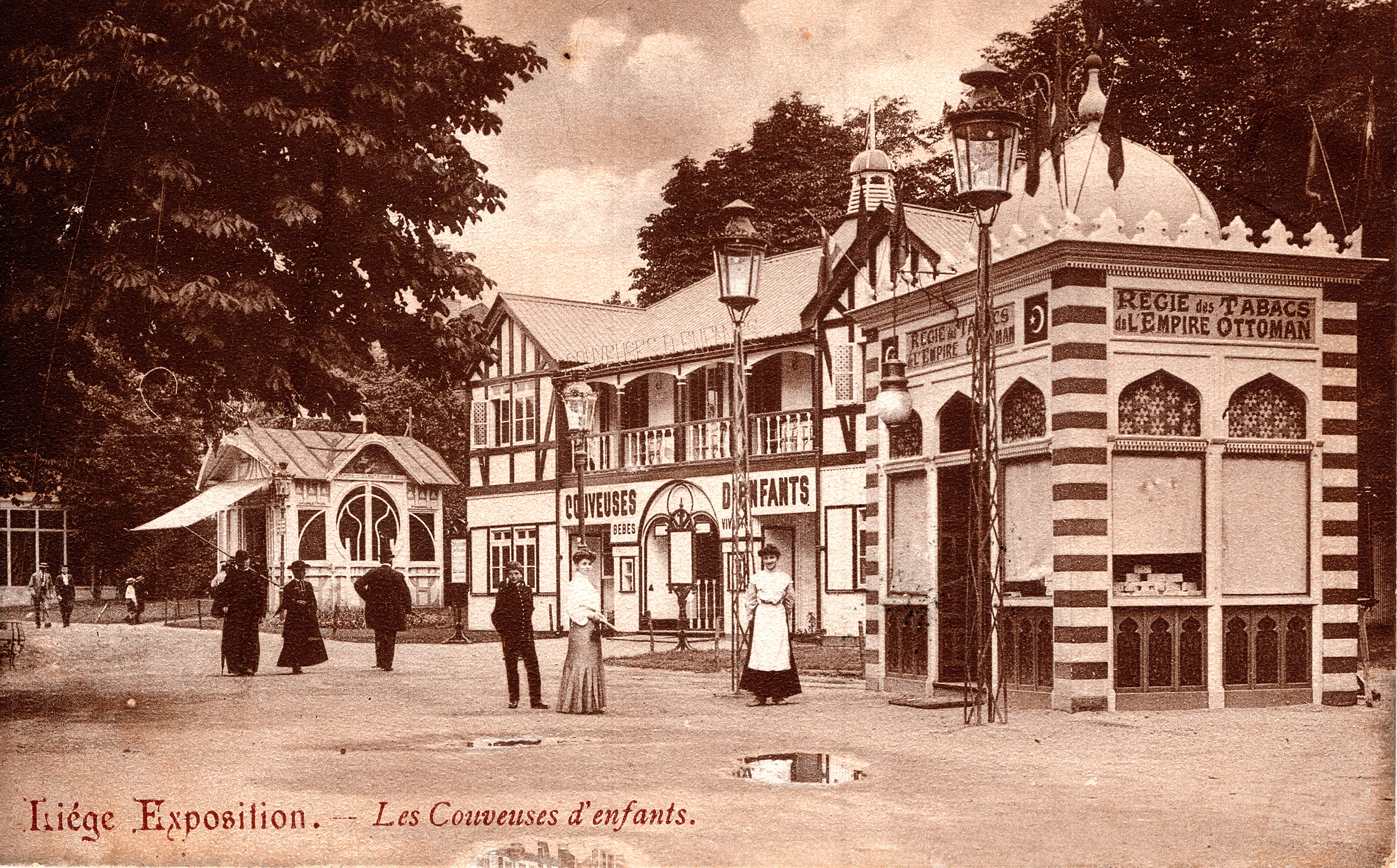
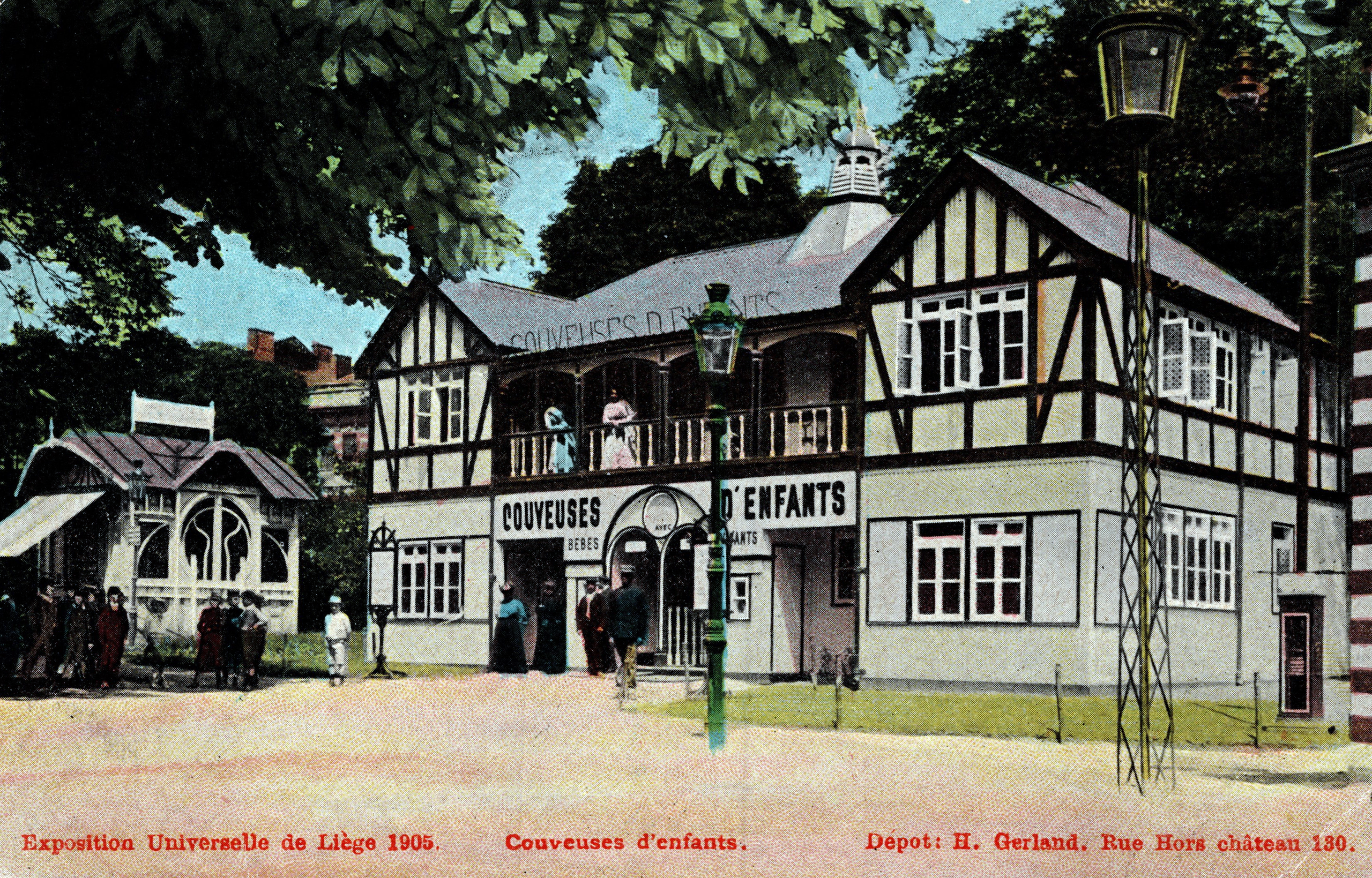
A classified ad in the Brussels Le Soir of 6 July 1905 reads: “Une nourrice demandée de suite, 60 fr. p. mois. Écr. Couveuses d’enf. Jardin d’Acclimatation, Liége. 3781” — a wet nurse sought immediately at sixty francs a month, correspondence addressed to the establishment by location alone. And a Paris column syndicated across at least six newspapers on 24 or 25 June 1905 describes the gardens strewn with kiosks, mosques, panoramas and restaurant terraces where “des nègres vous poursuivent pour vous amener à une couveuse d’enfants, et le buste de Garnier, entouré de quatre amiraux français, veillant sur notre pavillon colonial, semble se reposer des bruits de la rue Royale.” The reference to Garnier’s bust, the admirals and the colonial pavilion ties this to Ehrlich’s site rather than Lion’s; and the touts working the garden paths are a detail no guidebook would print.
Ehrlich’s presence is confirmed from a fourth direction by the Yorkshire Evening Argus of 9 June 1905, reporting an interview with Councillor W. C. Lupton on his return from Liège. Among the side shows Lupton met “many old Bradford friends, notably Mr. Victor Bamberger and Dr. Erlich, with his Baby Incubator Institute, who were well to the fore.” Lupton had chaired the Bradford Exhibition, which places Ehrlich there in 1904; whether Bamberger had any connection to the incubator show or was simply another operator Lupton recognized is not obvious from the sentence. The honorific “Dr.” is title inflation — the Guide Remboursable gives M. Ehrlich and the official catalogue gives only the initial. No award to Ehrlich or to the incubator exhibit is recorded among the scattered prize notices in Livre d’or Tome II, which contains no central palmarès; so his award status at Liège remains unestablished.
Alexandre Lion, Fragnée
Lion’s pavilion opened a month after the fair. La Meuse announced on 27 May 1905: “« L’Œuvre Maternelle de Paris » vient d’ouvrir son établissement de démonstration, entre le pont de Fragnée et les Arènes Liégeoises. Quatre bébés nés avant terme y sont actuellement en couveuses et les visiteurs s’y portent en foule. — Entrée, 25 cent.” [“L’Œuvre Maternelle de Paris” has just opened its demonstration establishment, between the Fragnée bridge and the Liégeoises Arena. Four babies born prematurely are currently in incubators there and visitors are flocking there. — Admission, 25 cents.] The site was at the head of the attractions quarter on the plaine de Fragnée, across the Meuse from the Boverie — a different quarter of the exposition from Ehrlich’s.
Alexandre Lion is named in a classified in La Meuse of 14 June 1905: “On demande une Jeune Fille connaissant le français, l’allemand et le flamand. S’adresser à M. Lion, Couveuses, aux Arènes Liégeoises.” A souvenir postcard published by the establishment confirms the identification: it is titled “Exposition de Liège 1905 — (Fragnée),” subtitled ŒUVRE MATERNELLE DES COUVEUSES D’ENFANTS with Oeuvre Maternelle’s 1905 Paris address 5, rue Cart, St-Mandé (Seine), and the usual stock photos that Lion used on his postcards.
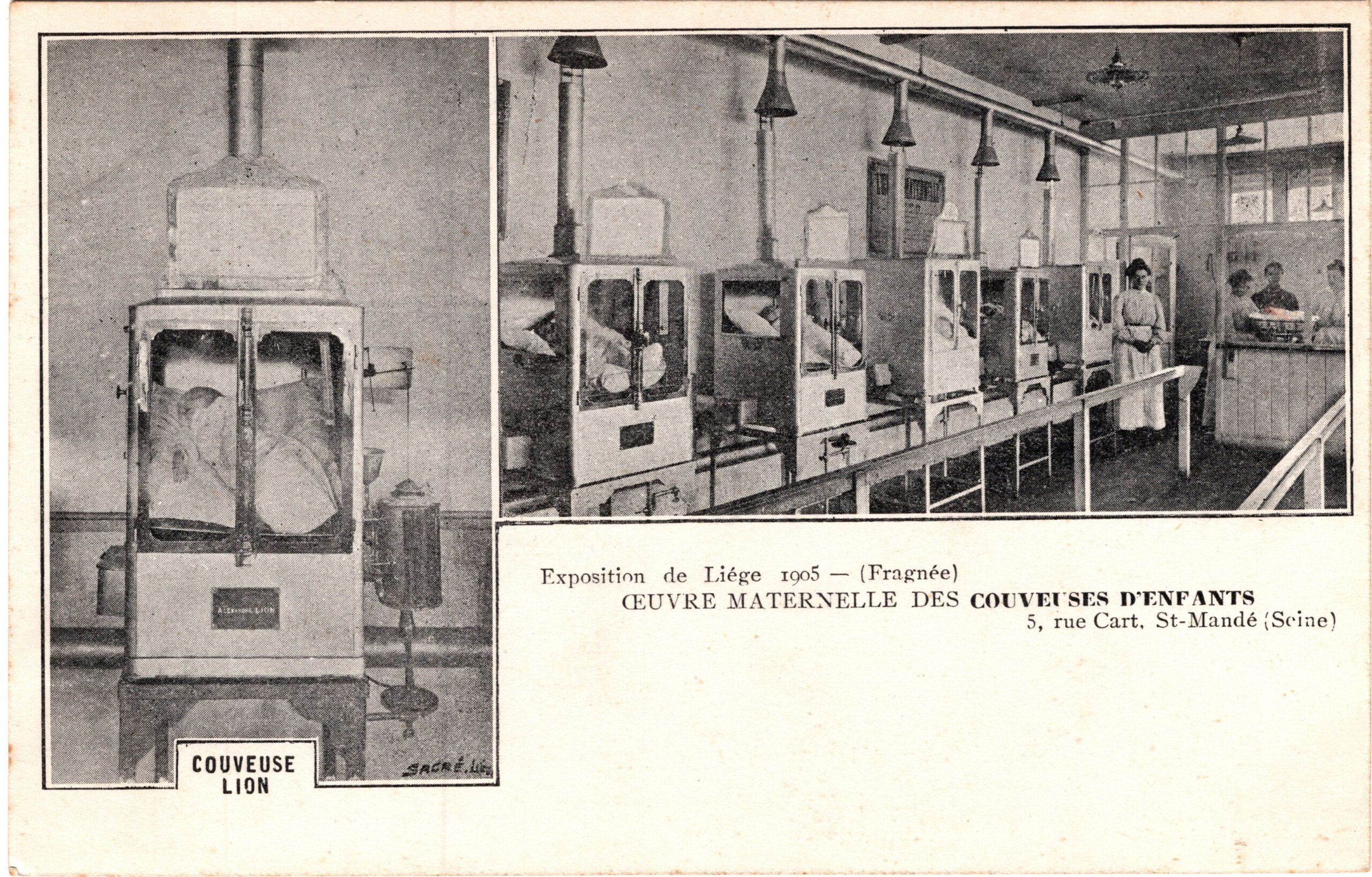
The exhibit was mentioned daily in the Mémento du visiteur on the front page of La Meuse, under the heading “A l’Exposition” and among the other attractions, as “Couveuses d’enfants (Fragnée). Ent. 0.25” or in the fuller form “entre le pont de Fragnée et les Arènes Liég.” Occupancy grew over the season: La Meuse reported on 13 July 1905 that “le pavillon de l’Œuvre mutuelle [sic], de Paris, vient de recevoir un tout petit bébé né trois mois trop tôt. Il ne pèse que 0 k. 850 gr. et fait l’admiration des visiteurs, qui se portent toujours en foule à cet établissement. 7 enfants y sont actuellement en couveuses.” [The Œuvre Mutuelle [sic] pavilion in Paris has just received a tiny baby born three months prematurely. Weighing only 850 grams, the infant is a source of wonder for the crowds of visitors who flock to the facility. Seven babies are currently in incubators there.] The last appearance of the “Couveuses d’enfants (Fragnée)” entry in the Mémento du visiteur is 13 October 1905, the Mémento on the following days was identical except for the omission of the couveuses, indicating that the pavilion closed on or about 13 October 1905, some three weeks before the exposition itself.
Lion appears in none of the official records. He is absent from the Catalogue officiel belge, from the Catalogue général officiel, Sections étrangères, and from the French section’s Rapport des récompenses; the Livre d’or mentions no couveuses. This is a statement about category rather than authorization. The Water-Chute and the Aéroplanes Maxim, both indisputably of the exposition, are likewise absent from both catalogues, which covered classed exhibitors only. Lion’s establishment therefore falls on the attractions side of the exposition’s organization, while Ehrlich’s was registered as an exhibit — the same technology (both using Lion’s incubators!) but presented in two vastly different contexts, one as a scientific exposition, the other an attraction between the Grand Music Hall and the Venetian gondolas.
Sources – General Information
- Exposition Universelle de Liège de 1905 – French Wikipedia
- Expo 1905 Liège – Bureau International des Expositions
- Exposition Universelle et Internationale de Liege – America’s Best History
- Vieux-Liège à l’Exposition Universelle de 1905 – Histoires de Liège
- Le Parc de la Boverie – Histoires de Liège
- Liege Expo 1905 – Chokier.com
- Universal and International Exhibition of Liege 1905 – worldsfair.info
- “Liege 1905,” by Matthew G. Stanard, in Encyclopedia of World’s Fairs and Expositions, McFarland and Company, Inc., Jefferson, NC, 2008.
Sources – Official and Semi-official Publications
- Catalogue général officiel. Sections étrangères, Exposition universelle et internationale de Liège 1905, p. 52 (Angleterre, Groupes III, Classe 16, no. 15). Digitized copy from the Getty Research Institute via HathiTrust / Internet Archive.
- Catalogue officiel belge, Exposition universelle et internationale de Liège 1905. No entry for Lion or the Œuvre Maternelle.
- Rapport des récompenses, French section, Exposition de Liège 1905. No entry for Lion or the Œuvre Maternelle.
- Guide Remboursable Illustré, 2ᵉ édition, Ch. Desoer, éditeur, Liège, 1905, price 2 francs, pp. 344 and 346, with photographic plate “Couveuses d’enfants” p. 345. Digitized from the University of California copy via Google Books.
- Plan Pharus de l’Exposition Universelle de Liège 1905. Author Dr. Cornelius Loewe; Pharus Verlag G.m.b.H., Berlin; sole concessionaire Charles Desoer, 4 rue Gérardrie, Liège. Reproduced with the Belgian catalogue; a zoomable copy is held by Ghent University Library.
- Gustave Drèze, Le Livre d’or de l’Exposition universelle et internationale de Liège 1905, Tome I (1906), 703 pp., pp. 406–407, with plate “Le Pavillon des Couveuses d’Enfants” and plates of the Guide Remboursable and Régie ottomane pavilions. Note that the Livre d’or was a private commercial publication by the director of the journal Liége-Exposition, granted the Comité Exécutif’s patronage and access to its archives, with the Comité expressly disclaiming responsibility for the appreciations expressed in it. Available on Internet Archive.
- Drèze, Livre d’or, Tome II (1907), 924 pp., pp. 909–911: “Rapport présenté par M. Émile Digneffe au nom du Conseil d’Administration à l’Assemblée ordinaire des actionnaires du 29 avril 1907.” Contains the settled accounts, the account of the Livre d’or‘s own commissioning, and the reference to litigation by concessionaires. No central palmarès located in this volume. Available on Internet Archive.
Sources – Press
- La Meuse (Liège), 17 May 1905, 27 May 1905 (opening notice, and Mémento du visiteur p. 1), 3 June 1905 (p. 1 Mémento; p. 8 classified), 14 June 1905 (p. 4 classified naming M. Lion), 13 July 1905 (p. 1), 11 August 1905 (p. 1), 12 October 1905 (p. 1), 13 October 1905 (p. 1, last listing), 14 October 1905 (p. 1, first absence), and 24 October, 31 October, 2 November and 6 November 1905.
- Le Soir (Brussels), 6 July 1905, classified advertisement, reference no. 3781.
- L’Indépendance belge (Brussels), 20 July 1905.
- Yorkshire Evening Argus, 9 June 1905, “Liege Exhibition: Its Leading Features — An Interview with Councillor W. C. Lupton.”
- “A l’Exposition de Liège,” syndicated Paris column, 24–25 June 1905; copies consulted in Le Petit Sou, 25 June 1905, and La Souveraineté Nationale, 25 June 1905. Reported in at least six titles.
- Ed. Lozé, “L’Exposition de Liège,” L’Économiste français, samedi 2 septembre 1905, pp. 339–341. Figures stated as of early August 1905 and explicitly projections.
* Moritz Ehrlich, referred to in most news accounts as M. Ehrlich, is a somewhat mysterious figure. I have not been able to find much information about him other than his claimed origin in Vienna and a later residence address at Lothringerstraße 59 in Berlin. He used Lion incubators, and his exhibits usually were named “Baby Incubator Institute” or some variation on that in the local language. He is known to have exhibited at Manchester in 1902 and 1903, Glasgow in 1903-1904, Bradford in 1904, Liege in 1905, Birmingham in 1905, Bucharest in 1906, Dublin in 1907, Edinburgh in 1908, Motherwell Scotland in 1934, Brussels in 1910, and Brussels in 1935. Undoubtedly there were others as yet unidentified. He also had some connection with Albert Leotardi, another entrepreneur on the incubator exhibit circuits, as evidenced by a lawsuit between them filed in Berlin on September 12th, 1899.
More Information about Alexandre Lion
- General Information
- Alexandre Lion
- The Lion Incubator
- The Engineer and the Newborns, by W. A. Nelson and Paul L. Toubas
- Lion Patents (France)
- Patent 201550, 1889, Couveuse électro-automatique
- Patent 221716, 1892, Couveuse automatique
- Patent 262090, 1896, Chambre vivifiante
- Patent 281687, 1898, Système de filtration de l’air
- Patent 287557, 1899, Système de filtration des fumées, de l’air et de toutes masses gazeuses avec tirage et ventilation
- Patent 189989, 1899, Appareil pour le filtrage et la purification de l’air et des fumées
- Maternité Lion Institutes and City Exhibits
- Alexandre Lion’s first incubator baby exhibit in Marseille, 1890.
- Œuvre Maternelle des Couveuses d’Enfants, Nice
- Œuvre Maternelle des Couveuses d’Enfants, Lyon
- Œuvre Maternelle des Couveuses d’Enfants, Paris
- Œuvre Maternelle des Couveuses d’Enfants, Toulouse
- Œuvre Maternelle des Couveuses d’Enfants, Amiens
- Œuvre Maternelle des Couveuses d’Enfants, New York
- Œuvre Maternelle des Couveuses d’Enfants, Barcelona
- Œevre Maternelle des Couveuses d’Enfants, Brussels
- Maternité Lion Souvenir Booklets
- Œuvre Maternelle des Couveuses d’Enfants , Paris Institute, Booklet Version #1 (appears to be ~1896)
- Œuvre Maternelle des Couveuses d’Enfants , Paris Institute, Booklet Version #2 (appears to be ~1901)
- Pamphlet from Alexander Lion’s exhibit at the 1898 exhibition in Torino, Italy. (PDF supplied by Dr. Thijs Gras, Amsterdam)
- Press Coverage
- La Maternité “Lion de Nice” pour Enfants Nés Avant Terme ou Débiles, by Dr. Ciaudo, 1895. Source: gallica.bnf.fr.

- Presentation d’Appareil, by M. A. Pinard, Bulletin de l’Académie nationale de médecine, 1893. Source: gallica.bnf.fr.
- Les couveuses d’enfant et le gavage, by César-A Queirolo, Includes discussion of Lion incubator and comparison to other types. Thèse de doctorat: Univ. Genève, 1897.
- Les Couveuses pour Enfants, Gazette Médicale de Paris, No. 40, October 6, 1900
- Couveuses d’Enfants, La Maternité Lion, Paris, La Patrie, 1897
- Paris Letter: An Improved System of Incubators, by O. Jennings, Pediatrics 1:427-428, 1896
- Baby Incubators, The Strand Magazine, 1896, by James Walter Smith
- Human Infant Incubation: A True Fairy-Tale of Modern Science from Leslie’s Weekly, 1897
- The Saving of Human Life, Maternité Lion in NYC, The Literary Digest, 1898
- Immature Infants in France, from The Lancet, January 16, 1897, page 196.
- De Lion Incubator at Low Maternity Hospital, by Francis H. Stuart, Brooklyn Medical Journal, 1901
- Alexandre Lion’s Incubator Charities in Europe (1894–1898) (The Embryo Project)
- La Maternité “Lion de Nice” pour Enfants Nés Avant Terme ou Débiles, by Dr. Ciaudo, 1895. Source: gallica.bnf.fr.
- Worlds Fairs and Expositions
- Maternité Lion at the Lyon Exposition Universelle et Coloniale, 1894
- Maternité Lion at the Lyon Exposition Universelle – Le Monde Illustré, 1894
- Maternité Lion at the Bordeaux Exposition of 1895.
- “La Maternité Lion,” by Louis Énault, Journal of the Bordeaux Exposition, 1895
- Maternité Lion at the Amsterdam World Exposition, 1895
- Maternité Lion at the Berliner Gewerbeausstellung, 1896
- “Bericht ǔber die Couveuse (Lion) oder Kinderbrutanstalt” [Report about the Lion Incubator] from Berlin und seine Arbeit – Amtlicher Bericht der Berliner Gewerbe-Ausstellung 1896. English Translation.
- Maternité Lion at the Exposition National Suisse, Geneva, Switzerland, 1896
- “Quelques Réflexions sur le Fonctionnement et les Résultats des Couveuses Lion pendant l’Exposition Nationale,” by Dr. Hector Maillart, Revue Médicale de La Suisse Romande, 1896. English translation.
- Internationale Ausstellung für Körperliche Erziehung, Gesundheitspflege und Sport, Innsbruck, 1896
- Maternité Lion at the Tennessee Centennial Exposition, 1897
- Maternité Lion at the Brussels International Exposition, 1897
- Maternité Lion at the Turin L’Esposizione Generale Italiana, 1898
- Maternite Lion at the Ghent Provincial Exposition of 1899
- Maternité Lion at the Greater Britain Exhibition of 1899
- Maternité Lion at the Paris Exposition Universelle of 1900
- Maternité Lion at the Woman’s Exhibition in Earls Court, London, 1900
- Maternité Lion at the Lille Exposition of 1902
- Maternité Lion at the Exposition Internationale de Reims, 1903
- Maternité Lion at the Nantes Exposition of 1904
- Maternité Lion at the Exposition du Nord de la France, 1904
- Maternité Lion at the Liège Exposition Universelle et Internationale, 1905.
- Maternité Lion at the Marseille Colonial Exposition of 1906
- Maternite Lion at the Bordeaux International Maritime Exposition of 1907
- Maternité Lion at the Marseille Exposition Internationale d’Électricité, 1908
- Maternité Lion at the Exposition Internationale de l’Est de la France, Nancy, France, 1909
- Maternité Lion at the Brussels Exposition Universelle et Internationale, 1910
- Maternite Lion at the Exposition du Centre de la France, Clermont-Ferrand, 1910
- Maternité Liion at the Rome International Exposition of 1911
- Maternité Lion at the Turin International Exposition of 1911
- Maternité Lion at the Exposition Internationale de Dunkerque, 1912
- Maternité Lion at the Ghent International Exposition of 1913
- Maternité Lion at the Exposition Internationale Urbaine de Lyon, 1914
- Maternité Lion at the Lyon Exposition Universelle et Coloniale, 1894
French primary sources were machine-translated, then checked against the originals and edited by the author. Portions of this page were drafted with machine assistance; the final text was reviewed, verified, and edited by the author. Click here to learn more.
Last Updated on 09/11/26