Exposition Universelle et Internationale de Bruxelles 1935


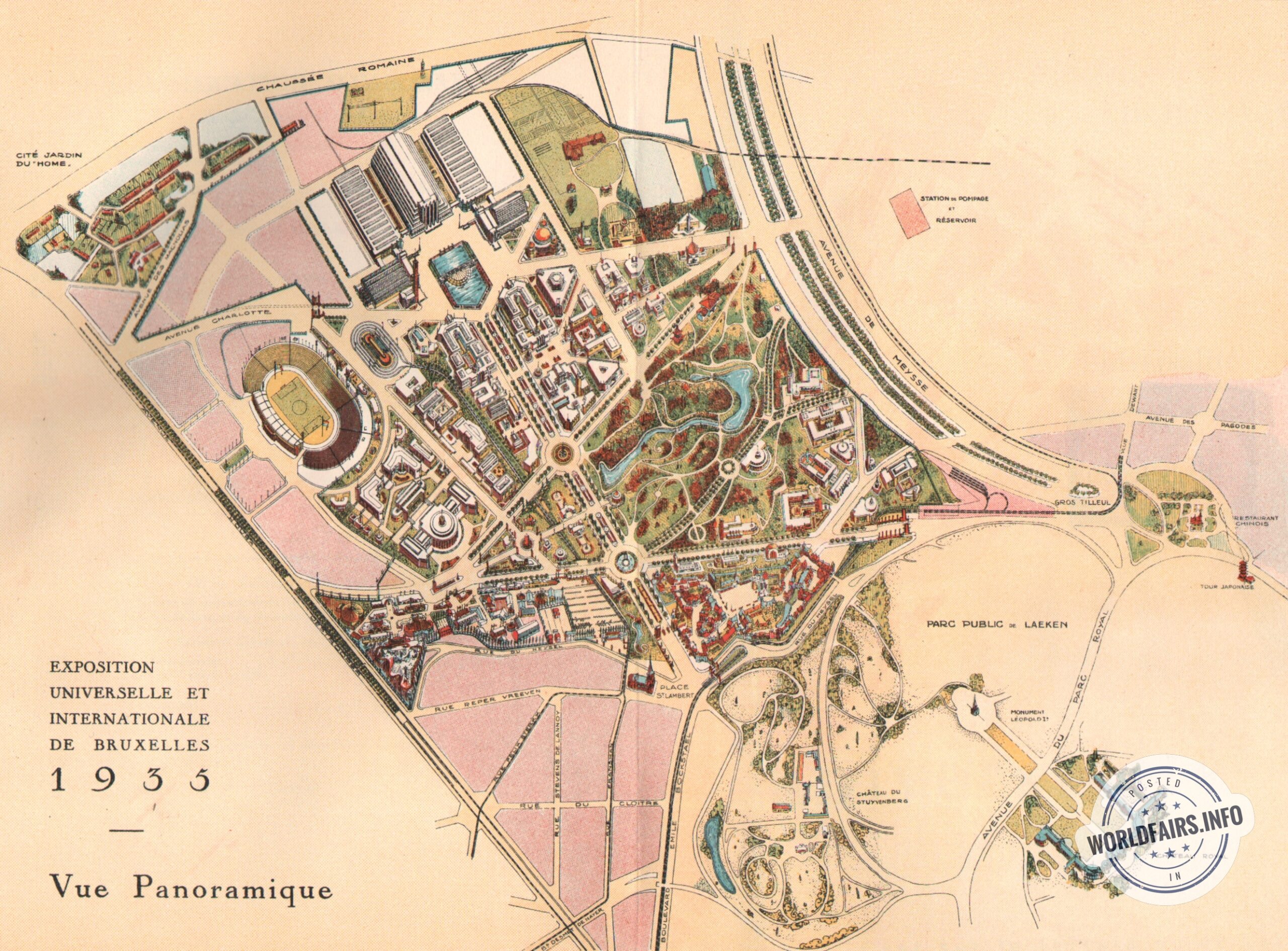
The 1935 Brussels Exposition was the first world’s fair registered and sanctioned under the Bureau International des Expositions (BIE), which had been established by the 1928 convention; it was formally registered at the BIE’s third General Assembly on 27 October 1932 as a first-category General (Universal) Exposition. It was held on the Heysel/Heizel Plateau, on land near the Royal Castle at Laeken that the city of Brussels had begun acquiring in the 1920s. The site itself is variously reported as 150 or 152 hectares. The fair grew out of Belgium’s 1930 independence-centenary celebrations, which had been awarded to Antwerp and Liège; Brussels, having ceded the centenary events, was instead given a universal exposition for 1935. Its theme is stated differently across sources — the BIE gives “Transport,” while others stress colonization. According to the official BIE record, the exposition opened on April 27,1935, and closed on November 6.
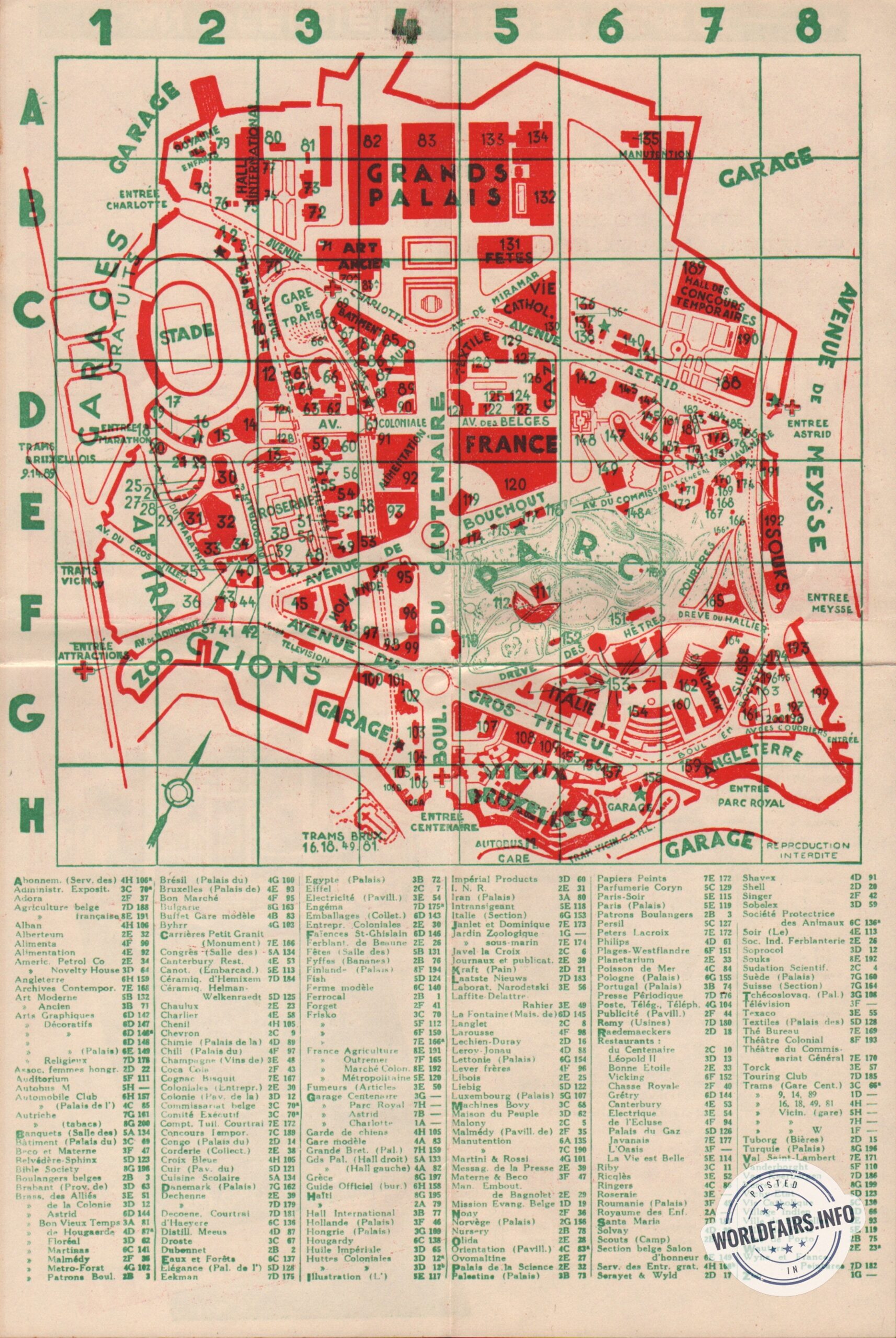
Belgian architect Joseph van Neck directed the general plan and designed the Art Deco Grand Palais, whose Central Hall was built entirely in reinforced concrete, spanning 86 metres in a single sweep of parabolic arches with no interior supports and rising about 31 metres. In keeping with the transport theme, the main hall was fitted out as a model railway station (Gare Modèle) by the modernist architect Victor Bourgeois, with twelve tracks displaying Belgian and foreign rolling stock. The grounds held several hundred pavilions — the French Wikipedia cites more than 450 — including a large Belgian section (over twenty pavilions), a substantial colonial section with an official Congo pavilion by René Schoentjes and a Soprocol colonial-propaganda pavilion, the Catholic Life pavilion (a functioning church) by Henry Lacoste, the Alberteum planetarium, and a stucco “Old Brussels.” Roughly twenty-five countries participated officially, though counts differ, and the United States, Japan, Spain, and Yugoslavia were accommodated in an improvised Halle Internationale after Germany withdrew in late 1934.
By Depression-era standards the exposition was a success, drawing more than 20 million visitors — about two-and-a-half times Belgium’s population — and closing on favorable budgetary terms, the first international exposition to do so; profit is commonly cited at 45 million Belgian francs (one source reports 55.4 million) and total cost is given as either 227 or 197 million francs. It operated amid genuine adversity, including economic crisis and the death of Queen Astrid during the exposition year, and was notably photographed in colour by the Dutch photographer Bernard F. Eilers. Its most durable legacy was physical: several permanent palaces were re-clad and reused for the 1958 Brussels World’s Fair (Expo 58) on the same site, and Palais 5 still stands and remains in use for trade fairs.
Incubator Exhibits
Although I have not been able to find any other pictures or information about the Incubator Exhibit so far, we know from the souvenir postcards below that Moritz Ehrlich exhibited at the 1935 Exposition. He remains a somewhat mysterious figure but may have worked with or for Alexandre Lion, he used Lion’s incubators, and exhibited at multiple regional and worlds’ fairs in the early 1900s.*
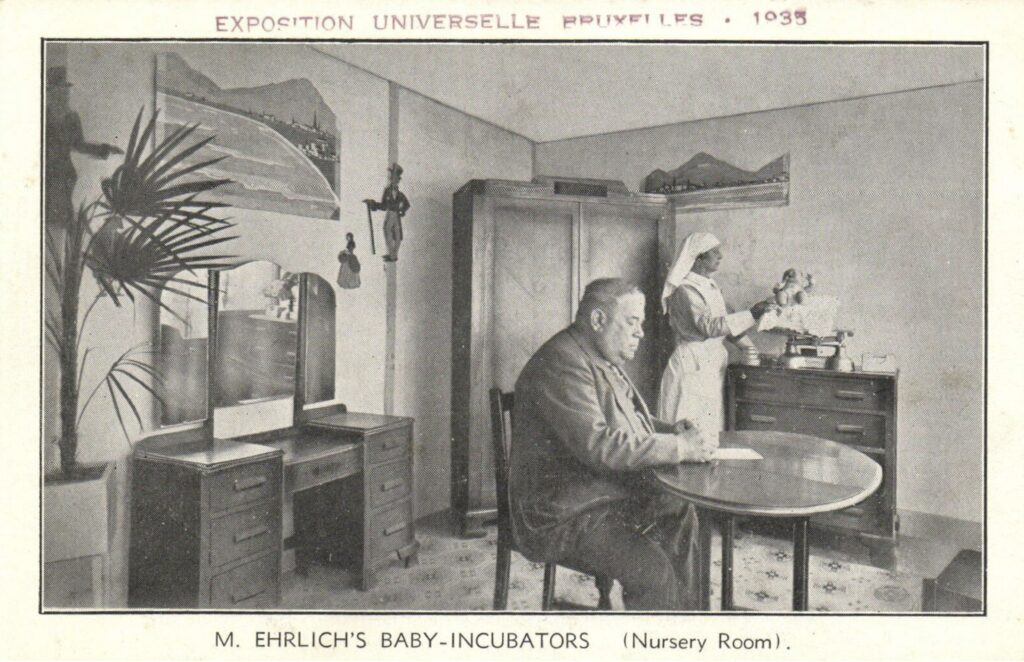
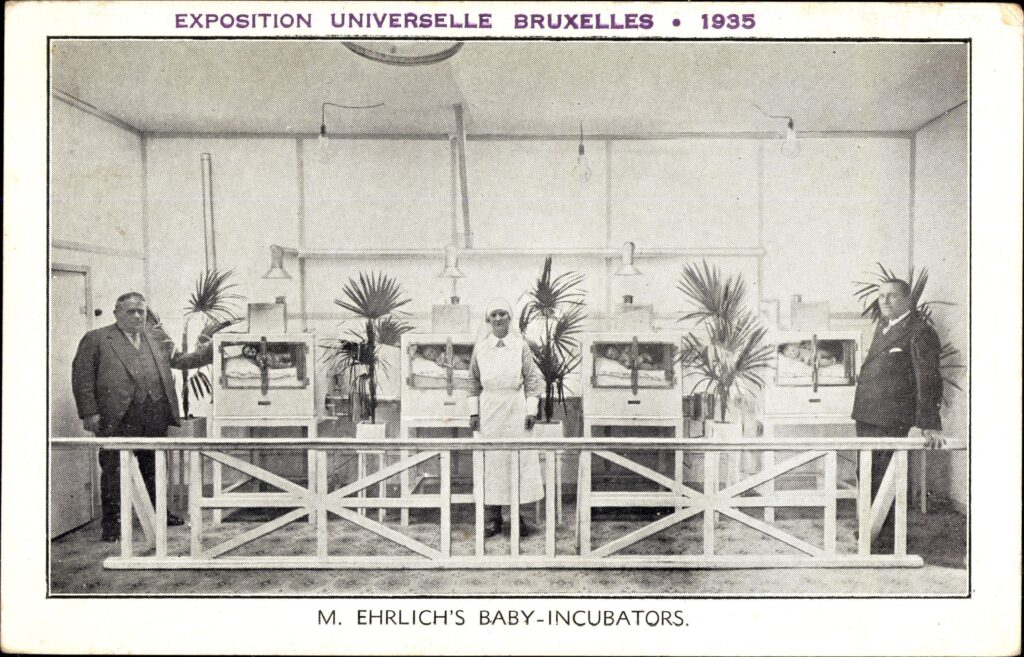
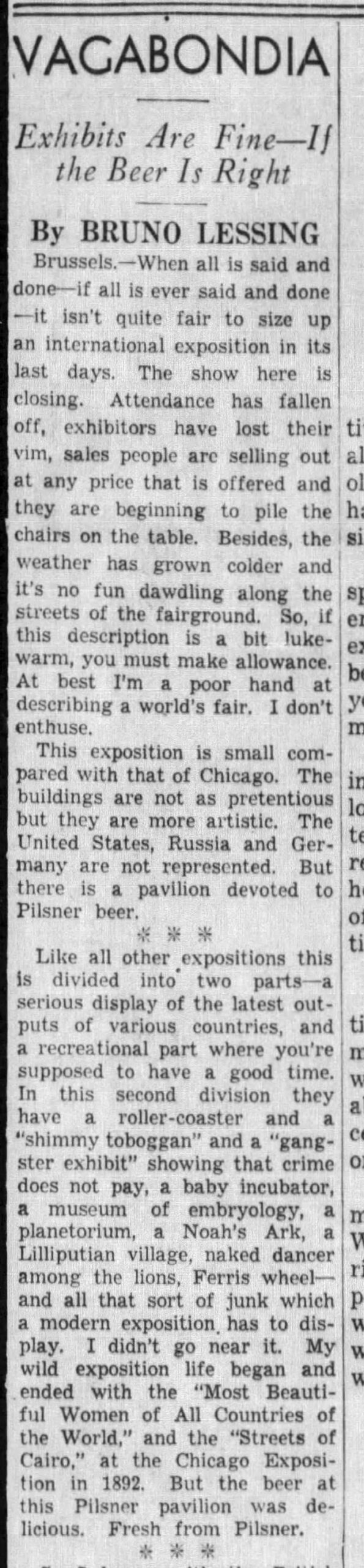
Unlike earlier European Worlds Fairs, the incubator exhibit at the Brussels 1935 Exposition were ignored in the Belgian and French press — despite diligent searching in both French and Belgian newspaper archives, I have not found any descriptions of an incubator exhibit at all so far. In fact the only press mention of incubators at the Exposition that I have found so far was a passing mention in the San Francisco Examiner article below.
Sources
- Exposition universelle internationale de Bruxelles de 1935, French Wikipedia — https://fr.wikipedia.org/wiki/Exposition_universelle_internationale_de_Bruxelles_de_1935
- Brussels International Exposition (1935), English Wikipedia — https://en.wikipedia.org/wiki/Brussels_International_Exposition_(1935)
- “Expo 1935 Bruxelles,” Bureau International des Expositions — https://www.bie-paris.org/site/fr/1935-brussels (English: https://www.bie-paris.org/site/en/1935-brussels)
- “L’Exposition Universelle de 1935 à Bruxelles…,” BIE In Focus (S. Pacchiani) — https://www.bie-paris.org/site/en/latest/infocus/entry/lexposition-universelle-de-1935-a-bruxelles-quand-larchitecture-faconne-lhistoire-et-defie-son-epoque
- “Brussels World’s Fair 1935,” America’s Best History — https://americasbesthistory.com/wfbrussels1935.html
- Pavillons / données, worldfairs.info (expo_id=29) — https://en.worldfairs.info/expolistepavillons.php?expo_id=29
- “1935 – Exposition universelle et internationale de Bruxelles,” Union des Maisons de Champagne — https://maisons-champagne.com/fr/encyclopedies/expositions-universelles/article/1935-exposition-universelle-et-internationale-de
* Moritz Ehrlich, referred to in most news accounts as M. Ehrlich, is a somewhat mysterious figure. I have not been able to find much information about him other than his claimed origin in Vienna and a later residence address at Lothringerstraße 59 in Berlin. He used Lion incubators, and his exhibits usually were named “Baby Incubator Institute” or some variation on that in the local language. He is known to have exhibited at Manchester in 1902 and 1903, Glasgow in 1903-1904, Bradford in 1904, Liege in 1905, Birmingham in 1905, Bucharest in 1906, Dublin in 1907, Edinburgh in 1908, Motherwell Scotland in 1934, Brussels in 1910, and Brussels in 1935. Undoubtedly there were others as yet unidentified. He also had some connection with Albert Leotardi, another entrepreneur on the incubator exhibit circuits, as evidenced by a lawsuit between them filed in Berlin on September 12th, 1899.
Last Updated on 07/11/26