Golden Gate International Exposition, 1939–1940
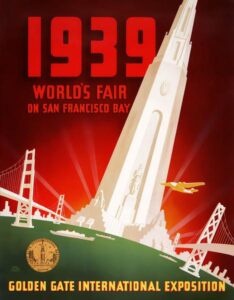
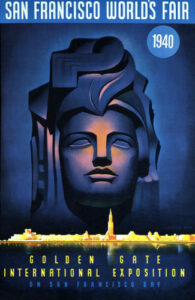
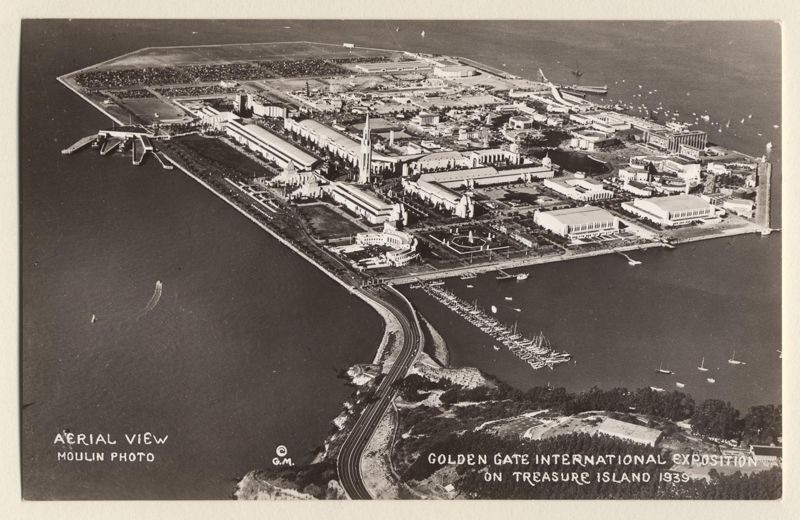
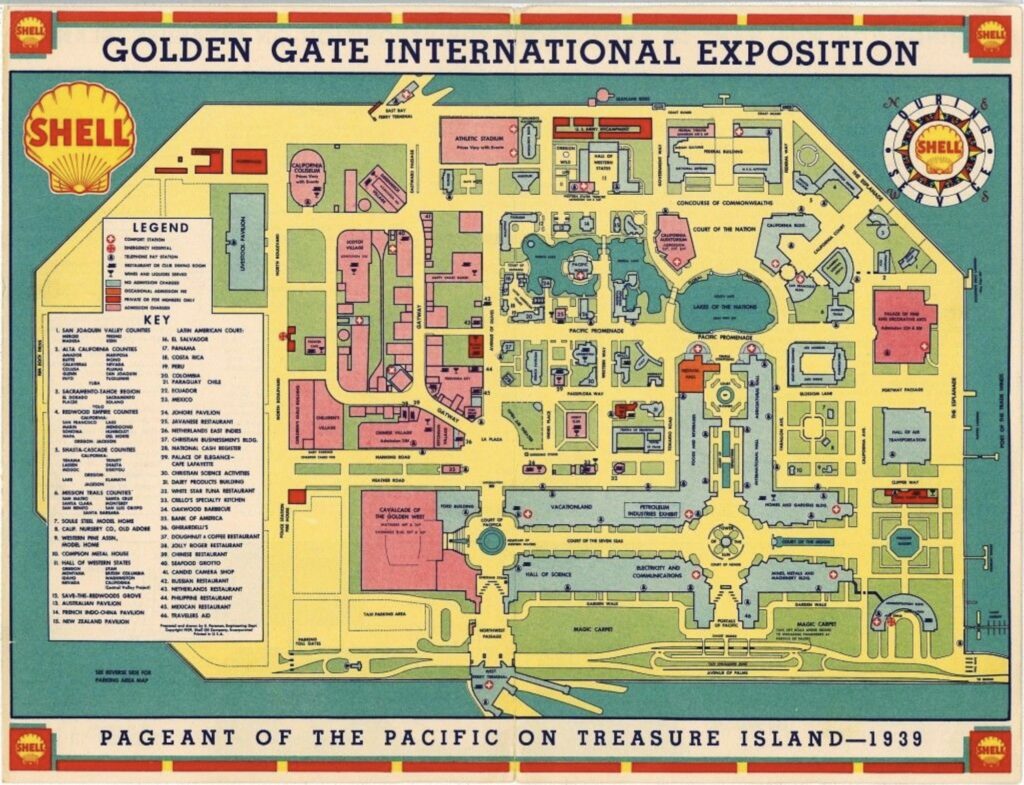
The Golden Gate International Exposition was a world’s fair held on Treasure Island — a 400-acre artificial island built in San Francisco Bay beside Yerba Buena Island — across two seasons, from February 18 through October 29, 1939, and again from May 25 through September 29, 1940. Themed “A Pageant of the Pacific” and celebrating the recently completed Bay and Golden Gate bridges, the fair drew on the order of seventeen million visitors over its two runs. The original plan for Treasure Island was that it would serve as San Francisco’s municipal airport after the exposition, as well as berths for the Pan American Clippers which landed on the Bay. However, the Navy took the island over in 1941, and it was known as Naval Station Treasure Island until 1997. The airport was eventually built south of the city.
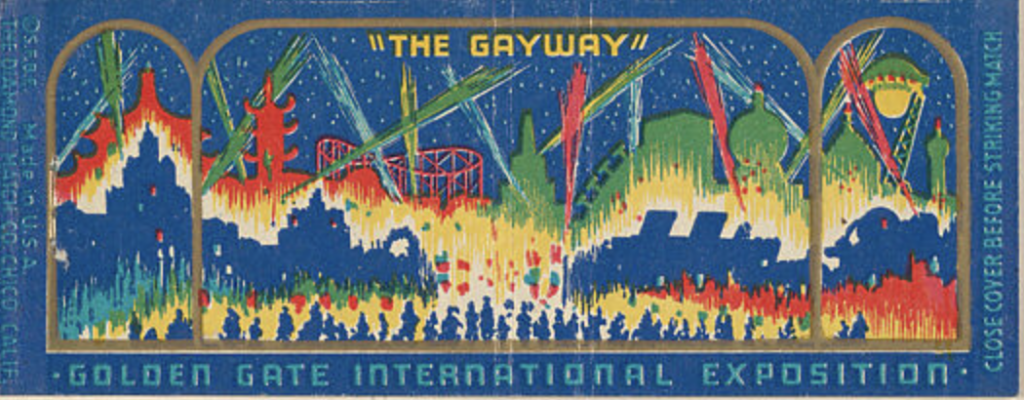
Its amusement district, a forty-acre strip officially named the Gayway, ran to sideshows, rides, and concessions of every description — Sally Rand’s Nude Ranch, Ripley’s Believe It or Not, a Midget Village, a giant python show, glass blowers, and sand sculptors among them. Filed squarely among these attractions, the official house history of the fair lists, without ceremony, “babies in incubators.”
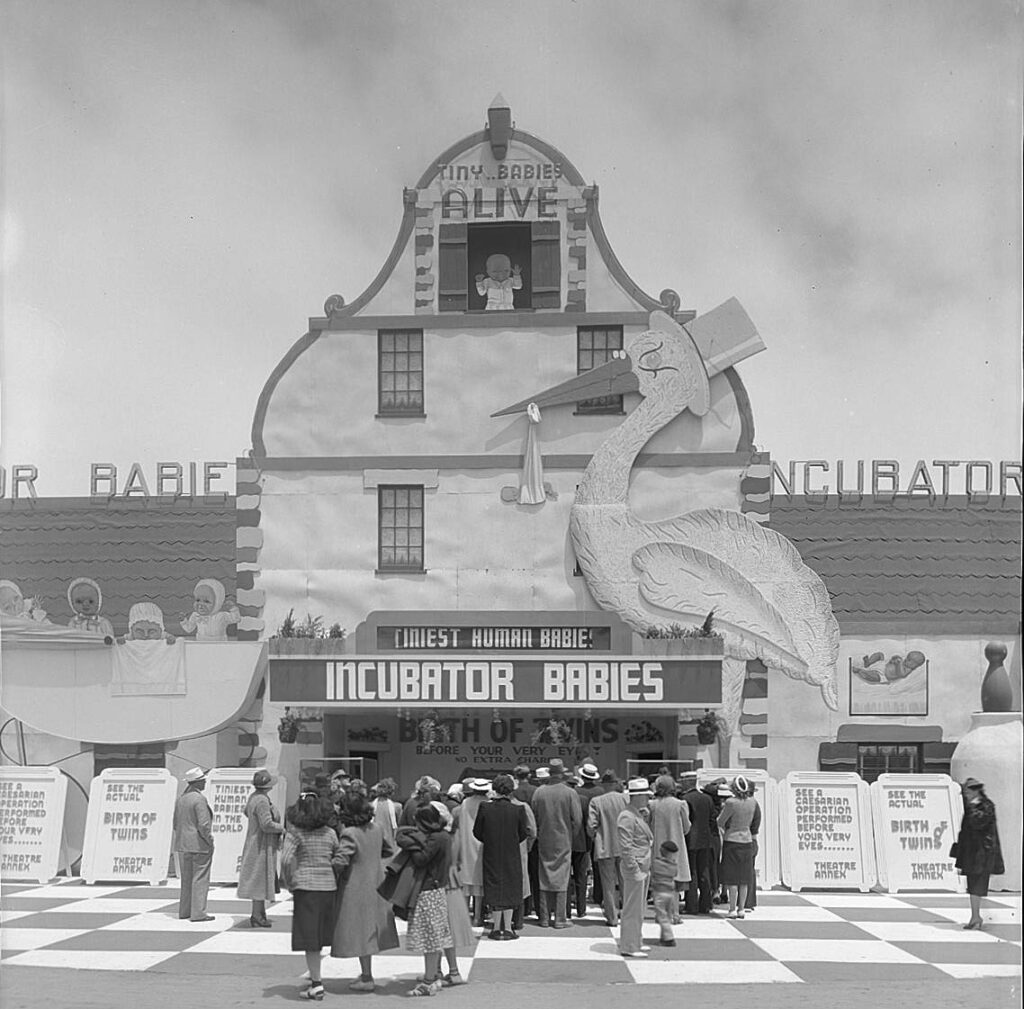
The incubator concession on the Gayway operated under at least three trade names across its two seasons — “Incubator Babies, Inc.” (as the 1939 Official Guide Book listed it, under the heading “Marvel of the Age”), “Better Babies, Inc.,” and, in the fair’s own promotional history, simply “the Incubator Baby Concession.” It was not connected to Martin Couney, the era’s famous incubator showman, who was running his own exhibit simultaneously at the New York World’s Fair. The Treasure Island show belonged instead to the recurring type of Couney-independent, promoter-run incubator concession: operated by carnival and amusement men, staffed with hired nurses and physicians, and competing for fair concessions on a commercial basis.
Operators and Naming
The operator history is unusually tangled, and the newspaper record — which is essentially the only record — yields four different men described as running the exhibit at different points, with no source clarifying how they were related. The earliest public face was Gabe Barnett. He appears in three independent San Francisco papers around the February 1939 opening: a Chronicle ski-jump preview of February 14 refers casually to “Gabe Barnett’s incubator baby show” as a Gayway landmark; the Examiner of February 16 calls him the “baby incubator and iron lung concessionaire”; and the Chronicle of the same day quotes him directly as “manager of the exhibit.” The papers thus apply both “concessionaire” and “manager” to Barnett interchangeably, suggesting the titles were used loosely. He is the documented spokesman at opening.
By late March 1939, Herb Caen’s Chronicle column noted that Fred Weddleton — until a few weeks earlier the Exposition’s own “all-powerful concessions chief” — had gone to work in the Incubator Babies exhibit, in a role left unspecified. By the May 1939 the Examiner identified the manager as Ed Breckenridge, and it is Breckenridge alone whom the later secondary literature records. In the 1940 season, the Chronicle quoted a “Manager David Smith.” The fair’s promotional history, for its part, attributes a 1939 announcement to an unnamed “manager of the Incubator Baby Concession.”
What the sources support, then, is a single concession trading under several names and managed by a rotating cast — Barnett at the 1939 opening, Weddleton attached by spring 1939, Breckenridge as manager by May 1939, and Smith managing in 1940 — with the relationships among them undocumented. The medical side was supplied by a consulting physician, Dr. Martha James, named in William Silverman’s 1979 history; none of the four promoters is known to have had medical training. Notably, the contemporary newspaper record gives a fuller picture of the operation’s management than the standard secondary account, which names only Breckenridge.
The Facility
The exhibit advertised “10,000 square feet of hospital area” and billed itself, in the careful language of its newspaper advertising, as “Truly authentic — ethically operated.” A Chronicle walking tour of the Gayway published February 16, 1939 supplies the only hardware count on record: the show was fitted with sixteen electrically heated incubators — described as “one of the most unusual exhibits ever shown at a World’s Fair” — with the writer’s hedge “or as many as are provided” indicating that sixteen was capacity rather than occupancy. Other accounts put the number of babies on view at any one time at around a dozen.
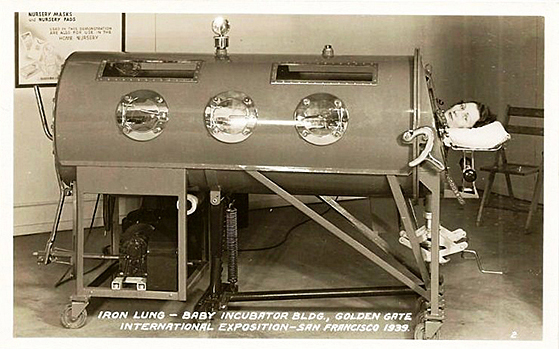
The exhibit also displayed an iron lung, framed from the outset not merely as a curiosity but as a public-service resource. Barnett, in his February 1939 Chronicle interview, described ultra-modern respirators on display — one of them holding an infantile-paralysis (polio) patient — alongside an auxiliary “lung” reserved for emergencies, and pledged that if a respirator were needed within five hundred miles of the fair, “we’ll send ours out gratis.” The exhibit’s iron lung was distinct from the standalone “Iron Lung” concession separately listed on the Gayway. Visitors to the incubator show were themselves invited, as a come-on, to “get inside an iron lung and see what these lifesavers feel like.”
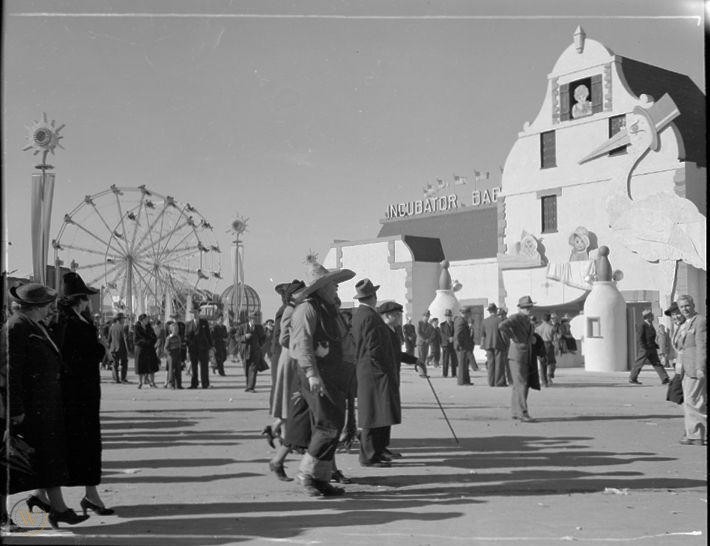
The concession sat immediately next to the Gayway snake show — Cliff Wilson and his python “Elmer,” and a “Monster Pit” of boa constrictors — an adjacency confirmed by both the 1939 newspaper tour and the fair’s 1941 house history, which records the snake handlers consulting the “Better Babies exhibit next door” for advice on feeding newborn boas. Around-the-clock nursing is documented: a Herb Caen column of August 1939 describes the exhibit’s night nurse working a midnight-to-eight shift over “the eight babies in the Incubator Babies exhibit,” and the 1940 operation was reported to employ six nurses and two pediatricians. Infant formula was supplied throughout both seasons by Borden’s Evaporated Milk of Modesto, and the nursery’s food was kept under refrigeration by Servel Electrolux gas units provided through the fair’s gas-industry exhibitors — part of a broader commercial ecosystem in which the exhibit’s reliance on gas appliances for heating, refrigeration, and sterilizing was itself a marketing point.
Notable Babies
The exhibit publicized individual infants steadily, often presenting them as recurring “personalities” and favoring multiple births as headline draws. In February 1939 it announced the admission of Chinese twins among an initial dozen signed infants. In May 1939 the Examiner reported identical twin boys, Donald and Ronald — about two months premature, weighing 31½ and 32¼ ounces — placed in the exhibit by Nurse Aileen Newman; by that date the concession claimed forty-three babies sent home recovered. A separate “Baby Ronald,” not to be confused with the twin, appears in an Oakland Post-Enquirer item of July 1939, gaining from nineteen to twenty-three ounces alongside a rival “Baby Elvin,” with the claim that no infant so small had previously survived more than a few hours.
The most-publicized 1940 case was Baby Consuelo, reported in both the Chronicle and the Oakland Tribune that June. Of Filipino parentage, weighing one pound fourteen ounces and roughly three months premature, she was born in Gilroy on Memorial Day and carried to Treasure Island in a specially built mobile incubator — a five-hour trip slowed by repeated stops to reheat the unit with hot water — then fed half an ounce of formula by eye-dropper every hour. She was billed as the smallest baby ever accepted at the concession, though such “smallest” claims conflict across sources and admission weights elsewhere are given as low as “from 26 ounces.”
In October 1940 the exhibit staged a publicity send-off for Albert Carl “little Al” Martens, born prematurely in Vallejo that July and, after a stay in the incubators, flown home to Glen Ellyn, Illinois, aboard a United Air Lines plane — promoted as the first incubator baby to travel by airplane. Accounts of his birth weight differ (3 lb 8 oz versus 3 lb 13 oz) while agreeing he departed at 7 lb 13 oz.
Showmanship and Racial Marketing
The exhibit’s promotion mixed genuine medical rescue with conventional carnival showmanship and the casual racism of the period. Its advertising explicitly marketed the babies’ races as part of the spectacle: a syndicated 1939 piece headlined “Incubator Babies of the West” invited fairgoers to admire “colored and Mexican as well as white infants,” and the Chinese twins were similarly foregrounded. The clearest instance came in July 1939, when the concession nicknamed a pair of recently admitted Black premature twins “Amos ‘n’ Andy,” after the white-performed blackface radio comedy, and tied the stunt to an Amos ‘n’ Andy broadcast staged at Treasure Island that week; the announcement ran with a sketch by Irvine Sinclair, operator of a neighboring Gayway concession. A follow-up profile two weeks later — labeled “Personality No. 5 – ‘Amos'” in a numbered series — reported that the twins, who had arrived near death, were by then recovering and healthy. The episode commodified the infants and trafficked in the racial attitudes of its time; it also documents two real premature babies who, by these accounts, survived.


Reception and Attendance
The exhibit was among the Gayway’s most heavily promoted attractions and, by its own figures, among the better-attended. A Los Angeles trade item of May 1940, headlined “Incubator Babies Slated to Steal Exposition Show,” reported more than 500,000 paid admissions to the concession during the 1939 season. National columnists took notice: Ernie Pyle, visiting in 1939, described the “Incubator Babies’ Palace” with about a dozen babies behind glass and an attendant in an iron lung, noting that the infants were mostly premature children of mothers who could not afford hospital care. The exhibit also advertised motion pictures of births — a filmed twin delivery in 1939, and “natural-color” footage of a Caesarean birth of twins in 1940 — shown at an adjoining theater.
The Iron Lung Sent to Seattle
The public-service pledge Barnett had made at the 1939 opening was, at least once, honored in fact. In July 1940, during a polio outbreak, the iron lung on display at the Incubator Babies’ concession was crated and shipped by train to Seattle at the request of Willis Dorr, the Seattle American Legion commander. The destination lay well beyond the five-hundred-mile radius Barnett had originally named — Seattle is some 680 miles distant — so the loan is best understood as the promise kept in spirit, in a genuine emergency. The episode closes a thread that ran through the exhibit’s whole life: polio and respirators were part of its identity from the first week to the last summer, and its iron lung functioned, at least on this occasion, as something more than a sideshow prop.
Outcome
The concession’s own running tallies of babies “sent home” climbed over the first season — forty-three by late May 1939, forty-seven by mid-June — and Silverman’s 1979 account, drawing on the promoters’ claims, puts the total at eighty-five infants cared for across the two-year run. These figures originate with the operation’s publicity and cannot be independently verified. Point-in-time censuses from the press are more modest and consistent with a small working nursery: sixteen incubators as capacity, about a dozen babies on view at peak, eight present overnight in late August 1939, and nine in care in June 1940.
The fair’s own promotional history supplies a rare deflating note. It records that the manager of the concession announced the creation of a “complete maternity ward, to be available in all emergencies” — with actuaries estimating it might be used some twenty times during the run — but adds dryly that, despite a few close calls, there is no record the ward was ever used. Dr. Martha James, the exhibit’s medical consultant, was reported by Silverman to have been unimpressed with the attendance; the promoter’s own verdict, in the same source, was simply “Business is great!” The juxtaposition captures the exhibit’s double character: an advertised hospital that was also, unmistakably, a Gayway show.
The Exhibit in Context
The Treasure Island concession is easily misread as an isolated curiosity, but it fits a pattern that recurred across American expositions for four decades. When Couney applied for the incubator concession at the 1904 Louisiana Purchase Exposition in St. Louis, it went instead to a promoter named Edward M. Bayliss, who outbid him on the fair’s revenue share and partnered with a physician, Joseph Hardy, who had no experience with incubators or premature infants. Treasure Island in 1939–1940 reprised that structure: a showman-promoter holding the concession (Barnett, then Breckenridge, then Smith) with a hired medical consultant (Dr. James) supplying legitimacy. Such shows competed for fair concessions on commercial terms throughout the era, and the surviving incubator-show historiography — overwhelmingly devoted to Couney — has left the people who ran them largely untraced. None of the four men associated with the Golden Gate exhibit appears in the documentary record beyond the Treasure Island coverage itself.
In retrospect, our information is limited and our judgment must be guarded. The fair’s 1941 house history is an official, promotional account and leans boosterish; the bulk of the exhibit’s “record” is its own advertising and the favorable, often credulous newspaper coverage it generated; and Silverman’s 1979 article — the standard secondary treatment — predates the later scholarship (notably Dawn Raffel’s) that corrected the self-mythology surrounding incubator showmen generally. What remains beyond dispute is that a promoter-run incubator show on the Golden Gate Exposition’s Gayway took in premature infants, displayed them for paid admission, employed nurses and consulting physicians, lent out an iron lung during a polio emergency, and returned a contested but real number of babies to their families over two seasons.
Newspaper sources
- “Ski Yoomp: Human Flyers Arrive.” San Francisco Chronicle, February 14, 1939, p. 23.
- “Treasure Island Short-Wave Station Plans Broadcasts to ‘Japanese’ China.” San Francisco Chronicle, February 16, 1939, p. 6.
- “Chinese Twins Join Fair Incubator.” San Francisco Examiner, February 16, 1939, p. 9.
- “Yes, Gayway Has a Roller Coaster.” San Francisco Chronicle, February 16, 1939, p. 48.
- Opening-day Exposition overview (Wendell Webb / Galveston). Galveston Tribune, February 18, 1939, p. 3.
- Kevin Wallace, “Treasure Isle Tales.” San Francisco Examiner, March 2, 1939, p. 11.
- Herb Caen, “It’s News to Me.” San Francisco Chronicle, March 25, 1939, p. 12.
- “Yes! They Are Alive” (advertisement). San Francisco Chronicle, March 26, 1939, p. 2.
- “Incubator Babies of the West.” The Alexander City Outlook, June 1, 1939, p. 2.
- “Baby-Saver at Fair Kept Busy” (Associated Press). Press-Telegram (Long Beach), June 17, 1939, p. 9.
- “Don’t Fail to Visit the Incubator Babies” (advertisement). San Francisco Chronicle, June 29, 1939, p. 28.
- Ernie Pyle column (“Incubator Babies’ Palace”). Ogdensburg Advance-News, May 24, 1939, p. 2.
- “Manager Ed Breckenridge…” (Donald and Ronald twins). San Francisco Examiner, May 29, 1939, p. 13.
- “Amos ‘n’ Andy” (Irvine Sinclair sketch). San Francisco Chronicle, July 13, 1939, p. 26.
- “Baby Ronald” / “Baby Elvin.” Oakland Post-Enquirer, July 28, 1939, p. 18.
- “Personality No. 5 – ‘Amos.'” San Francisco Chronicle, July 29, 1939, p. 26.
- Servel Electrolux / gas-industry exhibit item. Elizabethtown Chronicle, August 25, 1939, p. 2.
- Herb Caen, “Memos to Myself” (night nurse). San Francisco Chronicle, August 30, 1939, p. 13.
- “Incubator Babies Slated to Steal Exposition Show.” Los Angeles Evening Citizen-News, May 2, 1940, p. 8.
- “Hello Folks We’re Back Again” (advertisement). San Francisco Examiner, May 21, 1940, p. 27.
- “Better Babies, Inc.” 1940-season item. Oakland Tribune, May 23, 1940, p. 36.
- “The Fair” (Manager David Smith; Baby Consuelo; attendance). San Francisco Chronicle, June 20, 1940, p. 13.
- “Expo Show Boasts ‘The Smallest Baby'” (Baby Consuelo). Oakland Tribune, June 21, 1940, p. 20.
- “Fair Iron Lung Sent to Seattle on Mercy Job.” San Francisco Chronicle, July 11, 1940, p. 23.
- Albert Carl “little Al” Martens (incubator baby flown home). Berkeley Daily Gazette, October 1, 1940, p. 9.
- “Little Al” Martens send-off. Oakland Tribune, October 1, 1940, p. 17.
- “Little Al” Martens (United Press). San Francisco Chronicle, October 2, 1940, p. 7.
Other sources
- Jack James and Earle Weller, Treasure Island, “The Magic City,” 1939–1940: The Story of the Golden Gate International Exposition (San Francisco: Pisani Printing and Publishing Co., 1941), pp. 209, 211, 218. Full scan: archive.org/details/treasureislandma00jamerich.
- Official Guide Book, Golden Gate International Exposition (1939), Gayway concession listings.
- William A. Silverman, M.D., “Incubator-Baby Side Shows,” Pediatrics 64, no. 2 (August 1979): 127–141. Reproduced at neonatology.net.
- “Louisiana Purchase Exposition, 1904.” Neonatology on the Web (for the Bayliss/Hardy concession parallel). https://neonatology.net/gallery/exhibitions/louisiana-purchase-exposition-1904/
- Images of the Golden Gate Exposition on Kathryn Ayre’s page
- Gallery of tourist snapshots of the Exposition
- Guidebook Pages for the Exposition
- Golden Gate International Exposition on Wikipedia
- Golden Gate International Exposition on America’s Best History
- Golden Gate International Exposition on Treasure Island Museum site
- Golden Gate International Exposition at the University Libraries Digital Collections
- Treasure Island Fair at FoundSF
- Golden Gate Exposition at StoryMaps
- Golden Gate International Exposition at ToxicService
- Golden Gate International Exposition at EarthStation9 – many statistics
Last Updated on 06/13/26