The Pennsylvania Infant Incubator Company
Athough neither Alexandre Lion nor Martin Couney were medical doctors, both ran creditable medical operations that saved thousands of premature babies (regardless of Couney’s ever-changing personal legend). Other, less scrupulous entrepeneurs attempted to leverage the public’s interest in incubator baby exhibits to make a quick buck at regional fairs and carnivals. The figure at the center of this sad story operated under a remarkable range of names across the historical record — a pattern so consistent that it appears deliberate rather than accidental. Newspaper clippings from 1909–1910 identify him variously as:
- H. K. Snyder (most common usage; Roanoke World-News, Raleigh Times, News & Observer, Mayfield Messenger, Courier-Journal, Spokane Press, Wilkes-Barre Times Leader)
- K. H. Snyder (Western Sentinel, Winston-Salem, Sept. 17, 1909)
- H. Snyder (Raleigh Times, Oct. 1, 1909)
- H. J. Snyder (Buffalo Courier and Courier-Journal, both Sept. 19, 1910)
- Douglas Snyder / Douglass Snyder (Asheville Citizen-Times, Greenville News, Pittsburgh Post, Pittsburgh Post-Gazette, all Sept. 1910)
- Lucas Snyder (Salt Lake City Herald, Sept. 19, 1910, and at least three other western papers on the same date)
He consistently presented himself as a physician under the title “Dr. Snyder,” and consistently claimed Pittsburg (or Pittsburgh) as his place of residence. However, the Pittsburgh city directory contained no listing for him under any of his known name variants, and when reporters and investigators attempted to identify him as a licensed Pittsburgh physician following his 1910 arrest, those efforts came up entirely empty. Trial testimony in Louisville confirmed the obvious conclusion: Dr. Snyder admitted he was not a licensed physician.
There are reasons to suspect that Chicago — not Pittsburgh — was his actual place of residence or at least his principal operating headquarters. In his statement to reporters after the Louisville arrests, Dr. Snyder revealed that the babies died because “he was unable to give them the proper attention while making the trip from Chicago to Louisville.” This offhand remark places him in Chicago immediately before the Kentucky State Fair engagement — a detail inconsistent with someone based in Pittsburgh traveling south.
Combined with his complete absence from the Pittsburgh city directory and the fact that his Pittsburgh baby-supply network operated through local intermediaries rather than through his own presence, the evidence suggests that Pittsburgh served as a convenient institutional address lending the company medical credibility, while the operator himself was based elsewhere — most plausibly Chicago.
The Company and Its Origins
The Pennsylvania Infant Incubator Company of Pittsburg, Pa. — also referred to in at least one Pittsburgh paper as the “Pittsburgh Incubator Company” — presented itself as a legitimate medical enterprise. Its promotional materials described a traveling hospital operation that claimed to be building permanent incubator hospitals “in many of the larger cities of the country,” with the fair circuit serving as a public demonstration of the technology. The company’s standard claim was that while only 15 percent of premature infants survived under ordinary conditions, its incubator system saved “practically 90 per cent of those taken in.”
The exhibit traveled with a portable, custom-built building carried in knocked-down form and re-erected at each venue, with all interior materials sterilized by the most approved methods. It maintained three incubators and a full nursing staff headed by Miss Kreig (1909 season), a graduate nurse of the Pennsylvania Hospital, later replaced by Miss Maud Brodmerkel and Miss Lena Heffner (also rendered as “Hafer” and “Haefler” in various papers) of Swissville, PA. A staff of physicians described as having taken special training under Dr. Snyder rounded out the operation. Bookings were arranged nationally through the United Fairs’ Booking Agency.
The Supply of Infants
One of the most disturbing aspects of the operation was the sourcing of babies. Post-mortem examination established that the infants placed in the incubators were not premature infants in genuine medical need. Dr. George Jenkins, who conducted the autopsies on the three Louisville babies, testified that “the babies in the show were of mature birth” and that “there was no need of putting the children in an incubator, as they were fully developed children.” One baby was eight weeks old; the others were four and five weeks old respectively.
Dr Jenkin’s statement is supported by the only photo of Snyder’s operation I have found in a newspaper account, which appears to show a term baby in a simple glass box.
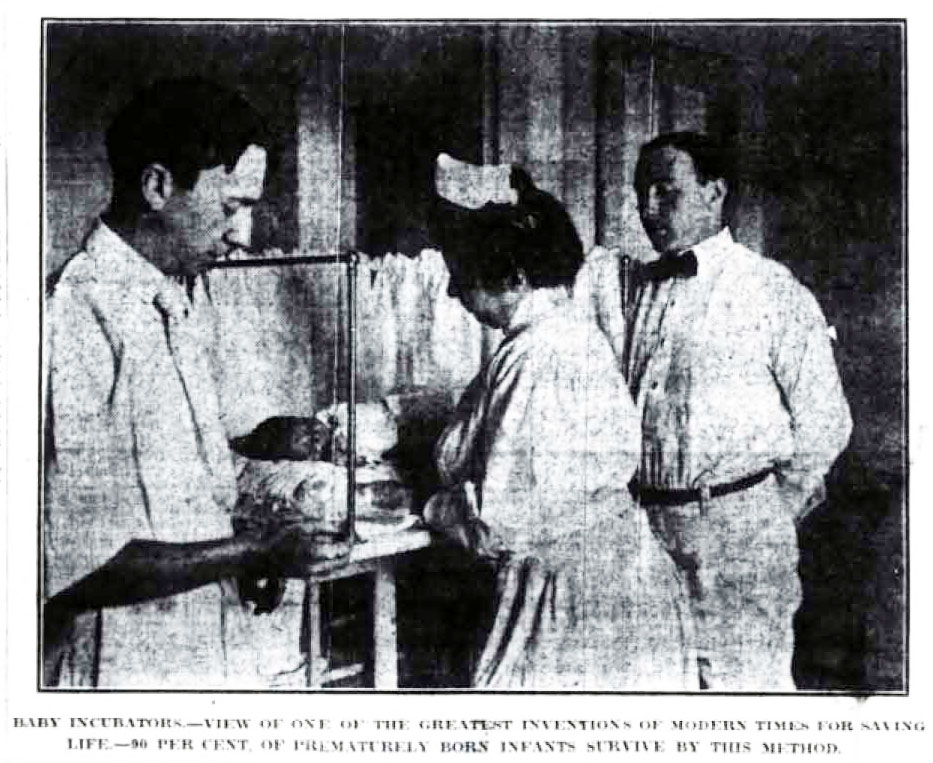
The supply chain ran through Pittsburgh maternity institutions, but the Pittsburgh Post-Gazette (Sept. 19, 1910) added a crucial layer to the picture: a female intermediary in the Pittsburgh neighborhood of Hazelwood was responsible for physically collecting babies from the Colonial Private Maternity Hospital at 915 Irwin Avenue, North Side. This woman was described as “a woman physician who runs a children’s home in Hazelwood” and was identified as “a registered physician in Ohio, if not in Pennsylvania.” Most strikingly, she had previously traveled with Dr. Snyder as his nurse in charge of the babies — a former employee who had apparently transitioned into a supplier role. She had collected three children for Dr. Snyder: one who had left the hospital about six weeks earlier, and two others, both born of foreign parents, about two weeks before the Louisville disaster. One of the dead infants had in fact been adopted by this woman at some point, further deepening her entanglement with the operation.
When babies died on the circuit, the standard protocol — confirmed by nurse Lena Heffner’s testimony — was to dispatch someone to Pittsburgh for replacements. Heffner described one specific trip she made from Columbus, Ohio, to Pittsburgh to retrieve three new babies. A second nurse testified she had procured two babies from the Pittsburgh hospital “for the mere asking.” Dr. Snyder himself described the babies as “all charity patients” from Pittsburgh maternity hospitals, claiming he intended to raise them and “turn them over to some good family for adoption” — a statement that, if true, would mean he was removing charity infants from hospital care and transporting them around the country in railroad day coaches.
Exhibition Timeline
Multiple 1909 promotional articles describe the exhibit as having previously been shown “at all the great world’s expositions,” with the Jamestown Exposition of 1907 specifically named. However, in the contemporary accounts of the Jamestown Exposition, there is no mention of Snyder or the Philadelphia Infant Incubator Company. The 1909 regional fair circuit was described as the first time the exhibit was being shown “outside of great world’s expositions.”
September 21–24, 1909 — Great Roanoke Fair, Roanoke, Virginia. Advance coverage in the Roanoke World-News (Sept. 16) described the complete hospital outfit coming “at enormous expense,” with Miss Kreig as head nurse and a full staff of physicians.
September 28 – October 1, 1909 — Lynchburg Interstate Fair, Lynchburg, Virginia. Confirmed by the News and Advance (Sept. 26) and the Culpeper Star-Exponent (Sept. 17). Described as “a similar exhibit to that made at the Jamestown Exposition.”
Week of October 4–8, 1909 — Virginia State Fair, Richmond, Virginia. Confirmed by the Richmond Times-Dispatch (Oct. 4). The Raleigh Times (Oct. 1) noted the exhibit would travel directly from Richmond to Raleigh.
October 5–8, 1909 — Piedmont Fair, Winston-Salem, North Carolina. Confirmed by the Western Sentinel (Sept. 17). The incubator was to be located in the Exposition Building during the fair.
October 18–23, 1909 — Great State Fair of North Carolina, Raleigh, North Carolina. Confirmed by both the Raleigh Times (Oct. 1) and the News and Observer (Sept. 22), the latter running an extended promotional piece under the headline “Babies Under Glass at Fair.”
November 1909 — Grand Military Carnival, Jacksonville, Florida. Confirmed by the Florida Times-Union (Nov. 16). The exhibit had been secured by Carnival Director DaCosta through the United Fairs’ Booking Agency.
Summer 1910 — Luzerne County Fair, Wilkes-Barre, Pennsylvania. The Wilkes-Barre Times Leader (Aug. 30, 1910) reported the exhibit currently running with three incubators and three babies under Dr. H. K. Snyder, presenting it as an unqualified success. However, Louisville trial testimony later established that two babies died at Wilkes-Barre during this engagement, after which Dr. Snyder obtained replacement babies from Pittsburgh’s Maternity Hospital before proceeding.
Late Summer 1910 — Ohio State Fair, Columbus, Ohio. Established through Louisville trial testimony as the stop immediately preceding Kentucky. Nurse Brodmerkel testified that babies were removed from the incubators on a Friday night at Columbus and not replaced until the following Tuesday — a four-day gap. Babies were carried from Columbus to Louisville in a railroad day coach wrapped only in blankets.
September 15–17, 1910 — Kentucky State Fair, Louisville, Kentucky. Three babies died during the exhibition’s brief run, and the show was shut down by police. Dr. Snyder was arrested at Jeffersonville, Indiana — across the Ohio River — where he had gone ostensibly to await a telephone call from his wife at the fair. His statement to reporters revealed that he had been traveling from Chicago to Louisville when the babies’ condition deteriorated.
Litigation
Civil Suit: Snyder v. Starbird (April 1909)
A Pittsburgh Post-Gazette legal notice from April 11, 1909 reveals a serious internal rupture before the 1909 season began. H. K. Snyder filed a bill in equity against W. H. Starbird, seeking an injunction to prevent Starbird from suing on certain promissory notes, and demanding a full accounting of the Pennsylvania Infant Incubator Company’s finances. Snyder’s filing stated that he and Starbird had organized the company together as partners, but that Starbird had been “the active head” with “charge of the entire affairs of the company.” Starbird then allegedly manipulated him — claiming Snyder owed the company $500 and inducing him to hand over $100 in cash and $400 in notes. When those notes came due, Starbird sued to collect. The outcome of this case is not documented in the available clippings.
Arrest and Trial: Louisville, Kentucky (September–October 1910)
Three infants died during the Kentucky State Fair exhibition. Trial testimony established that five babies in total had died over a two-week period across multiple stops — two at Wilkes-Barre and three in Louisville. Post-mortem examination confirmed the cause of death as inanition (starvation and neglect). The babies were of mature birth, did not medically require incubation, and one child’s stomach was found to be completely empty.
Mrs. Snyder was arrested at the State Fair grounds. Dr. Snyder was captured at Jeffersonville, Indiana, and returned to Louisville. The show was closed by Captain Hogan of the county police. Twelve warrants each were sworn out against both defendants by County Attorney Scott Bullitt, Acting Coroner Hays, and Julius Hind of the Board of Children’s Guardians, charging “unmerciful exposure of a child,” “exhibiting for gain or reward an infant under 16 years of age,” and willful injury to infants under 16 (the last twelve warrants each were ultimately dismissed). The pair were released on $500 bond, with Mrs. Snyder using her jewelry, valued at $2,000, as security. The three Louisville babies were buried at Cave Hill Cemetery at Dr. Snyder’s expense.
Dr. Snyder gave a consistent statement to multiple papers: “My arrest has come entirely through misguided sentiment. I am not exhibiting these babies for the mere pittance that I ask as an admission, for I would be a fool to do so. I have bought this machine and am trying to introduce it to the public.” He blamed the deaths on the fair’s electrical supply, and notably distanced himself from the company — claiming to have purchased the equipment rather than being its proprietor.
Key trial testimony came from Dr. George Jenkins (post-mortem: mature-birth babies, died of inanition, incubation medically unnecessary); Dr. George Hays (Acting Coroner: confirmed inanition, one stomach completely empty); Dr. E. J. Meyers (fair hospital staff: saw babies wrapped in blankets and visibly ill; Snyder asked him to sign death certificates; Snyder admitted he was not a licensed physician); Miss Maud Brodmerkel (nurse: prior deaths at Wilkes-Barre, replacement babies obtained from Pittsburgh, babies transported in day coach); Miss Lena Heffner/Hafer (nurse: described trips to Pittsburgh for replacement babies when prior ones died); Tom Beatty (employee: Mrs. Snyder had joint authority and gave orders); and J. W. Newman (fair secretary: attraction booked through United Fairs’ Booking Agency).
The verdict (September 27, 1910). Fines and costs totaling $242 were assessed: Dr. Snyder $5 and costs on each of nine charges; Mrs. Snyder $1 and costs on each of nine identical charges. Twelve charges of willful injury to infants were dismissed against both defendants.
Disappearance After 1910
Following the Louisville conviction, the Pennsylvania Infant Incubator Company and its operator vanish entirely from the newspaper record. The final dated clipping is the Spokane Press item of October 4, 1910 — demonstrating that the story had reached national circulation from the Atlantic seaboard to the Pacific Northwest. No subsequent fair appearances, court proceedings, company reorganizations, or obituaries for anyone matching this profile have surfaced in the available clippings. The Louisville scandal exposed the operator as unlicensed, revealed that healthy babies had been removed from hospital charity wards and allowed to die of neglect across multiple stops on the circuit, and generated a national news cycle. The fine itself was trivially small, but the publicity made further operations under this name — or any similar name — effectively impossible after the autumn of 1910.
Summary of Known Exhibition Locations
| Date | Venue | Location |
|---|---|---|
| Sept. 21–24, 1909 | Great Roanoke Fair | Roanoke, VA |
| Sept. 28–Oct. 1, 1909 | Lynchburg Interstate Fair | Lynchburg, VA |
| Week of Oct. 4, 1909 | Virginia State Fair | Richmond, VA |
| Oct. 5–8, 1909 | Piedmont Fair | Winston-Salem, NC |
| Oct. 18–23, 1909 | Great State Fair of NC | Raleigh, NC |
| November 1909 | Grand Military Carnival | Jacksonville, FL |
| Summer 1910 | Luzerne County Fair (two babies died) | Wilkes-Barre, PA |
| Late summer 1910 | Ohio State Fair | Columbus, OH |
| Sept. 15–17, 1910 | Kentucky State Fair (show closed; arrests) | Louisville, KY |
Citation List
- Pittsburgh Post-Gazette (Pittsburgh, PA), April 11, 1909, p. 19. “In the Courts.”
- The World News (Roanoke, VA), September 16, 1909, p. 3. “Roanoke Fair Mails Heavy.”
- The Western Sentinel (Winston-Salem, NC), September 17, 1909, p. 8. “Getting Ready for Great Fair.”
- Culpeper Star-Exponent (Culpeper, VA), September 17, 1909, p. 6. “Lynchburg’s Gala Week.”
- The News and Observer (Raleigh, NC), September 22, 1909, p. 5. “Babies Under Glass at Fair.”
- The News and Observer (Raleigh, NC), October 17, 1909, “The Infant Incubators”
- The News and Advance (Lynchburg, VA), September 26, 1909, p. 1. “All Ready for Opening Fair Tuesday at 9.”
- The Raleigh Times (Raleigh, NC), October 1, 1909, p. 5. “Baby Incubators: Exhibit at the Great State Fair, October 18–23.”
- Richmond Times-Dispatch (Richmond, VA), October 4, 1909, p. 5. “Infant Incubator at the Fair.”
- The Florida Times-Union (Jacksonville, FL), November 16, 1909, p. 9. “Entries Coming in for Floral Parade.”
- Wilkes-Barre Times Leader, the Evening News (Wilkes-Barre, PA), August 30, 1910, p. 7. “A Successful Opening of Local County Fair.”
- Asheville Citizen-Times (Asheville, NC), September 18, 1910, p. 4. “Incubator Baby Show Broken Up by Death of Three of Its Exhibits.”
- Buffalo Courier (Buffalo, NY), September 19, 1910, p. 1. “Hold Couple for Deaths of Three Little Children.”
- The Greenville News (Greenville, SC), September 19, 1910, p. 1. “Current Insufficient, and the Babies Died.”
- The Pittsburgh Post (Pittsburgh, PA), September 19, 1910, p. 2. “Hospitals Here Send Infants.”
- Pittsburgh Post-Gazette (Pittsburgh, PA), September 19, 1910. “Pittsburgh Babes Die in Incubator.” [Separate newspaper from the Pittsburgh Post above; the two did not merge until 1927.]
- Salt Lake City Herald (Salt Lake City, UT), September 19, 1910, p. 1. “Incubator Babies Die and Caretakers Are Arrested.” [Wire service dispatch; same text ran in the Salt Lake Telegram, Helena Independent Record, and Anaconda Standard on the same date, all using the name “Lucas Snyder.”]
- The Courier-Journal (Louisville, KY), September 18, 1910, p. 3. “Man and Wife Arrested Following Death of Incubator Babies.”
- The Courier-Journal (Louisville, KY), September 25, 1910, p. 4. “Heavy Fines.”
- The Mayfield Messenger (Mayfield, KY), September 28, 1910, p. 3. “Baby Incubator Showman is Fined.”
- The Spokane Press (Spokane, WA), October 4, 1910, p. 6. “Doctor Fined for Neglecting Infants in Baby Incubators.”
Portions of this page were drafted with machine assistance; the final text was reviewed, verified, and edited by the author. Click here to learn more.
Last Updated on 07/20/26