Woman’s Exhibition in Earls Court, London, 1900

The Woman’s Exhibition, formally the Woman’s International Exhibition, opened at Earl’s Court on Saturday afternoon, 5 May 1900. It was the latest of the themed summer seasons staged there by London Exhibitions Ltd under its Director General, the impresario Imre Kiralfy. The Lady Mayoress declared it open in the Central Hall, attended by the Lord Mayor, Sir A. J. Newton, and the Sheriffs, Sir W. P. Treloar and Sir A. Bevan, all present in state. Kiralfy thanked her on behalf of the directors. One reporter described the ceremony as about as brief as it could possibly be, after which the civic party went to lunch. The grounds were still unfinished on opening day. The stated purpose was to show the home life, work and pastimes of the women of all nations. The idea grew out of the “Woman’s Work” section of Kiralfy’s 1897 Victorian Era Exhibition, and the Saturday Review wondered whether it had been proposed at the International Congress of Women held in London in 1899. An honorary committee of seventy-nine lent its names. Members included titled women, working artists such as Henrietta Rae and Henrietta Ward, the novelist John Oliver Hobbes, and the actress Ellen Terry.
The serious core of the exhibition was substantial: about 1,300 pictures by women and 3,500 objects, organised in Fine Art, Applied Art, Historical and Loan, and Commercial and Industrial sections. The Queen’s Hall was given over largely to paintings by women artists. The Victoria Gallery held a historic loan collection and portraits of contemporary women, among them a much-noticed portrait of Sarah Bernhardt. Other sections covered working handicrafts, a nursery and children’s section, and a British and Irish silk industry display in the Ducal Hall. The exhibition’s novelty was its staff. Women took the money at the turnstiles, sold the programmes, waited at table, led the donkeys, kept the crowds moving in the theatre, and played in the bands. The bands included the Swedish Hussar Ladies’ Band, the Maine Ladies’ Naval Orchestra, a “ladies’ khaki band,” and an orchestra of sixty women, alongside the Band of the Grenadier Guards. Apart from the Great Wheel and the Water Chute, contemporaries reported that women ran the whole exhibition, though the mixing of American drinks was still left to men.
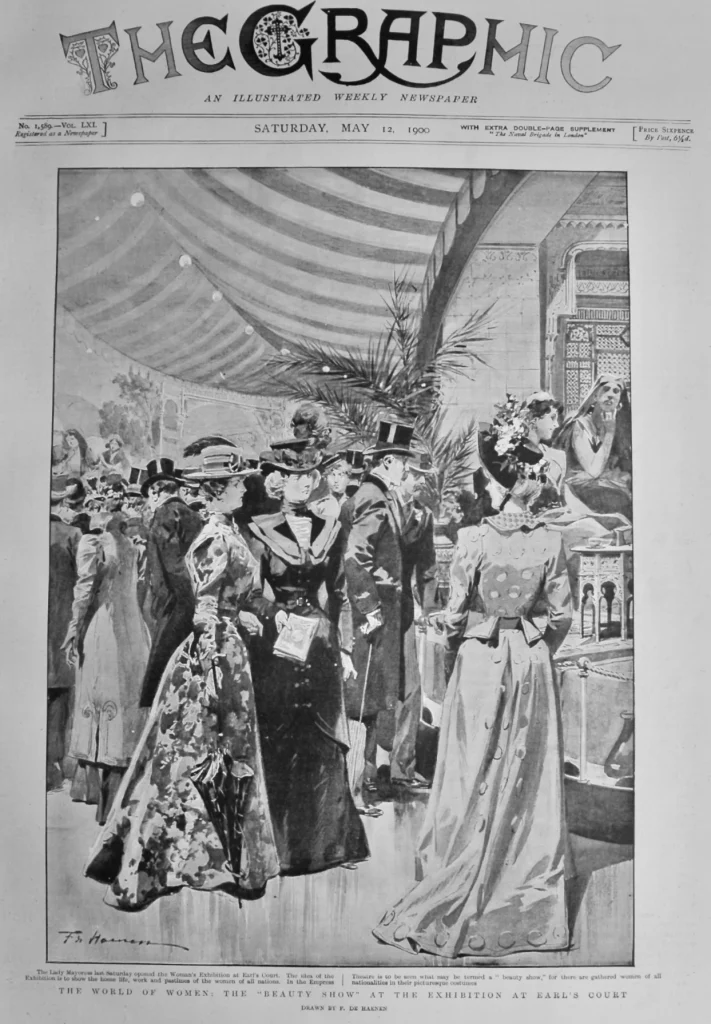
In other respects the exhibition kept Earl’s Court’s familiar pleasure-ground formula. For a shilling, open from 11 a.m. to 11 p.m., visitors could ride the 300-foot Great Wheel, now outlined in electric lights, as well as the Great Canadian Water Chute, the Gravity Railway, swan and electric boats on the lake, and new pony-drawn jinrickshaws. Other entertainments included a mirror maze, illusions, living pictures, a “Vesuvius in Eruption” spectacle, Mlle. Marguerite’s twelve performing lions, and the Electrophone, which relayed performances from London theatres. Boer War subjects ran through the program, from cinematograph pictures of the war to a Transvaal rifle range. The centrepiece filled the Empress Theatre, whose usual tiers, stage and arena had been cleared for Kiralfy’s “Women of All Nations.” About 150 women in national dress, in some two dozen groups, carried on domestic crafts in reconstructed home settings; some groups made comforts for soldiers at the front. Kiralfy’s ethnographic displays continued with a “Fashoda and Dinka Village” and the “Streets of Khartoum,” both trading on interest in the recent Sudan campaign.
The exhibition drew large crowds through the summer. A Finchley visitor in August reported huge daily attendance, and judged the Canadian chute the greatest attraction and the biggest earner. The exhibition closed on Saturday, 13 October 1900, “amidst some regrets.” In the final vote the Irish group won the £100 first prize, ahead of England, Scotland and Canada; one paper thought the result showed “more patriotism than judgment.” The closing verdicts agreed that the season had not matched its predecessors. Attendance had not held steady at a high level, and returns were expected to fall short of the 1899 Greater Britain Exhibition. Still, the grounds had served Londoners well as an evening promenade and an attraction for visitors from the country. With the war in South Africa dominating public attention, the management announced a military exhibition for 1901.
The Incubator Exhibit
We know that Dr. Lion, or representatives of his company, were present with his incubators from the “Entertainments” section of the Daily Program, the Official Guide, and contemporary press (below), listed with his French trade name “Couveuses d’Enfants.” Aside from the official publications, there are only passing mentions in the press accounts, and no photos have been located to date. The incubator exhibit was, however, included in the advertisements which ran daily in multiple newspapers across the region.
It is rather remarkable that Lion staged this exhibition in London in the same period that he had a major exhibit at the Paris Exposition of 1900 as well as maintaining several permanent institutes in Paris, Lyon, Nice, and perhaps other cities. The logistics of staffing and equipment alone would have involved a considerable effort. He was quite an entrepreneur.


Sources
Official Publications:
- Woman’s International Exhibition (1900: London). Woman’s Exhibition, Earl’s Court, 1900: Daily Programme. Imre Kiralfy, Director General. London: Spottiswoode, 1900. Getty Research Institute copy via HathiTrust, https://catalog.hathitrust.org/Record/100600639. Accessed 3 October 2026.
- Woman’s International Exhibition (1900: London). Woman’s Exhibition 1900, Earl’s Court, S.W.: Guide. Imre Kiralfy, Director General. London: Spottiswoode & Co., 1900. Internet Archive, https://archive.org/details/gri_33125013839549. Accessed 3 October 2026. (Official guide; promotional.)
- Woman’s International Exhibition (1900: London). Woman’s Exhibition, 1900, Earl’s Court, London, S.W.: Official Fine Art, Historical and General Catalogue. Imre Kiralfy, Director General. London: Spottiswoode & Co., 1900. Internet Archive, https://archive.org/details/gri_33125013839424. Accessed 3 October 2026.
Press Sources
- “Opened by the Lady Mayoress.” The Echo (London), 5 May 1900. British Newspaper Archive. (Same-day evening report. Establishes the opening date and names the civic officials.)
- “From Our London Correspondent (By Private Wire).” Leeds Mercury, 7 May 1900. British Newspaper Archive. (London letter dated Sunday night, 6 May. Reprinted verbatim as “Metropolitan Gossip,” Grantham Journal, 12 May 1900.)
- E.R.S. “The Women’s Exhibition at Earl’s Court.” Downham Market Gazette, 12 May 1900. British Newspaper Archive. (Signed eyewitness account from opening week.)
- “At Earl’s Court.” The Graphic, 12 May 1900. Opening-week report. The same issue’s front page carries F. de Haenen’s drawing “The World of Women: The ‘Beauty Show’ at the Exhibition at Earl’s Court”. British Newspaper Archive, accessed 3 October 2026.
- “The Women’s Exhibition.” Finchley Press, 18 August 1900. British Newspaper Archive.
- “The Women’s Exhibition.” Western Times (Exeter), 16 October 1900. British Newspaper Archive. (Closing report.)
- “Earl’s Court.” London Standard and County Advertiser, 19 October 1900. British Newspaper Archive.
- Advertisement, “Woman’s Exhibition, Earl’s Court.” The Standard (London), 17 July 1900. British Newspaper Archive.
Other Sources:
- Clarke, Meaghan. Fashionability, Exhibition Culture and Gender Politics: Fair Women. London: Routledge, 2020 (paperback 2022). Chapter “Reinventing Fair Women: Women, Exhibitions and Art Writing,” section “Woman’s Exhibition 1897 and 1900.” https://www.routledge.com/Fashionability-Exhibition-Culture-and-Gender-Politics-Fair-Women/Clarke/p/book/9780367502751. Excerpt accessed via ebrary.net, 3 October 2026.
- “Women’s Work? Women Artists at the 1897 Victorian Era Exhibition.” Visual Culture in Britain, 2025. https://www.tandfonline.com/doi/full/10.1080/14714787.2025.2520181. Abstract and snippets accessed 3 October 2026
- Fox, Emma. “1900: The Woman’s Exhibition.” Grains of Knowledge (University of Lincoln Library blog), 9 March 2020. https://library.blogs.lincoln.ac.uk/2020/03/09/1900-the-womans-exhibition/. Accessed 3 October 2026. (Undergraduate dissertation.)
More Information about Alexandre Lion
- General Information
- Alexandre Lion
- The Lion Incubator
- The Engineer and the Newborns, by W. A. Nelson and Paul L. Toubas
- Lion Patents (France)
- Patent 201550, 1889, Couveuse électro-automatique
- Patent 221716, 1892, Couveuse automatique
- Patent 262090, 1896, Chambre vivifiante
- Patent 281687, 1898, Système de filtration de l’air
- Patent 287557, 1899, Système de filtration des fumées, de l’air et de toutes masses gazeuses avec tirage et ventilation
- Patent 189989, 1899, Appareil pour le filtrage et la purification de l’air et des fumées
- Maternité Lion Institutes and City Exhibits
- Alexandre Lion’s first incubator baby exhibit in Marseille, 1890.
- Œuvre Maternelle des Couveuses d’Enfants, Nice
- Œuvre Maternelle des Couveuses d’Enfants, Lyon
- Œuvre Maternelle des Couveuses d’Enfants, Paris
- Œuvre Maternelle des Couveuses d’Enfants, Toulouse
- Œuvre Maternelle des Couveuses d’Enfants, Amiens
- Œuvre Maternelle des Couveuses d’Enfants, New York
- Œuvre Maternelle des Couveuses d’Enfants, Barcelona
- Œevre Maternelle des Couveuses d’Enfants, Brussels
- Maternité Lion Souvenir Booklets
- Œuvre Maternelle des Couveuses d’Enfants , Paris Institute, Booklet Version #1 (appears to be ~1896)
- Œuvre Maternelle des Couveuses d’Enfants , Paris Institute, Booklet Version #2 (appears to be ~1901)
- Pamphlet from Alexander Lion’s exhibit at the 1898 exhibition in Torino, Italy. (PDF supplied by Dr. Thijs Gras, Amsterdam)
- Press Coverage
- La Maternité “Lion de Nice” pour Enfants Nés Avant Terme ou Débiles, by Dr. Ciaudo, 1895. Source: gallica.bnf.fr.

- Presentation d’Appareil, by M. A. Pinard, Bulletin de l’Académie nationale de médecine, 1893. Source: gallica.bnf.fr.
- Les couveuses d’enfant et le gavage, by César-A Queirolo, Includes discussion of Lion incubator and comparison to other types. Thèse de doctorat: Univ. Genève, 1897.
- Les Couveuses pour Enfants, Gazette Médicale de Paris, No. 40, October 6, 1900
- Couveuses d’Enfants, La Maternité Lion, Paris, La Patrie, 1897
- Paris Letter: An Improved System of Incubators, by O. Jennings, Pediatrics 1:427-428, 1896
- Baby Incubators, The Strand Magazine, 1896, by James Walter Smith
- Human Infant Incubation: A True Fairy-Tale of Modern Science from Leslie’s Weekly, 1897
- The Saving of Human Life, Maternité Lion in NYC, The Literary Digest, 1898
- Immature Infants in France, from The Lancet, January 16, 1897, page 196.
- De Lion Incubator at Low Maternity Hospital, by Francis H. Stuart, Brooklyn Medical Journal, 1901
- Alexandre Lion’s Incubator Charities in Europe (1894–1898) (The Embryo Project)
- La Maternité “Lion de Nice” pour Enfants Nés Avant Terme ou Débiles, by Dr. Ciaudo, 1895. Source: gallica.bnf.fr.
- Worlds Fairs and Expositions
- Maternité Lion at the Lyon Exposition Universelle et Coloniale, 1894
- Maternité Lion at the Lyon Exposition Universelle – Le Monde Illustré, 1894
- Maternité Lion at the Bordeaux Exposition of 1895.
- “La Maternité Lion,” by Louis Énault, Journal of the Bordeaux Exposition, 1895
- Maternité Lion at the Amsterdam World Exposition, 1895
- Maternité Lion at the Berliner Gewerbeausstellung, 1896
- “Bericht ǔber die Couveuse (Lion) oder Kinderbrutanstalt” [Report about the Lion Incubator] from Berlin und seine Arbeit – Amtlicher Bericht der Berliner Gewerbe-Ausstellung 1896. English Translation.
- Maternité Lion at the Exposition National Suisse, Geneva, Switzerland, 1896
- “Quelques Réflexions sur le Fonctionnement et les Résultats des Couveuses Lion pendant l’Exposition Nationale,” by Dr. Hector Maillart, Revue Médicale de La Suisse Romande, 1896. English translation.
- Internationale Ausstellung für Körperliche Erziehung, Gesundheitspflege und Sport, Innsbruck, 1896
- Maternité Lion at the Tennessee Centennial Exposition, 1897
- Maternité Lion at the Brussels International Exposition, 1897
- Maternité Lion at the Turin L’Esposizione Generale Italiana, 1898
- Maternite Lion at the Ghent Provincial Exposition of 1899
- Maternité Lion at the Greater Britain Exhibition of 1899
- Maternité Lion at the Paris Exposition Universelle of 1900
- Maternité Lion at the Woman’s Exhibition in Earls Court, London, 1900
- Maternité Lion at the Lille Exposition of 1902
- Maternité Lion at the Exposition Internationale de Reims, 1903
- Maternité Lion at the Nantes Exposition of 1904
- Maternité Lion at the Exposition du Nord de la France, 1904
- Maternité Lion at the Liège Exposition Universelle et Internationale, 1905.
- Maternité Lion at the Marseille Colonial Exposition of 1906
- Maternite Lion at the Bordeaux International Maritime Exposition of 1907
- Maternité Lion at the Marseille Exposition Internationale d’Électricité, 1908
- Maternité Lion at the Exposition Internationale de l’Est de la France, Nancy, France, 1909
- Maternité Lion at the Brussels Exposition Universelle et Internationale, 1910
- Maternite Lion at the Exposition du Centre de la France, Clermont-Ferrand, 1910
- Maternité Liion at the Rome International Exposition of 1911
- Maternité Lion at the Turin International Exposition of 1911
- Maternité Lion at the Exposition Internationale de Dunkerque, 1912
- Maternité Lion at the Ghent International Exposition of 1913
- Maternité Lion at the Exposition Internationale Urbaine de Lyon, 1914
- Maternité Lion at the Lyon Exposition Universelle et Coloniale, 1894
Portions of this page were drafted with machine assistance; the final text was reviewed, verified, and edited by the author. Click here to learn more.
Last Updated on 10/04/26