Hôpital Beaujon, France
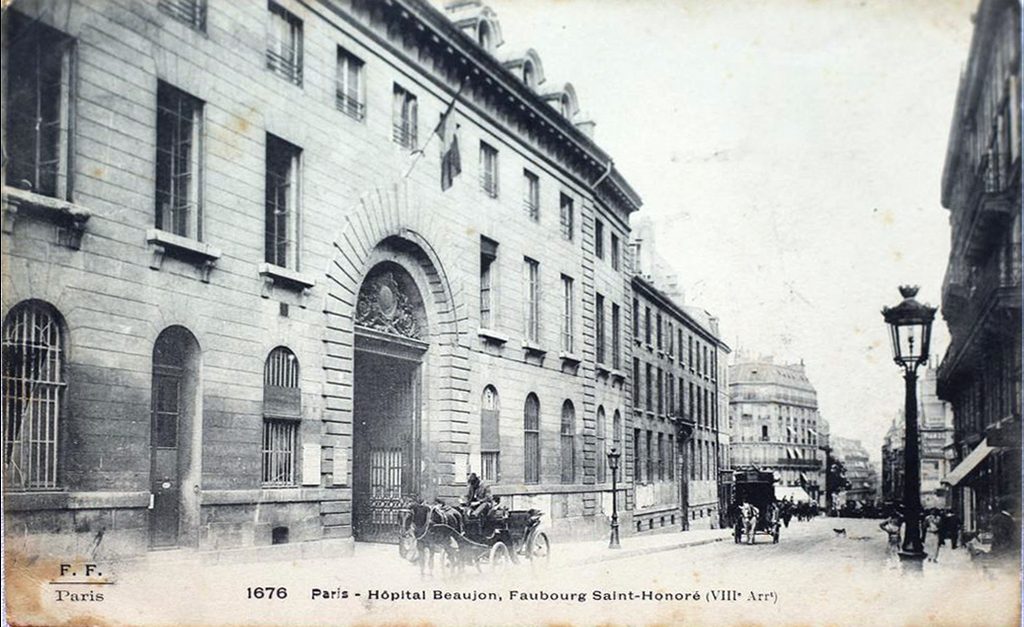
The Hôpital Beaujon began in 1784 as a private charitable foundation of Nicolas Beaujon (1718–1786), a Bordeaux-born financier and court banker who had amassed one of the great fortunes of the reign of Louis XV. Contemporary accounts say that in old age he turned his mind to his salvation, and he paid for an orphanage and school in the Faubourg du Roule, then on the western edge of Paris. It was established as the hospice Saint-Nicolas to take in twelve orphan boys and twelve orphan girls from the parish of Saint-Philippe-du-Roule. It soon became known as the hospice Beaujon or maison Beaujon in honor of its founder. The building was designed by Nicolas-Claude Girardin, Beaujon’s regular architect, and survives with few alterations at 208 rue du Faubourg-Saint-Honoré in today’s 8th arrondissement.
The institution did not keep its original purpose for long. Under the decree of 17 January 1795, the Convention converted the hospice into a hospital and renamed it the hôpital du Roule. It later took back its founder’s name as the hôpital Beaujon. After 1801 it was run by the Conseil général des hospices, and from 1849 by the newly created Assistance Publique.
During the nineteenth and early twentieth centuries, Beaujon became one of the main general and teaching hospitals of western Paris. It served the working-class and artisan neighborhoods around it with medicine, surgery, and obstetrics. As a hospital for the sick it had 122 beds in 1810 and nearly 700 by 1935. By 1903 its chiefs of service included Professor Debove, dean of the Faculté de médecine, and the surgeons Tuffier, Bazy, and Berger.
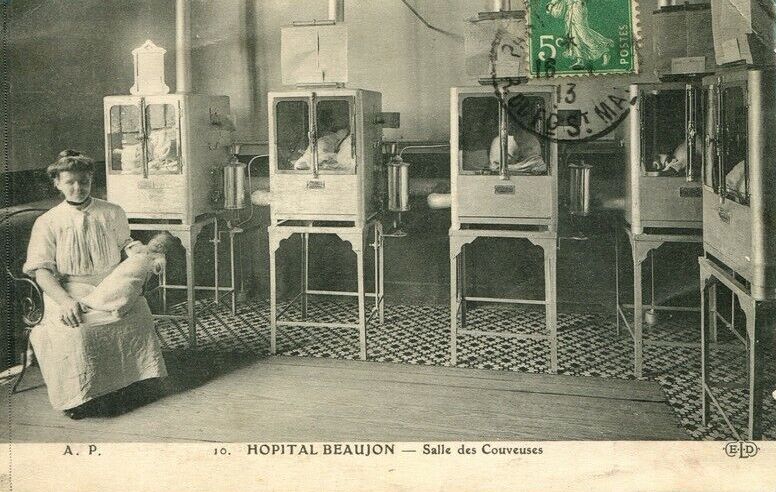
For most of the century its obstetric service was cramped: until 1895 the hospital had a single delivery room, described as unhealthy and short of water in summer. On 30 May 1895 a new maternity designed under the obstetrician Ribemont-Dessaignes was inaugurated before Assistance Publique officials and leading Paris obstetricians, including Budin, Pinard, and Auvard. It consisted of an isolation pavilion and a three-story maternity building with an elevator large enough for a rolling bed, fittings designed for strict antisepsis, and a special room for incubators watched by a nurse assigned solely to that post. Remarks at the inauguration indicate the incubators were gas-heated, so most likely they were Lion incubators, but their manufacturer is not recorded. The room predates Alexandre Lion’s first Paris institute, which opened at 26 boulevard Poissonnière in February 1896. That year Lion offered the Assistance Publique twenty of his incubators, but they were meant for use in families’ homes under his supervision, so the infant would stay with its mother, not for hospital wards.
Ribemont-Dessaignes still directed the maternity in 1903, when President Émile Loubet toured it and was shown its infant incubators. By the early 1910s a commercial postcard of the “Salle des Couveuses” shows the room equipped with a row of Lion couveuses. The press records it taking in infants from outside the hospital, including a foundling discovered on the fortifications at boulevard Berthier in August 1913 and placed in an incubator.
By then the old hospital’s physical limits were plain. During Loubet’s 1903 visit, the surgeon Bazy complained that the operating room opened directly onto a landing, and that up to a hundred outpatients at a time had to wait for consultation on a staircase. By the early twentieth century, the crowded complex in the Faubourg du Roule was considered obsolete and poorly suited to aseptic surgery, radiology, and rising patient numbers.
To rebuild the hospital and relieve crowding in central Paris, the Assistance Publique bought a twelve-hectare site in Clichy in 1916, between the Seine and major roads. An architectural competition held in 1930 chose the design by Jean Walter, working with Urbain Cassan and Louis Plousey. Construction ran from 1932 to 1935. The building rejected the low pavilion layout that had dominated French hospital design and followed the American vertical “monobloc” model instead. At twelve stories it was the first vertical, non-pavilion monobloc hospital in France. Its main tower stands 46 meters tall. Built for 1,000 beds, it admitted its first patients on 15 February 1935, after construction overran its budget, largely because of the foundations. The move from the old site was gradual. The old Beaujon closed its maternity at the end of March 1935, and in December 1936 the administration arranged for it to stop functioning as a hospital. The Clichy hospital officially received the name hôpital Beaujon in 1938.
The Clichy hospital has been called a landmark in the history of hospital architecture, marking the definitive abandonment of the pavilion model in France, and it has been designated a remarkable work of contemporary architecture. It still serves the northern Paris metropolitan area but is scheduled to close around 2030, when its services move to the new Grand Paris-Nord hospital in Saint-Ouen.
Press Clippings:
- “Enfant abandonné sur les fortifications.” Le Petit Journal (Paris), 31 August 1913.
- Fleury, Maurice de. “Les couveuses d’enfants.” Le Figaro (Paris), 27 February 1896. This is the original statement of Lion’s donation to the Assistance Publique for home use.
- “Nos échos.” Le Soir (Paris), 14 November 1896. Paraphrases Fleury on the donation; prints the address as boulevard Poissonnière 85, apparently a misprint.
- Franc, Pierre. “Couveuses d’enfants. La Maternité Lion.” La Patrie (Paris), 21 December 1897. Quotes Fleury, including the donation passage.
- “À l’hôpital Beaujon.” Le Mot d’ordre (Paris), 31 May 1895. The same text appeared in Le Réveil (Paris), 31 May 1895.
- “M. Loubet à l’hôpital Beaujon.” Le Radical (Paris), 30 May 1903. President Émile Loubet toured the hospital and was shown its infant incubators.
Other Sources:
- Hôpital Beaujon – French Wikipedia
- AP-HP Archives, “Beaujon, Paris (1784–1937)”, includes a bibliography
- Nicolas Beaujon – French Wikipedia
* “Les Prématurés aux XIXE Siécle: Entre Humanisme et Technique,” by Catherine Rollet, 2013. Pages 191 to 220 in: Marie-France Morel, “Accueillir le nouveau-né, d’hier à aujourd’hui.”
Last Updated on 10/10/26