Marshall H. Klaus, M.D. (1927–2017)
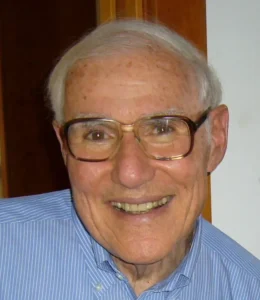
Marshall Henry Klaus was born on June 6, 1927, in Lakewood, Ohio, to Dr. Max Henry Klaus and Caroline Epstein. He was 6 when his father died of sepsis and his died of breast cancer when he was a teenager. Klaus and his brother went to live with their uncle, a physician. The early experience of loss and the steadying presence of a doctor in the home may have shaped the deep empathy that would characterize his later work. A bout with polio during medical school left him with a weakened right arm, and he chose a specialization that would be physically possible for him. He graduated from Case Western Reserve University School of Medicine and completed his residency in 1954 at Children’s Hospital in Cleveland. In 1961, he completed a Pulmonary Medicine Fellowship at the University of California in San Francisco (UCSF) and took a position as Assistant Professor of Pediatrics at Case Western Reserve University.
In 1967, he became neonatal director at Rainbow Babies and Children’s Hospital in Cleveland, and in 1973 published his first book, Care of the High Risk Neonate, co-authored with Avroy Fanaroff. The text was the first truly practical neonatal reference, compact yet packed with relevant facts, cases, and commentaries, and became the key source of information for the generation of neonatologists trained in the 1970s and ensuing decades. It remains in print today as Klaus and Fanaroff’s Care of the High-Risk Neonate and is currently in its eighth edition (2025).
Klaus’s first major scientific contributions came in pulmonary biology. Mentored by giants in the field including John Clements, Richard Havel, and Julius Comroe, he determined the composition of surfactant and subsequently identified natural surfactant’s origin from alveolar epithelial cells — studies that formed a basis for Clements’ development of artificial surfactant and the highly successful introduction of surfactant into clinical therapy. Because of his residual polio, Klaus was always in favor of ventilatory support that did not require tracheal intubation, a preference that later made him an early proponent of nasal CPAP. Together with Kattwinkel, Fanaroff, and colleagues, he co-authored one of the first descriptions of nasal CPAP administration in newborns, published in Pediatrics in 1973.
The pivot that defined Klaus’s legacy came from a simple observation at Stanford. While studying neonates in a special nursery for premature infants, Klaus noticed that when he examined healthy infants, the mother was always watching; when he examined premature or deformed infants, the mothers were detached, sitting far away. That observation, coupled with his earlier experiences seeing high infant mortality and absent bonding at an overcrowded Singapore maternity ward, narrowed his research focus to the maternal side of childbirth and attachment.
In 1970, Klaus published “Neonatal Separation: The Maternal Side of Interactional Deprivation,” which initiated his formal research into maternal-infant bonding, detailing a collaboration with John Kennell in which they studied early interactions between more than fifty mothers and their infants within one hour of birth. In 1976, Klaus and Kennell published Maternal-Infant Bonding, concluding that a mother’s attachment to her baby is stronger if she is able to bond in the first hours after birth, with effects on breastfeeding, child development, and child abuse rates. The book prompted hospitals worldwide to change procedures — allowing partners in delivery rooms, encouraging rooming-in, and permitting siblings to visit — practices that are now so commonplace as to seem self-evident.
Klaus was careful to refine his own message as the evidence evolved. He later acknowledged that calling the immediate postpartum period a “critical” period had been a mistake. “It’s a ‘sensitive’ period,” he said in an oral history interview for the American Academy of Pediatrics in 2000. “‘Critical’ means if it doesn’t occur, all is lost.” He emphasized, rather, that additional early contact might be particularly helpful for some mothers — especially those with limited social support.
From bonding, Klaus and Kennell turned to the labor experience itself. Following a 1973 study in Guatemala where a female student’s supportive presence was observed to shorten labor, a formal study in 1980 found that supportive companions reduced the length of labor, perinatal complications, and cesarean rates while promoting early maternal bonding. Klaus later named these supportive companions doulas, from the Greek word for servant-woman. In 1992, Klaus and his wife Phyllis joined with Kennell, Penny Simkin, and Annie Kennedy to found DONA International, the first doula certifying organization.
In 1991, the World Health Organization and UNICEF launched the Baby-Friendly Hospital Initiative, which recognized hospitals focused on infant feeding and maternal-infant bonding — an initiative shaped in large part by Klaus’s research, and one that globally reduced rates of infant abandonment.
Klaus was a brilliant teacher and enthralling storyteller who captivated his audience, using play-acting during rounds as a potent teaching tool. His personal motto — be kind to the mother — was, in the recollection of colleagues, something he said often and meant always.In 1984, he was awarded the C. Anderson Aldrich Award for their contributions to the field of child development from the American Academy of Pediatrics (AAP).
Marshall Klaus passed away on August 15, 2017, at the age of 90. The AAP Section on Neonatal-Perinatal Medicine honors his legacy through the Marshall Klaus Perinatal Research Award, established in 2002 and given annually to outstanding neonatal fellows. His influence lives on in skin-to-skin care, rooming-in, the disappearance of the central nursery, and the now-universal presence of the doula — changes so thoroughly absorbed into modern perinatal practice that most families experiencing them today have no idea whose work made them possible.
- Marshal Klaus obituary, New York Times, August 25, 2017.
- Marshall Henry Klaus, Embryo Project Encyclopedia
- KLAUS MH, CLEMENTS JA, HAVEL RJ. Composition of surface-active material isolated from beef lung. Proc Natl Acad Sci U S A. 1961 Nov 15;47(11):1858-9. doi: 10.1073/pnas.47.11.1858. PMID: 14456669; PMCID: PMC223225.
- M. Klaus et al. ,Alveolar Epithelial Cell Mitochondria as Source of the Surface-Active Lung Lining.Science137,750-751(1962).DOI:10.1126/science.137.3532.750
- Barnett CR, Leiderman PH, Grobstein R, Klaus M. Neonatal separation: the maternal side of interactional deprivation. Pediatrics. 1970 Feb;45(2):197-205. PMID: 4983976.
- Klaus MH, Jerauld R, Kreger NC, McAlpine W, Steffa M, Kennel JH. Maternal attachment. Importance of the first post-partum days. N Engl J Med. 1972 Mar 2;286(9):460-3. doi: 10.1056/NEJM197203022860904. PMID: 5009748.
- Sosa R, Kennell J, Klaus M, Robertson S, Urrutia J. “The effect of a supportive companion on perinatal problems, length of labor, and mother-infant interaction.” New England Journal of Medicine. 1980;303(11):597–600.
- Klaus MH, Fanaroff AA. Care of the High-Risk Neonate. Philadelphia: WB Saunders, 1973. (8th ed., 2025.)
- Klaus MH, Kennell JH. Maternal-Infant Bonding. St. Louis: CV Mosby, 1976. (2nd ed. published as Parent-Infant Bonding, 1982.)
- Klaus MH, Kennell JH, Klaus PH. The Doula Book (originally Mothering the Mother). Cambridge, MA: Perseus/Da Capo Press, 1993; 2nd ed., 2002.
Last Updated on 03/18/26