Bloxsom Air Lock
Developed in the late 1940s by Dr. Allan P. Bloxsom, a pediatrician at St. Joseph Hospital and Baylor College of Medicine in Houston, Texas, the Bloxsom Air Lock represents one of several harsh lessons in the history of neonatal care, where new technologies have been introduced on the basis of anecdote or intuition, without validation by clinical trials.
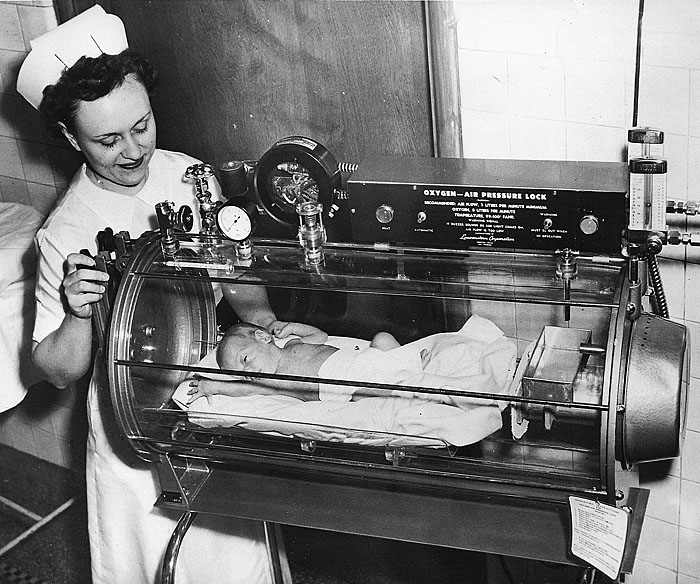
The device’s origin has elements of an urban legend. Bloxsom was inspired by the moist, low-heat environment of his wife’s crock pot. He theorized that premature infants—often born with underdeveloped lungs—required a “conditioning” environment that mimicked the physical sensations of birth. Manufactured by the John Bunn Corporation, the Air Lock functioned as a pressurized plexiglass incubator that cycled air pressure every 60 seconds to simulate uterine contractions, while simultaneously providing a humidified atmosphere of 60% oxygen.
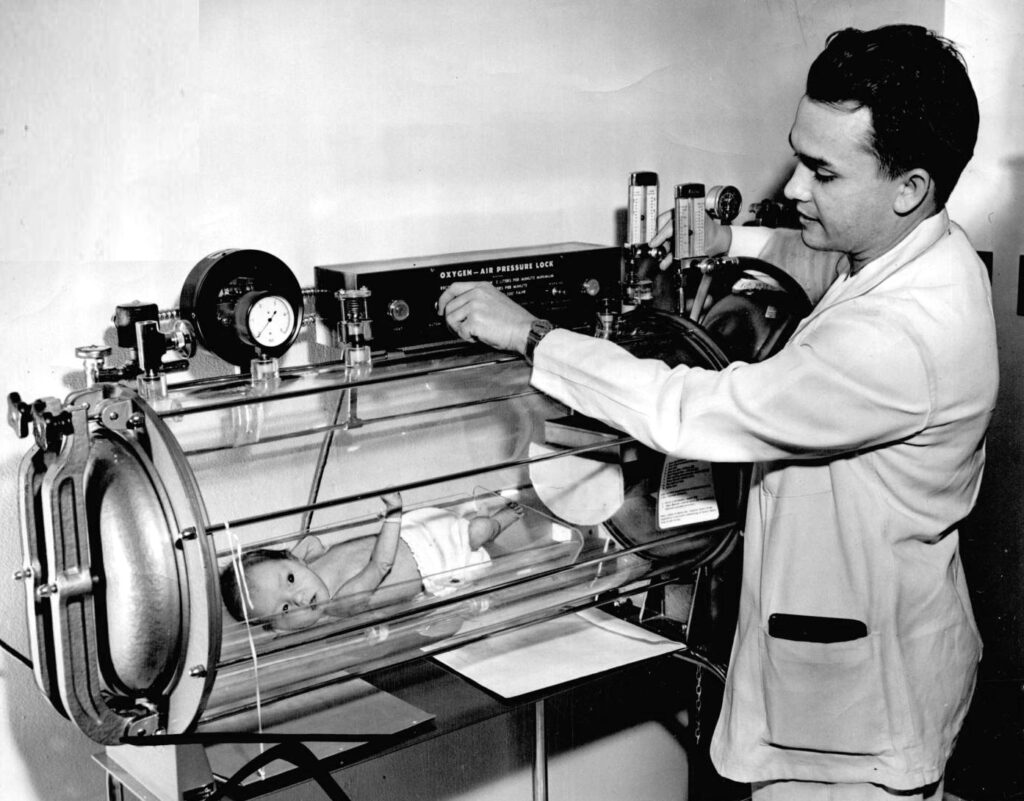
Between 1950 and 1952, the Air Lock became a medical sensation. Dubbed the “Mechanical Mother” or “Plexiglass Mother” by the press, it was adopted by over 700 hospitals. At a cost of $1,000 (roughly $11,500 today), it was viewed less as a tool and more as a status symbol of cutting-edge technology. Proponents praised it for shielding infants from “meddlesome” handling, effectively sealing the fragile patients away from the outside world.
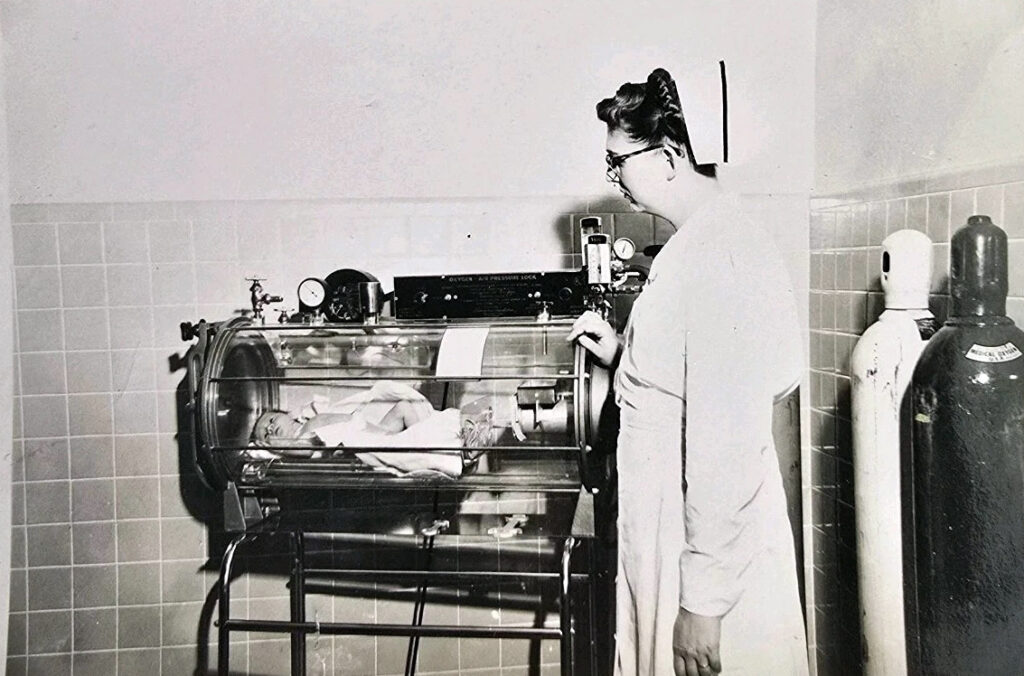
The decline of the Bloxsom Air Lock was as rapid as its ascent, fueled by a shift toward clinical trials. In 1953, Virginia Apgar and Joseph Kreiselman conducted a study in which they placed anesthesized dogs inside the chamber. They found that the device did not improve the exchange of carbon dioxide or oxygen in these dogs. In 1956, a landmark study by Reichelderfer and Nitowski at Johns Hopkins Hospital concluded that the device offered no survival advantage over standard, significantly cheaper incubators.
More devastatingly, the high oxygen concentrations used within the Air Lock were linked to an epidemic of retrolental fibroplasia (now retinopathy of prematurity), which caused permanent blindness in thousands of newborns. By the late 1950s, the medical community abandoned the device. In 2001, Kending and colleagues wrote, “The Bloxsom AL device experienced a precipitous birth, a rapid acceptance and proliferation of usage, a rapid death, and now extinction.”[ Today, it serves as a cautionary tale in medical history, with the few remaining units housed in museums like the Pharmacy and Medical Museum of Texas.
For more information about the Bloxsom Air Lock and its impact, the following may be helpful:
- Revere, S. M., & Kwader, L. (2014). “The Bloxsom Air Lock: A History of Innovation and its Unintended Consequences.” Journal of Perinatology. (Discusses the transition from intuition to evidence-based neonatology).
- Nitowsky HM, Rechelderfer TE. “A controlled study of the use of the Bloxsom air lock.” Pediatrics. 1956 Dec;18(6):918-28. PMID: 13378920.
- Robertson, Alex F. (2003). “Reflections on Errors in Neonatology: II. The “Heroic” Years, 1950 to 1970″. Journal of Perinatology. 23 (2): 154-161. doi:10.1038/sj.jp.7210843. PMID 12673267. S2CID 34236009.
- Kendig, James W., Maples, Philip G., Maisels, M. Jeffrey (December 1, 2001). “The Bloxsom Air Lock: A Historical Perspective“. Pediatrics. 108 (6): e116. doi:10.1542/peds.108.6.e116. PMID 11731643.
- Bloxsom Air Lock (Wikipedia)
- US Patent 2810384 for the Bloxsom Air Lock.
For a deeper dive into the history of oxygen use in prematures and its role in the epidemic of retrolental fibroplasia, see:
- Silverman, W. A. (1980). Retrolental Fibroplasia: A Modern Parable. Grune & Stratton. (A seminal text detailing the oxygen-induced blindness associated with early incubators, does not discuss the Bloxsom Air Lock specifically).
- Baker, J. P. (1996). The Machine in the Nursery: Incubator Technology and the Origins of Newborn Intensive Care. Johns Hopkins University Press. (Provides a comprehensive historical context for the Air Lock’s role in early NICUs).
Last Updated on 07/20/26