The BabyBird Infant Ventilator
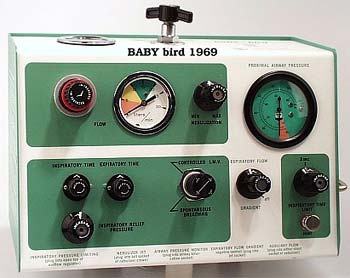
The history of the BabyBird infant ventilator is a pivotal chapter in neonatal medicine, credited with a dramatic shift in survival rates for premature infants. Developed by Dr. Forrest Morton Bird (1921-2015) , it transitioned technology from high-altitude fighter cockpits to the neonatal intensive care unit (NICU).
Forrest Bird was a World War II aviator, inventor, biomedical engineer, and physician. During the war, he noticed that pilots struggled to breathe at high altitudes as air became thinner. He studied a crashed German Junkers Ju 88 bomber and analyzed its oxygen regulator, which he eventually modified to create the first high-altitude pressure-breathing masks and anti-G suits.
After the war, Bird applied these principles of fluid dynamics to medicine. He realized that the lungs were like “rudimentary airfoils.” In 1958, he introduced the Bird Mark 7 (the “little green box”), the first mass-produced, reliable ventilator for adults.
While the Mark 7 saved countless adults, it was too forceful for the fragile, “stiff” lungs of premature infants suffering from Respiratory Distress Syndrome (RDS). Adult ventilators were based on delivering a specified volume, and would continue to increase pressure if necessary to try and deliver that volume, tearing the delicate newborn lung.
In the late 1960s, Bird began miniaturizing his technology, and developed a version specifically for neonates. Unlike previous machines that were essentially adult ventilators modified with smaller tubing, the BabyBird was designed for the unique physiology of infants.
- It utilized time-cycled, pressure-limited ventilation, rather than the volume-limited ventilation used for adults.
- It featured a continuous flow system that allowed the baby to breathe spontaneously between the machine’s mechanical breaths—a precursor to Intermittent Mandatory Ventilation (IMV).
The BabyBird was commercially introduced in 1970 (some sources cite clinical release in 1971). It was an immediate success and widely adopted. Before the BabyBird, the mortality rate for premature infants with severe respiratory failure was roughly 70%. Within two years of its widespread implementation, that rate plummeted to less than 10%. Its success was largely due to its ability to maintain “Functional Residual Capacity” (keeping the tiny air sacs open) without causing the “barotrauma” (lung tissue tearing) common with older, high-pressure machines.
The Babybird was unique for its use of fluidic logic—using the movement of gases themselves to control the timing of breaths, rather than complex electronics which were prone to failure in the humid environments of 1970s incubators.
The BabyBird did not have the infant ventilator market to itself for long. By the late-1970’s, the Bourns BP-200 and the Sechrist Model IV were also in widespread use.


- US Patent No. 3,842,828 for “Pediatric Ventilator” (the BabyBird), filed in 1970 and granted in 1974.
- “The Bird Ventilator,” by RN Westhorpe and C Ball, published in Anaethesia and Intensive Care 40(4), July 2012.
- Forest Bird entry at the National Inventors Hall of Fame. Forrest Bird was inducted in 1995 for the invention of the medical respirator. Their records credit the Babybird (1970) with reducing infant mortality from 70% to 10%.
- Forest Bird entry at “Life in the Fast Line” LITFL.COM, a medical education resources and documents the timeline of the BabyBird’s release in 1971.
Editor’s note: I (RD) was fortunate to enter my clinical training at the exact inflection point where successful ventilation of premature infants became (relatively) routine. When I was a third year medical student on my nursery rotation, I saw a premature infant on an adult MA-1 ventilator, who unfortunately went on to perish of respiratory distress syndrome. By the time I was a pediatric intern, BabyBird infant ventilators and Bournes BP-200 infant ventilators were in everyday use.
Portions of this page were drafted with machine assistance; the final text was reviewed, verified, and edited by the author.
Last Updated on 07/20/26