Pan-American Exposition, Buffalo, 1901
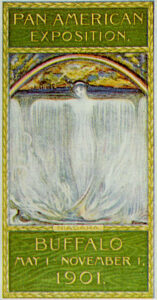
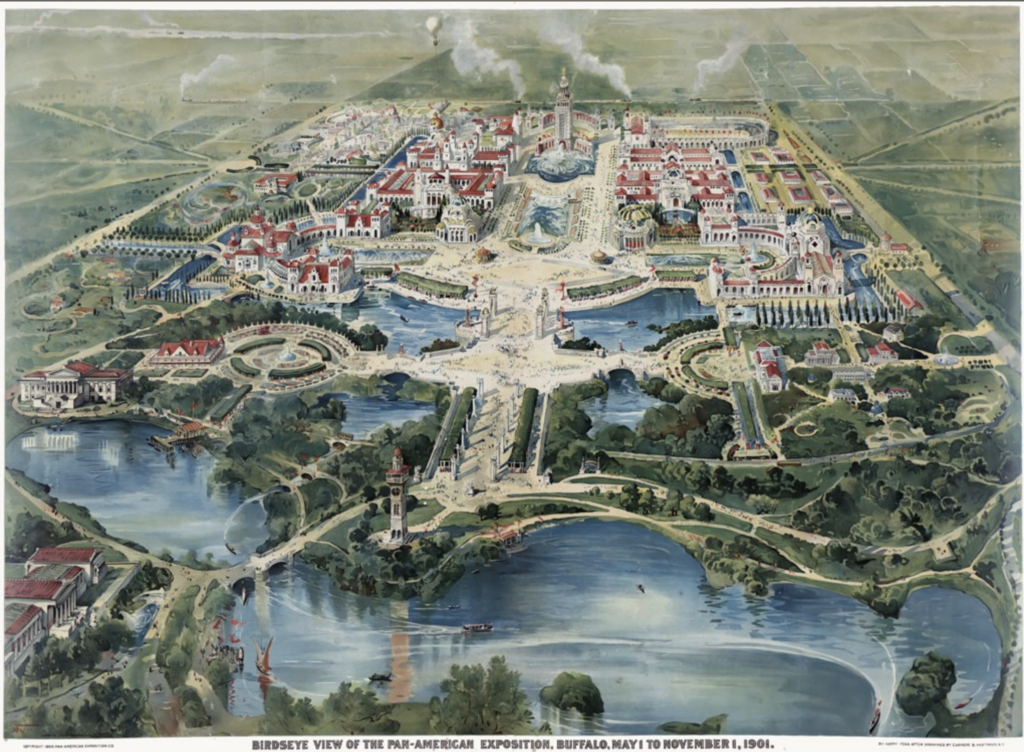
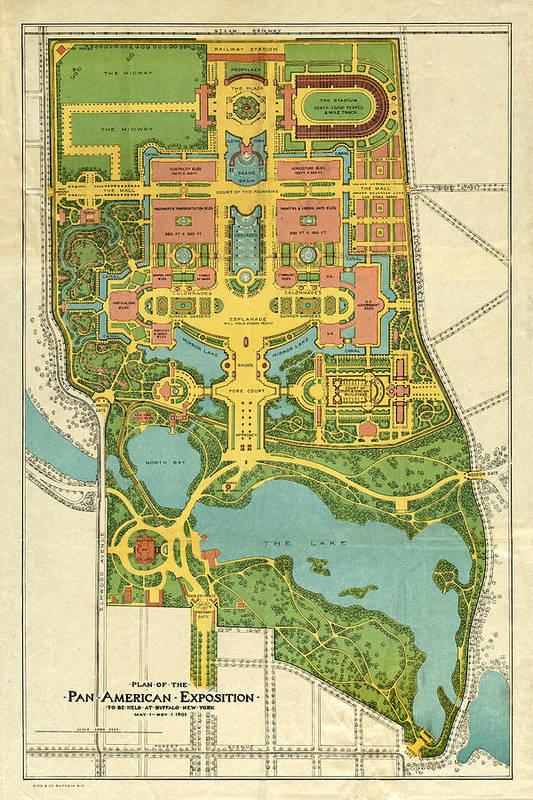
The Pan-American Exposition was a world’s fair held in Buffalo, New York, from May 1 through November 2, 1901, occupying 350 acres on the western edge of what is now Delaware Park. The fair highlighted the cultures and achievements of Western Hemisphere nations and served as an opportunity to display exciting new technologies, with electricity — powered from Niagara Falls twenty-five miles away — being among the most prominent. More than eight million visitors attended over the course of the exposition, which is today remembered primarily as the site of the assassination of President William McKinley, shot on September 6, 1901. Known as the “Rainbow City” for its spectacular illuminated buildings, the fair drew visitors to its main exhibition halls as well as to its entertainment district, the Midway.
In a prominent position in the Midway — that part of the Pan-American Exposition almost wholly given over to the amusement of those frivolously inclined — was situated the building devoted to infant incubators. The location away from the more serious side of the Exposition irritated Martin A. Couney (also rendered “Coney”), who managed the exhibit together with his partners Solomon Fischel and Samuel Schenkein using “Qbata Company” as their DBA. They had previously exhibited infant incubators at the Victorian Era Exhibition at Earl’s Court in London in 1897, and the Trans-Mississippi Exposition in Omaha in 1898. All three passed themselves off as physicians (and were frequently referred to in news accounts as “Dr.”) although none are known to have had medical degrees or training.
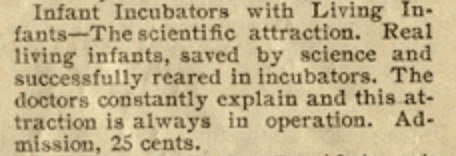
Recruitment for the Exhibit
Well before the Exposition opened, in April 1901, Fischel spent three days in Rochester canvassing hospital directors, physicians, and midwives, explaining his purpose and obtaining promises of the first available premature infants. The Democrat and Chronicle and Buffalo Enquirer reported his visit in nearly identical terms: the incubator would be seen for the first time in this country, and the key advantage claimed for it was that the heat was automatically regulated — eliminating the fatal risk of nurse inattention that could allow a temperature collapse under the old system. Fischel was characteristically forthright about the commercial dimension: he expected to have a large number of babies in his care before the Exposition was well underway, and as each infant graduated to good health it would be discharged to make way for others. He noted that in other cities an unlooked-for result of the exhibitions had been the adoption of incubator-raised infants by curious visitors who had come simply to look.
The Facility
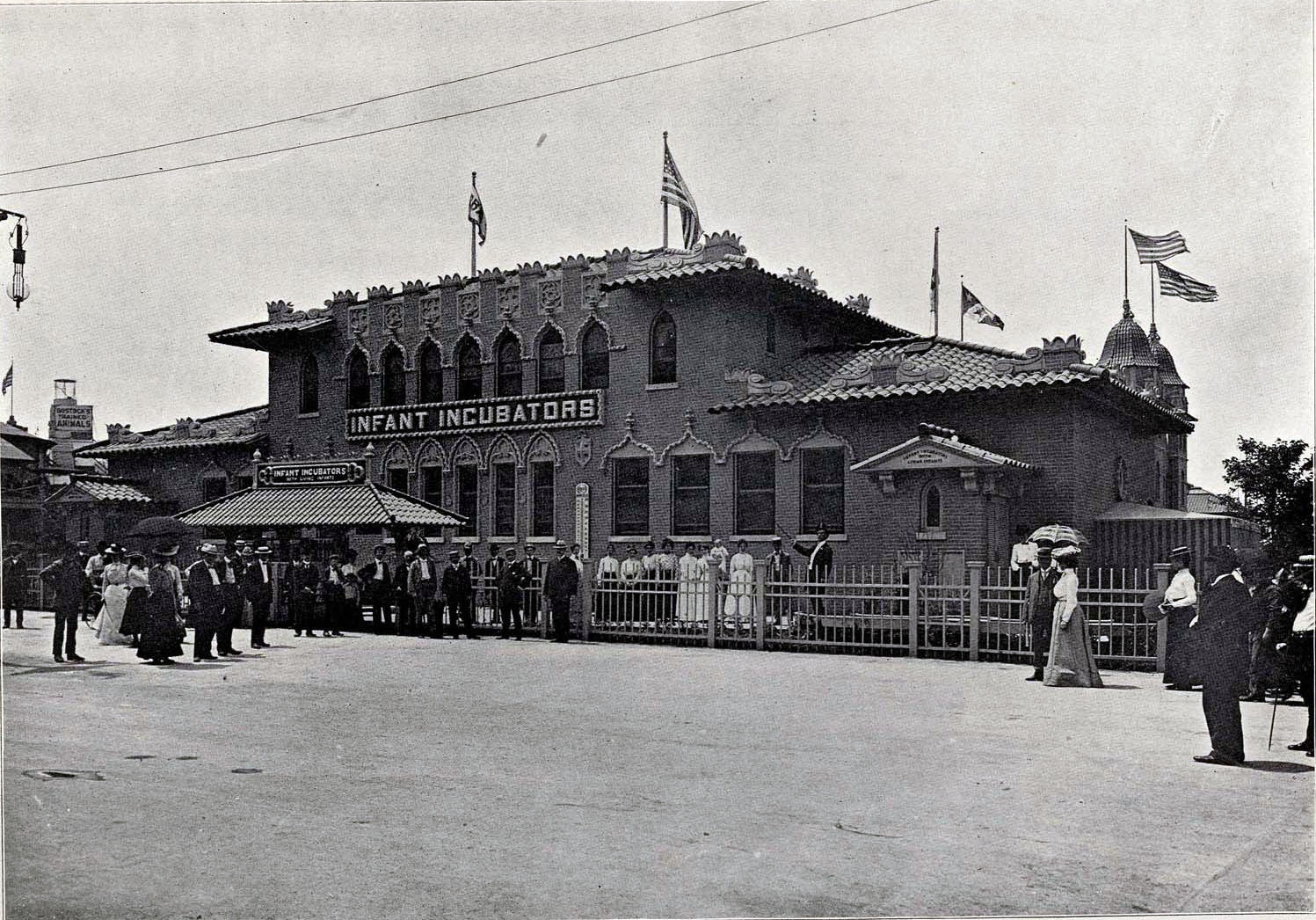
The Buffalo Enquirer of May 10 and the Buffalo Morning Express of June 12 described the exhibit as it opened and filled. The building — a two-story brick structure at the junction of the Midway and the Mall — was approximately one hundred feet in length and housed what was described as a complete and elaborate nursery fitted under glass.
The Qbata Company provided the incubator equipment, based on the patent design of French inventor Alexandre Lion and manufactured by Paul Altmann of Germany. The twelve Lion incubators consisted of steel frames with glass sides and doors, raised from the floor on steel rods so that they were elevated to a convenient height and the occupants fully visible to the public, who viewed them from behind railings. Each incubator maintained a constant temperature through a system of water heated by natural gas stoves, alternating with piped cool water, the whole regulated automatically by a thermostat. The managers claimed to maintain temperature to within 2 degrees Fahrenheit of the desired optimum at all times. Fresh outdoor air entered through a pipe in the outer wall, passed first through an antiseptic fluid to destroy germs, then through cotton to filter any physical impurities, and was finally warmed before being admitted to the infant’s chamber. A pan of warm water maintained atmospheric humidity, registered by a small hygrometer at the side of each unit.
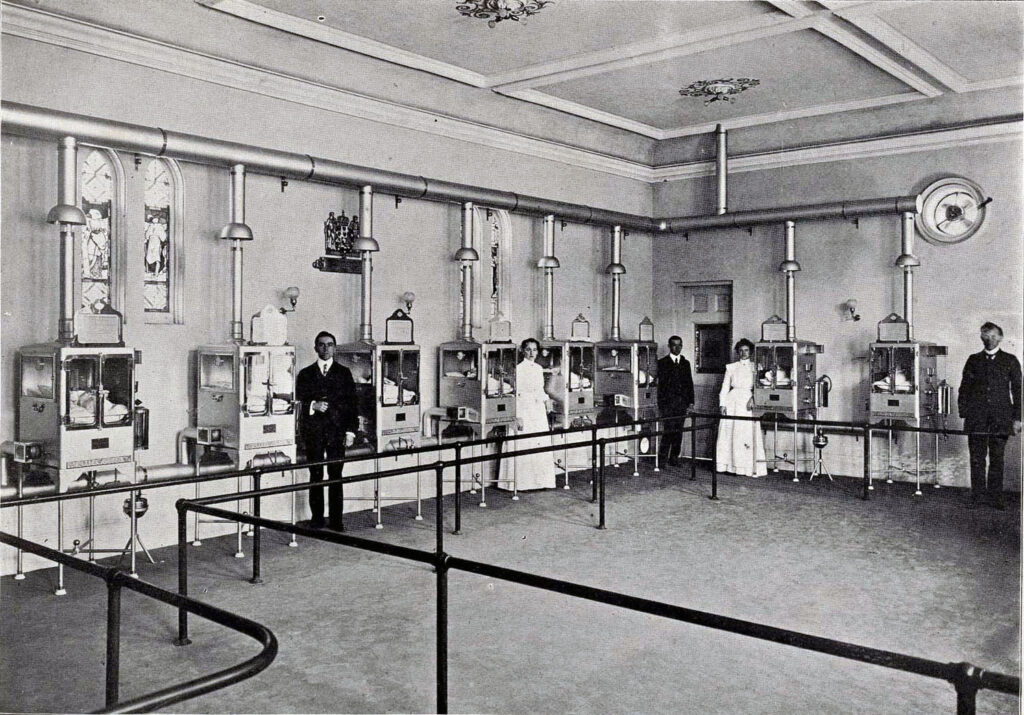
Admission procedure was systematic and carefully documented in the June 12, 1901 Buffalo Morning Express. As soon as a child was received it was given a mustard bath in water and water, then two drops of brandy were placed in its mouth as a stimulant. It was then placed in the incubator, kept at 96 degrees Fahrenheit, and left undisturbed for five days before being removed regularly for feeding. Each infant wore around its neck a necklace of between seven and eleven olives, believed by the Germans to ward off ill-fortune, with a silver tag stamped with the child’s initials and number sealed to the neck on admission and removed only on discharge. A corresponding number was placed on the child’s incubator. A card above each incubator recorded the child’s initials, date of birth, date of admission, weight, period of gestation, and other clinical details.
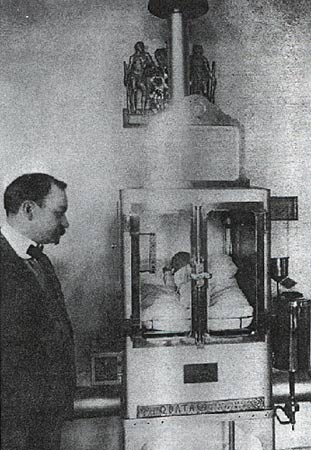
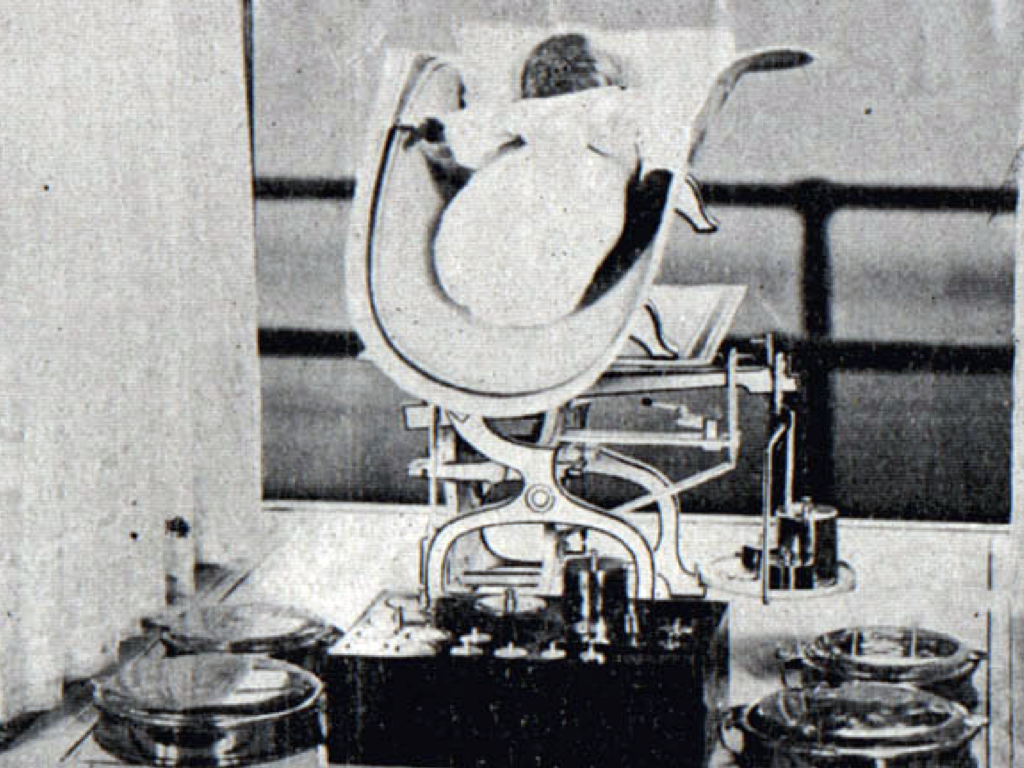
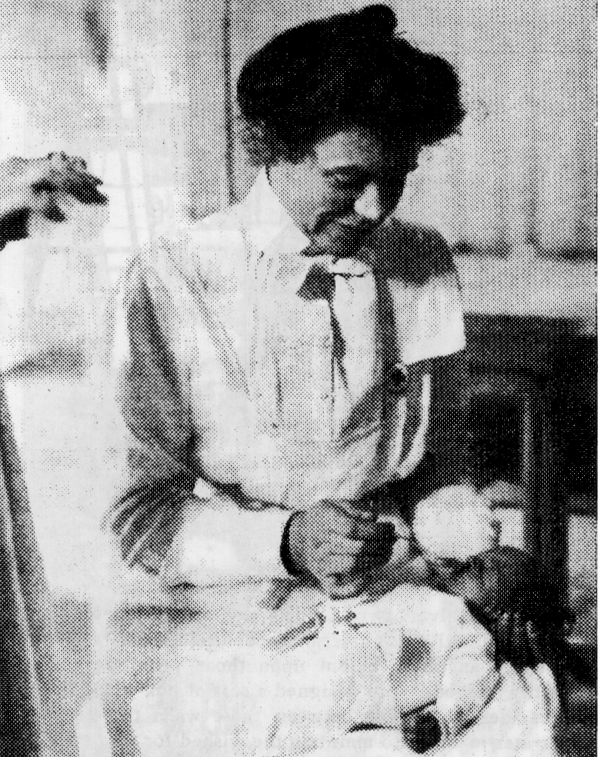
Feeding followed a careful progression keyed to the infant’s strength. A child too weak to be brought to the breast was initially fed a drop of milk at a time through the nose using a nasal spoon. As strength grew, it was fed via a teterelle — a device by which milk was delivered by gravity directly into the child’s mouth. Only when sufficiently strong to take at least 30 grams at a single sitting was natural feeding attempted. Every two hours, by day and night, infants were removed from the incubators, taken by basket elevator to the second floor, weighed, fed, and returned. The second floor also served as dormitory for the nursing staff. Nurses from the Berlin baby incubator institution were in attendance throughout, supplemented by graduate nurses. Wet nurses provided breast milk; where breast feeding was impractical, the institution maintained cows whose milk was sterilized before use.
Notable Cases
The first baby admitted — given the nickname “Little Willie” by the nursing staff — arrived April 26 and weighed two pounds fourteen ounces at birth. By the time of the June 12 Morning Express account he had been in the institution for five weeks and would remain under observation for another five, making his stay the longest of any patient. He was something of a mascot.
A second infant, nicknamed “Cocoa,” was unusual in that it was actually born at the incubator institution itself on June 3, rather than being admitted from outside. It arrived in expiring condition but was rapidly stabilized.
On July 4 an infant was brought in from Tonawanda, one hour after birth, who quickly became a particular favorite with visitors. Though too young to have developed the sense of sight, he opened what the papers described as large violet eyes and appeared to smile at the crowd of spectators. He was given the name George Washington in honor of his birth date.
The most remarked-upon cases were multiple births. On July 17, three girl triplets arrived from New York City, the daughters of Morris Cohn of 25 Pike Street — subsequently referred to in several papers as “Cohen.” They traveled in a special compartment of the Lackawanna Express, attended by their mother and three trained nurses. They were Romanian, twelve days old, and weighed nine pounds ten ounces combined on arrival. Dr. Coney was on duty when they arrived, was overjoyed, and prepared the central three incubators for their reception. The Buffalo Evening News reported that they were “the first triplets in this country to be placed in an incubator.” Initially sharing a single apparatus, they had gained enough strength by July 31 to be separated into individual units, by which time they had collectively gained over a pound. Dr. Coney fixed identifying bows on their dresses — black for Rebecca, red for Rose, white for Sophia — so their mother could tell them apart through the glass.
On August 2 the Buffalo Evening News reported the arrival of premature twin boys, Joseph and Theresay Cuneo’s children from New York City, whose combined weight was less than four pounds. The smaller twin had refused nourishment for two days and had a face no larger than a silver dollar. Each was less than twelve inches long. They had been wrapped in cotton wadding, hot water bags, and blankets for their journey.
Also at the institution during the summer was the son of Apache Indian Chief Many Tales and Princess Ikishupaw. The Buffalo Morning Express of July 31 reported that he was expected to graduate from the incubator within about two weeks and be returned to his parents at the Indian Congress exhibit.
A set of Buffalo triplets had been admitted July 2; of three, only two survived to reach the incubator — the third dying before the parents could be persuaded to avail themselves of the apparatus.
Reception
The incubator exhibit drew an unbroken stream of visitors throughout the Exposition. The Buffalo Medical Journal reported in August that there were then eighteen babies in the incubators and called it more instructive than any other exhibit on the grounds. Scientific American described it as a model nursery and devoted a full illustrated article to its operation. Arthur Brisbane, writing in Cosmopolitan in September, offered a lyrical extended meditation comparing the incubator babies to Niagara Falls — the two extremes of the Exposition — and argued that the infant’s brain, though smaller than half an apple, represented the spiritual force of organized thought that ultimately ruled the world far more powerfully than the cataract.
Medical reception was more mixed. A physician writing anonymously in the Buffalo Medical Journal praised the management and cleanliness of the exhibit while raising what he considered the deeper question of whether preserving such infants was a benefit to humanity, arguing that medicine undid the advantages of sanitary reform by preserving weaklings who would otherwise have perished in the struggle for existence. The Qbata Company’s own promotional language was correspondingly careful to frame the exhibit as primarily educational, designed for the benefit of the medical profession rather than the general public, while also acknowledging that it would “draw big crowds.”
The Buffalo Times closing summary noted that the exhibit had done something more practically valuable: it had overcome popular prejudice. The incubators, if advertised in the papers as poultry incubators, would attract very little attention; people needed the demonstration, actual proof of the merits, before they would purchase the concept. Hundreds of thousands of people had now seen the devices in working order.
Outcome
The Buffalo Times published a detailed accounting at the close of the Exposition. Over the six months, 52 infants had been treated. All were of approximately seven months’ gestation; admission weights ranged from one pound to two pounds eight ounces. Of the 52, 48 survived, all living at the time of the report and none discharged at under four pounds. Not a single case of bowel trouble, bronchitis, or pneumonia had developed during the Exposition period — a remarkable record given the age of the patients.
Four infants died. The causes were: one died as it was being removed from the incubator building during the sheriff’s seizure (see below); one died of strangulated hernia, which the paper described as incurable regardless of treatment; one died of congenital disease of the spine; and one further case was noted involving twins brought in after an unusually prolonged period lost in transit, who were borderline viable on admission.
The most notable case highlighted in the closing summary was that of the Cohn family — whom the Buffalo Times called the “Cohen quadruplets,” though contemporary July reporting consistently described three girls. Brisbane had called them triplets in his Cosmopolitan piece. The closing article may have conflated them with another multiple-birth case or simply erred.
Partnership Dispute
As the Exposition wound down in early November, the incubator concession became the subject of acrimonious litigation that received wide press coverage. The enterprise had been operated by three parties: Samuel Schenkein, a diamond dealer of New York City; Martin A. Couney (variously spelled Coney, Conery, or Conroy across different papers) of Buffalo; and Emmett McConnell, who had served as a financial backer. The gross receipts of the concession had amounted to $125,000. McConnell claimed he was entitled to one-quarter of that sum ($31,250), of which he had received only $14,000, leaving a balance of $17,250. He filed suit for this balance plus $75,000 in damages for the repudiation of a similar agreement for the coming St. Louis Exposition, for a total claim of $92,250.
On November 8, Deputy Sheriff Michael Howard seized the personal property of the incubator concession — worth approximately $1,000 and including $55 in cash — pursuant to a writ from the Supreme Court. The inventory included eleven incubators, eight natural-gas stoves, kitchen furniture, twenty bottles of lotion, ten dozen infant linen, twelve dozen toilet powder, twenty-four dozen toilet soap, and twelve dozen jars and twenty dozen tubes of toilet cream. Five infants were in the incubators when the seizure was made; they were returned to their parents by the management. The Lowell Daily Courier observed dryly that the deputy sheriff had not been required to pass a civil service examination as a nursemaid and was therefore unacquainted with such domestic duties.
Schenkein was briefly taken into custody on an order of arrest granted by Supreme Court Justice White but gave bail of $1,000; his bondsmen were subsequently discharged and the order vacated. Couney and Schenkein were brought before Judge Hazel in United States District Court on a further application by McConnell’s attorney, who alleged that the defendants were about to leave Buffalo with $29,000 in which McConnell had a decided interest. Attorney Louis Babcock appeared for the defendants and satisfied Judge Hazel that they would remain available; the case was adjourned.
In January 1902, Referee Hotchkiss issued a ruling on three preliminary questions raised by the defendants. He determined that McConnell had not been a full partner but merely a financial backer and secured creditor; that the attachment was neither a judgment nor a transfer and therefore could not constitute a preference; and that he declined at that stage to rule on solvency. He overruled all three objections and ordered a full hearing set for January 13, 1902.
Epilogue
After the Exposition closed, the Children’s Hospital of Buffalo on Bryant Street purchased the Lion incubators, on the recommendation of Drs. Jones and Sherman. The Buffalo Morning News of December 8, 1901 gave the purchase poignant context: shortly after the Exposition closed, three premature baby boys born to Mrs. Theodore Steuernagel, wife of a Postal Telegraph operator, died within 24 hours because their father searched Buffalo fruitlessly for an incubator. Had the city been equipped as the Pan-American exhibit had demonstrated was possible, those three lives might have been prolonged. The Children’s Hospital committed to installing the apparatus immediately, and the article quoted its president as saying the incubators would be installed “very soon.”
Reunion
Three years after the Pan-American Exposition closed, the incubator babies it had saved were brought back together. On July 31, 1904, the Infant Incubator Institute at Dreamland, Coney Island — by then one of two Coney Island stations operated by Dr. Couney, the other being at Luna Park — held its first annual reunion of incubator graduates. Three New York papers covered the event on August 1, 1904: the New York Tribune, the New York Times, and the Times Union.
About forty graduates attended, ranging in age from three months to three years. The greatest interest attached to the three-year-olds — three girls from Brooklyn whose lives had been saved at the Pan-American incubator exhibit in 1901, and who were now, in the papers’ phrase, “big, bright and healthy.” The New York Times identified them as the Cohen girls, Rebecca, Rosie, and Rachel, born in a house on Pike Street on July 17, 1901, and taken to Buffalo by Dr. Fischel two days later. The 1901 Buffalo papers had given the third girl’s name as Sophia rather than Rachel; the discrepancy may reflect a misreading of a name or a subsequent change, and cannot be resolved from the available sources. All three accounts agreed that the triplets attracted the most attention of any graduates present and that their good health was a powerful advertisement for the system.
The reunion itself was festive. Every attraction at Dreamland was free to the graduating babies and their families. Drs. Couney and Fischel provided special entertainments and a luncheon at the management’s expense, with the stated purpose both of giving the rescued families a good time and of following up clinically on the long-term outcomes of the graduates. The New York Times concluded that it would be hard to find a finer set of infants anywhere.
Newspaper sources
- “Collecting Babies for Pan-American.” Rochester Democrat and Chronicle, April 22, 1901.
- “Collecting Babies for Exposition.” Buffalo Enquirer, April 22, 1901.
- “Incubators for Babies Discussed.” Buffalo Enquirer, May 10, 1901.
- “Incubator Babies: Twelve at the Exposition.” Buffalo Morning Express, June 12, 1901.
- “Triplets to be Reared in an Incubator.” San Francisco Chronicle, July 19, 1901.
- “Three Tiny Girls in the Incubators.” Buffalo Evening News, July 17, 1901.
- “Those Proud Babies: Separate Incubators.” Buffalo Morning Express, July 31, 1901.
- “Twin Boys Come to Buffalo.” Buffalo Evening News, August 2, 1901.
- “Baby Incubator Trouble.” New York World, November 7, 1901.
- “A Claim of $92,250.” New York Times, November 7, 1901.
- “Midway Suit.” Buffalo Post, November 9, 1901.
- “Seized by Sheriff.” Buffalo News, November 9, 1901.
- “Partnership Dispute.” Buffalo Review, November 9, 1901.
- “Babies Seized by the Sheriff.” Post-Standard (Syracuse), November 10, 1901.
- “Forty-Eight Out of Fifty-Two Babies Survived.” Buffalo Times, November 10, 1901.
- “Babies May Die.” Jackson Citizen Patriot, November 11, 1901.
- “Thought Them About to Skip.” Buffalo Times, November 10, 1901.
- “Infant Incubator Case Must Go On.” Buffalo Times, January 7, 1902.
- “Lost a Chance to Save Three Lives.” Buffalo Morning News, December 8, 1901.
- “Forty Incubator Babies There: Graduates Hold Successful Reunion at Dreamland.” New York Tribune, August 1, 1904.
- “Incubator Graduates Hold a Reunion: Forty Healthy Babies Meet at Coney Island.” New York Times, August 1, 1904.
- “Reunion of Incubator Infants.” Times Union (Albany), August 1, 1904.
Other sources
- “The Infant Incubator.” panam1901.org. https://panam1901.org/midway/infant_incubator/infant_incubator.htm
- “Pan-American Exposition.” Wikipedia. https://en.wikipedia.org/wiki/Pan-American_Exposition
- “The Pan-Am Exposition.” TR Inaugural Site. https://www.trsite.org/experience/in-trs-time/the-pan-am-exposition/
- “Buffalo Pan-American International Exposition 1901.” America’s Best History. https://americasbesthistory.com/wfbuffalo1901.html
- Pan-American Exposition of 1901 Digital Collection. University at Buffalo Libraries. https://digital.lib.buffalo.edu/collection/LIB-005/
- “Some Medical Aspects of the Pan-American Exposition.” Buffalo Medical Journal, August 1901 (reprinted from Boston Medical and Surgical Journal, July 18 and 25, 1901). https://neonatology.net/history/classic-books/4786-2/
- “Baby Incubators at the Pan-American Exposition.” Scientific American 85 (August 3, 1901): 68. https://neonatology.net/history/classic-books/4922-2/
- Brisbane, Arthur. “The Incubator Baby and Niagara Falls.” Cosmopolitan 31, no. 5 (September 1901): 509–516. https://neonatology.net/history/classic-books/the-incubator-baby-and-niagara-falls/
- “Exhibit of Infant Incubators at the Pan-American Exhibition.” Pediatrics 12, no. 11 (December 1, 1901): 414–419. https://neonatology.net/history/classic-books/4785-2/
Portions of this page were drafted with machine assistance; the final text was reviewed, verified, and edited by the author. Click here to learn more.
General Information about Martin Couney
Martin Arthur Couney
- Short biography of Martin Couney
- Martin Couney, Wikipedia – contains outdated information
- Martin Couney’s Obituary, from The New York Times, March 2, 1950 – contains outdated information
Primary Source Documents
- Gellert Ship Manifest, 1888
- US 1910 Census
- US 1920 Census
- US 1940 Census
- Marriage Certificate 1903
- Passport Application 1904
Business and Associates
Martin Couney Exhibits in World’s Fairs and National Expositions
- Victorian Era Exhibition at Earl’s Court, 1897
- Trans-Mississippi Exposition, Omaha, 1898
- Pan-American Exposition, Buffalo, 1901
- Lewis and Clark Centennial Exposition, Portland, 1905
- Panama-Pacific International Exposition San Francisco, 1915
- Century of Progress International Exposition, Chicago, 1933-34
- New York World’s Fair, New York, 1939-1940
Martin Couney Sideshows in Amusement Parks
- Asbury Park Boardwalk, New Jersey
- Coney Island Sideshow at Luna Park
- Coney Island Sideshow at Dreamland
- Lakeside Amusement Park, Denver.
- Luna Park, Pittsburgh
- Wonderland – Minneapolis and St. Paul
- Wonderland – Revere Beach
- Boardwalk – Atlantic City
- White City Amusement Park – Chicago
- White City Amusement Park, Indianapolis, Indiana
- White City Amusement Park, Cleveland, Ohio
Recent Books
- The Strange Case of Dr. Couney, by Dawn Raffel, Blue Rider Press, ISBN 0399175741
- Buy on Amazon (your purchase will support “Neonatology on the Web”)
- Miracle at Coney Island, by Claire Prentice (Kindle or audiobook)
- Buy on Amazon (your purchase will support “Neonatology on the Web”)
General Articles
General articles about Martin Couney and his exhibits are linked below. Additional links may be found in specific posts about his participation in expositions or sideshows.
Reader beware: many of these were written before the full facts about Martin Couney’s background became known, or have not incorporated that new information, so they include information from his self-invented background legend.
- Incubator Baby Sideshows, by William Silverman, from Pediatrics.
- Postscript to Incubator-Baby Sideshows, by William. Silverman, from Pediatrics
- Martin Couney’s Story Revisited, by AAP Perinatal Section Ad Hoc Committee on Perinatal History, from Pediatrics
- Martin Couney’s Obituary, from The New York Times, March 2, 1950.
- A Patron of the Premies, by A. J. Liebling, from The New Yorker
- The Coney Island Baby Laboratory, by Gary R. Brown, from American Heritage Invention and Technology Magazine
- American Characters: Martin Couney, by Richard Snow, from American Heritage Magazine
- The Man Who Ran a Carnival Attraction… by Claire Prentice, from Smithsonian Magazine
- Life under Glass, audio documentary by Claire Prentice, from the BBC
- Martin Couney and Incubator Exhibits from 1896 to 1943, from the Embryo Project
- The Incubator Baby and Niagara Falls, by Arthur Brisbane, from The Cosmopolitan
- Babies on Display, from NPR
- Beginner’s Luck, from Family Circle Magazine 1993
- Coney Island’s Incubator Babies, by Rebecca Rego Barry, from JSTOR Daily
- The Infantorium, by Katie Shornton, from 99% Invisible
- How One Man Saved a Generation of Premature Babies, from BBC News
- Baby Incubators: From Boardwalk Sideshow to Medical Marvel, by Erin Blackmore, from History.Com
- Babies in Sideshows, by Julie Andreson, from Engines of our Ingenuity
- Dr. Martin Couney, from Coney Island History Project
- “The Use of Incubators for Infants,” The Lancet, May 29, 1897.
- “The Victorian Era Exhibition at Earl’s Court,” The Lancet, July 17, 1897.
- Incubator Baby Shows: A Medical and Social Frontier, by Hannah Lieberman, from The History Teacher 35.1, November, 2001.
- The Child Hatchery, from City Pages.
- Good Old Coney Island, by Edo McCullough, excerpt from the book
- “And Next to the Bearded Ladies…” from The New York Times (captured as PDF)

- Kinderbrutanstalt: Leisure Space and the Coney Island Baby Incubators, by Scott Webel, Text, Performance, Practice, 2003. (captured PDF)
- Premie Road Shows from Hippocrates (captured PDF)
- Transferring the Incubator: Fairs and Freak-Shows as Agents of Change, by Katie Proctor, 2004. (captured PDF)
- Pan-American Exposition Baby Incubator Exhibit in Buffalo, New York, 1901 (from the U. of Buffalo Library web site)
Martin Arthur Couney
- Short biography of Martin Couney
- Martin Couney, Wikipedia – contains outdated information
- Martin Couney’s Obituary, from The New York Times, March 2, 1950 – contains outdated information
Primary Source Documents
- Gellert Ship Manifest, 1888
- US 1910 Census
- US 1920 Census
- US 1940 Census
- Marriage Certificate 1903
- Passport Application 1904
Business and Associates
Martin Couney Exhibits in World’s Fairs and National Expositions
- Victorian Era Exhibition at Earl’s Court, 1897
- Trans-Mississippi Exposition, Omaha, 1898
- Pan-American Exposition, Buffalo, 1901
- Lewis and Clark Centennial Exposition, Portland, 1905
- Panama-Pacific International Exposition San Francisco, 1915
- Century of Progress International Exposition, Chicago, 1933-34
- New York World’s Fair, New York, 1939-1940
Martin Couney Sideshows in Amusement Parks
- Asbury Park Boardwalk, New Jersey
- Coney Island Sideshow at Luna Park
- Coney Island Sideshow at Dreamland
- Lakeside Amusement Park, Denver.
- Luna Park, Pittsburgh
- Wonderland – Minneapolis and St. Paul
- Wonderland – Revere Beach
- Boardwalk – Atlantic City
- White City Amusement Park – Chicago
- White City Amusement Park, Indianapolis, Indiana
- White City Amusement Park, Cleveland, Ohio
Recent Books
- The Strange Case of Dr. Couney, by Dawn Raffel, Blue Rider Press, ISBN 0399175741
- Buy on Amazon (your purchase will support “Neonatology on the Web”)
- Miracle at Coney Island, by Claire Prentice (Kindle or audiobook)
- Buy on Amazon (your purchase will support “Neonatology on the Web”)
General Articles
General articles about Martin Couney and his exhibits are linked below. Additional links may be found in specific posts about his participation in expositions or sideshows.
Reader beware: many of these were written before the full facts about Martin Couney’s background became known, or have not incorporated that new information, so they include information from his self-invented background legend.
- Incubator Baby Sideshows, by William Silverman, from Pediatrics.
- Postscript to Incubator-Baby Sideshows, by William. Silverman, from Pediatrics
- Martin Couney’s Story Revisited, by AAP Perinatal Section Ad Hoc Committee on Perinatal History, from Pediatrics
- Martin Couney’s Obituary, from The New York Times, March 2, 1950.
- A Patron of the Premies, by A. J. Liebling, from The New Yorker
- The Coney Island Baby Laboratory, by Gary R. Brown, from American Heritage Invention and Technology Magazine
- American Characters: Martin Couney, by Richard Snow, from American Heritage Magazine
- The Man Who Ran a Carnival Attraction… by Claire Prentice, from Smithsonian Magazine
- Life under Glass, audio documentary by Claire Prentice, from the BBC
- Martin Couney and Incubator Exhibits from 1896 to 1943, from the Embryo Project
- The Incubator Baby and Niagara Falls, by Arthur Brisbane, from The Cosmopolitan
- Babies on Display, from NPR
- Beginner’s Luck, from Family Circle Magazine 1993
- Coney Island’s Incubator Babies, by Rebecca Rego Barry, from JSTOR Daily
- The Infantorium, by Katie Shornton, from 99% Invisible
- How One Man Saved a Generation of Premature Babies, from BBC News
- Baby Incubators: From Boardwalk Sideshow to Medical Marvel, by Erin Blackmore, from History.Com
- Babies in Sideshows, by Julie Andreson, from Engines of our Ingenuity
- Dr. Martin Couney, from Coney Island History Project
- “The Use of Incubators for Infants,” The Lancet, May 29, 1897.
- “The Victorian Era Exhibition at Earl’s Court,” The Lancet, July 17, 1897.
- Incubator Baby Shows: A Medical and Social Frontier, by Hannah Lieberman, from The History Teacher 35.1, November, 2001.
- The Child Hatchery, from City Pages.
- Good Old Coney Island, by Edo McCullough, excerpt from the book
- “And Next to the Bearded Ladies…” from The New York Times (captured as PDF)
- Kinderbrutanstalt: Leisure Space and the Coney Island Baby Incubators, by Scott Webel, Text, Performance, Practice, 2003. (captured PDF)
- Premie Road Shows from Hippocrates (captured PDF)
- Transferring the Incubator: Fairs and Freak-Shows as Agents of Change, by Katie Proctor, 2004. (captured PDF)
- Pan-American Exposition Baby Incubator Exhibit in Buffalo, New York, 1901 (from the U. of Buffalo Library web site)
Last Updated on 07/20/26