Cork International Exhibition, 1902-1903
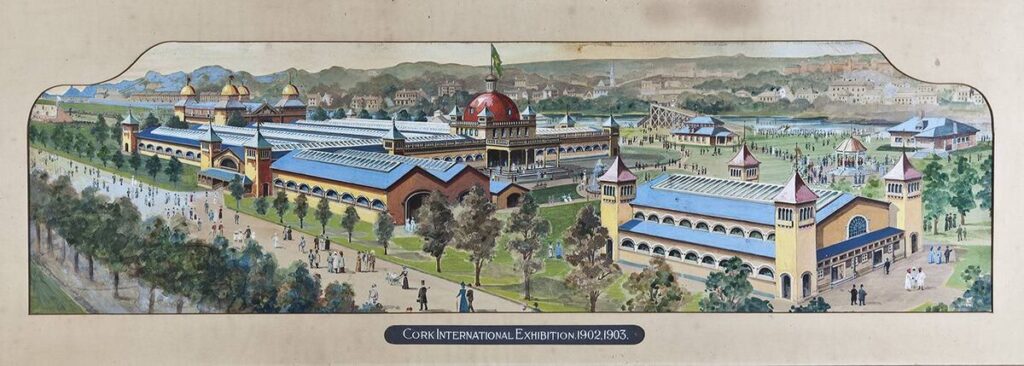
The Cork International Exhibition was the third and largest of the city’s great fairs, following those of 1852 and 1883 and spurred partly by the Paris exposition of 1900. It was the initiative of Edward Fitzgerald, Lord Mayor of Cork, who proposed it to the Municipal Council in February 1901. Officially the International Exhibition of Manufactures, Arts, Products and Industries, it opened on May Day (1 May) 1902 with a civic procession and general holiday, and ran to November 1902. The 44-acre site lay on the Mardyke beside the River Lee, and was built in roughly fifteen months at a cost of about £100,000. Its success prompted a second season in 1903 as the Greater Cork International Exhibition, opened on 28 May 1903 by the Lord Lieutenant, the Earl of Dudley, and closed on 31 October 1903. The buildings were then demolished and auctioned; in 1906 the grounds were vested in Cork Corporation, becoming Fitzgerald’s Park, with Shrubberies House converted to a municipal museum.
Henry A. Cutler served as honorary architect, with local builder William O’Connell of Hanover Street constructing the halls, kiosks and restaurants. The temporary structures were mostly timber finished in white plaster with red roofs and turrets, domes and a cupola, and a Corinthian-columned Irish-stone entrance leading to the Grand Avenue. The Industrial Hall, in the southwest corner, was the largest building at roughly 170,000 sq ft, laid out as seven parallel avenues crossed by one transverse avenue. The adjacent Machinery Hall held a boiler house generating the site’s electricity, and the Grand Concert Hall seated about 2,000, with room for a choir and orchestra of up to 500. A Canadian pavilion — one of two foreign-government pavilions — and a purpose-built 400-room hotel completed the principal works.
More than 500 exhibitors took part, mostly Irish, English and Scottish, with foreign sections from Canada, Japan, Italy, Austria, Turkey, Russia, Poland and Syria. Displays spanned a Women’s Section, raw materials, geology, natural history, modern science, archaeology and history, forestry and education; the Industrial Development area showed electric light, wireless telegraph, an X-ray plant, and a specimen of radium as its headline scientific novelty. Commercial exhibitors included Hadji Bey Turkish delight, Fry’s, Jacob’s, Denny’s and Schweppes, while the art galleries held work valued around £200,000, including pieces by John Butler Yeats and Oliver Sheppard and loans from English municipal collections and Buckingham Palace. Amusements ran along and on the Lee: a 70-foot Great Water Chute, a switchback railway, aerial ropeway, skating rink, shooting galleries, distorting mirrors, the Topsy Turvy House, a Submarine Pavilion with divers in a glass tank, gondolas poled by Venetian boatmen, and an infant incubator exhibit. An agricultural Western Field featured an Irish Labourer’s Cottage, a “Normandy Plot,” a Bee Pavilion and Fish Ponds.
By the authoritative account of Breen and Spalding, the exhibition drew over 1.8 million visitors and turned a profit in both years — £6,177 in 1902 and £1,793 in 1903, the latter folded directly into the creation of Fitzgerald’s Park. The 1903 season, though renamed to signal the promoters’ ambition, was essentially a leaner reprise: much of the Executive Committee stayed on, the agricultural work continued on a smaller scale under Richard Barter, and construction costs fell sharply because the grounds and buildings were already in place. Consistently judged one of the most significant events in Cork’s history, the exhibition’s lasting legacy is Fitzgerald’s Park and the Cork Public Museum on the former site — even as the event itself faded from wider public memory.
The Infant Incubator Exhibit
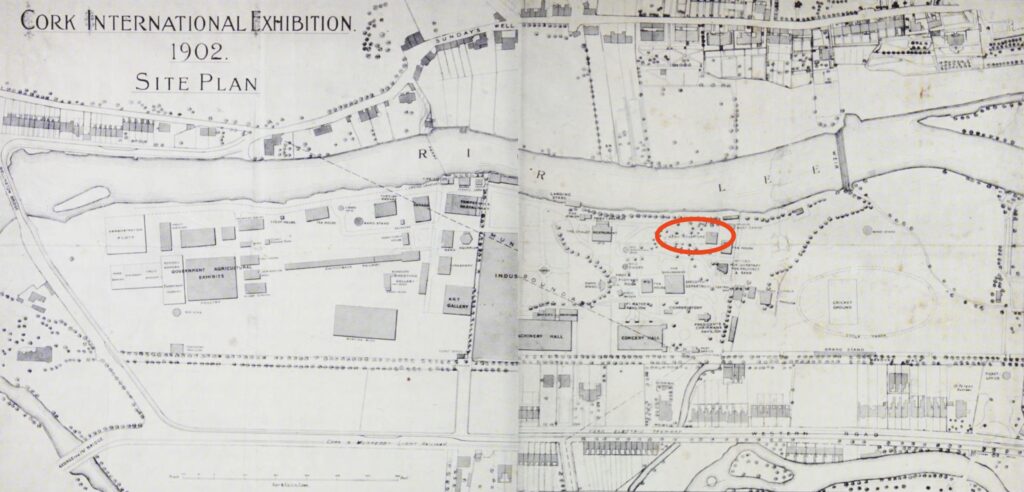
The baby incubator exhibit was one of the later additions to the Cork International Exhibition of 1902. Trading as the “Baby Incubator Institute,” it opened on Thursday 17 July 1902 — some ten weeks after the exhibition itself — and was reported by the local press as already drawing large crowds within a fortnight. It stood among the sideshows in the central part of the grounds, near the Shrubberies and the river, as marked on the official 1902 site plan. Its absence from the exhibition catalogue is unremarkable: incubator shows were frequently mounted as late concessions and often went unlisted.
The exhibit was directed by a “Monsieur Leotarde” — assumed to be a local phonetic rendering of Albert Léotardi, who had worked under Alexandre Lion at the Berlin Exposition of 1896 before operating independently. He used the “Baby Incubator Institute” name at other venues as well. Three incubators, each holding a live infant, were on display; Breen and Spalding give “three or four,” but the contemporaneous Cork press consistently reports three. The origin of the infants is not recorded. Breen and Spalding suggest a nearby Magdalene home or the Erinville lying-in hospital as possible sources, but no source connects either to the exhibit, and it remains conjecture.
Press descriptions — largely reproducing a supplied notice rather than independent observation — describe a squarish box of silvery metal raised about three feet on iron supports, ventilated by a constant stream of filtered, heated air drawn from outdoors, with hot-water pipes and an automatic thermo-regulator maintaining temperature. Glass sides allowed viewing and gave the infants light; a chart on the front recorded each child’s weight, temperature, pulse, respiration, name, condition at birth and parentage. The description is consistent with the Lion incubators Léotardi used in other exhibitions. Infants were fed every two hours and typically remained about forty days. The accompanying commentary framed the apparatus as a serious medical advance against the high mortality of prematurely born children.
Not all coverage was credulous. A Daily Express correspondent (“E.R.L.”) judged the three infants “too real and too much alive” to be genuinely premature and doubted the claims made “in imperfect English” by the attendant — a reminder that these exhibits sat awkwardly between medical demonstration and popular spectacle. The same piece incidentally records roughly 15,000 visitors passing through the turnstiles on a typical day in late July 1902.
Primary and On-Line Sources
Breen, Daniel, and Tom Spalding. The Cork International Exhibition 1902–1903: A Snapshot of Edwardian Cork. Irish Academic Press. — p. 10 (44-acre site; £100,000 budget; 15-month build); pp. 144–145 (1903 season rationale and organization); p. 310 (1902 attendance, 1.2 million); Appendix 3 (financial accounts: 1902 profit £6,177; 1903 profit £1,793), p. 204 (incubator exhibit, “Leotarde,” three or four infants, possible sources of infants); pp. 156–57 (site plan, location of exhibit). Viewed on the Internet Archive.
Doig, Tom. “The Cork International Exhibition, 1902–03.” The Archive: Journal of the Cork Folklore Project, Issue 17 (2013), pp. 3–5. — Architecture; Industrial, Machinery and Concert Halls; Women’s Section; radium/X-ray displays; amusements; agricultural Western Field.
McCarthy, Kieran. “7. Cork International Exhibition, 1902–1903.” Cork Heritage, corkheritage.ie/?page_id=4745. — Chronology; opening day; Water Chute; 1903 reopening under the Earl of Dudley; close on 31 Oct 1903; 1906 vesting of the park.
O’Hanlon, Oliver. “When the world came to the Lee.” The Irish Times, 28 Aug 2023. — Distinguished visitors; exhibitor origins; brands; Canadian Pavilion; art galleries.
Press Sources
“The Baby Incubator: Opening of an Interesting Invention.” Cork Weekly News, 19 July 1902. — Opening on Thursday 17 July; “Baby Incubator Institute”; Leotarde as director; technical description.
Southern Star, 26 July 1902. — Three infants; popular reception.
“A Day at the Cork Exhibition,” by E.R.L. The Daily Express (Dublin), 28 July 1902. — Three infants; skeptical account; ~15,000 daily turnstile figure.
The Irish Times, 30 July 1902 (Exhibition Notes). — Incubator among “the latest additions” to the sideshows, in full working order; technical description.
Portions of this page were drafted with machine assistance; the final text was reviewed, verified, and edited by the author.
Last Updated on 07/20/26