Hospice des Enfants-Assistés
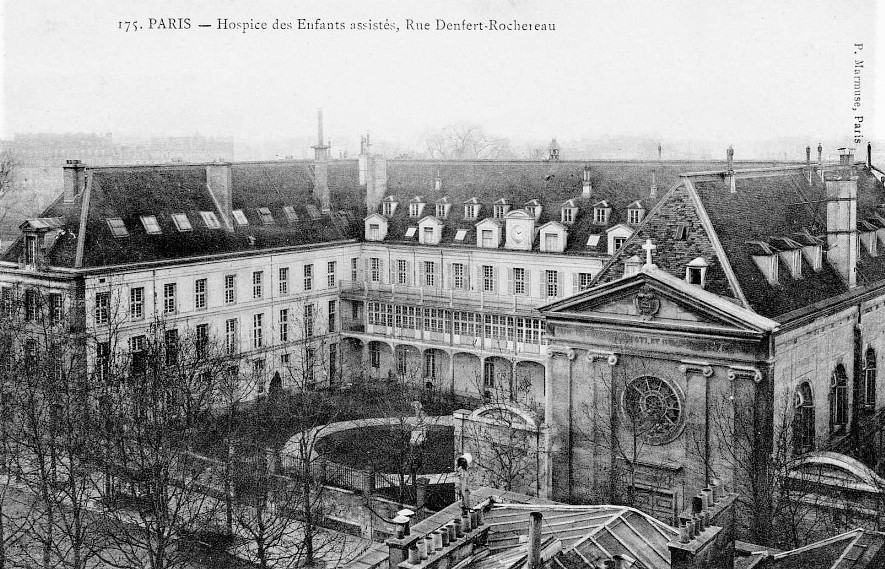
The origins of the Hospice des Enfants-Assistés go back to the 17th-century charitable work of Saint Vincent de Paul and Louise de Marillac, who began organized care of Paris foundlings in 1638. In 1670 a royal edict of Louis XIV formally established the Hôpital des Enfants-Trouvés and attached it to the Hôpital Général. Its purpose was to receive and care for the many infants abandoned in Paris. The institution first operated near the cathedral of Notre-Dame, where a dedicated building went up around 1748, and also used a house in the faubourg Saint-Antoine. During the Revolution and the early 19th century, care for foundlings passed from the Hôpital Général to civil administration under the Conseil général des hospices (1801), which was succeeded in 1849 by the newly created Assistance Publique à Paris. After partial transfers beginning in the 1790s, the foundling service was consolidated in 1814 at the former novitiate of the Oratoire on the Rue d’Enfer (now Avenue Denfert-Rochereau). From then on it served as Paris’s central depot for foundlings, orphans, and abandoned newborns.
In the first half of the 19th century, much of the intake came through the tour d’abandon (foundling wheel), a revolving turntable set into the hospice wall. It let a parent leave an infant anonymously, without face-to-face contact, and an 1811 decree required every foundling institution in France to have one. Paris had a single tour, at the Rue d’Enfer hospice. As thousands of infants arrived each year, the hospice suffered severe overcrowding, very high mortality, and epidemics of infectious diarrhea and measles. Around 1859 the institution was renamed the Hospice des Enfants-Assistés, reflecting an administrative effort to group foundlings, abandoned children, and orphans under the single category of enfants assistés. Paris closed its tour around 1860 (some sources give 1862) and shifted to admission through an open bureau, along with assistance meant to encourage unwed mothers to keep their infants. The law of 27 June 1904 abolished the tour nationwide.
In the late 19th and early 20th centuries, under the Third Republic, the hospice changed from a holding depot into a clearinghouse and clinical center. Infants arrived from police commissariats, maternity wards, and poor households. They were examined, and then either admitted to the infirmary wards or sent to the provinces to be raised by supervised rural wet nurses. The hospice also employed resident nurses (nourrices sédentaires) on site. Because many admissions were frail, malnourished, and already infected, the medical wards became a center for late-19th-century pediatric pathology and hygiene. Joseph Parrot, chef de service from the late 1860s to the early 1880s, described infantile wasting there under the name athrepsie. In the 1890s Victor-Henri Hutinel introduced a rigorous antisepsis program and glass-walled isolation cubicles (the “boxes de Hutinel”). He worked with his intern Maurice Delestre, and the two co-authored studies of the hospice’s premature infants.
Incubators were in routine use at the hospice by the 1890s, and Hutinel’s service examined their risks closely. In a two-part paper published in 1899 in the Annales de médecine et chirurgie infantiles, Hutinel and Delestre argued that apparently healthy premature infants who died within days in the couveuse died of infection, not “congenital weakness.” Delestre had frequently found streptococci, colibacilli, and other pyogenic organisms in their blood hours before death. Drawing on Bertin’s thesis, also written in their service, they concluded that an incubator was only as safe as the ward around it, and they identified the hands of nurses and wet nurses as a major route of infection. Their own observations suggested that infants in incubators became infected more easily and more severely than neighbors in cradles. They therefore laid down strict rules: incubators only for hypothermic infants, never for infected ones, kept at about 32 to 33°C, and removed as soon as rectal temperature held at 37°C. After that, infants were placed in cradles in airy, sunlit rooms and, weather permitting, outdoors. They rejected heated nursery rooms (chambres de chauffe) as impossible to keep aseptic. The hospice used a deliberately simple incubator of its own design: an enameled faience tub with a perforated galvanized-iron floor set over a metal box heated by hot-water bottles, closed by a thick glass lid, and wiped down daily with mercuric chloride. Hot water was preferred over gas heating, whose regulators could fail.
The paper also described the hospice’s new nourricerie, a single-story pavilion set in gardens and divided into four rooms that did not communicate directly: one for healthy premature infants, one for “doubtful” cases, one for infected infants, and a dormitory for the nurses. The tiled floors were washed daily, windows stayed open, and cradles were moved into small adjoining gardens, which the authors called a sanatorium for newborns. In its first months, from May 1899, 21 infants under 2,000 g were admitted with three deaths, a mortality of 14 percent against 36 percent in the previous nursery service. This work fed the hospice’s continued emphasis on asepsis, bottle sterilization, and isolation in the early 1900s. Hutinel left in 1907 to succeed Grancher at the Hôpital des Enfants-Malades. Over the following decades the hospice gradually shifted from a child-depot model to a full clinical hospital, a change under way by about 1930, and in 1942 it was renamed the Hôpital Saint-Vincent-de-Paul.
Sources
- Hutinel P, Delestre M. Les couveuses aux Enfants-Assistés. Annales de médecine et chirurgie infantiles. Part 1: 1899;3:881–884 (no. 23), Part 2: 1899;906–911 (continued).
Additional Information
- Bibliography of resources regarding the Hospice des Enfants-Assistés
- La Couche at Children’s Homes UK
- Neonatology on the Web: L’Hôpital des Enfants-Trouvés
- Victor Henri Hutinel – French Wikipedia
French primary sources were machine-translated, then checked against the originals and edited by the author. Portions of this page were drafted with machine assistance; the final text was reviewed, verified, and edited by the author. Click here to learn more.
Last Updated on 10/10/26