Charles C. Chapple
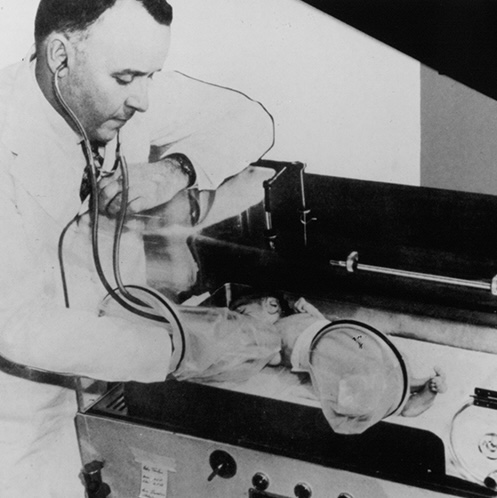
Charles Culloden Chapple was born in Billings, Montana, on April 27, 1903. He received his MD from the University of Michigan in 1928, interned at University Hospital in Ann Arbor, and came to the Children’s Hospital of Philadelphia (CHOP) as a pediatric resident in 1929. He spent the next three decades in Philadelphia. From 1935 to 1942 he was Associate Pediatrician at the Hospital of the University of Pennsylvania, and before the war he served several area hospitals, including Abington Memorial, Chestnut Hill, and Germantown. In 1931 his daughter Cornelia was born with a dislocated hip. Her case drew him into a lifelong study of congenital hip dislocation and fetal developmental defects. By 1938 he had designed a chair bed to hold affected infants in a corrective position, and his papers include correspondence on the subject with Sir Denis Browne.
His most consequential work began with a margin sketch. Early in practice, he set out to annotate Holt’s Pediatrics with his clinical notes, and his answer to the chapter on premature infants was a drawing. It showed a glass-walled box with sleeved hand ports, a two-door pass-through for bottles, and a fan drawing outside air over heated water. A helium-oxygen chamber for asthmatics, funded by a Detroit family, put the same principles into practice. His first completed incubator followed in 1936. He described it in 1938 as an airtight, insulated unit holding temperature within one degree. The first wooden unit sat on the CHOP baby ward among sick children, tended by nurses who wore no gowns or masks. During two ward epidemics, no infant in the incubator was infected. He also found that raising humidity to near saturation let the chamber run about ten degrees cooler while infants thrived. Through his friendship with television pioneer Philo Farnsworth, a Farnsworth-affiliated company built 35 wooden units before the war, and Chapple serviced each one himself. He patented the design in 1938 and assigned it to CHOP; the patent issued in 1941.
During World War II Chapple consulted for the Army’s Chemical Warfare Service and collected Aleut artifacts on Attu Island, which he donated to the Penn Museum in 1945. After the war he became Senior Physician at CHOP and held professorships at Penn. Samuel Y. Gibbon, a former banker turned medical-equipment manufacturer, had acquired the aircraft-parts firm Air-Shields. Chapple proposed the incubator to him as a first product. Gibbon’s team remolded the design in wartime bomber-nose plastic, and Gibbon named it the Isolette. The first version in 1947, the model C-33, did not get UL approval because of exposure of oxygen to electrical and mechanical connections with potential fire risk. Nevertheless, a considerable number of C-33s were manufactured and sold. After a redesign, the Model C-35 debuted in 1948, received UL approval and dominated the market by 1950.* Its tight seal made high oxygen concentrations easy to deliver, contributing to the retrolental fibroplasia epidemic of that era. Chapple also developed humidification devices, including the Croupette, and was elected a Fellow of the College of Physicians of Philadelphia in 1950.
In 1958 Chapple joined Howard University as Associate Clinical Professor. In 1966 he became Professor of Pediatrics at the University of Nebraska Medical Center. His late research included work on the interaction of aluminum and mercury. He died of cancer in Omaha on March 23, 1979, survived by his wife Sally and four children. His basic design, a transparent sealed chamber with sleeved access ports and active environmental control, remains the template for the modern closed incubator.
More Information
- Dr. Charles Chapple, Obituary, New York Times, March 25, 1979
- Chapple, Charles C. – SNAC
- An Incubator for Infants, by Charles C. Chapple, Am. J. Obst. and Gynec. 35:1062-1065, 1938
- The Chapple Incubator
- US Patent 2,243,999 for the Chapple Incubator
- US Patent US-2648327 for the Air-Shields C-35 Isolette
- “Infant Incubation, Part II,” personal observations by Dr. Chapple. NeoReviews, Vol 13, No, 8, August 2012, pp. e463-466
* Air-Shields, Inc. v. Air Reduction Company, 331 F. Supp. 673 (N.D. Ill. 1971), U.S. District Court for the Northern District of Illinois, Docket Number: 67 C 1767, Date Decided: March 18, 1971
Portions of this page were drafted with machine assistance; the final text was reviewed, verified, and edited by the author. Click here to learn more.
Last Updated on 11/06/26