Dr. John A. Clements (1923–2024)
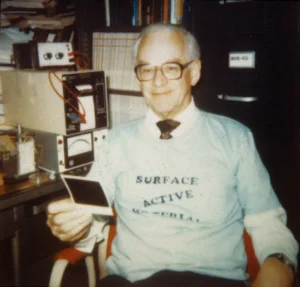
Dr. John Allen Clements was born on March 16, 1923, in Auburn, New York. He completed his undergraduate studies at Princeton University and graduated from Weill Cornell Medical College in 1947. In 1949, rather than the biochemistry research he had planned, he was assigned by the U.S. Army to the Medical Laboratories of the Army Chemical Center in Edgewood, Maryland, to study the effects of chemical agents on the lungs. While pondering how the lungs could fully exhale without collapsing like a deflated balloon, Clements hypothesized that a surface-active substance must be reducing the surface tension of the fluid lining the alveoli. He confirmed this experimentally, submitted the manuscript to Science (where it was rejected), and published his findings in the Proceedings of the Society for Experimental Biology and Medicine in 1957.*
Among those impressed by the publication was Mary Ellen Avery, then a research fellow at the Harvard School of Public Health. With Clements’s guidance and access to his surface film balance, she and Jere Mead demonstrated in 1959 that the lungs of premature infants who died of hyaline membrane disease (now respiratory distress syndrome, RDS) lacked surface-active material entirely.** Before effective treatment existed, roughly 10,000 American infants died annually from RDS, with a survival rate of approximately 5 percent.
Recruited to UCSF in 1959, Clements joined UCSF’s Cardiovascular Research Institute and Department of Pediatrics full time in 1961 and received a full chair in 1964. There he organized an interdisciplinary surfactant research group that attracted basic scientists, engineers, and clinicians alike, and mentored generations of trainees — among them the future UCSF Chancellor Sam Hawgood. His laboratory work on alveolar mechanics also contributed directly to the development of continuous positive airway pressure (CPAP) for neonatal RDS, which Drs. George Gregory, William Tooley, Roderic Phibbs, and Joseph Kitterman introduced in 1971.
Clements spent several decades developing a protein-free synthetic surfactant, work undertaken in collaboration with Burroughs Wellcome (now GlaxoSmithKline). With characteristic dryness, he later recalled proposing “in a few weeks or months” to accomplish what “had taken divine providence millions of years.” The preparation, marketed as Exosurf, received FDA approval in 1990; the initial clinical trial was published the following year.† Although subsequent NIH-funded trials established that animal-derived surfactants were more effective — and those are used today — Exosurf’s approval marked a critical turning point, and survival rates for premature infants with RDS rose from roughly 5 percent to upwards of 90 percent over the ensuing decades.
In 1994 Clements received the Albert Lasker Clinical Medical Research Award for what the judges described as “the most important discovery in pulmonary physiology in the last 50 years.” He donated his $25,000 prize to UNICEF. He retired as professor emeritus in 2004 but continued attending UCSF’s weekly pulmonary physiology seminars well into old age, regularly asking, as colleagues recalled, “always the best question.” A fine pianist, he often accompanied his wife Margot, an opera singer. He died on September 3, 2024, at his home in Tiburon, California, at the age of 101, survived by two daughters.
* Clements JA. Surface tension of lung extracts. Proc Soc Exp Biol Med. 1957 May;95(1):170-172. doi:10.3181/00379727-95-23156. PMID: 13432025.
** Avery ME, Mead J. Surface properties in relation to atelectasis and hyaline membrane disease. AMA J Dis Child (1959) 97(5, Pt 1):517-23. PMID 13649082
† Phibbs RH, Ballard RA, Clements JA, et al. Initial clinical trial of EXOSURF, a protein-free synthetic surfactant, for the prophylaxis and early treatment of hyaline membrane disease. Pediatrics. 1991 July;88(1):1-9. PMID: 2057244.
Biographical References
- “John Clements, Whose Science Transformed Newborn Care, Dies at 101.” UCSF News, September 12, 2024. https://www.ucsf.edu/news/2024/09/428391/john-clements-whose-science-transformed-newborn-care-dies-101
- “Remembering John Clements.” Office of the Chancellor, UCSF, September 12, 2024. https://chancellor.ucsf.edu/news/remembering-john-clements
- “John Clements, Whose Invention Helped Save Preemies’ Lives, Still Pushing His Field Forward at 93.” UCSF News, January 26, 2017. https://www.ucsf.edu/news/2017/01/405646/john-clements-whose-invention-helped-save-preemies-lives-still-pushing-his
- “Veteran UCSF Scientist Looks Back on Key Discovery That Helped Save Preemies’ Lives.” KQED, August 3, 2015. https://www.kqed.org/stateofhealth/56245/veteran-ucsf-scientist-looks-back-on-key-discovery-that-helped-save-preemies-lives
- “John Allen Clements.” Obituary. The Lancet. 2024. doi:10.1016/S0140-6736(24)02364-X. Published November 2, 2024. (Paywall.)
- “John A. Clements Dies at 101; His Research Saved Thousands of Babies,” New York Times, September 19, 2024. https://www.nytimes.com/2024/09/19/science/dr-john-a-clements-dead.html
Selected Publications by Clements
- Clements JA. Dependence of pressure-volume characteristics of lungs on intrinsic surface-active material. Am J Physiol. 1956;187:592. (Abstract; no PMID.)
- Clements JA. Surface tension of lung extracts. Proc Soc Exp Biol Med. 1957 May;95(1):170-172. doi:10.3181/00379727-95-23156. PMID: 13432025.
- Clements JA, Hustead RF, Johnson RP, Gribetz I. Pulmonary surface tension and alveolar stability. J Appl Physiol. 1961 May;16(3):444-450. doi:10.1152/jappl.1961.16.3.444-450.
- Klaus MH, Clements JA, Havel RJ. Composition of surface-active material isolated from beef lung. Proc Natl Acad Sci USA. 1961 Nov;47(11):1858-1859. doi:10.1073/pnas.47.11.1858.
- Clements JA. Surface phenomena in relation to pulmonary function. Physiologist. 1962 Feb;5:11-28. PMID: 13879904
- Schürch S, Goerke J, Clements JA. Direct determination of surface tension in the lung. Proc Natl Acad Sci USA. 1976 Dec;73(12):4698-4702. doi:10.1073/pnas.73.12.4698.
- Phibbs RH, Ballard RA, Clements JA, et al. Initial clinical trial of EXOSURF, a protein-free synthetic surfactant, for the prophylaxis and early treatment of hyaline membrane disease. Pediatrics. 1991;88(1):1-9. PMID: 2057244.
- Clements JA. Lung surfactant: a personal perspective. Annu Rev Physiol. 1997;59:1-21. doi:10.1146/annurev.physiol.59.1.1.
Portions of this page were drafted with machine assistance; the final text was reviewed, verified, and edited by the author. Click here to learn more.
Last Updated on 07/20/26