Expoziţia Generală Română 1906
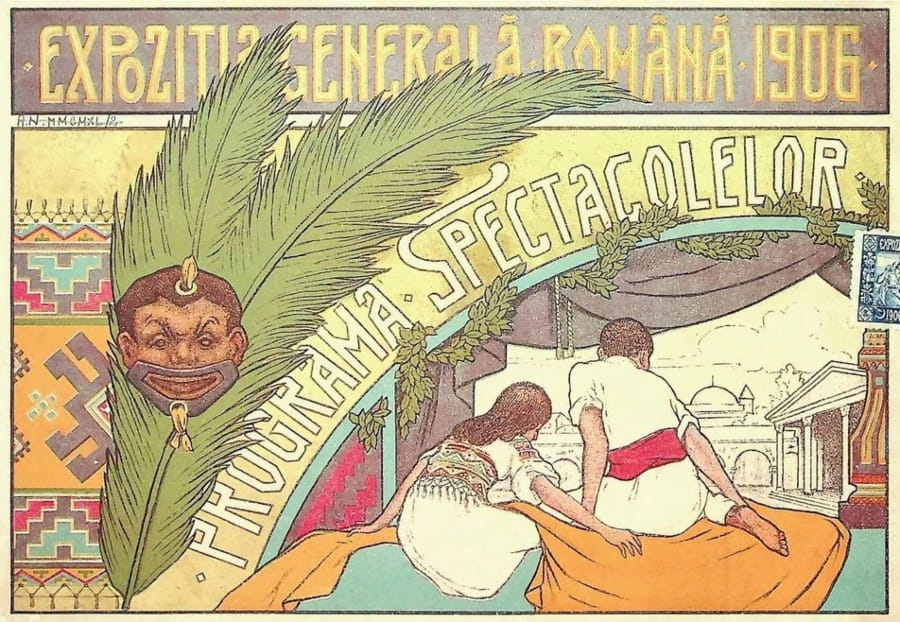
The Romanian General Exhibition (Expozițiunea Generală Română) opened in Bucharest on 6 June 1906 and closed on 23 November 1906. It was staged as a jubilee for three anniversaries: forty years of Carol I’s reign, twenty-five years since Romania was proclaimed a kingdom, and eighteen hundred years since Trajan’s conquest of Dacia. King Carol I opened it at the Roman Arenas in the presence of Queen Elisabeth, the government, the diplomatic corps and foreign guests, including Karl Lueger, the mayor of Vienna. Illness kept the king away from the closing ceremony, where Lahovari thanked the foreign governments and the Romanians from beyond the kingdom’s borders who had taken part. Over its five and a half months the exhibition drew roughly two million visitors.
The exhibition was organized by the Ministry of Domains under Ion N. Lahovari, whom contemporaries credited with pushing the project through Parliament. Its general commissioner was Dr. Constantin I. Istrati, chemist, former Minister of Public Instruction and president of the Romanian Academy. The site was the marshy Filaret plain on the southern edge of the city, turned in less than a year into a landscaped park of about 37 hectares with a lake of about 2.5 hectares, to designs by the French landscape architect Édouard Redont. The grounds and buildings were planned by architects including Ion D. Berindei, Ștefan Burcuș and Victor G. Ștefănescu, on the model of the Paris exposition of 1900. The exhibition cost some 6.6 million lei against revenue of 1.5 million, with a further 3 million spent on the park. The park survives today as Carol I Park.
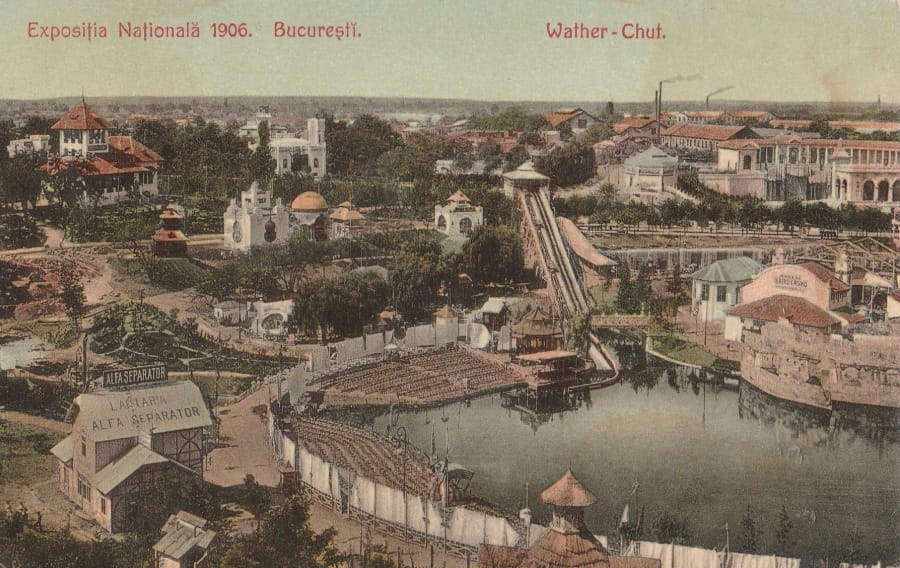
Some 165 to 170 pavilions were grouped into twelve sections, from agriculture and industry to hygiene, public assistance and social economy. The largest buildings stood on the high ground at the south end of the site. They included the Palace of Arts (later the Military Museum, demolished in 1943), the Royal Pavilion, a Roman-style arena seating about 4,500, a water tower in the form of Vlad Țepeș’s fortress, and a replica of the Cuțitul de Argint church. Austria, Hungary, Italy and France had pavilions, and Romanians from Transylvania, Bucovina, Bessarabia, Macedonia and Serbia exhibited in pavilions of their own.
The exhibition also had a lively amusement side. Attractions included a 22-meter water chute, a toboggan, Venetian gondolas and staged naval battles of Port Arthur on the lake, an “enchanted grotto,” and evening illuminations and fireworks by James Pain & Sons of London. A “Romanian village” of peasant houses from Transylvania, Bucovina and other regions, inhabited by villagers in local dress, was also announced. Admission was 1 leu on most days and 2 lei on illumination and fireworks days, and season tickets cost 50 lei. In January 1907 most of the buildings were still standing under snow, but the exhibition was not reopened.
The Incubator Paviliion
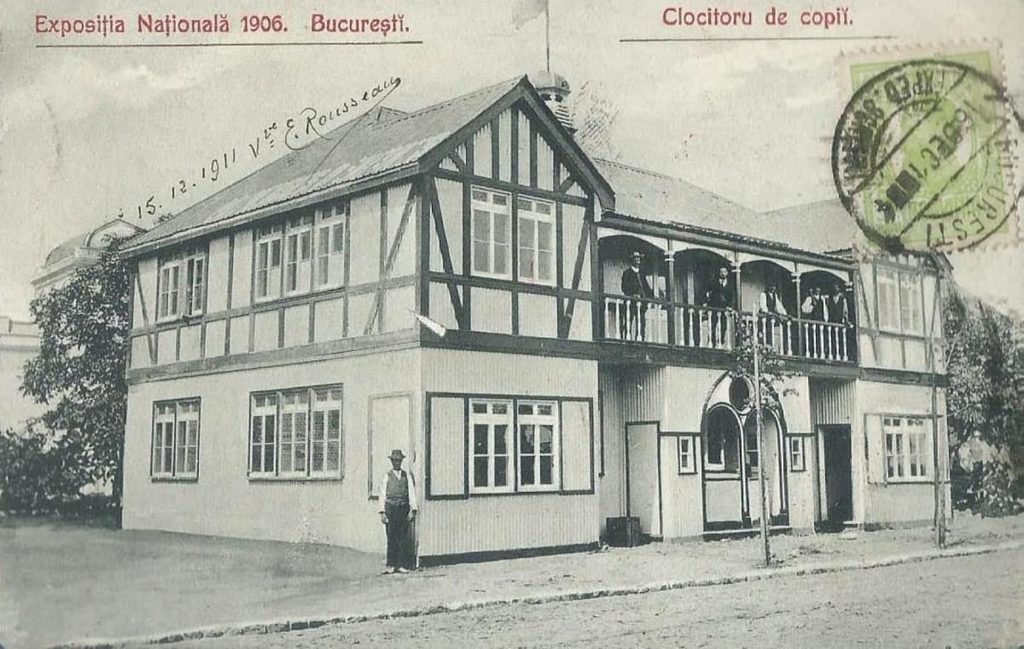
An infant incubator exhibit, with live premature infants, was among the attractions at Bucharest in 1906. Romanian sources describe it as the “crescătoarea de copii (incubatorul),” a pavilion where babies born before term were cared for under supervision. A souvenir postcard captions it “Clocitoru de copiĭ” (“child hatchery”). The pavilion’s own roof sign, in French, read “Couveuses d’enfants,” the same wording used at Liège the year before.
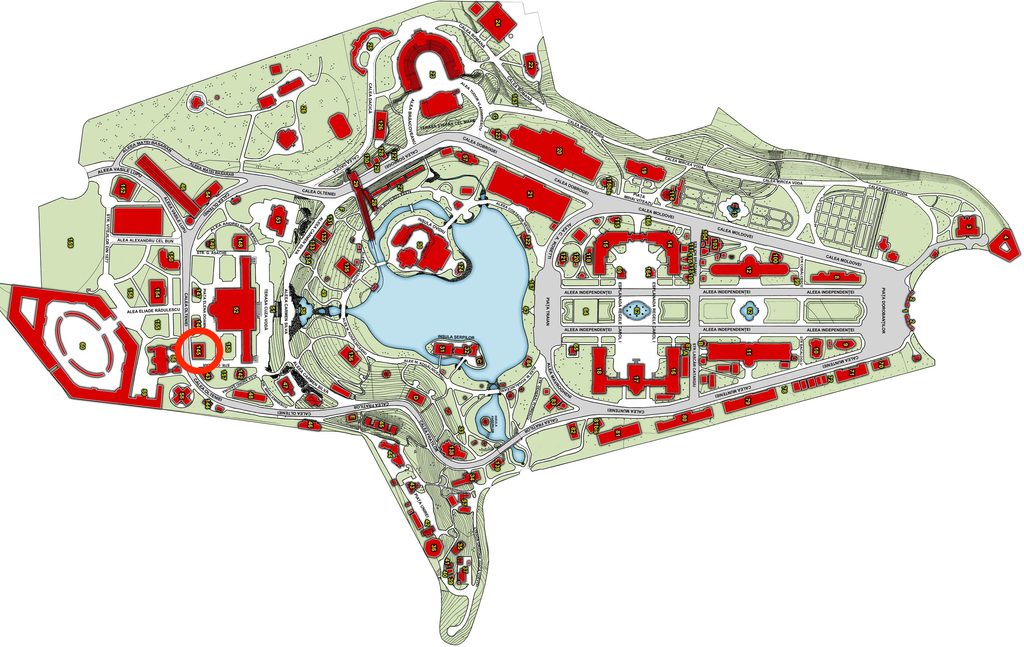
The pavilion stood among the smaller buildings behind the Palace of Arts. A correspondent signing himself “Nicky,” writing in the French and Belgian press in February 1907, listed “la couveuse d’enfants” there alongside the pavilions of the Sainte-Catherine crèche (the Leagănul Sf. Ecaterina foundling society), the pharmacists and the prison administration. Both surviving plans of the grounds place a “Nursery” or “Children’s Pavilion” at that spot, next to the Sainte-Catherine pavilion. A contemporary photograph of the Leagănul pavilion shows the incubator pavilion immediately behind it.
The operator was Moritz Ehrlich, the Vienna-born entrepreneur who ran Lion-type incubator exhibits across Europe. The official plan of the exhibition, approved by the general commissioner on 12 May 1906, lists the pavilion as “Ehrlich. Crescătoare de copii” (no. 145), beside the Leagănul Sf. Ecaterina (no. 146). The building itself confirms the attribution. It is virtually identical to Ehrlich’s pavilions at Liège (1905), Dublin (1907) and Edinburgh (1908), with a paneled ground floor, a half-timbered upper story with gabled wings, a four-arched loggia over the center bay, an arched entrance and a ridge turret. Bucharest also falls exactly in sequence with those engagements, one exposition a year. The ribbed panel cladding suggests a demountable structure that Ehrlich shipped and re-erected from fair to fair.
The same plan lists an International Pavilion (no. 55), and the exhibition’s official bulletin records that “M. Ehrlich” held its concession for the sale of foreign goods and souvenirs. In May 1906 his circular advertising it drew a protest from the Bucharest Chamber of Commerce.
Primary Sources
- Buletinul oficial: Expozițiunea Generală Română, ed. C. I. Istrati, Bucharest, Imprimeria Statului, nos. 1–15 (September 1905–December 1906). Digitized by Biblioteca Academiei Române (e-Acad).
- No. 8 (April 1906): notice of admission fees.
- No. 9 (May 1906), pp. 210–211: Bucharest Chamber of Commerce to the General Commissioner, no. 406 (received 3 May 1906), and Istrati’s reply (9 May 1906), concerning M. Ehrlich and the International Pavilion.
- No. 14 (October–November 1906): award lists.
- “Nicky,” “Lettre de Roumanie: L’Exposition générale roumaine,” Le Peuple, 4 February 1907 (part 1) and 5 February 1907 (“Suite et fin”). Part 2 also appears in La France, 4 February 1907.
- G. G. Longinescu, “Expozițiunea Generală din 1906,” Natura: Revistă științifică de popularizare, vol. I (October 1905–July 1906), pp. 87–91 [issue not printed; probably No. 3, December 1905].
- [Unsigned], “Expozițiunea Generală Română,” Natura, vol. I, No. 10 [probably July 1906], pp. 305–309. Both Natura articles digitized by Biblioteca Digitală a Bucureștilor.
- Plan of the exhibition, “Plan de l’Exposition générale de Roumanie 1906,” modern redrawing, Arhiva Națională de Filme, via University of Graz, https://gams.uni-graz.at/o:baci.1275.
- Planul Expozițiunii Generale Române 1906, by Ș. Burcuș, V. G. Ștefănescu and É. Redont, “văzut și aprobat” by C. I. Istrati, 12 May 1906. Legend transcribed and redrawn by Andrei Popescu, “Pavilioanele Expoziţiei generale române din 1906 – plan,” Idei Urbane, 20 November 2014, https://ideiurbane.ro/pavilioanele-expozitiei-generale-romane-din-1906-plan/.
- Muzeul Municipiului București, “Expoziția Generală Română din 1906 – Jubileul în imagini la 120 de ani,” exhibition at Palatul Suțu, 2026, https://muzeulbucurestiului.ro/expozitia-generala-romana-1906-sutu/.
Secondary Sources
- Biblioteca Națională a României, Serviciul Colecții Speciale, “Parcul Carol și Expoziția Generală Română de la 1906,” virtual exhibition (2025), https://bibnat.ro/wp-content/uploads/2025/12/LB5-PDF.pdf.
- Traian-Sorin Dorobanțu, “The Pavilions of the National Exhibition from 1906,” Journal of Romanian Literary Studies 24 (2021): 995–1003.
- Traian-Sorin Dorobanțu, “The National Exhibition of 1906 Reflected in the Press of Time,” Journal of Romanian Literary Studies 25 (2021): 1172–1177.
- Victor Manta, “General Exposition of 1906 in Bucharest,” marci-postale.com (2020).
- Odyssey, “1906 Romanian General Exposition,” interactive map, https://odyssey.ooo/exhibition/bucharest_1906/.
- Postcard image, “Expoziția Națională 1906. București. Clocitoru de copiĭ.” Copy via odyssey.ooo; a mailed copy is inscribed “15.12.1911 Vve E. Rousseau.”
- Postcard image, Leagănul Sf. Ecaterina pavilion with the “Couveuses d’enfants” pavilion behind. Copies via odyssey.ooo and Biblioteca Națională a României.
* Moritz Ehrlich, referred to in most news accounts as M. Ehrlich, is a somewhat mysterious figure. I have not been able to find much information about him other than his claimed origin in Vienna and a later residence address at Lothringerstraße 59 in Berlin. He used Lion incubators, and his exhibits usually were named “Baby Incubator Institute” or some variation on that in the local language. He is known to have exhibited at Manchester in 1902 and 1903, Glasgow in 1903-1904, Bradford in 1904, Liege in 1905, Birmingham in 1905, Bucharest in 1906, Dublin in 1907, Edinburgh in 1908, Motherwell Scotland in 1934, Brussels in 1910, and Brussels in 1935. Undoubtedly there were others as yet unidentified. He also had some connection with Albert Leotardi, another entrepreneur on the incubator exhibit circuits, as evidenced by a lawsuit between them filed in Berlin on September 12th, 1899.
* Moritz Ehrlich, referred to in most news accounts as M. Ehrlich, is a somewhat mysterious figure. I have not been able to find much information about him other than his claimed origin in Vienna and a later residence address at Lothringerstraße 59 in Berlin. He used Lion incubators, and his exhibits usually were named “Baby Incubator Institute” or some variation on that in the local language. He is known to have exhibited at Manchester in 1902 and 1903, Glasgow in 1903-1904, Bradford in 1904, Liege in 1905, Birmingham in 1905, Bucharest in 1906, Dublin in 1907, Edinburgh in 1908, Motherwell Scotland in 1934, Brussels in 1910, and Brussels in 1935. Undoubtedly there were others as yet unidentified. He also had some connection with Albert Leotardi, another entrepreneur on the incubator exhibit circuits, as evidenced by a lawsuit between them filed in Berlin on September 12th, 1899.
Portions of this page were drafted with machine assistance; the final text was reviewed, verified, and edited by the author. Click here to learn more.
Last Updated on 10/11/26