Irish International Exhibition of 1907

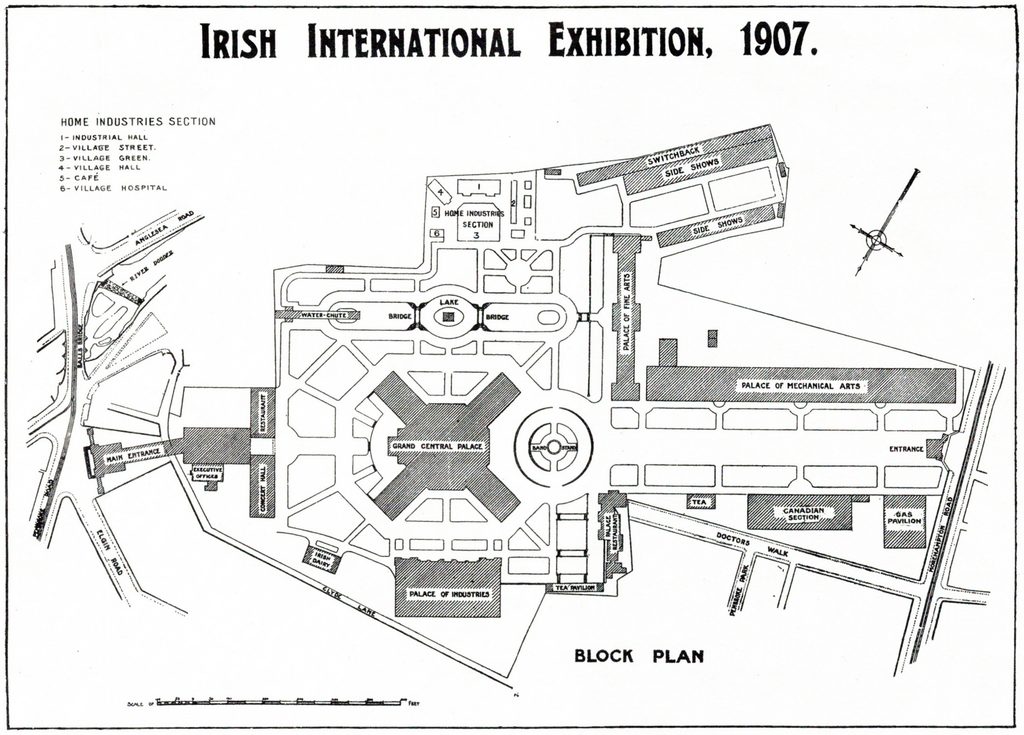
The Irish International Exhibition of 1907, staged across 52 acres in Ballsbridge from May 4 to November 9, was Ireland’s grandest world’s fair. Conceived in the wake of the successful 1902 Cork International Exhibition, the Dublin event aimed to showcase modern Irish commerce, technology, and arts while drawing foreign exhibits from nations including Canada, France, Italy, and New Zealand. Its architectural centerpiece was the massive Grand Central Palace, whose octagonal domed court measured 215 feet across, encircled by specialized halls devoted to motor cars, electric lighting, power generation, and fine arts.
Beyond its industrial showcases, the exhibition served as a massive public spectacle, drawing approximately 2.75 million visitors. Popular diversions included a switchback railway, an enormous water chute, a dedicated concert hall hosting daily orchestral performances, and period oddities such as a premature baby incubator exhibit. Reflecting the era’s colonial exhibition practices, one of the most visited and controversial features was the “Somali Village,” an ethnographic living display that attracted immense crowds while drawing critique from Irish nationalists who favored a strictly indigenous economic focus.

The exposition was politically charged in Ireland, occurring in the context of an increasing level of cultural awareness in Ireland, along with a movement to “de-Anglicize,” restore use of the Gaelic language, and a perception that the exhibition was more focused on the promotion of foreign and manufactured goods than local artisan products, art, music, and literature.
Although the expo ran a deficit of around £100,000 (equivalent to about $16,000,000 in 2026), which had to be covered by the guarantors, it was widely deemed an operational and cultural triumph. After the temporary plaster pavilions were cleared, the landscaped grounds were gifted to the local council as public parkland. Known today as Herbert Park, several original features endure, most notably the ornamental duck pond (originally constructed as the landing basin for the fair’s water chute) and the park’s historic bandstand.
The Incubator Exhibit
The incubator exhibit first appeared in the press in early July, when the Evening Irish Times noted a building going up beside the Somali Village whose placard announced the Baby Incubator Institute, an enterprise it said caused “some perplexity and no little curiosity” among the crowds. It was not listed in the Official Catalog or the Program, which indicates that it was a late addition to the concessions. By late August the exhibit was open, situated between the Somali Village and the Helter-Skelter lighthouse, with admission at sixpence (Dublin Evening Herald, August 26, 1907). It was directed by Moritz Ehrlich,* described by the press as the patentee of the incubators and holder of a Grand Prix and diplomas of honour from exhibitions in Paris, Berlin, Vienna, London, Glasgow, Bradford, Cork, and elsewhere. Skilled nurses attended the infants, who were fed roughly every two hours.
Among the many items classed under the side shows none attracts more attention than the Baby Incubator Institute, which is being conducted under the direction of M. Ehrlich. Externally the building is interesting and attractive, and internally it excites wonder and a good deal of admiration. The object of the baby incubator is to preserve the lives of prematurely born and weakly infants, and on purely scientific lines this has been found to be perfectly possible and in most cases successful.
There are several infants of varied sizes in the institute, and each is allotted a neat square metal box placed about three feet from the floor and fitted with heat and air providing apparatus. The temperature and air supply are regulated to a nicety, and the little ones in the “nests” are constantly under the care of skilled nurses. There are two glass sides to each incubator, to allow sufficient light to the inmate and also free observation by the nurses, and among the fittings is an automatic temperature regulator. The babies are fed on an average every two hours, and according to their size and strength the method is arranged.
— The Irish Independent, Friday, September 6, 1907
Coverage focused heavily on the infants’ progress, often reported in precise weights. In late August four infants were in care, including one admitted on August 6 and a pair of twins admitted on August 8 at 3 lb 7 oz and 2 lb 15 oz, who had reached 4 lb 5½ oz and 3 lb 9½ oz by early September. The Irish Times also described an infant admitted at seven weeks old weighing 3 lb 1½ oz, reportedly given up by doctors, who gained 1 lb 5 oz in four weeks, and another sent home to its mother after gaining nearly a pound in a fortnight. The most publicized patients were triplets born in Dublin on September 2 and placed in Ehrlich’s care by doctors of the Rotunda Hospital. The Daily Express urged readers to see them soon, since infants were discharged on reaching 7 lb, which the triplets were expected to do within about ten days.
Public and professional reception was strongly favourable. Several papers called it the side show attracting the most attention, the Irish Times reported “many thousands” of visitors, and the Daily Express described the passage before the incubators as thronged throughout the day. The triplets drew large crowds on Saturday, September 7. Medical interest was emphasized repeatedly: local medical men visited in large numbers, several expressed satisfaction with the exhibit, and an inspection by the Dublin medical profession was being arranged. Several items appear to share wording (the Evening Herald and Irish Independent pieces of Aug 26/27 and Sept 5/6 are nearly identical), suggesting they drew on material supplied by the Exhibition or the Institute.

Sources
General Information
- Irish International Exhibition of 1907, Wikipedia
- Villanova University Falvey Library – postcards and catalog
- Exhibition Souvenir (Hely’s)
- On This Day in Dublin – Dublin People, May 4, 2021
- Dublin 1907 – Exhibition Study Group (via Wayback Machine)
Press Sources
- “Exhibition Notes.” Evening Irish Times (Dublin), July 5, 1907. (Contemporary press report; notes the Institute’s building under construction beside the Somali Village.)
- “Baby Incubator Institute.” Evening Herald (Dublin), August 26, 1907. (Contemporary press report; likely draws on Institute-supplied material: Ehrlich’s award list and admission weights. Text closely matches Irish Independent, Aug 27, 1907.)
- “Grand Programme at Exhibition To-night: Magnificent Illuminations.” Irish Independent (Dublin), August 27, 1907. (Contemporary press report; incubator paragraph nearly verbatim with Evening Herald, Aug 26, 1907, suggesting common promotional source.)
- “Irish International Exhibition.” Freeman’s Journal (Dublin), August 29, 1907. (Daily programme listing; source for sixpence admission. Official Exhibition schedule, not reportage.)
- “Pleasant Weather at the Exhibition and Big Attendance.” Evening Herald (Dublin), September 5, 1907. (Contemporary press report; incubator description nearly identical to Irish Independent, Sept 6, 1907, suggesting common promotional source.)
- “The Exhibition’s Triumph: Crowds of Visitors, Delighted with Display.” Irish Independent (Dublin), September 6, 1907. (Contemporary press report; see caveat above.)
- “Baby Incubators at the Exhibition.” Irish Times (Dublin), September 6, 1907. (Contemporary press report; most detailed weight figures, including triplets born Sept 2. Patent claim and award list likely supplied by Ehrlich.)
- “The Incubator Institute.” Daily Express (Dublin), September 7, 1907. (Contemporary press report; independent wording; source for Rotunda Hospital referral of the triplets and 7 lb discharge standard.)
- “From Far and Near: Visitors to Exhibition; Picturesque Illuminations.” Irish Independent (Dublin), September 9, 1907. (Contemporary press report; brief mention of triplets drawing visitors on Saturday, Sept 7.)
* Moritz Ehrlich, referred to in most news accounts as M. Ehrlich, is a somewhat mysterious figure. I have not been able to find much information about him other than his claimed origin in Vienna and a later residence address at Lothringerstraße 59 in Berlin. He used Lion incubators, and his exhibits usually were named “Baby Incubator Institute” or some variation on that in the local language. He is known to have exhibited at Manchester in 1902 and 1903, Glasgow in 1903-1904, Bradford in 1904, Liege in 1905, Birmingham in 1905, Bucharest in 1906, Dublin in 1907, Edinburgh in 1908, Motherwell Scotland in 1934, Brussels in 1910, and Brussels in 1935. Undoubtedly there were others as yet unidentified. He also had some connection with Albert Leotardi, another entrepreneur on the incubator exhibit circuits, as evidenced by a lawsuit between them filed in Berlin on September 12th, 1899.
Last Updated on 11/01/26