George Gregory (1934- )
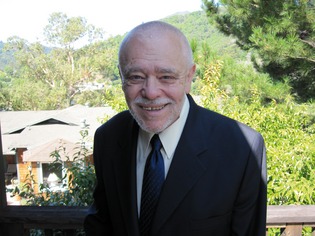
George Gregory was born on June 27, 1934, in Denver, Colorado, and moved to San Diego with his family during World War Two, then to Los Angeles where he grew up. He became interested in medicine and particularly in anesthesia at age 8 when he was treated for a leg abcess. He attended college at UCLA in 1955-59, medical school at UCSF 1959-1963, and completed his internship at Los Angeles County Hospital in 1963-64. After a year of surgical residency at UCSF, he took an anesthesia residency from 1965–1967, followed by an anesthesia research fellowship at the Cardiovascular Research Institute at UCSF in 1967-68.medical school at UCSF 1959-1963, and completed his internship at Los Angeles County Hospital in 1963-64. After a year of surgical residency at UCSF, he took an anesthesia residency from 1965–1967, followed by an anesthesia research fellowship at the Cardiovascular Research Institute at UCSF in 1967-68.
Dr. Gregory has made numerous contributions to neonatology and pediatric anesthesia through his research and is widely known for his textbook Gregory’s Pediatric Anesthesia, but his most important achievement is undoubtedly the invention of the use of continuous positive airway pressure (CPAP) for respiratory distress syndrome.
When Dr. Gregory was still a junior anesthesiologist on call in the NICU, he was called to see a premature infant in severe respiratory distress with a PaO2 of 30 mmHg. Without intervention, the baby would undoubtedly would have perished. Dr. Gregory recalls, “The infant was in respiratory distress and actually went to the (cardiac catheter) lab because the cardiologists thought he had congenital heart disease. He didn’t have congenital heart disease. The baby was breathing 150 times a minute, so I intubated his trachea and put an end expiratory pressure of 6–8 mmHg on the tube using a Jackson-Rees modification of the Ayres T-piece. Over the next hour, the PaO2 rose to about 230 mmHg.” [1] The child survived. Subsequently the therapy was applied to 20 infants of birthweight 930-3800 g with respiratory distress syndrome over a 16-month period, with 16 surviving.[3]
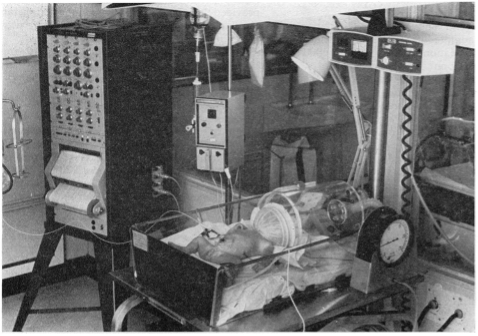
In order to avoid the trauma and risks of intubation, Dr. Gregory evolved his treatment to use what was later referred to as a “Gregory Box,” or pressurized plastic chamber with the infant’s head inside, receiving an oxygen/air mixture under controlled pressure, and the body outside for easy access.[2] Because of the danger of pressure leaks around the neck if the baby moved (or was moved), Dr. Peter Dunn’s team in the UK developed a pressure monitoring module that would warn of leaks and also provide a relief valve in case of overpressure. However, head boxes had their own challenges – a very loud environment for the baby, gastric distension from the babies swallowing the pressurized air, and difficult access for nurses when they needed to suction the baby or do other care around the head.
In a very short time, the teams of Dr. Kattwinkel and Dr. Agostino separately developed and published a technique for delivering CPAP using soft nasal prongs or nasal cannulas, which (along with the so-called “bubble CPAP” pioneered by Sahni and Wung) remain the standard of practice today. [4] [5] [6]
The introduction of CPAP took place at least 5 years before the widespread availability of infant ventilators, and undoubtedly saved an untold number of lives. Severe respiratory distress syndrome, however, continued to take its toll, until neonatologists could bring other technologies to bear: pressure-limited time-cycled ventilators, and later, surfactant replacement.
Dr. Gregory is currently serving as Professor Emeritus at the University of California, San Francisco (UCSF). In his honor, UCSF created the “George Gregory Teaching Award” that is given by the graduating fellows to one Pediatric Anesthesia faculty member each year.
[1] Mai CL, Yaster M, Firth P: “The Development of Continuous Positive Airway Pressure: an Interview with Dr. George Gregory.” Pediatric Anesthesia 23 (2013) 3-8. doi:10.1111/pan.12075
[2] Dunn PM: “Continuous Positive Airways Pressure Using the Gregory Box.” Proceedings of the Royal Society of Medicine, (67) 245-247, May 1974.
[3] Gregory GA, Kitterman JA, et al: “Treatment of the Idiopathic Respiratory Distress Syndrome with Continuous Positive Airway Pressure.” NEJM 284(24), 1333-1340. June 17, 1971.
[4] Kattwinkel J., Fleming D., Cha C. C., Fanaroff A. A., Klaus M. H. A device for administration of continuous positive airway pressure by the nasal route. Pediatrics. 1973 Jul;52(1):131–134.
[5] Caliumi-Pellegrini G., Agostino R., Orzalesi M., Nodari S., Marzetti G., Savignoni P. G., Bucci G. Twin nasal cannula for administration of continuous positive airway pressure to newborn infants. Arch Dis Child. 1974 Mar;49(3):228–230. doi: 10.1136/adc.49.3.228.
[6] 5. Sahni R, Wung J-T. Continuous positive airway pressure (CPAP). Indian J Pediatr 1998;65:265–71. 10.1007/BF02752303
Last Updated on 02/14/26