A Warm Room for the Newborn: Dr Colrat’s Chamber-Couveuse at the Hospice de la Charité in Lyon
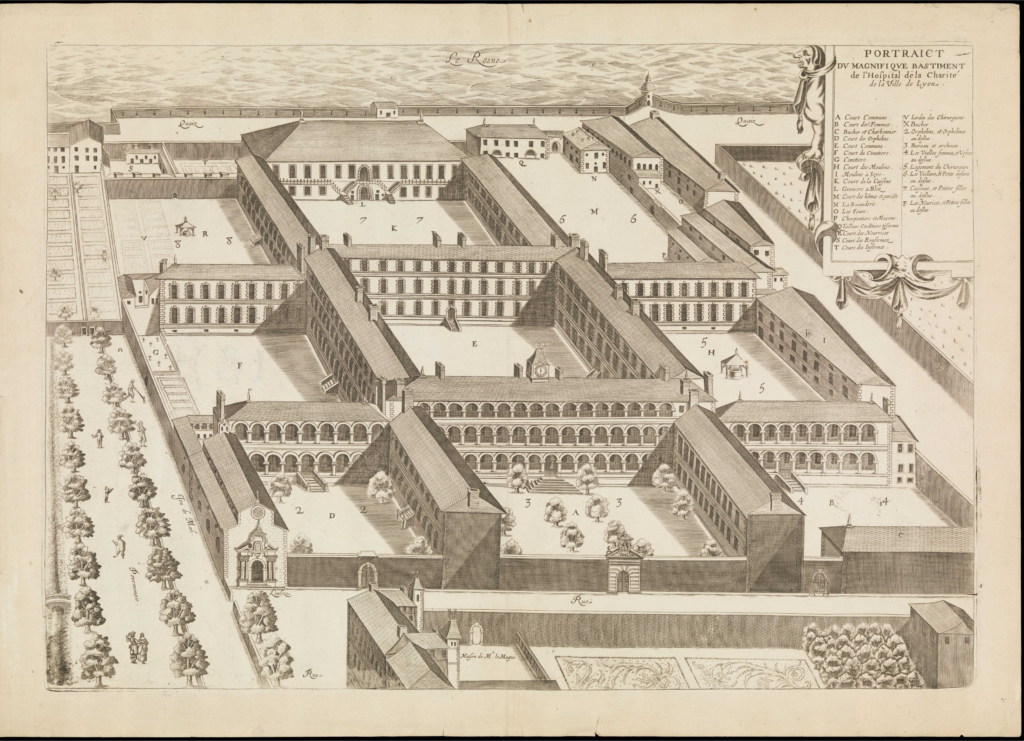
The Hôpital de la Charité grew out of Lyon’s Aumône Générale, the municipal charity founded in the early 1530s to relieve famine and curb mendicancy. For most of its life it was less a hospital than a refuge for the healthy poor — the city’s sick went to the Hôtel-Dieu — but from the beginning its largest constituency was children. After 1783, when it began admitting pregnant women and newborns, it took the formal name Hôpital général des Enfants trouvés et de la Maternité, and the care of foundlings, orphans, and the children of parents temporarily unable to keep them became its defining work. The scale was considerable: into the closing years of the nineteenth century the house received on the order of 1,400 to 1,700 abandoned children a year, drawn from Lyon and the surrounding departments.
The machinery for receiving them is one of the more poignant chapters in the institution’s history. A tour d’abandon — the rotating wooden cylinder set into the street wall that allowed a parent to leave an infant anonymously — was installed in 1804; a parent rang a small bell and slipped away, and an attendant on the inside took the child in. (I’ve posted a photograph of a surviving tour, taken at the Musée de l’Assistance Publique–Hôpitaux de Paris, here.) An open reception office, the bureau ouvert, was created in 1843, and the Lyon tour was finally suppressed in 1858. However it arrived, each child was registered with its belongings, examined by a hospital sister in the crèche, baptised, and — if judged healthy — sent out to a wet-nurse, usually in the countryside of Savoie, the Ardèche, or the Dauphiné, where it might remain for years. Mortality during transport and placement was high, and the registers that survive record, child by child, the entries, placements, and far too many deaths.
Over the second half of the nineteenth century the old hospice became a genuine hospital, and its specialisation turned decisively toward women and children. A maternity and an obstetrical clinic took shape, the service for sick children (begun in 1856) expanded, a gynaecological pavilion was built, and in 1894 the crèche service was reorganised. It was within that crèche — the unit that received the city’s débiles, the weak and premature newborns — that one of its physicians built something quietly remarkable.
“A warm room in place of the isolated incubators”
By the mid-1890s the incubator, or couveuse, was well established in French practice, thanks to the work of Tarnier and Budin. But the crèche of the Charité owned only two ageing individual incubators, and infants were constantly being sent in specifically to be placed in one. The matériel was plainly insufficient. The obvious remedy was to buy more of the small glass-and-wood boxes — but each held only one or two infants, each had to be tended and watched separately, and in a busy hospital a proliferation of them became a burden to supervise and maintain.
The physician of the service, Dr Paul Colrat — médecin des hôpitaux, who had taken up his post at the Charité in 1882 — took a different route. He had seen, in Professor Arloing’s laboratory at the Lyon Faculty of Medicine, a large étuve, a heated room of unusual size that held a perfectly constant temperature, of the kind also used in bacteriology. Why not, he reasoned, build something similar as a collective incubator — a single warm room in which a number of infants could be cared for at once? The chamber was built by the hospices’ own engineers, Gonnard and Mathian, with the heating installed by Leau, and went into service on 1 January 1896. Colrat presented the concept to the Société des Sciences médicales de Lyon in July 1896, and it was published in the September 6, 1896 issue of Lyon Médical.
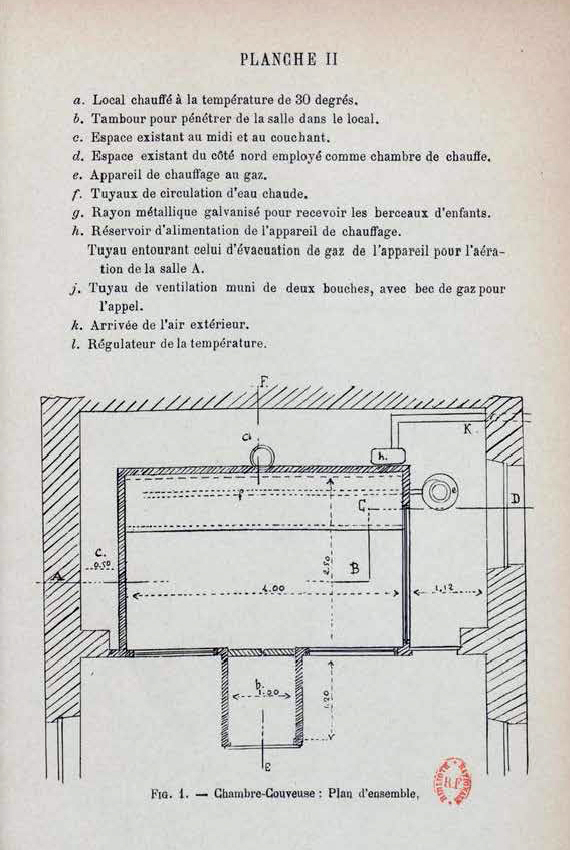
The chamber was four metres by two and a half by two and a half, enclaved within the salle des nourrices sédentaires (room for resident wet nurses) and isolated on every side by a surrounding cushion of air. Two walls and the ceiling were stuccoed masonry — the ceiling double-built, with a fifteen-centimetre air void to limit heat loss — and the two remaining faces were double-glazed, entered through a double-door airlock. Infants lay in ordinary wicker baskets ranged on a galvanised metal shelf set against the far wall, at a height chosen both for ease of care and because the temperature there was steadiest. Heat came from a serpentine hot-water coil beneath the shelf, fed by a gas stove housed in one of the enclosing air-spaces; a Wiesnegg regulator — a U-shaped steel-and-zinc bar whose branches moved with the heat and governed the gas valve — held the temperature automatically. This is the crucial point of the design, and the thing that distinguishes it from the familiar incubator: the babies were not in glass boxes at all. They were in open cradles, and the warmth came from the room.
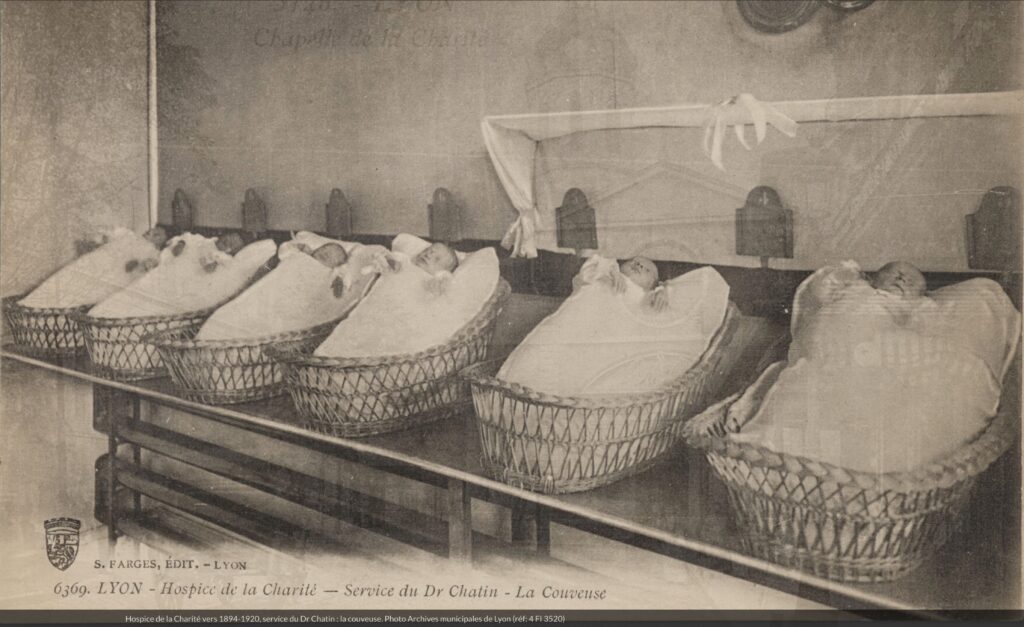
Hospice de la Charité vers 1894-1920. Source: Photo Archives municipales de Lyon (réf: 4 FI 3520)
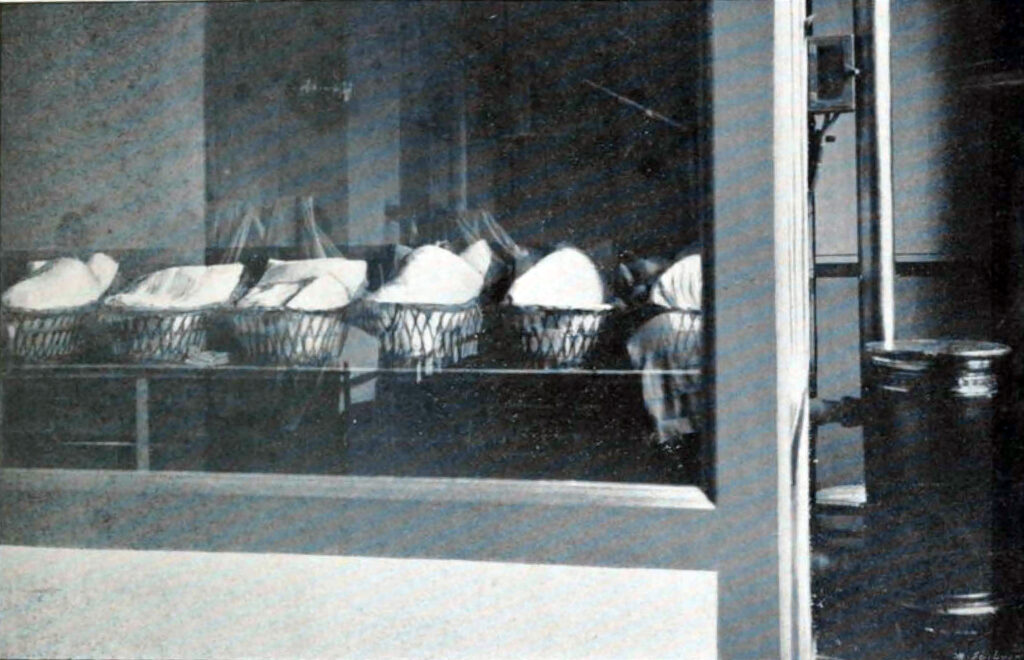
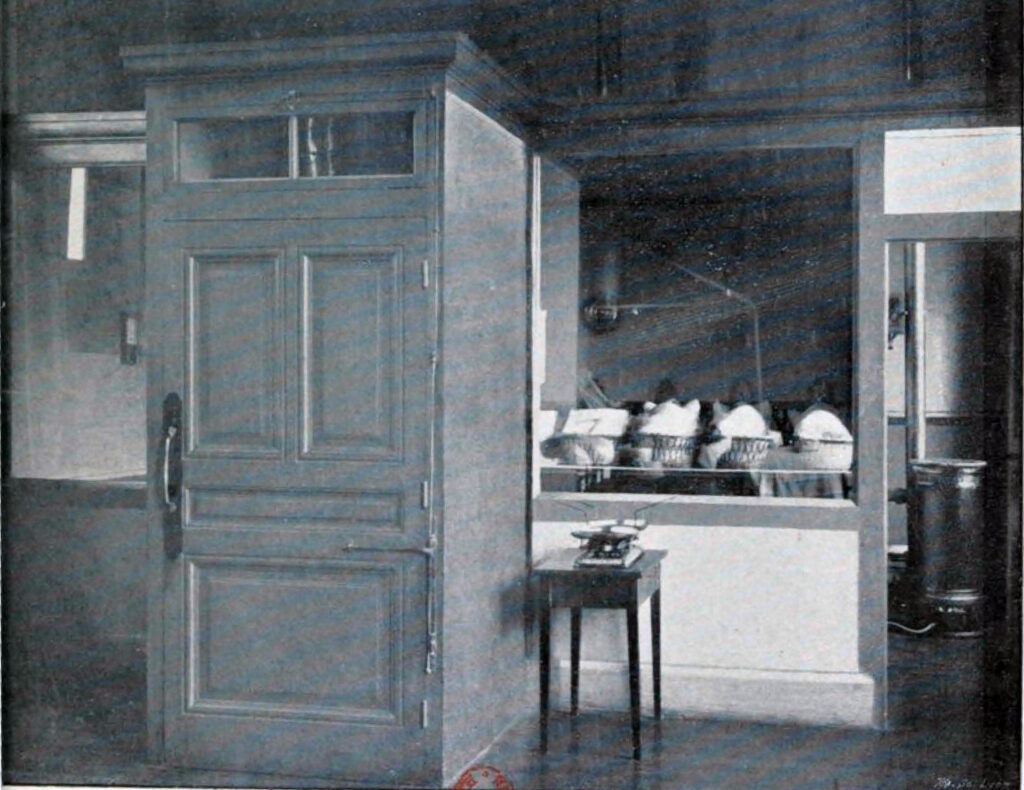
Photos of the chamber-couveuse in operation. Source: Source: Gignoux Thèse de médecine, Lyon, 1898.
Colrat fixed the working temperature, by experience, at 30°C — above that, he found, the infants grew restless, cried, and slept badly, and the Lion incubators of the day did not exceed it either. Fresh air was drawn directly from the courtyard at roof height, well away from the ward, through ducts that sheathed the hot-water pipes and so arrived pre-warmed; stale air escaped at floor level, and a burner-fitted funnel could force a complete air change in four or five minutes without dropping the temperature more than two degrees. Damp swaddling cloths hung along one wall kept the humidity close to that of the adjoining room. Temperature charts taken every three hours showed the room holding at 30° within a degree or two — steadier, in fact, than the small incubators.
The advantages, as Colrat and his thesis-writing pupil Jean Gignoux set them out, were practical and humane at once. It was far cheaper to build one chamber (around 2,300 francs, gas the only running cost) than to buy ten incubators at roughly 500 francs apiece. It was easy to run — the handling could be entrusted to anyone — and it was safe, since the temperature physically could not climb past 38° even with every tap open, so no alarm bell was needed. Its glazed, almost elegant appearance was less alarming to mothers than the old elongated wooden boxes. The obvious worry — that crowding nine or ten infants invited contagion — proved unfounded in practice: cases of broncho-pneumonia, thrush, erysipelas, and purulent conjunctivitis all passed through the room without a single transmission, because each infant had one attendant assigned to it and no one else was permitted to touch it. Infants only slept in the chamber; feeding and changing were done outside it, near a stove.
The chamber-couveuse design was of a piece with Colrat’s whole approach to the newborn and the sick child, which leaned hard on physical and hygienic measures and was sparing of drugs. His obituarist put it bluntly: across this series of works “there is no question of remedies — he gave few, and gave them less importance than hygiene, regimen, and the exact surveillance of his patients.” Warmth, clean air, humidity, and watchfulness — the logic of the warm room — were of a piece with his use of baths and thermal regulation elsewhere in his paediatrics. After the death of his colleague Perroud, he was reckoned the most sought-after consulting physician for children’s illnesses in Lyon. He died on 8 August 1901.
The Charité itself was demolished in 1934; only the bell tower of its church, built to a design attributed to Bernini, still stands on the place Antonin-Poncet. The chamber-couveuse survives only in the documentary record — in Gignoux’s 1898 thesis, with its plates and temperature curves, and in the picture postcards of the period, which show the warm room and its rows of basketed infants under the label “Service du Dr Chatin — La Couveuse,” after the physician who succeeded Colrat in the crèche service.
A road not taken
For all its ingenuity, the chamber-couveuse was an evolutionary dead end. The mainline of incubator development ran through the sealed individual box — Tarnier to Auvard to Budin to Lion to Hess to Chapple — and it was that design, not the warm room, that survives in the incubators we use today. It is worth asking why, because the Lyon chamber did not fail on its own terms. Gignoux’s temperature curves are stable, his weight charts climb, and Colrat’s clinical judgment was sound. The room kept its babies warm and they survived. It lost on other grounds entirely.
The deepest of these was isolation. The whole Tarnier–Auvard–Lion lineage gave each infant its own enclosure; the chamber gave them a shared airspace and a staffing rule — one dedicated attendant per cradle, forbidden to touch any other. That the chamber worked is not in doubt: Gignoux records broncho-pneumonia, thrush, erysipelas, and purulent conjunctivitis all passing through the room without a single transmission. But the very length at which he defends the point is the tell. A barrier made of discipline holds only as long as the discipline does, and a field moving rapidly toward the germ theory was coming to trust physical separation over procedure. Budin’s own program of per-infant hygiene pointed the same way.
The other reasons were structural. The individual incubator was a product — buildable, saleable, transportable, usable in a private home or any ward, and improvable model by model. Lion could open incubator storefronts across France and beyond; no one was going to franchise a masonry room. The chamber was a single architectural installation tied to one room in one building, and when the Charité was pulled down in 1934 it simply ceased to exist, while the incubator-as-object kept evolving toward the machines of modern neonatology. The economic logic that had justified the room in the first place — the cost and labor of running ten separate boxes in a high-volume foundling crèche — also thinned as incubator manufacture matured and prices fell. The chamber would have become impractical in any event as smaller and smaller babies were cared for that required closed-loop temperature control.
So the chamber-couveuse belongs to the history of neonatal care as a genuine branch that bore no descendants: a coherent, humane, well-documented answer to the problem of warming the newborn that happened to back the losing architecture. It is a useful reminder that the survival of a medical technology turns not only on whether it works at the bedside, but on whether it can be manufactured, moved, multiplied, and reconciled with the direction the rest of medicine is travelling. On those counts the glass box won, and the warm room was left to the postcards.
Primary sources
Colrat, Paul. “Nouvelle couveuse pour enfants.” Société des Sciences médicales de Lyon, séances de juillet 1896. In Lyon Médical, 28e année, tome LXXXIII (6 September 1896): 415–417. Source: Gallica (BnF): https://gallica.bnf.fr/ark:/12148/cb343488352/date1896
Gignoux, Jean. Des avantages au point de vue hospitalier de la chambre couveuse installée à la Charité de Lyon. Thèse de médecine. Lyon: A. Rey, imprimeur de la Faculté de médecine, 1898. Source: Gallica (BnF): https://gallica.bnf.fr/ark:/12148/bpt6k64680981
[Aubert, P.] “Le docteur Paul Colrat.” Obituary. Lyon Médical, no. 33, 33e année, tome XCVII (18 August 1901): 209–214. (Accompanied by the unsigned death notice “Mort du docteur Colrat,” p. 205.) Digitised on Gallica (BnF): https://gallica.bnf.fr/ark:/12148/cb343488352/date1901
Institutional and biographical references
“Hôpital de la Charité de Lyon.” Wikipédia. https://fr.wikipedia.org/wiki/Hôpital_de_la_Charité_de_Lyon
“L’Hôpital de la Charité.” Patrimoine-Lyon.org. https://www.patrimoine-lyon.org/secteur_unesco/presqu_ile/ainay-3/l-hopital-de-la-charite
“Hospice de la Charité, hôpital général de la Charité.” Inventaire général du patrimoine culturel, Auvergne-Rhône-Alpes. https://patrimoine.auvergnerhonealpes.fr/dossier/IA69007053 (postcard series, incl. “Crèche, service du Dr Chatin, vers 1910,” AC Lyon 4FI_03526)
“Un registre d’inscriptions des filles-mères pour l’accouchement.” Archives municipales de Lyon. https://www.archives-lyon.fr/documents-remarquables/un-registre-dinscriptions-des-filles-meres-pour-laccouchement
“Fonds de l’hospice de la Charité (XVe siècle–1935).” Hospices civils de Lyon / FranceArchives. https://francearchives.gouv.fr/findingaid/420d8009ca136c1334d65671167215f25c7be2ce
“Colrat, Paul.” CTHS – La France savante. https://cths.fr/an/savant.php?id=107738
Image
“Le tour d’abandon (The Desertion Tower).” Neonatology on the Web. https://neonatology.net/history/le-tour-dabandon-the-desertion-tower/ (photograph taken at the Musée de l’Assistance Publique–Hôpitaux de Paris, https://www.aphp.fr/musee)
French primary sources were machine-translated, then checked against the originals and edited by the author. Portions of this page were drafted with machine assistance; the final text was reviewed, verified, and edited by the author. Click here to learn more.
Last Updated on 07/20/26