Die „Kinderbrutanstalt“ auf der Berliner Gewerbe-Ausstellung
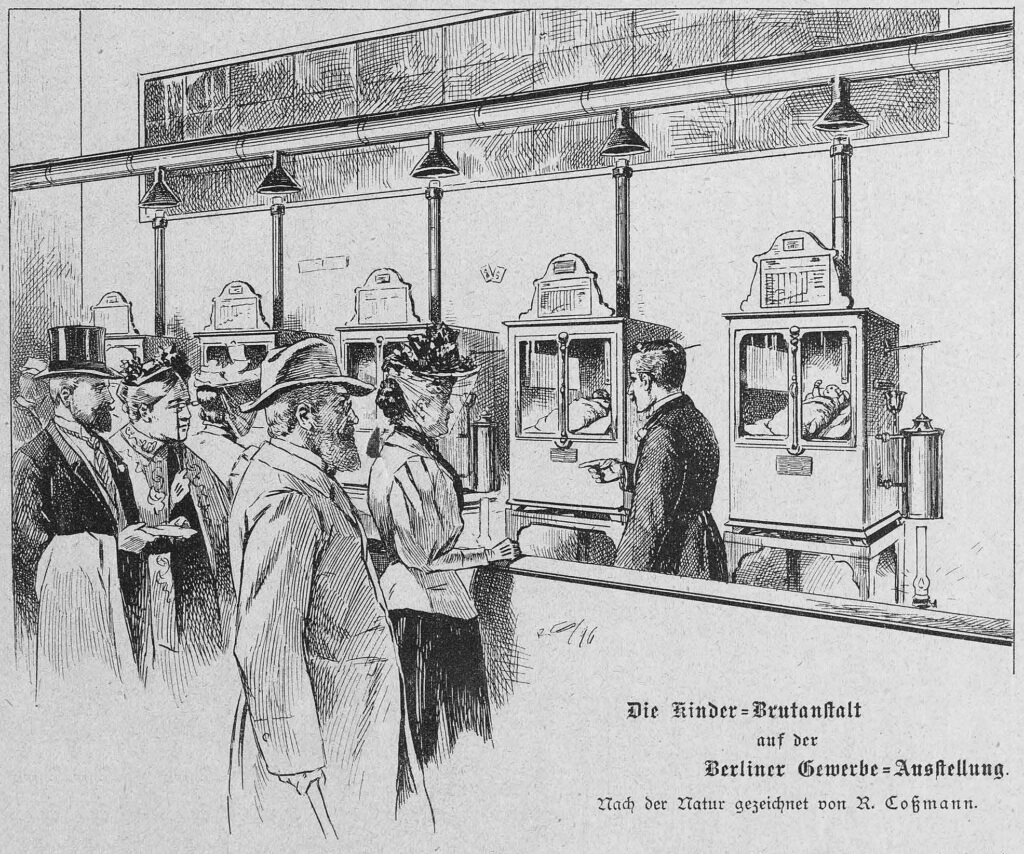
The “Children’s Hatchery” at the Berlin Trade Exhibition.
Berliner Illustrirte Zeitung October 11, 1896
One of the most interesting exhibits on the Treptow grounds is undoubtedly the incubator of Mr. Lion from Nice. The rather unappealing German name for this welfare institution, so important for the preservation of our little earthlings, as “Children’s Hatchery,” has given rise to some rather peculiar assumptions about its purpose among naive minds; indeed, there has been no shortage of believers who thought that the great problem of creation, the chemical production of the Son of Man, had finally been solved. Semach! [Not so fast!] Our science has not yet progressed that far, and the homunculus will have to wait a while longer
Strictly speaking, the “incubator” is merely an device in which prematurely and weakly born infants are to be kept alive through appropriate regulations, above all by constant exposure to a suitable temperature. Mr. Lion’s incubator serves this important purpose. It consists of a box made of sheet iron and nickel-plated copper, resting on a cast-iron base. A well-closing hinged door is located on the front, while the left side has a window through which the mother can observe the child’s movements when the apparatus is placed next to the mother’s bed. The child rests on an iron grid suspended freely by four hooks, which is slightly inclined, like a metal hammock. The apparatus is heated by hot water.
The water circulates in a spiral tube beneath the child’s bed, and this tube is connected to a water reservoir at the base of the apparatus. Any type of heating element can be used to heat the water. The temperature in the cistern is determined by the attending physician, taking into account the child’s age and physical condition. Generally, the temperature ranges between 25 and 38 degrees Celsius. The temperature is regulated automatically by an extremely sensitive device. Inside the casing is a copper coil filled with alcohol, at one end of which is a lever that extends through the wall and carries a float, a double-flap-shaped cap, on a fine chain. This cap closes a hollow cylinder, whose double wall forms the water reservoir that supplies the heated water to the coils of the heating element. If the temperature of the air in the heating element rises even by a vanishingly small fraction, the copper coil inside expands, the lever is set in motion, and the cap is lifted. This allows some of the excess heat to escape, causing the water in the heating coil to cool and the temperature in the apparatus to drop. A thermometer allows the temperature to be monitored in the usual way.
Just as the supply of warm water to the serpentine tube system is well provided for, so too is the supply of fresh, clean air. The air enters the apparatus from outside through a purifying cotton filter; the necessary humidity is also supplied to the interior air. The air is extracted through a vent opening at the top. In this ingeniously yet simply constructed incubator, the little being rests continuously, leaving its softly bedded resting place only to receive nourishment in an adjoining room. The length of stay depends on the child’s state of strength; once its body weight has reached 5-6 pounds, the child can leave the apparatus, but not before the temperature has been lowered in the days leading up to its release, in order to acclimate the little earthling to the outside temperature of the room to get used to it. The “hatchery” in the trade exhibition, located between the main hall and the building for welfare facilities, houses 5 incubators; next to the exhibition room are rooms for the wet nurses, the waiting staff, etc. It is supervised by Director Léotardi.
Currently, there are three tiny infants in the institution, one of whom should soon be discharged as fully viable. A second child was admitted on the day of its birth, in mid-September, weighing a meager 1440 grams, i.e., not quite 3 pounds. Initially, it was so weak that it had to be artificially fed with a spoon constructed by Lion, inserted through its nose. Now the little girl has already gained 260 grams, as the orientation chart on the outside of the apparatus indicates. The third child, a miserable, weak boy, was brought in weighing only 1210 grams (!); its strength, too, has already increased considerably.
In France, the Lion Couveuse has achieved extremely favorable results in various cities, including Paris, Nice, Bordeaux, Lyon, and Marseille; even our most distinguished physicians and hygienists are favorably disposed toward this truly beneficial institution.
Dr. B
German primary source was machine translated, then checked against the original and edited by the author.
Last Updated on 07/20/26