Pragel Newborn Transport Incubator
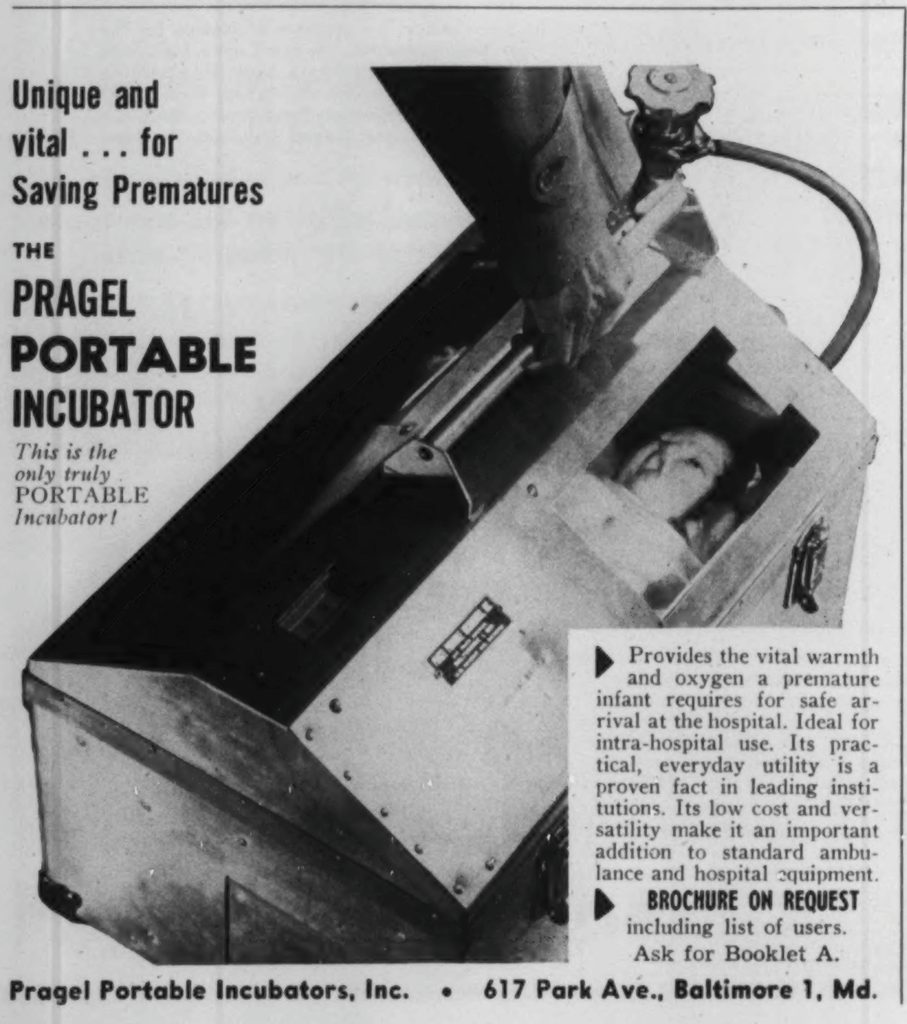
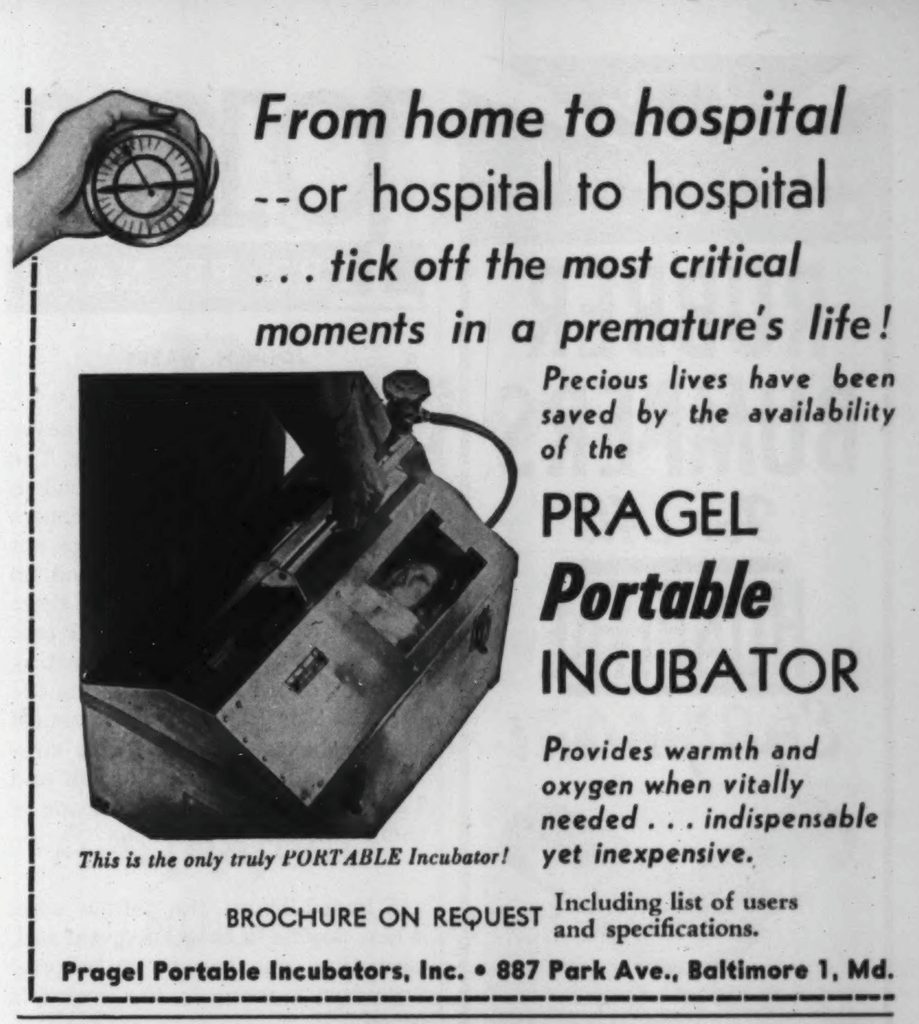
Pragel Portable Incubators, Inc. was a mid-20th-century medical equipment maker in Baltimore, Maryland. The company was founded by John Louis Pragel (1883–1953), a maker of steel trunks and racks for automobiles in Baltimore, Maryland. The idea for the incubator did not start with him. The idea for the infant carrier originated with Beatrice McKellar, an obstetric nurse at Johns Hopkins Hospital. Sara Fetters, at the Maryland Department of Health, worked with Pragel to build a carrier “for transporting prematurely born infants from outlying communities to hospitals having incubators” (Fielding, “Life-Saving Box,” The Baltimore Sun, 29 May 1949).
Pragel filed for a patent on August 15, 1947. He received U.S. Patent No. 2,470,721, “Portable Infant Incubator,” on May 17, 1949. The patent lists no assignee. By the time the patent issued, Maryland was already using the carrier widely: the same Baltimore Sun article reported forty-nine (49) carriers strategically located around the state at firehouses and police stations. A nurse who learned of a premature birth called the nearest station to have a carrier brought to the home.
The patent states: This invention relates to a portable baby incubator which is particularly useful in the handling and treatment of prematurely born infants. It is the object of the present invention to provide a portable baby incubator which is readily transportable from place to place and which may function as an infant’s bed or ambulance for prematurely born infants, accommodating them for proper treatment from a time immediately following birth to such a time when they are in a sufficiently healthy and mature state to be disposed in a conventional baby crib or bassinet.

- Material: The patent calls for sheet aluminum because it is light and easy to sterilize. It names metal, fiber, or plywood as alternatives, and methyl methacrylate (acrylic) for the clear parts. The Smithsonian unit is cataloged as aluminum; plastic; glass; rubber (overall material).
- Size and weight: 19 1/2″ long by 13″ wide by 15″ tall. The patent gives a weight of about 13½ lb without the oxygen attachments.
- Hood and fasteners: The hood is hinged along one side and opens about 180°. It is secured with hasp fasteners of the kind used on trunks and luggage, which reflects Pragel’s trade. Surviving units have two latches on the front which release a hinged top.
- Carrying handle: A long handle on top of the hood lets the carrier shift their grip. The patent provides this because the center of gravity moves when the oxygen carrier is attached.
- Access and Observation: Two sliding transparent panels in the sloped sides of the hood let staff reach the infant without opening the whole unit. A thermometer is mounted inside the hood and can be read through a small fixed window in the top.
- Heating: The unit has no electrical heating, so it could be used where power was unavailable, such as rural areas. Heat comes from hot water bottles (the patent shows three, placed beneath and beside the platform) or from chemical water heaters, with water at about 140°F.
- Ventilation: A screened opening in the foot-end wall has a single sliding gate that adjusts how wide it opens.
- Oxygen: A detachable aluminum plate hooks over the head-end wall and holds a small oxygen tank. The gas passes through a sealed water jar, which humidifies it and shows the flow rate as visible bubbles, and then through tubing into a port in the hood. The plate can be removed when oxygen isn’t needed. Not every surviving unit still has this assembly.
- Infant Platform: A removable rack holds a perforated platform on uprights above the floor of the case. The perforations let heat from the bottles reach the infant, and the space underneath holds the bottles and supplies.
Surviving examples: The Smithsonian’s National Museum of American History holds one unit (catalog no. 1984.1028.01), dated ca. 1950.


Nicholas Studer was kind to supply pictures of the Pragel incubator in an 1963 Pinner-Chrysler ambulance (https://www.allpar.com/fleets/pinner.html).


Sources
- Smithsonian NMAH: Pragel Portable Infant Incubator
- Smithsonian object record
- U.S. Patent 2,470,721 (PDF)
- Wikipedia: Newborn transport
- “Life Saving Box,” The Baltimore Sun, May 29, 1949.
Created 12/16/2007 / Last modified 4/9/2022
Converted to WordPress 12/2/2025
Last Updated on 11/05/26