L. Joseph Butterfield, MD (1926–1999)
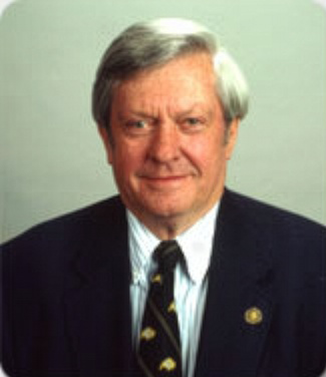
L. Joseph Butterfield was born in 1926 and received his medical degree from the University of Colorado School of Medicine in 1955. After an internship at UCSF, he did his pediatric residency at the Children’s Hospital in Denver and would spend virtually his entire career in Denver, building one of the most consequential programs in the history of American neonatal medicine at what is now Children’s Hospital Colorado. Trained during an era when the premature infant nursery was largely an afterthought in the architecture of pediatric hospitals, Butterfield entered the field at precisely the moment it was ready to be transformed from a custodial specialty into a true intensive care discipline. His instincts were those of a builder and organizer as much as a clinician, and the institutions and systems he created would endure long after his own lifetime.
By 1961, before neonatology even existed as a named subspecialty, Butterfield had founded the Denver Perinatal Society, a collegial network for physicians interested in the care of high-risk newborns and their mothers. Two years later, in 1963, he became Director of the Premature Infant Center at the University of Colorado Medical Center, one of the few dedicated facilities of its kind in the American West. In 1965 he established the Newborn Center at Children’s Hospital Colorado — the neonatal intensive care unit that would serve as the clinical and educational hub of the regional perinatal care system he was already envisioning. Appointed Director of Continuing Medical Education at Children’s Hospital in 1967, he used that platform to build the educational infrastructure that would sustain the region’s workforce for decades, well before formal subspecialty board certification in neonatal-perinatal medicine existed.
Butterfield’s most far-reaching contribution to the field was his relentless advocacy for regionalized perinatal care — the principle that sick and premature newborns should be born at or transported to facilities capable of providing the level of care they actually required, rather than receiving whatever happened to be available at the hospital of delivery. As early as 1969 he was working within the American Medical Association’s Committee on Maternal and Child Care to draft formal policy language on regional perinatal care. That early advocacy helped lay the groundwork for one of the landmark documents in American perinatal health policy: the 1976 March of Dimes report Toward Improving the Outcome of Pregnancy, which recommended a national system of tiered, regionalized perinatal care centers jointly endorsed by the American Academy of Pediatrics and the American College of Obstetricians and Gynecologists. The subsequent, measurable decline in neonatal mortality across the United States during the late 1970s is inseparable from the implementation of that framework.
To bring the concept to life in his own region, Butterfield developed what he called “Newborn Country USA,” a regionwide integrated perinatal care system built around the Denver Regional Perinatal Center. The program coordinated among four Denver-area hospital units — Children’s Hospital, Denver General Hospital, Fitzsimons Army Medical Center, and the University of Colorado Medical Center — and extended outreach education and consultation to 223 hospitals across portions of ten states serving more than 70,000 births annually. Research by Butterfield and colleagues comparing neonatal mortality rates in Colorado from 1971 through 1976 demonstrated that the neonatal mortality rate declined by 35% as regionalization activity increased, with the greatest reductions in counties that had previously lacked any institutional newborn services. These findings gave a state-level dataset to an argument that had largely been made on theoretical grounds, and they helped validate regionalization as a matter of policy rather than aspiration.
A critical enabler of regional care was the safe transport of critically ill newborns, and Butterfield was a pioneer in that domain as well. In 1974 he founded Children’s One Emergency Transport, the dedicated neonatal transport service that would become a model for programs across the country. His 1975 collaborative paper with Gerald Merenstein, Frederick Battaglia, and colleagues in Pediatrics analyzed air transport outcomes across Denver’s neonatal units and demonstrated that well-trained nurse-based transport teams, with physicians involved selectively rather than routinely, could achieve excellent outcomes — a finding with significant practical implications for extending specialty care into remote areas. He later synthesized the full arc of this work in a widely cited historical review, “Historical Perspectives of Neonatal Transport,” published in the Pediatric Clinics of North America in 1993.
At the national organizational level, Butterfield’s influence was equally formative. In 1975, under his guidance, the American Academy of Pediatrics established the Section on Perinatal Pediatrics — today’s Section on Neonatal-Perinatal Medicine — which became the professional home of neonatologists within the AAP and the organizing body for the specialty’s educational programming, policy work, and fellowship engagement. He later documented the first quarter-century of the Section’s history in the 1999 Year Book of Neonatal and Perinatal Medicine, providing the field with an authoritative account of its own organizational development. The Journal of Perinatology, which became the Section’s official publication, dedicated an entire issue in April–May 1999 to a festschrift in his honor, with tributes written by a generation of colleagues who regarded him as a mentor, diplomat, and architect of the specialty — a recognition he received just weeks before his death.
Late in his career Butterfield turned with characteristic energy to the history of neonatal medicine itself, collaborating closely with William A. Silverman in a decades-long scholarly project to document the origins of the infant incubator. Together they assembled a substantial archive of correspondence, photographs, and research materials tracing the careers of the showman-physician Martin Couney, the incubator innovator Alexandre Lion, and the Chicago pediatrician Julius Hess. Butterfield organized an informal study group that became the AAP Perinatal Section’s Ad Hoc Committee on Perinatal History,. This work of historical recovery, conducted with the same rigor he brought to clinical and policy work, ensured that a formative chapter of the specialty’s origins was documented rather than lost. The research collection he and Silverman assembled was donated to the AAP’s Gartner Pediatric History Center and remains open to scholars today.
Dr. Butterfield received many awards and honors. He was elected to the American Pediatrics Society, received the Virginia Apgar Award, the highest honor of the Perinatal Section of the AAP, the Certificate of Service from the Colorado Medical Society, the Silver and Gold Award from the University of Colorado Medical Alumni Association, the Distinguished Service Award from ACOG, the C. Henry Kempe Award for service to children, a special award from the National Institutes of Child Health and Human Development, and the L. Joseph Butterfield Lifetime Achievement Award of the Colorado chapter of the March of Dimes/Birth Defects Foundation. The perinatal section of the AAP established the L. Joseph Butterfield Lectureship in Perinatal Strategy in 1997, in 1998 the L. J. Butterfield Chair in Pediatrics was established at the Denver Children’s Hospital.
L. Joseph Butterfield died on June 1, 1999, in Denver, at the age of 72, having served Children’s Hospital and the University of Colorado for 34 years. He left behind a NICU, a transport service, an annual perinatal conference that now bears his name and has continued for more than four decades, and the organizational infrastructure of neonatology as a national subspecialty. He was, in the phrase chosen by his colleague Philip Sunshine for the 1999 festschrift, a man for all seasons — simultaneously a clinician, educator, administrator, historian, and advocate. Few individuals in the founding generation of neonatologists shaped as much of the field’s structure while remaining so close to the patients the specialty was built to serve.
- Festschrift to L. Joseph Butterfield, MD. J Perinatol. 1999;19(3):165–211. PMID: 10712102. [Includes Sunshine P, “A Man for All Seasons,” pp. 176–178; Merenstein GB, “Personal Reflections,” p. 179; Jones MD Jr., “Personal Reflection on Joe Butterfield,” pp. 187–188.]
- Altman LK. L. Joseph Butterfield, pioneer in neonatology, is dead at 72. New York Times. June 6, 1999.
- Dr Butterfield Remembered for his Tenacity, Passion. AAP News, July, 1999, page 27.
Last Updated on 04/04/26