Chapple Incubator
In the late 1930s, the standard of care for premature infants was dangerously rudimentary. Incubators were effectively heated boxes with lids that had to be opened for every procedure, exposing vulnerable infants to fluctuating temperatures and airborne pathogens. Dr. Charles C. Chapple, a pediatrician at the Children’s Hospital of Philadelphia (CHOP), recognized that warmth alone was insufficient; to reduce the staggering mortality rates of the era, infants needed a stable, isolated micro-environment.
Dr. Chapple’s solution was a radical departure from existing technology. He designed an airtight chamber that pulled air from outside the hospital room (or filtered room air), creating a positive-pressure environment to keep pathogens out. His most distinct innovation was the introduction of sleeved ports (later “iris ports”). These allowed nurses and doctors to insert their hands and perform procedures without opening the main canopy, maintaining constant temperature and humidity. This design transformed the incubator from a passive warmer into an active medical tool, capable of precise environmental control.
Dr. Chapple described his innovations in a paper titled “An Incubator for Infants,” published in the American Journal of Obstetrics and Gynecology in 1938. He wrote:
“The apparatus described herein contains certain important features not included in other incubators. The fact that it remains closed at all times permits the fulfillment of the following prerequisites hitherto considered not practicable. (1) An accurate maintenance and adjustment of temperature and humidity permits the selection necessary in such air-conditioning for infants of different weights. (2) The infant may remain without covering or clothes which condition allows great freedom of muscular activity especially for the important function of respiration. This lack of clothes also facilitates handling and prevents the usual alterations in temperature dependent upon covering and uncovering or upon changing the diaper. (3) In addition special gas mixtures, either for emergency or prolonged use, may be provided. (4) Also, a practically complete isolation is maintained against pathogenic microorganisms, whether air-borne or otherwise. (5) It permits the nurse to work in an atmosphere which is comfortable for her. In the ordinary air-conditioned room the optimum humidity and temperature for the infant are too great for the nurse’s tolerance.”


(Figures above are from Dr. Chapple’s original paper.)
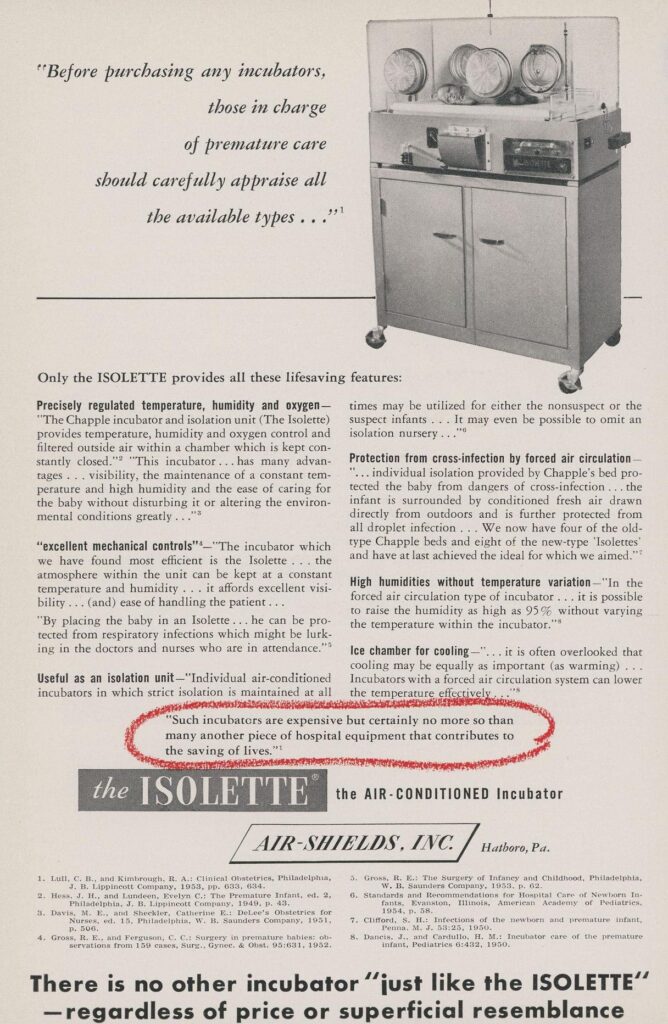
To commercialize this complex machine, Chapple partnered with Samuel Y. Gibbon, the founder of Air-Shields, Inc. based in Hatboro, Pennsylvania. The collaboration was a unique instance of wartime technology transfer: Air-Shields had spent World War II manufacturing shielded ignition leads for aircraft engines to prevent radio interference. Gibbon applied this expertise in insulation, sealing, and precision manufacturing to Chapple’s medical vision. In 1947, they released the commercial version of Chapple’s design: the Isolette Model C-35.
The Isolette captured the market by 1950, and fundamentally changed neonatology. It drastically reduced cross-infection and cold stress, helping to lower infant mortality rates and moving the care of “preemies” from sideshows to professional Neonatal Intensive Care Units (NICUs). However, the initial rollout faced significant hurdles:
- The Barrier Problem: Nurses initially resisted the device, finding the “hands-off” nature of the ports alienating. The “aquarium” effect created a psychological barrier between staff and patient.
- Hygiene Paradox: While designed for isolation, the complex humidity reservoirs were difficult to clean. If neglected, they became breeding grounds for bacteria like Pseudomonas, turning the sterile environment into a source of infection.
- The Oxygen Tragedy: The most tragic legacy was the Isolette’s efficiency. Because the seal was so effective, doctors could easily administer high concentrations of oxygen to prevent cyanosis. This unchecked oxygen therapy led to an epidemic of Retrolental Fibroplasia (now ROP), causing blindness in thousands of infants before the link was discovered in the 1950s.
Despite these early challenges, the architectural standard established by Dr. Chapple—a transparent, environmentally controlled box with port access—remains the blueprint for the modern incubator, and the later models of the Isolette and its competitors are seen everywhere today. They are sturdy, long-lasting, and easily maintained. The Isolette (later acquired by Dräger) became the global gold standard, demonstrating once again that the survival of premature infants depended not just on heat, but on the meticulous control of their entire physical environment.
- “An Incubator for Infants,” by Charles C. Chapple, Am. J. Obst. and Gynec. 35:1062-1065, 1938
- Chapple Incubator Patent US2243999, filed March 4, 1938, granted June 3, 1941.
Last Updated on 02/15/26