The Infant Incubator Company
Origins and Incorporation
The Infant Incubator Company was the formal business vehicle through which Martin Couney — born Michael Cohen in Prussia, circa 1869 — commercialized the incubator exhibition enterprise he had been running since the late 1890s. Couney was a businessman as well as a showman, and formed the Infant Incubator Company to market and sell incubators manufactured by Kny-Scheerer and to supply equipment for his various exhibits.
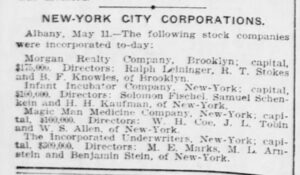
The certificate of incorporation bears the date May 10, 1905; it was filed in the Office of the Secretary of State, Albany, New York, on May 11, 1905, and in the Office of the Clerk of the County of New York on May 12, 1905. The New York Tribune of that same day published the incorporation notice: “Infant Incubator Company, New-York; capital, $100,000. Directors: Solomon Fischel, Samuel Schenkein and H. H. Kaufman, of New-York.” Its original capital stock consisted of 1,000 shares of common stock at $100 par value, totaling $100,000. The timing is notable: records of the New York Supreme Court show that Michael Cohen (by then having immigrated under the name of Martin Cohn), changed his name legally to Martin Couney on October 1, 1905 — suggesting a deliberate effort that same year to consolidate both his personal and commercial identity.
Key Figures and Relationships
Samuel Schenkein, listed as one of three founding directors, was a London-based exposition promoter whose partnership with Couney stretched back to the earliest documented phase of Couney’s exhibition career. The first well-documented association of the two men in an incubator baby exhibit is the Victorian Era Exhibition at Earl’s Court, London, in 1897, where they appeared together as co-representatives of the apparatus. Their collaboration in the United States followed from there, and Schenkein’s incorporation as a founding director of the 1905 company was the formal capstone of a partnership of nearly a decade’s standing.
The third founding director, Solomon Fischel, died in October 1913, his stock was sold by his widow at auction, and Schenkein’s involvement with the company also eventually ended. Per Louise Recht’s sworn deposition testimony, in or about 1922 the capital of the Infant Incubator Company was reduced from 1,000 shares ($100,000) to 200 shares ($20,000) — an 80% contraction. At that point there were just four stockholders: the Couneys, Louise Recht, and the Couneys’ cousins, with neither Schenkein nor Fischel among them. This capital reduction almost certainly reflects the mechanism or final accounting of Schenkein’s exit, with his shares retired or bought out as part of the restructuring. Dawn Raffel’s narrative of the 1920s in The Strange Case of Dr. Couney notes simply that “Schenkein was out.” A subsequent news story in the Brooklyn Eagle (June 8, 1928) stated that at as of 1928 there were six stockholders: Martin Couney, his wife May Couney, Louise Recht, Isador Schulz, Sol Schulz, and Benjamin Schulz.
The Hardware Side: Kny-Scheerer and the Lion Incubator
The company’s primary hardware sourcing relationship appears to have been with Kny-Scheerer, a New York surgical supply firm. The Kny-Scheerer catalog of “Surgical Instruments,” 20th Edition, 1915, contained an entry for an incubator that follows the Lion Incubator design exactly, with a description identical to that of the Lion Incubator in contemporary articles in the medical press. It appears that Kny-Scheerer manufactured these incubators in the US under license from Alexandre Lion. The Kny-Scheerer incubators were used in many exhibitions and incubator sideshows in the US after 1901. Before that date, Martin Couney and others imported incubators built by Paul Altmann in Berlin, Germany, also under license from Alexandre Lion. The Infant Incubator Company therefore sat at the downstream end of a transatlantic licensing chain that ran: Lion (France) → Altmann (Berlin) / Kny-Scheerer (New York) → Infant Incubator Company → exhibitions nationwide.
While Couney and his colleagues Fischel and Schenkein frequently claimed to be inventors of the incubators they used, it is clear that the incubators were based directly on Lion’s French patents and that Couney’s business had no manufacturing capabilities.
Commercial Activities and Advertising
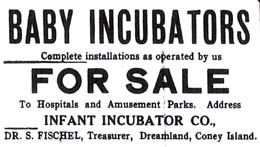
The Infant Incubator Company was not merely a holding entity for Couney’s own exhibits — it actively marketed to the broader trade. The Infant Incubator Company at Dreamland advertised in The Billboard, the trade magazine for theatrical professionals including sideshow and midway performers: “Baby Incubators, complete installations as operated by us, for sale to hospitals and amusement parks” (May 1, 1909). The dual customer base — hospitals and amusement parks — perfectly encapsulates the ambiguous position the company occupied: simultaneously a medical supplier and a midway concessionaire. The company also frequently staged short-lived incubator baby installations at state and regional fairs, Solomon Fischel often taking a leading role in marketing and managing these traveling exhibits.
A June 10, 1928 New York Times report on a federal tax proceeding sheds rare light on the company’s financial operations during 1920, before the capital restructuring. The Board of Tax Appeals ruled that the Infant Incubator Company — then conducting exhibitions at Luna Park, Palisades (N.J.), Atlantic City, and Chicago — was not a “personal service corporation” under the 1920 tax law, and therefore owed taxes at the higher rate applicable to general corporations. The company had argued that all of its stockholders were regularly engaged in operating the incubators and that personal service was therefore its principal income-producing activity. The Board disagreed, holding that “capital was a material income producing factor” and that admission receipts from public exhibitions — explained by on-site lecturers — did not qualify as personal service income. A deficiency of $1,529.55 was assessed. The proceeding also revealed the company’s venue cost structure: in most cities it paid annual rentals ranging from $5,000 to $7,000, while at Luna Park it paid no fixed rental but instead a commission of $13,913.38 — a figure that speaks to the Coney Island exhibit’s outsized revenue relative to the touring locations.
At major expositions, Kny-Scheerer itself sometimes appeared as the contracting party. The April 1908 Alaska-Yukon Magazine included the Baby Incubator Exhibit on a list of concessions “already signed,” with “Kny-Scheerer Company, New York” credited as signatory on the contract. This suggests the corporate relationship between the Infant Incubator Company and Kny-Scheerer was close enough that the two entities were sometimes functionally interchangeable in exposition contracts.
Context and Legacy
The Infant Incubator Company existed within a broader ecosystem of competing and imitating shows. The perceived dangers of fairground exhibits were accentuated by imposter shows, which began appearing in fairgrounds as a result of the profitability of shows such as Couney’s Infantorium. These shows often did not adhere to the same cleanliness and professional standards as the well-known Infantorium. The company’s advertising — distinguishing “complete installations as operated by us” — was partly a commercial differentiator against this cottage industry of imitators.
The company’s active lifespan as a going concern is not precisely documented beyond the 1922 restructuring, but the underlying exhibition enterprise it supported continued until Couney’s permanent Coney Island exhibit at Luna Park finally closed. Couney continued his display at Luna Park until 1943, claiming he would not retire until city hospitals opened up proper incubator wards. By then, mainstream neonatology had largely absorbed the methods the company had spent four decades demonstrating at a quarter a head.
Portions of this page were drafted with machine assistance; the final text was reviewed, verified, and edited by the author. Click here to learn more.
Last Updated on 07/20/26