Exposition Universelle et Internationale de Dijon, 1898
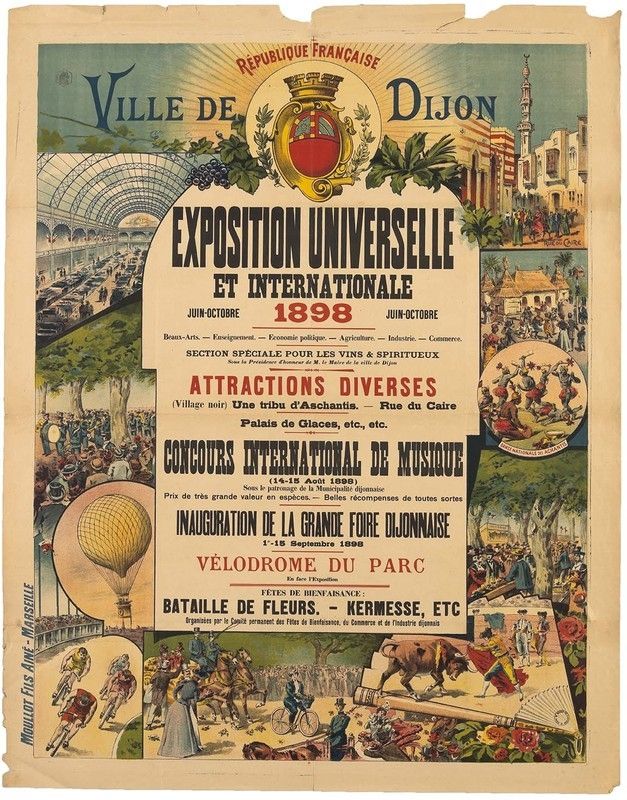
The Exposition Universelle et Internationale de Dijon ran from June to October 1898, on a site of about 30,000 m² near the rond-point of the allées du Parc. The site was slightly outside the city centre and was reached by tramway. The exposition director was M. Brunel, and Mayor Morin-Gacon took part in the official inauguration. The exposition was organized in 14 sections, including fine arts, social economy, hygiene, life-saving, electricity, military arts, women’s economic institutions and manual work, and colonies, with a special section for wines and spirits under the mayor’s honorary presidency. The official opening was set for June 25, but installations were still being finished into early July. The site was first lit by electricity on July 2, and it stayed open until 10:30 pm four nights a week. Admission was 1 franc by day (50 centimes for children, soldiers and students) and 50 centimes after 8 pm.
The main attraction was an ethnographic “village noir” of about 2,500 m², billed as a “tribu soudanaise.” The sources give between about 100 and 150 residents, and one poster calls them Ashanti. The press named the chief as Serrou Diop and described the group in the racialized terms of the day. Their fêtes were built into the exposition’s calendar. Other attractions included a Rue du Caire, a Palais de Glaces, a Moorish palace, the cinématographe, X-ray demonstrations, illuminated fountains, and baby incubators. Across the road, the Vélodrome du Parc staged popular events, including bullfights (Félix Robert killed two Carreros bulls there on July 10). The program also included a Concours International de Musique (August 14 to 15), the Grande Foire Dijonnaise (September 1 to 15), and charity festivals. A Sunday fête on July 31 drew about 10,000 visitors. A later secondary account puts total admissions at about 200,000, with receipts covering only about half of expenses, making the exposition a financial failure.
The incubator exhibit
The “Couveuses d’enfants avec bébés vivants” were supplied by Dr. Ch. Van Aubel, director of the Maternité Sainte-Anne in Brussels. They were announced in the Dijon press on June 19 as his “nouvelles couveuses,” shown in Dijon for the first time. The notices said the design had won a gold medal at the Brussels exposition of 1897. The official list of Brussels awards confirms a gold medal for “Van Aubel, Bruxelles” in the hygiene group, which covered personal, food, child and industrial hygiene, but does not name the object awarded. Alexandre Lion’s Œuvre maternelle des couveuses d’enfants, based in Paris, received a diplôme d’honneur, one grade higher, in the same group.
The incubator exhibit was declared “visible” on July 2, about a week after the exposition opened. By the press visit that evening it already held “plusieurs mignons pensionnaires” [several cute boarders]. It was run by M. and Mlle Trusson under the supervision of an unnamed Dijon physician. The exhibit was presented as philanthropy: care was free, the operators paid the infants’ costs, and the press stressed that it was not run for profit. Visitors still paid to enter, but from late July school groups were admitted free. Staff watched the infants day and night, and two wet nurses lived on site. On August 9, six incubators were in operation and four were occupied. The press was consistently favorable, but coverage stops after August 9, and nothing has been found so far in either the French or Belgian press about the exhibit’s closing or on outcomes for the infants.
The Progrès de la Côte-d’Or (August 1 to 2) described the apparatus in detail. Each unit was a glass cage of about 70 × 50 × 45 cm, with only the sides glazed. The floor was a grid of hollow metal bars carrying steam from a boiler of about 2 liters, heated by a gas lamp that vented outside. The infant lay on cloth stretched over two rods above the bars. Air warmed by the bars rose and left through a chimney opening in the glass top, which was capped by a horizontal vane to prevent drafts. A thermometer was linked to an electric alarm on a central board.
The exhibit had a precedent in Brussels. In April 1897 Van Aubel opened a room with four incubators at the Asile of the Œuvre des Enfants Martyrs, rue des Comédiens, charging 50 centimes entry for the charity’s benefit. Those units were already glass boxes and had an alarm driven by an ebonite rod. They were heated by hot water circulating through a coil at a regulated flow rate, not by the steam-heated bars described at Dijon. The Brussels press launch used a supplied notice that was reprinted word for word in two different daily papers. It described the design as having a French lineage running from Denucé to Tarnier.
A postcard of the Maternité Sainte-Anne pavilion at the Paris Exposition of 1900 shows glass cages on stands with a heater below each unit and a fitting on top that resembles the Dijon vane. That appearance, and the same combination of free care with paid entry, support my hypothesis that Dijon was a trial run for Paris 1900. It seems likely to me that the director of the Maternité Sainte-Anne, Dr. Ch. Van Aubel, was responsible for the Maternité’s participation in the Brussels Exposition of 1897, the Dijon Exposition of 1898, and the Paris Exposition of 1900. Searches of the Belgian press have not turned up any evidence of other incubator exhibits by Van Aubel.
Citations
Dijon press, 1898 (via Retronews unless noted)
- Le Progrès de la Côte-d’Or, June 19, 1898, p. 2: “Exposition de Dijon” and “Œuvre philanthropique des couveuses d’enfants avec bébés vivants.”
- Journal de Beaune, June 21, 1898, p. 3: “Exposition de Dijon.”
- Le Progrès de la Côte-d’Or, July 2, 1898: “A l’Exposition.”
- La Nouvelle Bourgogne, July 2, 1898: “Exposition de Dijon” (Brunel’s inauguration response) and the program for the Soudanese fête.
- La Nouvelle Bourgogne, July 4, 1898: “La presse à l’Exposition dijonnaise.”
- La Nouvelle Bourgogne, July 9, 1898: “Exposition de Dijon.”
- Le Progrès de la Côte-d’Or, July 10, 1898: “Exposition de Dijon.”
- La Nouvelle Bourgogne, July 11, 1898: “A l’Exposition.”
- La Nouvelle Bourgogne, July 25, 1898: “A l’Exposition.”
- Le Progrès de la Côte-d’Or, July 30, 1898: “A l’Exposition: La fête de dimanche; Les couveuses d’enfants.”
- Le Progrès de la Côte-d’Or, August 1, 1898: “A l’Exposition: Les couveuses d’enfants.”
- Le Progrès de la Côte-d’Or, August 2, 1898: “A l’Exposition: Les couveuses d’enfants (suite)” and “La fête de dimanche.”
- Le Progrès de la Côte-d’Or, August 9, 1898: “A l’Exposition: Les couveuses d’enfants.”
Brussels press, 1897 (via BelgicaPress, KBR)
- Journal de Bruxelles, April 24, 1897: “A l’asile des enfants martyrs.”
- La Réforme, April 26, 1897: “Une couveuse pour enfants.”
- Le Petit Bleu du Matin, April 26, 1897: “A la Société des enfants martyrs.”
- L’Indépendance Belge, April 27, 1897: “A la Société des enfants martyrs.”
- Journal de Bruxelles, October 27, 1897: palmarès of the Exposition internationale de Bruxelles, “Hygiène corporelle, alimentaire, de l’enfance…”
Posters, programs and postcards
- Exposition Universelle & Internationale de Dijon, program/flyer, 1898. Collection Clemens Radauer, via Human Zoos, “1898 Exposition Internationale de Dijon,” https://humanzoos.net/?page_id=11020
- “Ville de Dijon: Exposition Universelle et Internationale 1898,” poster, Moullot Fils Aîné, Marseille. Reproduced in “Errements en Bourgogne,” Cositas de toros, October 2020, https://www.cositas-de-toros.net/2020/10/errements-en-bourgogne.html
- “Exposition Universelle 1900: Les Couveuses d’enfants (Intérieur),” postcard no. 144, héliotypie E. Le Deley, Paris.
Secondary sources
- Daniel Larue, “Affiche de l’Exposition universelle de Dijon en 1898,” Facebook group Dijon, de l’Antiquité aux Années 60, December 5, 2023.
- “Errements en Bourgogne,” Cositas de toros, October 2020 (bullfights at the Vélodrome du Parc).
- “Maternité Sainte-Anne Exhibits at Paris 1900,” Neonatology on the Web, https://neonatology.net/gallery/exhibitions/paris-exposition-universelle-of-1900/
French primary sources were machine-translated, then checked against the originals and edited by the author. Portions of this page were drafted with machine assistance; the final text was reviewed, verified, and edited by the author. Click here to learn more.
Last Updated on 10/01/26