Hospice des Enfants Assistés, Bruxelles
Origins. Brussels had an organized charity for foundlings long before it had a dedicated building. Under Charles V, the Suprême Charité, created by ordinance in 1539, supervised the city’s charitable institutions and directly ran some public assistance functions, including care of foundlings. Under Charles V, a first attempt at centralization created the Suprême Charité (ordinance of 7 October 1539), ancestor of the CPAS, whose masters general controlled charitable accounts and directly exercised public-assistance functions including foundlings and poor orphans. The 1904 charity directory Belgique Charitable traces the tradition further back. It says that in 1211 Bishop Jean de Béthune of Cambrai ordered abandoned children to be taken in at the Hôpital Saint-Jean. The directory dates this order to 1211. Under the Ancien Régime, only four Belgian cities had a charitable foundation specifically for foundlings: Louvain (1441), Antwerp (1532), Mons (1682) and Brussels (1685). Bougard gives these four cities and dates. The surviving Brussels discovery registers begin on 24 June 1685, which matches that date. The first register in the CPAS inventory runs from 24 June 1685 to 15 June 1707.
The French period and the tour. After annexation by France, care of foundlings passed to municipal hospital commissions. A Conseil général des Hospices et Secours was established in 1803 at the start of the Napoleonic era. The Conseil Général des Hospices et Secours was created in 1803. In 1811 an imperial decree required Belgian public-assistance bodies to install a tour, a turning cradle that let parents leave a baby anonymously. The 1811 decree imposed tours on public assistance in all Belgian cities to receive babies discreetly, preserve the depositor’s anonymity and prevent infanticide. The Brussels hospice then stood in the rue du Bois Sauvage, beside the collegiate church of Sainte-Gudule, and its door held a tour until the mid-nineteenth century. A house in this street held the foundling hospice, with its tour d’abandon, until the mid-nineteenth century. According to French Wikipedia, 530 infants were left in the tour in 1841 alone, and the city prohibited this form of abandonment in 1843. Wikipedia gives 530 babies deposited in 1841 and a city ban in 1843. Mortality was severe. One popular history notes that foundlings rarely survived past age two.
Rue du Marais and the Enfants Assistés. By 1870 the institution was at rue du Marais 67, still called the Hospice des Enfants Trouvés in the population registers. An 1870 population register records a young man with his legal domicile at the Hospice des Enfants Trouvés, rue du Marais 67. A notarial act of 1878 already uses the name “hospice des enfants assistés” for an admission in April 1877. The 1878 act refers to admission to the hospice des enfants assistés in April 1877. The name change therefore appears to fall in the 1870s. By 1904 the Hospice, run by the Hospices Civils with lay staff, temporarily received foundlings, abandoned children, destitute orphans and children whose parents were in hospital, prison, a mendicity depot or an asylum. It also took sick children under two years old and infants needing a wet nurse, and kept a staff of resident nurses for that purpose. Belgique Charitable lists these categories of admission and the resident wet nurses. Healthy children stayed only until foster carers were found in the countryside or in town. The directory describes this placement system. Thus, by the 1890s the hospice was a pediatric intake center as much as an orphanage, with a population of fragile infants. That makes it a logical recipient for incubators.
Dr Henri Max and the incubators at the Hospice des Enfants-Assistés
The gift. On June 13,1897, while his incubator pavilion was drawing crowds at the Brussels Exposition, Alexandre Lion wrote to the city offering six infant incubators to its hospital establishments. Burgomaster Charles Buls acknowledged the offer on June 18 and passed it to the Conseil général des Hospices et Secours. On June 25, the Conseil, through its secretary Van den Broeck and its president Alfred Evrard, thanked Lion “in the name of the poor of Brussels.” It proposed to place one incubator at the hospice de la Maternité and the other five at the Hospice des Enfants-Assistés, and asked his permission to mark each one with his name as donor. La Réforme reproduced both letters, including the Conseil’s proposal for one incubator at the Maternité and five at the Enfants Assistés, with Lion’s name inscribed as donor. Le Vingtième Siècle reprinted the letters on 2 July and congratulated Lion for leaving the city’s charities a lasting reminder of his stay in Belgium.
The hospice already had at least one interaction with Lion’s incubator exhibit at the Exposition. In early July a newborn abandoned in the square Marguerite was taken by the police to the Lion incubators and revived there. On July 13, the Enfants-Assistés, which had legal custody of foundlings found in the city, claimed the child.
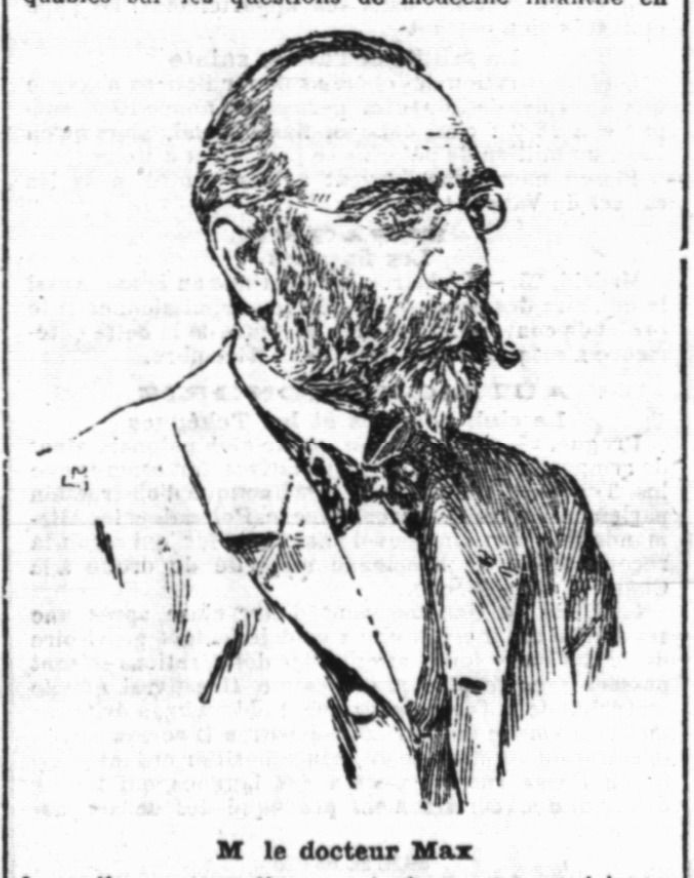
Dr Henri Max. The man who would put the incubators to work had run the hospice’s medical service since 1885. Henri Max came from a family of physicians, being the son, grandson and nephew of doctors, and took his degrees at the University of Brussels. He was appointed a médecin des pauvres in 1865. During the cholera epidemic of 1866 his work in the poorest districts earned him a citation from Burgomaster Anspach and the first-class civic medal, and later the knighthood of the Order of Leopold. In 1870 the city put him in charge of its ambulance service during the Franco-Prussian War, and he brought a convoy of French and German wounded back from Sedan for treatment in Brussels. He then became chef de service at the Hospice Pachéco (1870 or 1871; the sources differ), médecin en chef of the city orphanage in 1879, and chief of service at the Enfants-Assistés in 1885.
Under Max the hospice became, in effect, a children’s hospital. When he arrived he handled the whole service alone, and the free clinic saw about a thousand children a year. By 1900 it saw more than sixteen thousand. The Conseil gave him first one and then two students, then one and later two assistants. In 1895 the service was split into separate medical and surgical sections. Max also taught hygiene at the École industrielle and presided over a pediatric congress in Brussels.
Installation. The incubators came to the hospice after the Exposition closed in November 1897, but their permanent installation took longer. In mid-March 1898, Le Soir and Le Peuple reported that five incubators, the gift of an unnamed “philanthropist,” were about to be installed at the Enfants-Assistés in the rue du Marais. The fitting-out work included a slow-combustion stove, gas piping for heating, and ducts for ventilation. This plumbing suited the Lion design, which drew in filtered outside air and vented it through a flue, so each unit needed a fixed connection rather than standing free in a ward. Contemporaries credited Max with creating a room set aside for the incubators. It was still known as the salle des couveuses in 1905.
A year later the incubators were well established. In April 1899 Maurice de Waleffe, in his column “La Vie à Bruxelles” in L’Indépendance Belge, wrote that the incubators “qui furent à l’Exposition de 1897” were now working at the Hospice des Enfants-Assistés of the rue du Marais. He sketched premature twins asleep in a heated cage of iron and glass, watched over by wet nurses in white aprons. In the same vignette Lion himself appears unannounced, in black frock coat and goatee, handing out brochures. He complains that the hospice is cramped and its air foul, and offers his new air filter-ventilator (Lion filed three different patents for air filtration apparatus in 1898-1899), saying he has come from Paris and is on his way to London, presumably for the incubator exhibit at the Greater Britain Exhibit of 1899.
Results. Max kept statistics on the service. Between 15 November 1897 and 15 November 1900, 88 infants were incubated, weighing between 570 and 2,240 grams, and 38 survived. Survival rose steeply with maturity:
| Gestation | Survival | Weight | Survival |
|---|---|---|---|
| under 6 months | none | under 1,200 g | none |
| 6 months | 22% | 1,200–1,499 g | 45% |
| 6½ months | 25% | 1,500–1,999 g | 62.8% |
| 7 months | 45% | 2,000–2,240 g | 70% |
| 7½ months | 81.8% |
Max cited the weight figures himself in a November 1901 interview, as evidence of the surprising vitality of seemingly frail infants since incubators came into use. The fuller series was published in February 1902 by Dr Laigle of Marchienne-au-Pont in the Gazette de Charleroi. Laigle stressed that the outcomes had been measured several months after birth, not at discharge. He noted that counting only one-month survival would have produced figures as high as 84% for the 1,500–2,000 g group, and set the results against Uffelmann’s older estimate that 80% of weak infants died within their first year. Laigle’s numbers are more precise than those in Max’s interview, so he was probably working from a written report by Max that has not yet been located.
One discrepancy is unresolved. Max’s series begins on 15 November 1897, a week after the Exposition closed, yet the press described the permanent installation as still in progress in March 1898. The incubators may have been used provisionally over the winter before the dedicated room was completed, but no source says so.
Max’s departure. Hospice regulations limited a chief of service to fifteen years. Max’s term ended in December 1900, and on Christmas Day the staff combined the children’s annual Christmas tree with a tribute to him. The director, M. Vandesande, the chief of surgery, Dr Lorthioir, and Max’s first assistant, Dr Eugène Monnot, gave speeches. Four little girls from the free clinic presented flowers to “le grand ami des petits enfants.” Both accounts of the occasion credit Max with the incubator service and do not mention Lion. Within three years the gift had become, in the hospice’s own account, Max’s achievement.
Max’s reputation for infant care soon took him further. In November 1901 he was supervising the feeding of the newborn Prince Leopold, son of Prince Albert and Princess Elisabeth and the future Leopold III, using the Soxhlet system of sterilized bottled milk.
Legacy. The incubator room outlived Max’s tenure. On 18 May 1905 Prince Albert and Princess Elisabeth visited the hospice to choose children for a seaside stay at Wenduyne. They then toured the service of Dr Nauwelaers and “stopped for a long time in the salle des couveuses.” The press does not say whether these were still Lion’s original machines. The same visit showed how far the institution had outgrown its building. The surgeon Professor Laurent told the royal couple that operations were done in a cramped room opening onto the consulting room, that operated children had to be sent home at once for lack of beds, and that Brussels hospitals ranked last among comparable institutions in the world. Six months later Lion returned to Brussels on his own account, opening a short-lived demonstration branch of his Œuvre Maternelle in the rue de la Madeleine.
Sources
Belgian press (BelgicaPress, KBR)
- Journal de Bruxelles, 1 July 1897. Item on the gift of six incubators; excerpts of the Conseil général and Buls letters.
- La Réforme, 1 July 1897. “Échos de l’Exposition: Les couveuses d’enfants.” Full text of the letters of 18 June (Buls) and 25 June (Van den Broeck, Evrard); the date of the Conseil letter is illegible in this printing.
- Le Vingtième Siècle, 2 July 1897. “À l’Exposition.” Full text of both letters, Conseil letter clearly dated 25 June 1897; editorial note.
- Le Courrier de l’Escaut, 9 July 1897. “Enfant trouvé.” (Cited from neonatology.net; not examined.)
- Le Petit Bleu de l’Exposition, 13 July 1897. “Le bébé abandonné.”
- Le Soir, 17 March 1898. “Couveuses pour enfants.”
- Le Peuple, 19 March 1898. “Les couveuses d’enfants.”
- de Waleffe, Maurice. “La Vie à Bruxelles.” L’Indépendance Belge, 9 April 1899.
- Le Petit Bleu du Matin, 25 December 1900. “À travers la ville: Aux Enfants assistés.” With portrait.
- Milio. “Aux Enfants Assistés. La Noël des petits. Le docteur Max.” La Réforme, 26 December 1900. With portrait.
- “Comment on élève un enfant royal.” Gazette de Charleroi, 13 November 1901. Reprint of Jean Bar’s interview with Dr Max in La Chronique
- Laigle, Dr. “Les Couveuses d’Enfants.” Gazette de Charleroi, 22 February 1902 (dated Marchienne-au-Pont, 10 February 1902).
- “Le Prince et la Princesse Albert chez les petits enfants.” Le Petit Bleu du Matin, 19 May 1905.
Other primary and archival sources
- Saint-Vincent, Ludovic. Belgique Charitable. New edition revised by Mme Ch. Vloeberghs. Brussels: Albert Dewit, 1904. Entry “Bruxelles – Hospice des Enfants assistés,” transcribed at zwysen.be: https://www.zwysen.be/orphelinats/bruxelles/
- Dickstein, C. Inventaire des archives provenant de l’Hospice des enfants trouvés et abandonnés, puis Hospice des enfants assistés, 1595–1926. CPAS de Bruxelles: https://cpas-ocmwmuseum.be/fr/wp-content/uploads/2016/08/Inventaire_enfants_trouves_1595_1926.pdf
- Archives de la Ville de Bruxelles. Inventaire n° 11: https://archives.brucity.be/docs/0100/AVB_INV_011.pdf
Secondary sources
- Bougard, Jean-Paul. “Des enfants trouvés en Belgique au début du XIXe siècle: le cas de Bruxelles de 1797 à 1826.” In Enfance abandonnée et société en Europe, XIVe–XXe siècle. Rome: École française de Rome, 1991: https://www.persee.fr/doc/efr_0000-0000_1991_act_140_1_4456
- Dickstein-Bernard, Claire. Les collections du CPAS-Bruxelles. Musea Nostra. Ghent: Crédit Communal, 1994. (Cited via captions at perso.helmo.be)
- “Lambert et Dorothée, Thérèse et Marie Louise, enfants perdus, enfants trouvés. Contribution à l’histoire sociale (Bruxelles et environs, 1780–1914).” Cahiers bruxellois, 2015: https://www.cairn.info/revue-cahiers-bruxellois-2015-1-page-330.htm
- “L’évolution des institutions hospitalières bruxelloises.” Revue Médicale de Bruxelles, 2007: https://www.amub-ulb.be/system/files/rmb/old/305
- Archiviris. “CPAS de la Ville de Bruxelles”: https://archiviris.be/fr/archives-publiques-en-region-de-bruxelles-capitale/cpas-de-la-ville-de-bruxelles
- “L’abandon d’enfants dans l’histoire.” perso.helmo.be (Brussels captions only; main text concerns Paris): https://perso.helmo.be/jamin/euxaussi/famille/modaband.html
- “Des tours pour déposer les enfants abandonnés…” Curieuses Histoires Belgique: https://curieuseshistoires-belgique.be/des-tours-pour-deposer-les-enfants-abandonnes/
- “Tour d’abandon.” Wikipédia (Brussels figures uncited): https://fr.wikipedia.org/wiki/Tour_d’abandon
- “Brussels International Exposition, 1897”: https://neonatology.net/gallery/exhibitions/brussels-international-exposition-1897/
- “Œuvre Maternelle des Couveuses d’Enfants, Brussels”: https://neonatology.net/gallery/exhibitions/ouevre-maternelle-des-couveuses-denfants-brussels/
- “Institut Puériculture de Bruxelles”: https://neonatology.net/gallery/hospitals/institut-puericulture-de-bruxelles/
French primary sources were machine-translated, then checked against the originals and edited by the author. Portions of this page were drafted with machine assistance; the final text was reviewed, verified, and edited by the author. Click here to learn more.
Last Updated on 10/01/26