Madame Henry
Madame Félicité Henry (her given name rarely appears in the literature — she is usually identified only by her married name and title) was appointed at the age of 44 as Sage-Femme en Chef — Midwife-in-Chief — at the Maternité de Paris, Port-Royal under the renowned obstetrician Stéphane Tarnier. According to a 1994 French article by M. Martin on the evolution of the school for midwives at the Maternité, the Midwife-in-Chief had the same salary as a surgeon. She also received a stipend of 30 gold Francs per student. The student midwives received very comprehensive training with a discipline identical to military academics. The Midwife-in-Chief had the authority of a general. The student midwives were interns, arose at 5:30 AM, attended mass, received four lectures every day, attended physician rounds, spent 2 hours writing patient reports, and went to bed at 10 PM when they were not on call at night.
Mme. Henry’s most consequential contribution was institutional and financial. Under Dr. Tarnier’s direction, the first trials of incubators were performed at the Paris Maternité, beginning in 1881, and the success led to the construction of a special pavilion with incubators for sick newborns. The midwife-in-chief, Mme. Henry, raised the funds for the construction. This was a remarkable act of initiative for a midwife in a hospital hierarchy dominated by physician-obstetricians — she secured the resources that made the world’s first dedicated premature infant unit a physical reality. She did not merely advocate for the unit; she ran it. The pavilion — the pavillon des enfants débiles (pavilion of weakling infants) — housed the Tarnier incubators and was organized around the nursing care model that she oversaw directly.
Unusually, Madame Henry left a first-person historical record. She authored “Fondation du pavilion des enfantes débiles à la Maternité de Paris” [Foundation of the Pavilion of Sick Infants at the Maternity of Paris], published in Revue des Maladies de l’Enfance, Vol. 15, pp. 142–154, 1908 (French original and English translation). This paper, written more than a decade after she left the Maternité, is the primary source document for the founding of the unit in her own voice.
I talked to Mr. Tarnier: he supported and encouraged me a lot, but in order to realize this project, money was needed. I tried to establish a society which we called ” L’Oeuvre des couveuses”. It brought me with relative ease, subscriptions and few donations, about 10,000 Francs; this was insufficient. I searched out Mr. Peyron, Director general of ” Assistance Publique”; I told him about the logistic difficulties of the service of the crèche, he listened receptively, understood the importance of the foundation which I was soliciting, asking me to write everything that I told him, adding:” Find a little bit more money and we will help you.”- I then approached the Municipal Council of the city of Paris. Mr. Paul Strauss agreed to study the question and to present it to the Council. Mr. Peyron was consulted and gave a favorable advice, and in 1891, the establishment of the service was voted; a sum of 40,000 Francs, taken on the pari mutual betting was awarded.
The design of Mr. Rochet, architect of the Assistance Publique was adopted. It was decided that the pavilion will be constructed with masonry tiles. Mr. Imard (retired architect and inspector of the Assistance Publique) agreed to help us with its advice. When the pavilion was finished the costs exceeded by 17,000 Francs the initial project. The Council agreed to pay the difference.
Mr. Peyron, general director, Mr. Rousselle, president of the municipal council and Dr. Dubrisay, came to visit the new construction. They liked the inside, but disliked the grayish and sad exterior. To break the monotony of the masonry tile , we ordered the application of lattices painted in green on which plants could entwine. The 10,000 Francs I had collected helped to pay for the heating system and other devices that the administration was not able to provide; in addition 14 incubators were built on the model designed by Mr. Tarnier with few additional modifications; finally we purchased an autoclave and everything needed to embellish the pavilion inside and outside. On July 20th 1893, the pavilion was open.
Mme. Henry’s fundraising efforts were promoted in the Paris press, such as this example in Le Courrier de Paris, January 18, 1892 (translated from French):
Mrs. Henry, Chief Midwife at the Maternity Hospital—struck by the marvelous results she was achieving, thanks to the use of incubators and tube feeding, in raising infants born prematurely or in such frail condition that they had little chance of survival—conceived the idea of establishing a hospital specifically for frail newborns. For—an extraordinary and deeply regrettable fact—there does not exist in France a single hospital dedicated to children between the ages of one day and one year.
The hospital that Mrs. Henry proposes would fill this void and would contribute, to a certain extent, toward remedying the depopulation of France—an issue that weighs heavily on the minds of all those concerned for our country’s future. Children would be admitted there without their mothers and cared for free of charge, just as they would be in a hospital for adults.
Mrs. Henry rightly believed that by appealing to the hearts of French mothers, she would easily secure the resources necessary for this undertaking. Mr. Peyron, Director of the General Administration of Public Assistance, has pledged his benevolent support to this cause.
The Paris Municipal Council has generously and unanimously voted to allocate a sum of 10,000 francs for the construction of the small hospital in question.
Unfortunately, this allocation is insufficient to bring the project to fruition!
Approximately 50,000 francs would be required for the construction of the buildings. For the support of wet nurses and necessary staff, and to cover miscellaneous operating costs, an annual budget of 12,000 to 15,000 francs would be needed.
This modest sum would surely suffice to save the lives of at least 400 to 500 children each year! These figures are so eloquent that it is needless to add further arguments in favor of this humanitarian endeavor—one truly worthy of a woman’s heart.
To facilitate this task, an association has been formed in which each founding member contributes to the hospital’s operations through a three-year commitment, involving an annual subscription of 100 francs, payable in two installments of 50 francs each.
Those wishing to contribute more generously may, by means of a payment of 500 francs, assume nominal sponsorship for the upkeep of a cradle and an incubator.
Furthermore, there are “Donor Members” who, through an annual subscription of 30 francs (payable in a single installment), contribute to this initiative—an undertaking of such profound interest from every perspective.
TRÉZETTE.
The official opening of the new Pavilion was described in the November 28, 1893 issue of La Nation (translated from French):
On Thursday, the official inauguration took place at the Maternity Hospital for the new building dedicated to housing newborns who are frail, infirm, or premature. It was a truly heartening ceremony—if ever there was one—presided over by Professor Tarnier, the former Chief Surgeon of the Maternity Hospital and the inventor of the artificial incubator.
Taking their places around him were: Mme Henry, Chief Midwife of the Maternity Hospital; and Messrs. Peyron, Director of Public Assistance; Paul Strauss, Navarre, and Paul Bernard, all municipal councilors. Among the audience were a number of ladies, including—as I noted—Mme Guignard; Mme Duez (wife of the well-known painter); Mme Hayard; and Mme Léo Delibes. Mme Carnot, unable to attend, had sent a representative in her stead.
The pavilion hosting the ceremony is situated along the edge of Boulevard Port-Royal; adorned with trellises and flowers, it presents a most graceful appearance—I would even venture to call it cheerful, were it not, after all, a hospital. Guided by one of the service’s resident physicians—who graciously volunteered to place himself at my disposal to show me and explain the new improvements introduced for the rearing of frail and premature infants—we toured the various wings of the pavilion with a sense of deep, moving interest.
The facility comprises: four rooms for children suffering from contagious diseases; a large dormitory containing fourteen cradles; five smaller rooms dedicated to linen storage, the refectory, and milk sterilization; and, finally, a dormitory for the wet nurses, containing ten beds and ten cradles—with each nurse having a child right beside her.
This new department has been entrusted to the care of the kind and devoted Mlle Bataille, who oversees the wet nurses. “You simply must see this,” my amiable guide told me. …with what care, what delicacy—what tenderness, even—these brave women tend to these little beings, so frail, so slight, that it seems the slightest breath must surely cause them to perish.”
The methods employed to sustain the lives of these unfortunate children—who are sometimes brought in all but dead—are force-feeding and the incubator. The incubator consists of a glass-sided box; its upper section features a small, soft pillow upon which the baby rests, while its lower section houses a hot-water bottle maintained at a uniformly regulated temperature. The newborns do not leave the incubator for a cradle until they have reached full term—that is to say, nine months—provided, of course, that they are sufficiently robust.
The truly extraordinary success of this new method of infant care was demonstrated in a most striking manner by Mme Henry, who was the first to take the floor—initially to thank Messrs. Peyron and Paul Strauss, as well as the Municipal Council, for their support, and subsequently to provide a few details regarding the progress of the initiative.
Space does not permit me to express all the high regard I hold for the devoted Mme Henry and her colleagues. However, I feel compelled to state that M. Peyron acted as the voice of all those dedicated to doing good when he proposed that Mme Henry be awarded: the Cross of the Legion of Honor.
André TESSIER.
Mme. Henry’s work was also noted contemporaneously in the American medical press: the editors of Occidental Medical Times published a piece titled “Mme. Henri’s Couveuse Department at the Paris Maternité” in 1894 — just a year after the pavilion opened — indicating that her role was recognized internationally at the time.
Mme. Henry was listed in the “Intérieur – Chevaliers” section of “Les Décorations du 1er Janvier” in Le Temps, January 1, 1895. A news item in Le Journal des Femmes on March 1, 1895, said:
LE LEGION D’HONNEUR
Parmi les décorés de cette année se trouve le nom de Mme Henry, sage-femme en chef de la Maternité, bien connue dans le mond médical et appréciée de tous ceus qui ont été á même de connaître le zèle, le devoument et la grande intelligence dont elle fait preuve dans la place importante qu’elle occupe á la Maternité. Mme Henry est actuellement en France le seule sage-femme qui porte la croix de la Légion-d’honneur.
[“Among those decorated this year appears the name of Mrs. Henry, Chief Midwife at the Maternity Hospital—a figure well-known within the medical community and esteemed by all who have had the opportunity to witness the zeal, dedication, and great intelligence she demonstrates in the important position she holds at the Maternity Hospital.Mrs. Henry is currently the only midwife in France to wear the Cross of the Legion of Honour.”]
Madame Henry abruptly resigned “for personal reasons” when Dr. Tarnier retired and was succeeded as clinical chief by Dr. Pierre Budin in 1895. The unit was placed under medical direction in order to bring a scientific approach to the care of the sick newborns. The abrupt departure reflects a broader pattern of physician authority displacing midwifery leadership as neonatal care became medicalized. Her award of the Legion of Honor and her departure from the Maternité were both widely covered and discussed in the Paris popular press, an clear indication of how well she was known and respected in the region.
An article in Le XIXe Siècle on June 19, 1895 covered her departure, honored her contributions, and said she was planning to take on the position of Director of a worker’s shelter for pregnant women as well as the Directorship of a shelter and convalescent facility for children in Clichy:
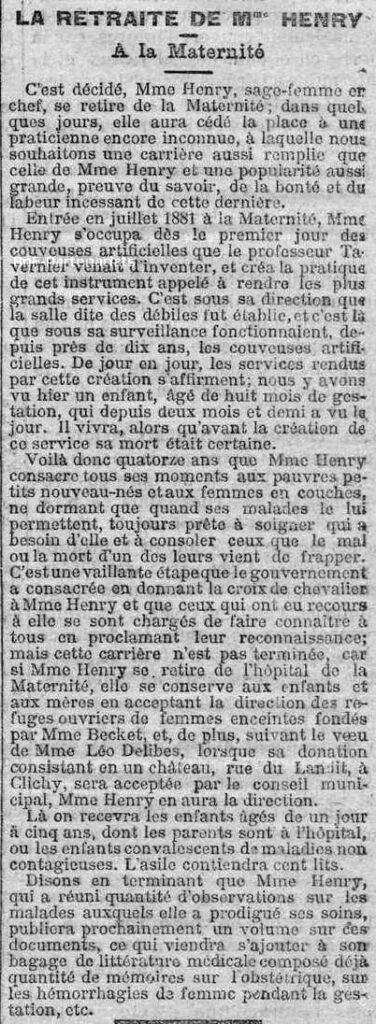
MADAME HENRY’S RETIREMENT
At the Maternity Hospital
It is official: Madame Henry, Head Midwife, is retiring from the Maternity Hospital. In a few days, she will have handed over her position to a practitioner who is as yet unknown—one to whom we wish a career as fulfilling as Madame Henry’s, and a popularity just as great—a popularity that stands as a testament to the knowledge, kindness, and unceasing labor of her predecessor.
Having joined the Maternity Hospital in July 1881, Madame Henry dedicated herself from day one to the artificial incubators that Professor Tavernier [sic] had just invented, and she established the practical protocols for this instrument, which was destined to render the greatest of services. It was under her direction that the ward known as the “Premature Ward” was established; indeed, it was under her supervision that the artificial incubators had been operating for nearly ten years. Day by day, the value of the services rendered by this facility becomes more evident; we have personally seen an infant there—born after only eight months of gestation—who has now been in the world for two and a half months. He will live—whereas, prior to the creation of this service, his death would have been a certainty.
Thus, for fourteen years, Madame Henry has devoted every moment to poor little newborns and women in childbirth—sleeping only when her patients allowed her to, and always ready to tend to anyone in need of her care, or to comfort those struck by illness or the death of a loved one.
It is a valiant career that the government has officially recognized by awarding Madame Henry the Cross of the Legion of Honour (Chevalier); it is a career, too, that those who have sought her aid have taken it upon themselves to make known to all, by proclaiming their gratitude. Yet this career is not truly at an end; for while Madame Henry is indeed retiring from the Maternity Hospital, she remains dedicated to children and mothers by accepting the directorship of the workers’ shelters for pregnant women founded by Madame Becket.
Furthermore, in accordance with the bequest of Madame Léo Delibes, a donation consisting of a château on Rue du Lanit in Clichy will be accepted by the municipal council; Mrs. Henry will serve as its director. The facility will admit children aged one day to five years whose parents are hospitalized, as well as children convalescing from non-contagious illnesses. The asylum will accommodate one hundred beds.
In closing, it is worth noting that Mrs. Henry—who has gathered a wealth of observations regarding the patients upon whom she has bestowed her care—will shortly publish a volume based on these records. This work will be a new addition to her body of medical literature, which already comprises numerous treatises on obstetrics, hemorrhages in women during pregnancy, and related topics.
Mme Henry’s article’s publication in 1908 suggests she remained engaged with the field well after her departure from the Maternité. Supporting evidence is found in L’Ecole des Sages-Femmes by Nathalie Sage Prachére (Presses universitaires François-Rabelais, 2017), which references a 1905 chapter by Berthod**:
La proposition d’allonger la scolarité des sages-femmes est reprise en 1906 par Félicité Henry, ancienne sage-femme en chef de l’Hospice de la Maternité de Paris : «La troisième année serait consacrée à l’étude théorique et clinique du diagnostic des maladies syphilitiques et tuberculeuses chez la mère et l’enfant et de la prophylaxie de ces deux maladies. De plus, les élèves suivraient des cours théoriques et cliniques sur le forceps9³.»
The proposal to extend the duration of midwifery training was revived in 1906 by Félicité Henry, former Chief Midwife at the Hospice de la Maternité in Paris: “The third year would be devoted to the theoretical and clinical study of the diagnosis of syphilitic and tuberculous diseases in mothers and children, and to the prophylaxis of these two diseases. Furthermore, students would attend theoretical and clinical courses on the use of forceps.”
A long extract from the book with a more details of the proposal in the form of a letter from Mme Henry appears on pages 129-131 of La Sage-Femme, no. 202, September 5, 1906.
Although the details of her personal life other than her dedication to her work are almost completely obscure, Madame Henry occupies a significant but underrecognized position in neonatal history. She was neither physician nor administrator in the conventional sense, yet she:
- Raised the public and private funds that constructed what is effectively the first dedicated premature infant unit in medical history
- Managed that unit operationally from its 1893 opening
- Wrote the founding historical account of the pavilion, including outcome statistics, published in a peer-reviewed journal
- Did so within an institutional context where midwives were beginning to be subordinated to physician authority — her departure marks that transition at the Maternité
- Was made a Chevalier of the French Legion of Honor for her services to the state, an unusual distinction for a woman at that time, let alone a midwife.
- Henry, Mme. “Fondation du pavillon des enfants débiles à la Maternité de Paris.” Revue des Maladies de l’Enfance, vol. 15, pp. 142–154, 1908. (Primary source — her own account; French original and English translation)
- Toubas, P.L. and Nelson, R. “The Role of the French Midwives in Establishing the First Special Care Units for Sick Newborns.” Journal of Perinatology, vol. 22, pp. 75–77, 2002. DOI: 10.1038/sj.jp.7210621 — PMID: 11840247. (Key secondary source; directly addresses her role)
- Editors, Occidental Medical Times. “Mme. Henri’s Couveuse Department at the Paris Maternité,” 1894. (Contemporary American notice of the unit under her management)
- Silverman, W.A. “Incubator-Baby Side Shows.” Pediatrics, 1979.
- “The Role of the French Midwives in Establishing the First Special Care Units for Sick Newborns,” by Paul L. Tobas and R. Nelson, Journal of Perinatology 22:75-77, January 2002.
- La Sage-Femme, no. 202, September 5, 1906, pages 129-131.
- Une Visite a la Maternité, La Femme, January 1, 1894. French original (source: Gallica), English translation.
* L’Opinion Nationale, December 4, 1875; Le Soir, December 4, 1875, L’Ordre de Paris, Nov. 30, 1875; La Patrie, November 29, 1875
** “Mme Henry”, article published in Berthod P. (ed.), La Médecine sociale et professionnelle,
Paris, 1905; reprinted in La Sage-Femme, September 5, 1906, no. 202, pp. 130–131.
.
Last Updated on 04/10/26