Century of Progress International Exposition 1933–1934
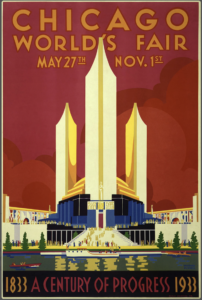
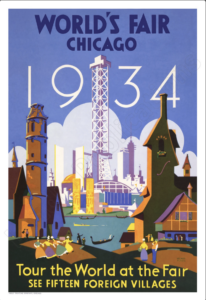
“A Century of Progress International Exposition,” Chicago’s second World’s Fair, opened on May 27, 1933, on a strip of made land along the lakefront south of the Loop. It drew sufficient attendance to reopen for a second season in 1934 before closing permanently that autumn. Organized to mark the city’s centennial, the fair took as its theme the advance of science and the transformation of daily life by industry — an emphatically optimistic message at the depth of the Great Depression. Its organizers built it without federal subsidy and, contrary to wide expectation, returned a profit, drawing tens of millions of visitors across the two seasons.
The 1893 World’s Columbian Exposition had presented itself in white neoclassical form; the 1933 fair deliberately departed from that model, favoring bold geometric buildings in the modern idiom, finished in colors unfamiliar to visitors accustomed to stone and brick and illuminated at night to suggest a vision of the future. The Hall of Science anchored the educational program. A Sky Ride carried passengers in rocket-shaped cars between two towers, and the Travel and Transport building, a German zeppelin overhead, the foreign villages, and the Enchanted Island children’s area completed a campus that extended for miles along the water.
The exposition was not, however, uniformly earnest. Its Midway placed commercial and sensational attractions alongside the educational ones — Sally Rand’s fan dance, the foreign-village concessions, sideshows and animal acts, cigar-rolling machines and candy kitchens, all competing for the same admissions. It was within this zone, where education and entertainment were intentionally blurred, that the fair situated one of its most popular and most unusual attractions: a working hospital for premature infants, operated as a paid exhibit.
The total attendance was 27,703,132 in 1933 and 21,066,095 in 1934. Tickets to the exposition were 50 cents for adults, 25 cents for children, $15 for the season (150 admissions).
The Incubator Facility
The incubator exhibit was promised to the public more than a year before the gates opened. In June 1932 the Chicago Tribune devoted a full page to it, with an architect’s rendering and a floor plan, under the headline “Babies, Babies, and Babies at World’s Fair.” The announcement came from Mrs. Kellogg Fairbank, the only woman on the exposition’s executive committee, who described the incubator station as simultaneously an amusement-zone concession and a charitable undertaking.
Fairbank was candid about the economics. The building, she explained, would be financed by a loan repaid from admission revenue, with any surplus directed to free patients at the Chicago Lying-In Hospital. She cited the precedent of the 1904 St. Louis fair, where an incubator concession had reportedly cleared $181,000, and predicted that the Chicago installation would prove highly popular; the plans were drawn to move roughly 3,000 visitors an hour past the infants.
The design, by the Chicago firm Schmidt, Garden & Erikson, reflected the same sentiment. The rendering by Hugh M. G. Garden depicted a white modern structure trimmed in pale blue and pink, with the word “babies” rendered in blue neon and repeated ten times across the façade. The floor plan set out an air-conditioned baby room ringed by plate-glass windows angled so that visitors could observe the infants from nearly all sides, together with a small theater for films on infant care, a museum display, quarters for wet nurses and nursing staff, and a mothers’ aid shop.
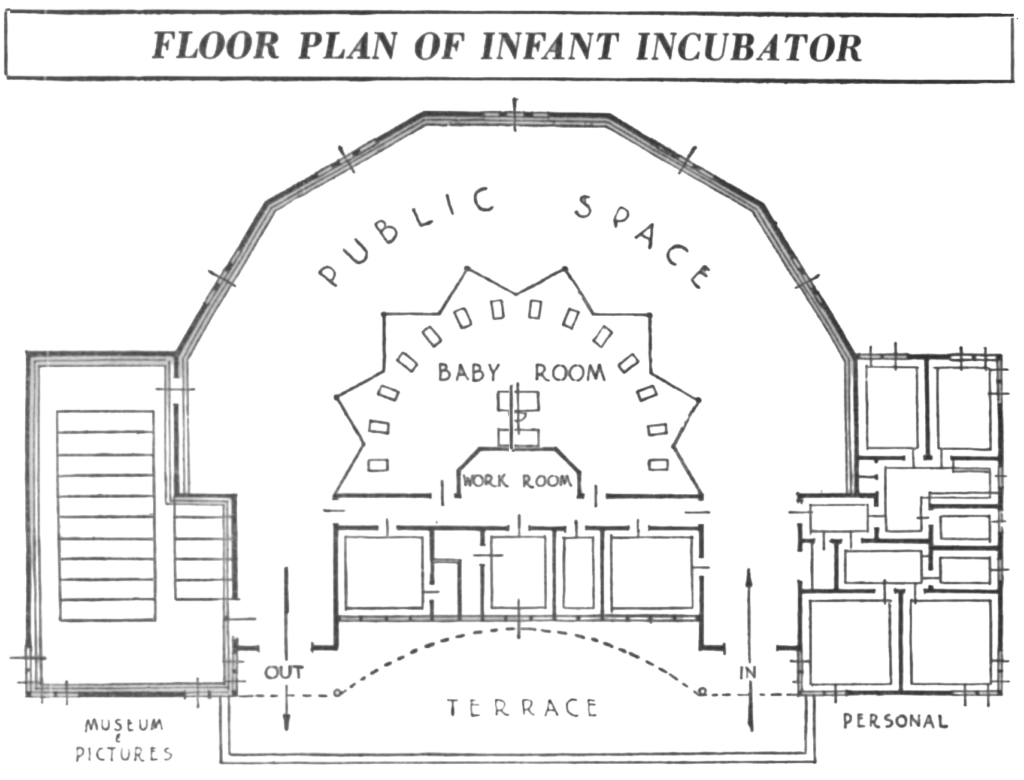
The exhibit as built departed from these plans in certain respects — it opened in 1933 as a pink-and-blue striped building and was repainted white the following year, and the medicine practiced inside owed more to Martin Couney and Julius Hess than to the committee’s early drawings — but the essential arrangement was already established in 1932: a glass-walled nursery, a paying public, and a charity financed by curiosity.
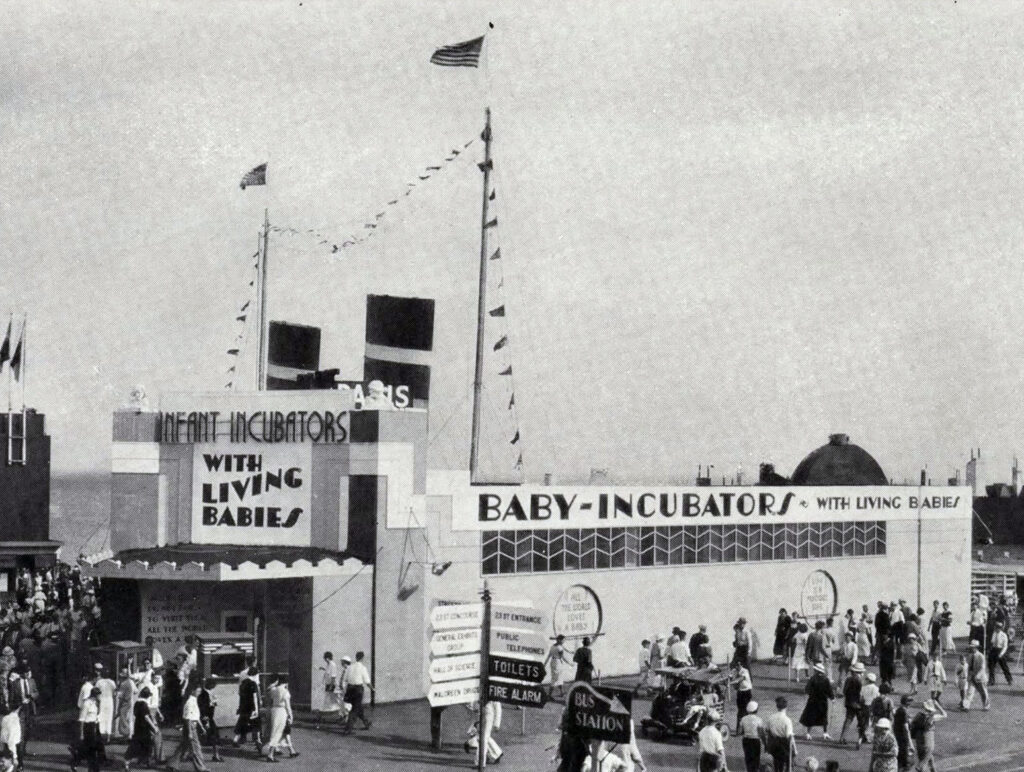
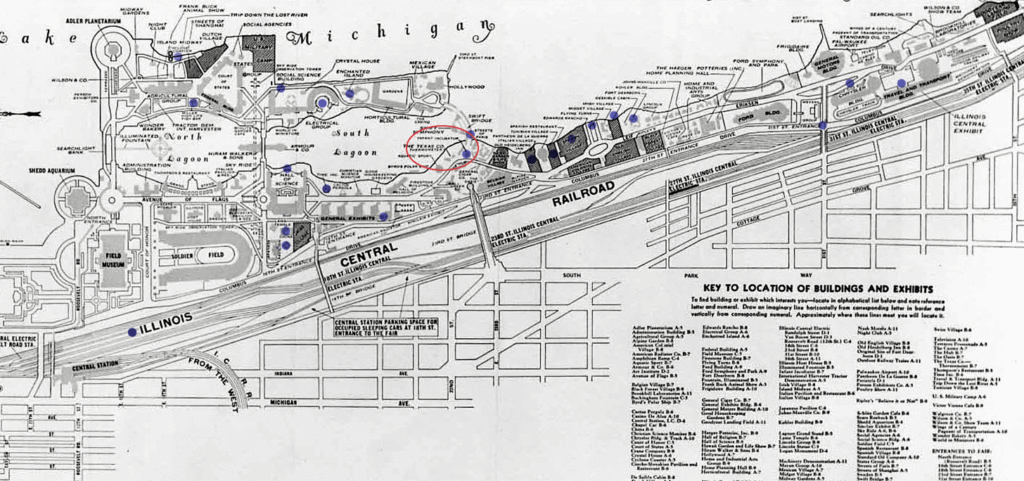
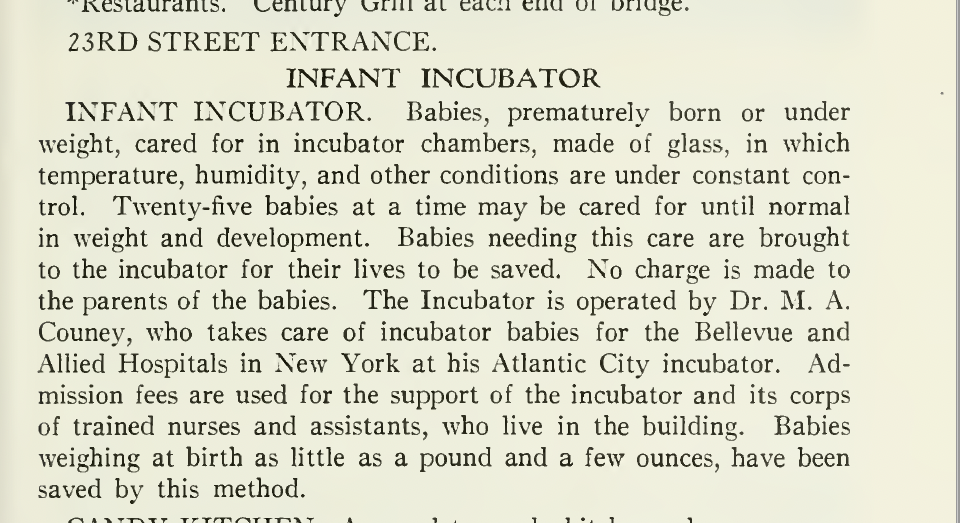
The completed exhibit stood near the Twenty-Third Street entrance and announced itself with a sign reading “Infant Incubators with Living Babies.” Behind glass lay infants weighing only a few pounds — most born prematurely, and most of whom, absent the warmed and filtered air of the incubators, would not have survived. Visitors passed in front of the nursery, and at intervals a nurse lifted an infant and slipped a ring over its arm to demonstrate its size. To much of the public the display resembled a Midway novelty. By the standards of 1933 it also represented advanced medical care.
The Exhibit
The incubator exhibit was managed by Martin Couney, who presented himself as “Dr. Couney” and equipped it through his Infant Incubator Company. His medical credentials were fabricated; the enterprise he had built, however, was substantial. For decades he had established incubator exhibits at fairs and amusement parks — at Coney Island, on the Atlantic City boardwalk, and at expositions on two continents — accepting prematurely born infants, charging the public admission, and charging the families nothing. Over the course of his career he saved several thousand infants. A precise figure cannot be established: Couney was a showman, his accounting was unreliable, and the totals he cited varied from one occasion to the next.
What distinguished the Chicago exhibit from Couney’s usual sideshows was the medical authority behind it. Remarkably, the exhibit operated in partnership with Julius Hess, the Chicago pediatrician then regarded as the country’s leading authority on premature-infant care, and Evelyn Lundeen, his chief nurse. The exhibit received its patients through their professional connections and their premature baby unit at the Sarah Morris Children’s Hospital and Michael Reese Hospital, together with the Chicago Lying-In Hospital, the maternity hospital from which many of the premature births came. Sarah Morris closed its own incubator station for the season and transferred its patients to the fairgrounds.
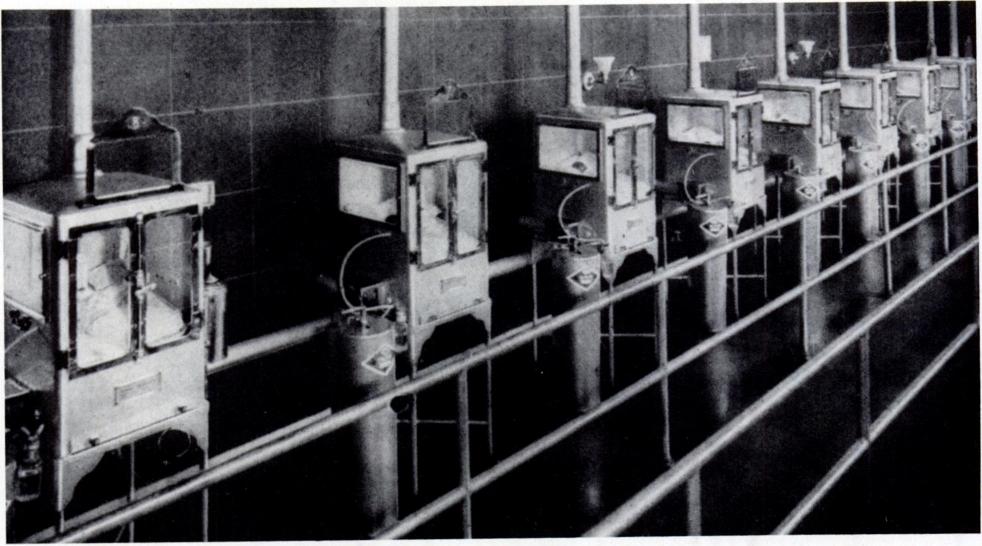
Inside the exhibit, a row of incubators lined one wall of a glass-fronted nursery, each connected to piping that supplied cool, filtered, heated air at a temperature set according to the individual infant. The infants were housed in standard Lion-type incubators, the type Couney used throughout his career; consistent with this, when the fair closed the exhibit’s equipment was returned to his sideshow at Coney Island, which used Lion incubators exclusively. The original plan (according to a feature in the Brooklyn Daily Eagle, April 23, 1933) was to place the most fragile infants — those suffering from cyanosis or pneumonia — in a back room in Hess oxygen beds, the design patented by Dr. Julius Hess and manufactured under his patent by the Scanlan-Morris Company of Madison, Wisconsin. These were the same units Hess used and wrote about in his premature-infant unit at Sarah Morris Children’s Hospital. Whether those Hess beds were ever actually installed at the fair is unclear; the surviving photographic evidence shows only Lion incubators with supplemental oxygen.
Patient Care
The care was methodical. Infants were weighed daily and recorded in grams, fed breast milk at short intervals, often by tube or dropper, and attended around the clock by a trained staff — six nurses and two wet nurses through the 1933 season. The decorative bows, the blue and pink ribbons, and the diaper service were presentation for the paying public; behind them were scales, sterilizers, ultraviolet lamps, and a heated hand-ambulance for transporting the smallest infants.
The personal accounts that survive indicate how closely the operation worked with families. The Gordon twins, Jerry and Larry, were born prematurely on November 3, 1933, and placed with Couney on the recommendation of Michael Reese staff. They can have spent only the final days of the 1933 season in the fair exhibit, which closed for the winter on November 12; thereafter they would have continued care in Hess’s premature-infant unit at Sarah Morris, since by the 1934 reopening they would have been some seven months old and long past the incubator stage. Their mother expressed milk, and their father delivered it daily to the nurses at the fair. Both twins entered the baking business with their father in adulthood. Jerry, who died in 2025 at the age of ninety-one, recalled throughout his life that he had been “a lucky boy.”
The Harbaugh twins — Jean, later Harrison, and Jane, later Umbarger — were born approximately six weeks early on August 17, 1934, each under four pounds. Their parents had not known they were expecting twins; their father’s recorded reaction, with the Dionne quintuplets only months old and the Depression underway, was “Please don’t go in there and get another one.” An aunt, Olive, a nurse at Michael Reese, arranged the girls’ admission to the exhibit. Their father, an employee of First National Bank, drove from Lombard each morning with their mother’s milk, which an attendant from the fair collected at the bank. The sisters grew up believing they had been housed in the science building and learned only as adults that they had been displayed on the Midway. They held a double wedding in 1953 and lived into their eighties.
Public Reaction
Public reaction ran from frank carnival curiosity to something closer to reverence, and individual visitors often moved between the two in the course of a single visit. The exhibit was among the fair’s most popular, and the press recorded the range of responses it provoked. Some accounts treated it plainly as a sideshow, cataloguing the infants among the pythons, the fan dancers, and the other Midway attractions, and at least one reporter arrived openly expecting fraud — “It’s probably a fake, but let’s go in anyway” — only to describe skepticism giving way to awe once inside. Others wrote with unguarded sentiment, lingering on the smallness of the infants, the ribbons and bows, and the practiced demonstration in which a nurse slipped a ring over a baby’s arm. The smallest infants became minor celebrities: visitors sought out particular babies by name and weight, and a one-pound-ten-ounce or 725-gram “doll baby” could draw crowds on its own.
The same coverage reveals how the exhibit’s framing shaped what visitors took from it. The lecturer’s narration, the placards naming Newton, Napoleon, and Darwin as premature infants, and the visible apparatus of scales, sterilizers, and trained nurses worked together to convert spectacle into something the public could read as science and charity rather than mere display. Reporters frequently noted that the families paid nothing and that admission fees supported the work — paying for the staff, equipment, and milk — which softened the discomfort of paying to look at sick infants. For families in severe economic difficulty during the Depression, the exhibit served as a financial as well as a medical resource.
Not every observer was won over — the carnival setting beside the burlesque hall drew pointed comment, and the more skeptical writers kept the infants firmly in the company of the fair’s other oddities — but the dominant note in the surviving coverage is one of conversion: visitors who came to gawk and left convinced that the smallest babies could be saved and were worth saving. That shift in ordinary public sentiment, repeated across millions of admissions, was arguably the exhibit’s most durable effect.
The Reunions
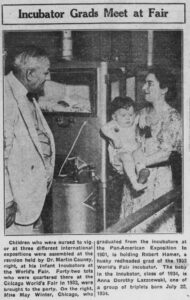
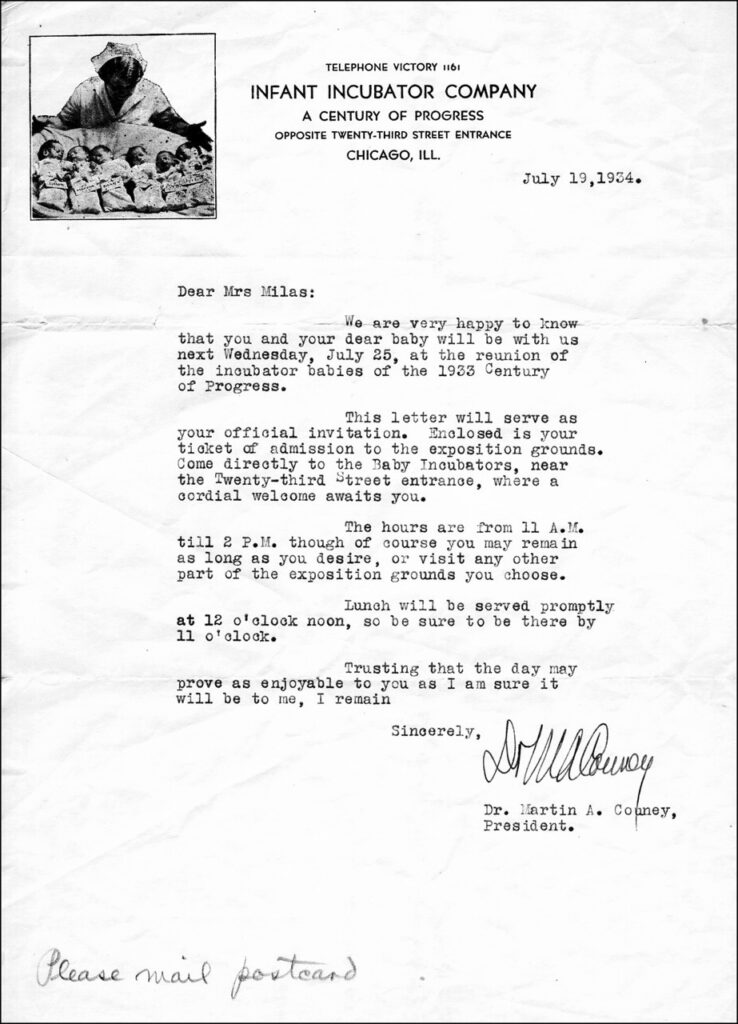
A recurring feature of Couney’s exhibits was the homecoming. On July 25, 1934, he assembled the previous season’s graduates — 41 of the 58 infants he and Hess had admitted during 1933 returned with their mothers — for a luncheon and a reunion broadcast over WMAQ and across the fairgrounds. His invitations also served as admission tickets; one survives, sent over his signature as company president to a Mrs. Milas, directing her to the Baby Incubators near the Twenty-Third Street entrance, where “a cordial welcome awaits you.”
The reunions served sentimental and strategic ends in equal measure. As recounted in Claire Prentice’s book, a former premature infant, Mae Winter — cared for at Couney’s 1901 Pan-American Exposition exhibit in Buffalo and, by family account, named in honor of Couney’s wife, Anabel Maye Couney — presented each graduate with a silver cup engraved with its name and a sweater bearing the exposition’s insignia. The platform of speakers carried greater institutional weight: Couney and Hess were joined by the Chicago health commissioner, Dr. Herman Bundesen, who commended the exhibit as a model for the country’s hospitals, while Dr. Morris Fishbein, editor of the Journal of the American Medical Association, attended. For a man long held at a distance by the medical profession, that endorsement was significant.
Mortality
The deaths formed the exhibit’s necessary counterweight, and they were real. Triplets admitted from local hospitals lost one of their number on more than one occasion across the two seasons. Fishbein placed the exhibit’s mortality at approximately fifteen percent and described it as among the lowest in the country for premature care; the figure, however, represented individual children.
The most difficult case coincided with the close of the fair. Emanuel Sanfilippo, born August 7, 1934, weighing nineteen ounces, was the son of Italian immigrants of limited means in Hammonton, New Jersey. He spent his brief life in Couney’s incubators — first at Atlantic City, then transported to Chicago in a specially heated chamber, accompanied by Couney’s daughter Hildegarde, herself an incubator infant twenty-seven years earlier. He died as the exposition closed in November. His entire story — the train ride to Chicago, his sojourn in the exposition’s incubators, and his death — received national coverage in the press.
As recounted in Dawn Raffel’s book, the Couney women corresponded with the family through the months by hand: Hildegarde wrote from the boardwalk, encouraging the mother to maintain her milk supply and reporting that the infant had gained thirty-five grams and “sucks his thumb sometimes,” and on one occasion enclosed three dollars for the parents’ round-trip bus fare to visit. After his death, Anabel Maye Couney wrote to describe the burial — a white velvet casket with silver trimmings, attended by herself, Hildegarde, and the head nurse, Madame Louise Recht — and returned the infant’s papers, his necklace, and his medal. The family preserved these, with a small knit hat, for eighty years. A brother born in 1937 and given the same name later inscribed three words on a photograph of the hat: my little brother.
Aftermath
When the exposition closed, the incubators were returned to Couney’s New York clinic, and the five or six infants still too weak to go home were transferred to Hess’s unit at the Sarah Morris Children’s Hospital. The exhibit helped to accomplish, however, what the medicine establishment of 1933 had not: it persuaded an ordinary paying public that the smallest infants were worth saving, at a time when prevailing eugenic attitudes dismissed them as weaklings. Within a generation, incubators and dedicated premature units became standard hospital practice.
Primary documents
- Official Guide Book of the Fair (A Century of Progress), 1934, p. 121 — “Infant Incubator” entry, 23rd Street entrance.
- Letter, Dr. Martin A. Couney (Infant Incubator Company, “Opposite Twenty-Third Street Entrance, Chicago”) to Mrs. Milas, July 19, 1934 — reunion invitation/admission ticket for the July 25, 1934 homecoming.
- Sanfilippo family correspondence from Hildegarde Couney and Anabel Maye Couney, August–November 1934, with burial certification from Msgr. William M. Foley, St. Ambrose Church (reproduced in Raffel, below).
- Scanlan-Morris Company advertisement, “Hess Infant Incubator and Bed,” The Modern Hospital, Vol. XX, No. 6 (1923) — documents the Hess-patented incubator manufactured by Scanlan-Morris of Madison, Wisconsin.
Contemporaneous newspaper coverage, 1932–1934
- Chicago Tribune, June 5, 1932 — “Babies, Babies, and Babies at World’s Fair” / “A Pink and Blue Nursery” (Mrs. Kellogg Fairbank; financing and St. Louis precedent; 3,000/hour; Hugh M. G. Garden rendering and Schmidt, Garden & Erikson floor plan).
- Chicago Tribune, May 9, 1933 — “Baby Incubator at Fair to Care for 25 Infants.”
- Brooklyn Daily Eagle, April 23, 1933 — Jo Ranson, “Human Mites in a Hot House” (Hess oxygen beds; Sarah Morris cooperation).
- Buffalo Times, June 12, 1933 — Joseph Mitchell, “Chicago’s Fair: Millennium of the Circus.”
- Pearl City News, June 15, 1933 — “For Dr. Ascher” (gate shared with two Chicago hospitals).
- Chicago Tribune, June 27, 1933 — James Marshall triplet death.
- Belleville Daily Advocate, July 11, 1933 — “Exposition Is Arranged So It Shows Progress” (25¢ admission).
- Wisconsin State Journal, Aug. 21, 1933 — Betty Cass, “Madison Day by Day” (Anabel Maye origin; Mae Winter) — see caveat below.
- Daily Press, Sept. 10, 1933 — Elizabeth Walker, “Saving the Babies Who Arrive Too Soon” (EveryWeek Magazine).
- Brooklyn Daily Eagle, Dec. 17, 1933 — “Scolds Mothers of Babies Born Prematurely.”
- Wichita Eagle, Aug. 2, 1934 — “Infant Incubator Interesting Exhibit at Century of Progress” (twelve incubators; “probably a fake” line; nursery detail).
- Chicago Tribune, May 22, 1934 — Virginia Gardner, “6,500 Men Rush Final Touches on Greater Fair” (1934 repaint to white with blue trim).
- Chicago Tribune, July 9, 1934 — Homecoming Day (July 25) notice; silver loving cups.
- Chicago Tribune, July 23, 1934 — Laszczewski triplet death.
- Chicago Tribune, July 26, 1934 — 41-baby reunion.
- Dowagiac Daily News, Sept. 5, 1934 — “Incubator Grads Meet at Fair” (three-exposition reunion; Mae/May Winter, 1901 Pan-American graduate).
- Evening Courier, Sept. 12, 1934 — “Tiniest Baby Goes to Fair” (Emanuel Sanfilippo leaves NJ; Hildegarde Couney).
- The Plain Dealer, Sept. 14, 1934 — “Guard Incubator Baby” (police escort).
- Southtown Star, Sept. 21, 1934 — “Fair’s Doll Baby” (Baby Olten, 725 g; Nurse Evelyn Mann).
- Chicago Tribune, Oct. 28, 1934 — “World’s Fair Notes” (more than 100 children saved; equipment returned to Couney’s New York/Coney Island clinic; remaining fragile infants transferred to Michael Reese).
- Jackson Citizen Patriot, Nov. 2, 1934 — “Tiny Incubator Baby Succumbs.”
- Miami Herald, Nov. 3, 1934 (AP) — “2 Incubator Babies, Fair Exhibits, Dead” (Fishbein’s ~15% mortality remark).
- Times-Picayune, Nov. 3, 1934 — “Tiniest Human Exhibit” (fair’s hope of landing the Dionne quintuplets).
- Minneapolis Journal, Nov. 4, 1934 — “Two World Fair Babies Die When Taken from Exposition to Homes” (Patricia Faguse/Fagus).
Modern coverage and books
- Heidi Stevens, “Saved by science, twins displayed in incubators at Chicago’s 2nd World’s Fair are now 84 and nestled happily in the suburbs,” Chicago Tribune, Aug. 30, 2018 (updated May 16, 2019). https://www.chicagotribune.com/2018/08/30/saved-by-science-twins-displayed-in-incubators-at-chicagos-2nd-worlds-fair-are-now-84-and-nestled-happily-in-the-suburbs/
- Mitch Dudek, “Gerald M. ‘Jerry’ Gordon, one of the incubator babies at the 1933 Chicago World’s Fair, has died at 91,” Chicago Sun-Times, Feb. 14, 2025. https://chicago.suntimes.com/obituaries/2025/02/14/incubator-babies-chicago-worlds-fair-gerald-gordon-jerry-martin-couney-dawn-raffel
- Dawn Raffel, The Strange Case of Dr. Couney: How a Mysterious European Showman Saved Thousands of American Babies (2018) — Sanfilippo correspondence; reception history.
- Claire Prentice, Miracle at Coney Island — background for the July 1934 reunion broadcast (Bundesen, Hess, Fishbein; 41 of 58; Mae Winter and the silver cups).
Background on the exposition
- “Century of Progress,” Wikipedia — https://en.wikipedia.org/wiki/Century_of_Progress
- “Chicago World’s Fair: A Century of Progress (1933–1934),” America’s Best History — https://americasbesthistory.com/wfchicago1933.html
- “Century of Progress,” Encyclopedia of Chicago (Chicago History Museum) — http://www.encyclopedia.chicagohistory.org/pages/225.html
- “1933–1934 Century of Progress Exposition,” Chicago Architecture Center, Architecture Encyclopedia — https://www.architecture.org/online-resources/architecture-encyclopedia/1933-1934-century-of-progress-exposition
- “A Century of Progress International Exposition,” Newberry Library, Digital Chicago Collections — https://dcc.newberry.org/?p=14406
- “1933 Chicago,” Bureau International des Expositions (BIE) — https://www.bie-paris.org/site/en/1933-chicago
Portions of this page were drafted with machine assistance; the final text was reviewed, verified, and edited by the author. Click here to learn more.
Last Updated on 07/20/26