Tarnier-Auvard-Budin Incubator
The history of the infant incubator is a pivotal chapter in neonatal medicine, involving the translation of agrarian technology to life-saving medical equipment. The evolution of the Tarnier-Auvard-Budin models represents the first successful attempt to industrialize the care of premature infants.
The modern incubator originated in late 19th-century Paris. In 1878, Stéphane Tarnier, a prominent obstetrician at the Maternité de Paris, visited the Jardin d’Acclimatation (the Paris Zoo) in the Bois du Boulogne. He was struck by the efficiency of the warming chambers used to hatch poultry. Recognizing that premature infants, like chicks, succumbed primarily to hypothermia, he envisioned a similar “human hatchery.”
Tarnier collaborated with Odile Martin, the zoo’s poultry manager and engineer, to adapt the design. The first “Tarnier-Martin” incubator was introduced at the Paris Maternité in late 1880 or early 1881. It was a large, wooden, two-tiered box capable of holding several infants, heated by a water tank and a gas-powered “Thermo-Syphon.” It had a glass door on the top which could be used to observe or access the infant.
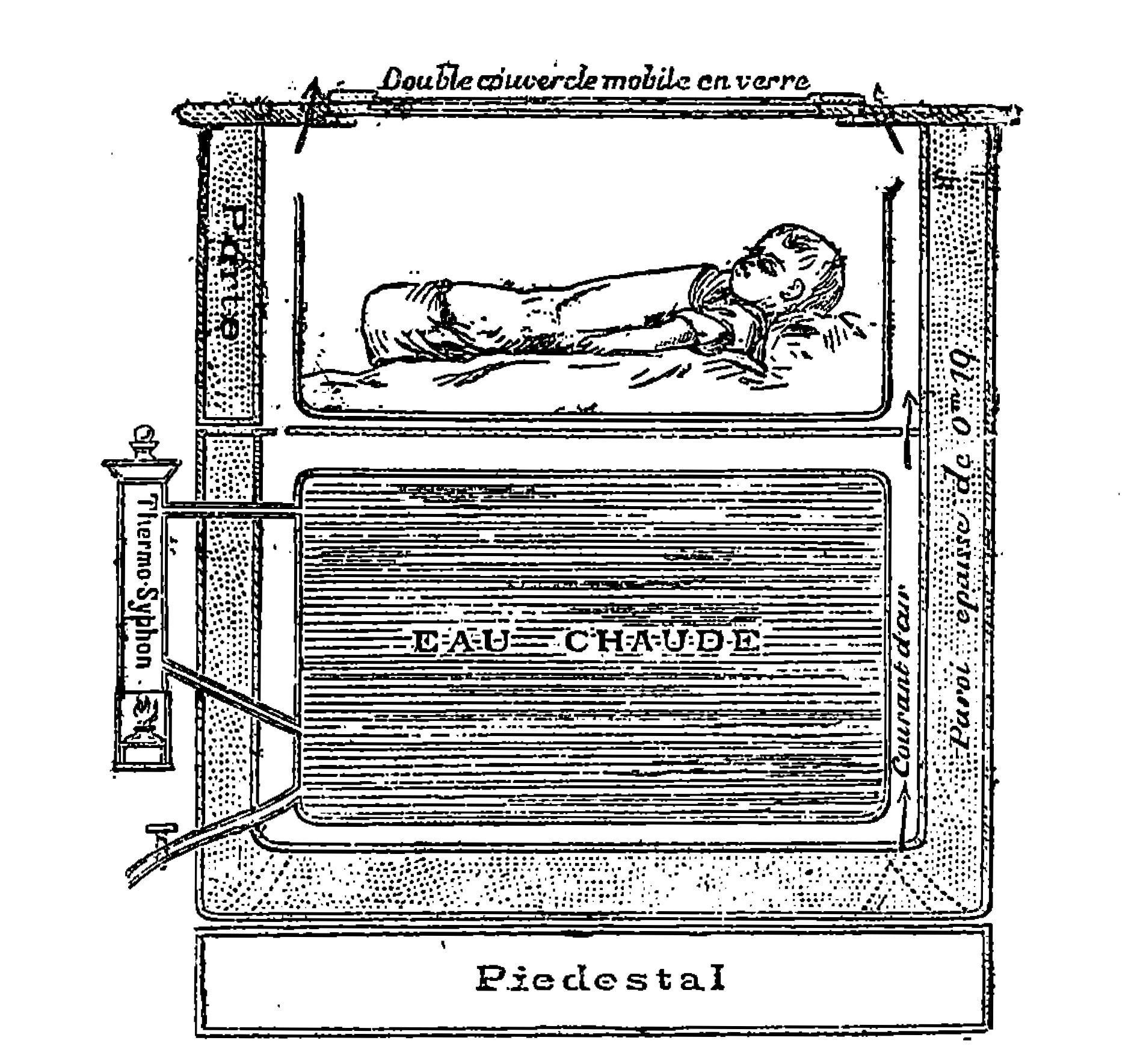
Tarnier conducted the first clinical trials, famously demonstrating that mortality for infants under 2,000 grams dropped from 66% to 38% within just a few years of its implementation.
In 1883, Pierre-Victor-Adolphe Auvard, an intern of Tarnier, published a significant modification (“nouvelle couveuse”). The original thermosiphon was expensive and difficult for nurses to maintain. Auvard replaced the complex heater with removable clay hot-water bottles (brocs) placed in a bottom compartment, and resized it for a single infant. This “Tarnier-Auvard” model was cheaper, portable, and easier to clean. The French instrument makers H. Galante et Fils soon manufactured the Tarnier-Auvard incubator, which became the most popular version of the incubator until the late 1890s.
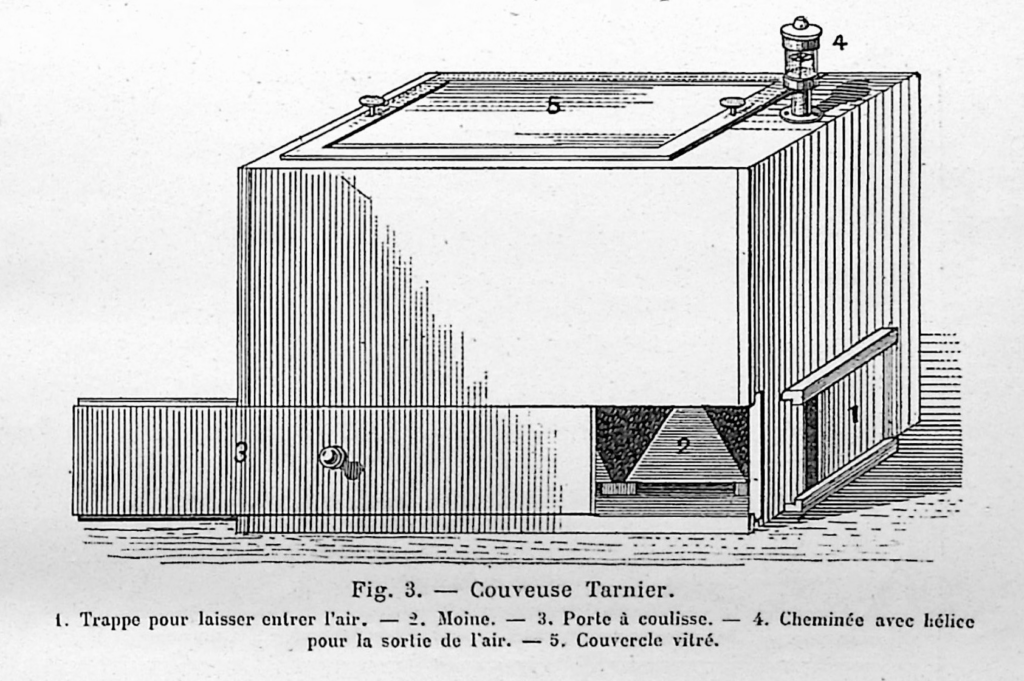
Pierre Budin was Tarnier’s successor. He further refined the incubator by adding glass sides for better observation of the infant (to detect cyanotic attacks) and introduced the Reynard regulator, an early thermostat that activated an electric bell to warn nurses if the temperature rose too high.
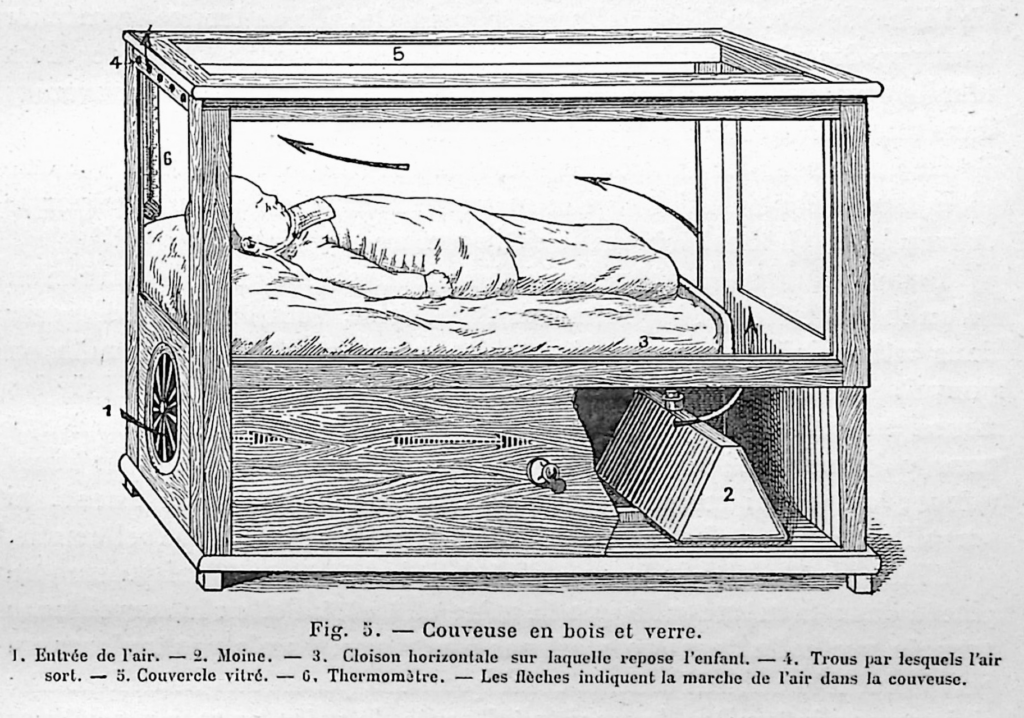
The various iterations of the Tarnier-Auvard-Budin incubator had advantages and drawbacks.
| Advantages | Drawbacks |
| Thermoregulation: Provided a stable, warm environment that prevented lethal heat loss. | Hygiene Issues: The wooden frames and sawdust insulation were porous and difficult to disinfect, harboring bacteria. Budin’s model with glass sides overcame most of these problems. |
| Observation: The glass lid (and later glass walls) allowed nurses to monitor breathing without exposing the baby to cold air. | Manual Labor: In the later versions, nurses had to replace hot water bottles every few hours, leading to temperature fluctuations if they were busy. |
| Infection Control: Isolated the infant from the crowded, often septic hospital wards. | Fire Risk: The Tarnier-Martin early gas-heated models posed a fire hazard in hospital settings. |
| Inexpensive: Could be built by local carpenters or small-scale instrument makers using Auvard’s published diagrams. | |
| Portable: The Auvard and Budin models required no plumbing or gas lines, making it suitable for any ward or even a private home. | |
| Open-Source: Tarnier, Auvard, and Budin did not exploit their designs for personal profit. Odile Martin did patent his inventions, but apparently never commercialized or enforced the patents. |
While Tarnier, Auvard, and Budin apparently made no effort to commercialize their designa, they published widely, and adaptations of their incubator were widely used throughout Europe because of their simplicity and can be found in pictures from various hospitals throughout the early 1900s (see our “Incubators Through the Years” page). At least a few companies are known to have produced commercial versions that were based on the Tarnier-Auvard-Budin design, such as the Tarnier-Auvard incubator advertised in the H. Galante et Fils 1885 catalog seen on the left below, or the glass and metal incubator advertised in the Flicoteaux, Borne et Boutet of Paris medical supplies catalog of 1900 seen on the right below, and the “Hearson Thermostatic Nurse” manufactured in London.


At the same time as Tarnier, Auvard, and Budin were refining and using their incubator, the “Lion Incubator” invented by Alexandre Lion in the 1880s, was being widely used in maternity hospitals, institutions, and expositions. Budin knew of its existence, but considered it too complex and too expensive for use in the Paris Maternité. Other designs emerged in the early 1900s, such as the “Rotch Incubator,” “Hess Incubator” and the “Chapple Incubator.” After World War II, the Air-Shields Isolette based on the Chapple design found rapid adoption and quickly supplanted all other designs.
Primary Sources (French)
- Auvard, P. V. A. (1883). “De la couveuse pour enfants.” Archives de Tocologie, Vol. 14, pp. 577–609.
- Berthod, Paul (1887): La Couveuse et le Gavage a la Maternité de Paris
- Budin, P. (1900). Le Nourrisson: Allaitement et Hygiène — Enfants Débiles et Enfants Nés à Terme. Paris: Octave Doin.
- Eustache, G.. (1885): “Une Nouvelle Couveuse pour Enfants Nouveau-Nés,” Journal des Sciences Médicales de Lille.
- Tarnier, S. (1885): Des soins à donner aux enfants nés avant terme, Archives de tocologie des maladies des femmes et des enfants nouveau-nés, p. 819.
- Tarnier, S. (1885). “Couveuse pour enfants.” Bulletin de l’Académie de Médecine, 2nd Series, Vol. 14, p. 116.
Primary Sources (English)
- Budin, P. (1907). The Nursling: The Feeding and Hygiene of Premature and Full-term Infants. Translated by W. J. Maloney. London: Caxton Publishing. (The authorized English translation of Budin’s masterwork).
- Sadler, S. H. (1896). Infant Feeding by Artificial Means: A Scientific and Practical Treatise on the Dietetics of Infancy. London: Scientific Press. (Contains detailed contemporary descriptions of the Tarnier-Auvard incubator).
Other Sources
- Baker, Jeffrey P. (1996): The Machine in the Nursery. Johns Hopkins Press, Baltimore and London. Chapter 2: Tarnier’s Invention.
Patents (French)
- Odile Martin Patent 136015, Filed April 9, 1880, “Artificial incubator with continuous egg rotation, with its pressure motor regulated by the water flow.”
- Odile Martin Patent 141161, Filed February 15, 1881, “A device system called an artificial mother, for raising premature infants.”
French primary sources were machine-translated, then checked against the originals and edited by the author. Portions of this page were drafted with machine assistance; the final text was reviewed, verified, and edited by the author. Click here to learn more.
Last Updated on 07/20/26