Lewis and Clark Centennial Exposition, 1905
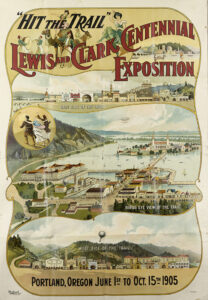
Portland staged its first and only world’s fair — and the first world’s fair held in the western United States — from June 1 through October 15, 1905. The idea behind staging the fair was essentially civic and competitive: Portland was vying for dominance in the Pacific Northwest against Seattle, Spokane, Tacoma, Everett, and Boise, all of which were competing for people, investment, and commercial primacy. A successful exposition could separate Portland from the pack. The Oregon Legislature appropriated $450,000 in 1903 to support the effort, and major financial backers included the Northern Pacific Railroad and brewer Henry Weinhard.
Officially titled the Lewis & Clark Centennial and American Pacific Exposition and Oriental Fair, the event marked the centennial of the Lewis and Clark Expedition and was designed to promote trade between the Pacific Northwest and Asia, showcase Oregon’s forestry and agriculture, and encourage the arts of the region. It drew 40,000 visitors on opening day alone. By the time the doors closed on October 15, nearly 1.6 million paying visitors had passed through the gates — more than 400,000 from outside the Pacific Northwest — a remarkable figure given that there was no passenger air travel and no highway system. Visitors came by train and boat.
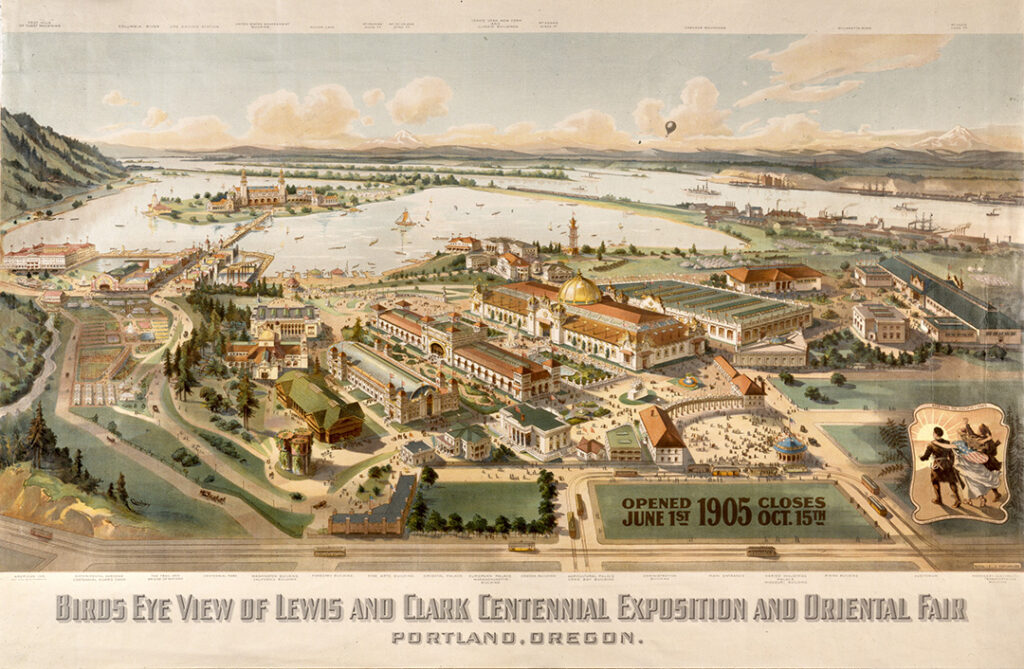
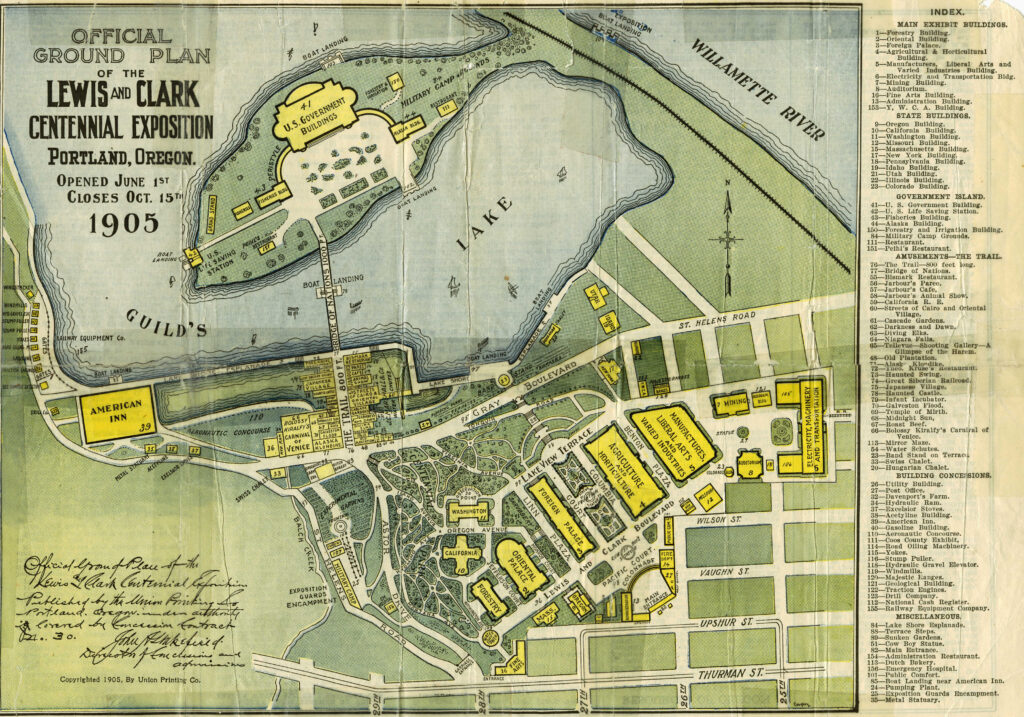
The fairgrounds covered some 400 acres on the northwest edge of Portland, centered on Guild’s Lake, which two years of landscaping had transformed from a marshy slough surrounded by dairies and truck farms into building sites and terraces. The formal layout imitated Chicago’s Columbian Exposition of 1893, with Spanish Renaissance–style exhibition buildings along a bluff overlooking the lake, designed by landscape architect John Olmsted (stepson of Frederick Law Olmsted) for an additional $5,000 fee. Buildings featured domes, cupolas, arched doorways, and red roofs, and were cheaply constructed from lath and plaster for quick demolition after the fair. An amusement street called the Trail featured novelties and scientific marvels alongside replicas of exotic places. Among those scientific marvels, none drew more sustained public attention than the Infant Incubators exhibit.
The fair succeeded on its own terms. It was one of the few American world’s fairs to turn a profit, and its impact on Portland’s growth was dramatic: the city’s population nearly doubled in the decade that followed, rising from 90,426 in 1900 to 207,214 in 1910.
The Incubator Exhibit and Its Operators
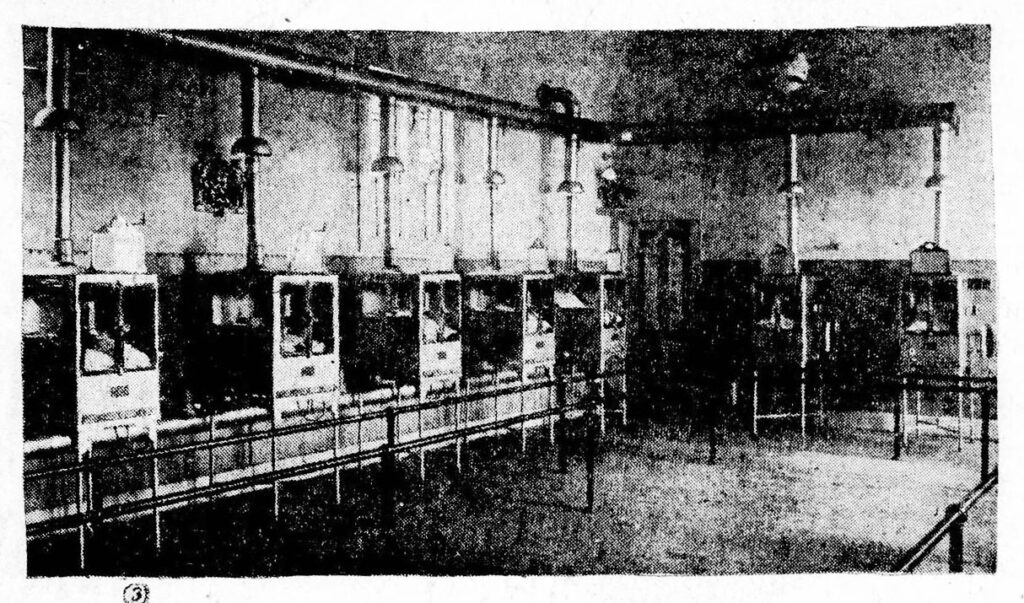
Well before the fair opened, Oregon newspapers were reporting on preparations for the incubator display. The Sunday Oregonian noted in April 1905 that a special building had already been constructed for the incubators on the Trail, and that the exhibit would be “quite certain to appeal to visiting motherhood of the wide world.” The paper described the setup as featuring a high-ceiling observatory housing 24 incubators with glass doors, where the public could observe infants progressing “through all the intermediate stages, up to fully developed babyhood.”
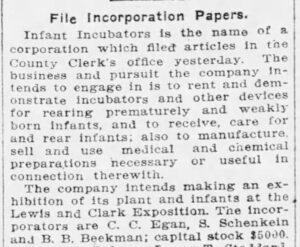
The enterprise was formally incorporated in Oregon in April 1905 under the name “Infant Incubators,” with C. C. Egan, S. Schenkein, and B. B. Beekman as incorporators and a capital stock of $5,000. An Oregon Daily Journal article from the same month identified Egan not as an equal partner but as Schenkein’s “chief assistant.” Dr. Schenkein visited Portland ahead of the opening to arrange with local physicians for the referral of prematurely born infants; the plan from the outset was to work through Portland’s medical community rather than to acquire patients independently. The same article revealed that the Schenkein company was simultaneously operating incubator exhibits at two Coney Island parks — Luna Park and Dreamland — making the Portland operation part of a broader commercial network of such exhibitions on the American exposition circuit.
The exhibit was operated by M. A. Couney and S. Schenkein, who, as multiple newspaper accounts noted, had previously managed similar exhibitions at Earl’s Court in London, the Trans-Mississippi Exposition in Omaha, and the Pan-American Exposition in Buffalo. Eight to ten machines were planned at the outset; later accounts during the fair variously report seven or ten incubators in active use, the variation likely reflecting fluctuations in the number of infants in care. Couney and Schenkein routinely claimed medical credentials and German and French medical connections in their conversations with newspaper reporters, but there is no evidence for either.
The Incubator Exhibit on the Trail
The incubator building sat on the Trail almost directly opposite the Streets of Cairo attraction. The Statesman Journal (Salem, OR), in a June 8, 1905 survey of Trail concessions, described it this way: “There is no gaiety about this concession. It represents the most astonishing achievement of modern science, the nurturing of the human being by artificial means. In the pleasing little building housing this attraction are several ingeniously constructed incubators containing real live infants. Visitors are allowed to gaze at them through plate glass, and apparently the tots are content to remain in their snug homes.”
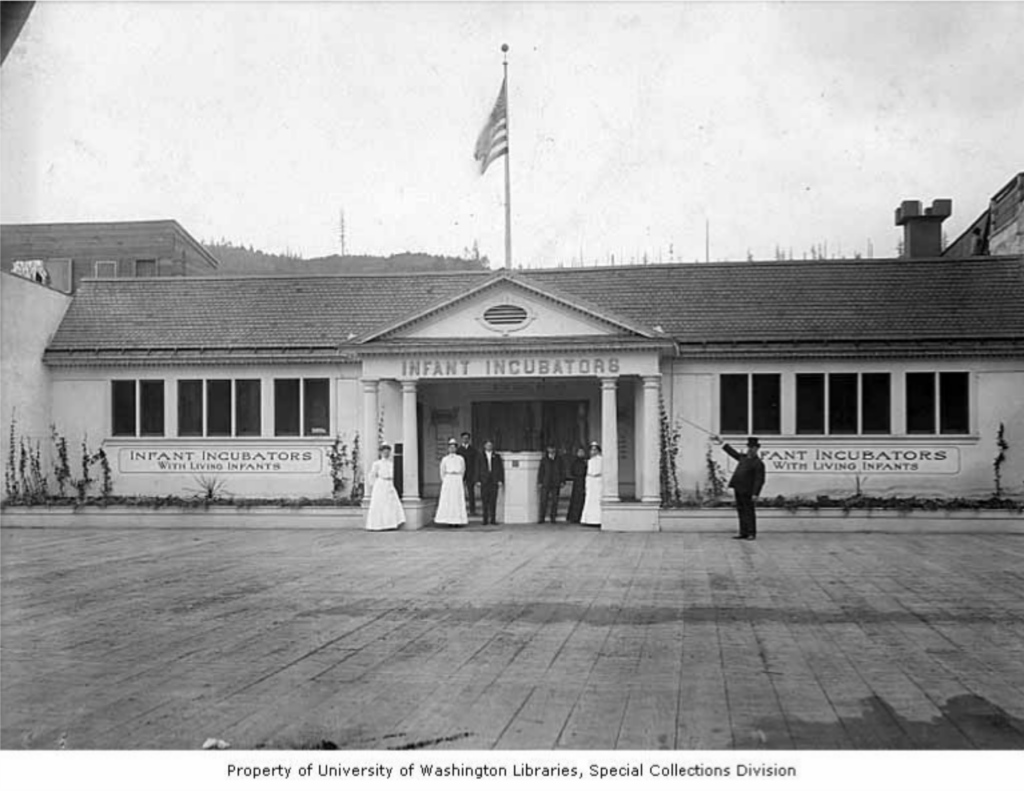
The Sunday Oregonian ran a large illustrated feature on July 16, 1905, with photographs of the building’s exterior — bearing the signage “INFANT INCUBATORS WITH LIVING INFANTS” — and interior views of the incubator ward, the nursery corner, the weighing apparatus, and a specially constructed double incubator built to house twins. The article noted that the exhibit drew its patients from every station in life, from the poorest families to the most prosperous households, and made no charge to parents regardless of background.
The Trail offered thirty-five concessions in all. The Statesman Journal noted that seven dollars would gain a visitor admission to every one of them — the most expensive being the Carnival of Venice at 50 cents. The infant incubators were priced at 25 cents, the standard rate shared by most of the Trail’s major attractions, including Gay Paree, the Concert Hall, Cascade Gardens, the New York Animal Show, the Haunted Swing, the Land of Midnight Sun, the Grand Siberian Railway, and others. A few lesser attractions ran as low as 10 cents.
The Babies and Their Care
According to the newspaper accounts, premature infants on display arrived at the incubators averaging about two and a half pounds. Upon arrival, each infant was given a bath in water and mustard as a stimulant, followed by two drops of brandy placed in the mouth. The body was rubbed with a specially prepared lotion before the child was placed in the incubator. For the first four days, the incubator temperature was maintained between 90 and 105 degrees Fahrenheit. The infants were removed every two hours, day and night, to be fed fifteen grams of nourishment — milk supplied by healthy wet nurses. Because the babies were too weak to feed normally, a nasal spoon was used: the milk was drawn into a tall glass immersed in warm water to keep it at the proper temperature, then administered as the infant breathed. Each child was weighed before and after every feeding to track nourishment taken, and complete records were kept of all aspects of the incubator process.
The incubators maintained a uniform temperature via automatic contrivance. Fresh air was introduced through a large pipe, purified first by passing through an antiseptic fluid and then through cotton, and warmed before entering the infant’s compartment. A thermometer at the front of each incubator provided a constant guide to thermal conditions. Beyond the incubators themselves, the facility included a small pharmacy and equipment for sterilizing milk, along with delicate scales for weighing infants before and after each feeding. Three physicians were in constant attendance day and night, in addition to the nursing staff. The nursing staff, described in press accounts as half a dozen nurses trained at incubator institutions in Berlin and Paris, devoted their time and care to the babies under the doctors’ superintendence. [See note on the nursing staff below.]
An infant was considered out of danger once it could take at least 30 grams — one ounce — of nourishment at a single feeding. Couney declared that any baby reaching the incubator within forty-eight hours of birth and still alive at that point would have a good chance to live and thrive. The Sunday Oregonian‘s July feature gave a weight-based breakdown of survival rates: infants in the heaviest category (above five pounds, nine ounces) had near-certain survival; those in the three-to-five-pound range had a 90 percent survival rate; and even the smallest and most fragile had dramatically improved chances compared to ordinary conditions. Multiple accounts summarized the overall improvement as a rise from roughly fifteen percent survival under ordinary conditions to eighty-five percent with the incubator. Parents were not charged for the care of their infants; the cost of approximately $15 per child per day was covered by ticket sales.
Admission and Finances
Admission to the exhibit was 25 cents, confirmed by the Statesman Journal‘s June 8 listing of Trail concession prices. Ticket revenue was the financial engine of the operation: the daily cost of caring for each infant was approximately $15, and parents paid nothing for their child’s care. The $15-per-day figure is reported by Slabtown Tours without citation of a primary source and should be treated as plausible but as yet unverified against a contemporary document.
Post-fair financial reporting by both the Oregonian and the Oregon Daily Journal (October 16, 1905) confirms the exhibit turned a profit. The Oregonian put the figure at approximately $3,000; the Oregon Daily Journal described it as “about equal” to the YWCA restaurant’s estimated $2,000–$3,000 earnings in 1905 dollars. Either way, it was one of the very few Trail concessions to finish in the black. Princess Trixie led the profitable concessions at approximately $10,000–$20,000; Gay Paree also turned a profit, though that was erased by losses on other concessions its proprietors held. The Trail as a whole was a financial disaster for most operators: J. A. Gorman, president of the Trail corporation, stated that the Trail had lost more than $150,000 out of roughly a half-million dollars invested, with some estimates putting total concession losses as high as $450,000.
Public and Press Reception
The incubator exhibit attracted sustained coverage throughout the fair’s run. A Corvallis Gazette piece described “seven of these miracles of modern science, each containing its living, breathing, struggling little soul, fighting bravely for the life otherwise denied but for the Incubator.” The Siskiyou Daily News called it “the premier attraction of all the greater and better features” and praised the exposition management for “securing this wonderful scientific curio.” A group of sixteen society women from Utah, brought to the fair as guests of the Ogden mayor’s newspapers after a voting contest, issued what the Petaluma Daily Morning Courier described as a “unanimous verdict”: the incubators were “the feature par excellence of the great Lewis and Clark fair,” with “every other attraction” paling before “this life-saving, humanitarian, scientific curio.” The Independent (July 6) noted that the exhibit drew “nearly everybody” and that women in particular found the sight so fascinating they returned time and again.
The Sunday Oregonian‘s July 16 illustrated feature — the most extensive single piece of coverage — included photographs of the exterior and interior and noted that physicians in general practice welcomed the system as an invaluable adjunct to their own work. The article also referenced a printed prospectus produced by the institution itself, suggesting Couney and Schenkein invested in formal promotional literature as part of their standard operating approach.
Press coverage consistently emphasized both the humanitarian dimension — “neither race nor color are considered; humanity is the keynote,” as the Petaluma paper put it, a claim borne out in practice by a photograph in the Oregon Sunday Journal (August 13) captioned “Colored child in the baby incubator at the exposition” — and what reporters described as the German origins of the technology. In fact, as discussed below, that attribution was part of Couney’s carefully cultivated public narrative rather than a straightforward account of the incubators’ provenance.
After the Fair
On October 16, the day after the fair closed, both Portland papers ran post-mortem accounts of the Trail. The Oregon Daily Journal reported that a sign had been placed on the incubator concession reading “Gone, but not forgotten.” The Oregonian of October 18 noted that the incubator equipment was destined for Los Angeles, along with several other Trail attractions, although I have not been able to find any press coverage of an incubator exhibit in Los Angeles in 1905 or 1906 so far. Shortly after, the Oregon Daily Journal carried a classified advertisement offering the building and furniture for sale. By the end of October, the exhibit that had drawn visitors continuously for four and a half months had been dismantled and dispersed.

Couney’s Narrative and Its Limits
The newspaper accounts of the Portland exhibit reproduced, largely without scrutiny, a promotional narrative that Couney had been refining and deploying at expositions for nearly a decade. Several elements of that narrative deserve skepticism.
Every press account describes the nurses as having been trained at incubator institutions in Berlin and Paris — almost certainly standard promotional language rather than a verifiable fact. No individual nurse at the Portland exhibit is named in any of the news stories I found. It is possible that Louise Recht, a nurse with genuine Paris training who was associated with Couney’s operations, was present, but she goes unmentioned in the coverage. The more likely reality is that the nursing staff consisted of American nurses or nurse’s aides who had received whatever training Couney and Schenkein provided on site. The “Berlin and Paris” credential was a reliable piece of the exhibit’s mystique, repeated in city after city, but it should not be taken at face value.
Newspaper coverage at Portland — as at earlier Couney exhibitions — consistently attributed the incubator to German science and German invention. The Oregon Daily Journal‘s April 16 advance piece stated flatly that “the infant incubator system had its origin in Germany and is conducted there under the auspices of the government.” In fact, the incubators Couney used were based on the design of Alexandre Lion, a French inventor and physician who had developed and patented his couveuse in Nice in the 1890s. The technology was French, not German, although it is possible that the incubators used in Portland were sourced from Paul Altmann in Berlin, who manufactured them according to Lion’s design.
Couney’s association with German medicine — he presented himself as Berlin-trained and his co-operator Schenkein was identified as being of Berlin — was integral to his self-created legend. In the 19th century, German medicine was considered the standard of excellence, and many American physicians went to Germany to study. The Portland news coverage is a faithful record of what Couney told reporters; it is a less reliable guide to the actual history of the incubator or the people who staffed the exhibit.
Newspaper Sources
- The Oregon Daily Journal (Portland, OR), April 16, 1905, p. 7 — “Think of Calling Incubator ‘Mamma'”: Schenkein and Egan visit Portland ahead of the fair; Egan identified as chief assistant; Coney Island operations at Luna Park and Dreamland mentioned; 8–10 machines planned; repeats German origin claim.
- The Sunday Oregonian (Portland, OR), April 16, 1905, p. 4 — “In the Infant Incubators”: advance notice of the exhibit’s construction on the Trail and description of the incubator apparatus and care regimen.
- The Sunday Oregonian (Portland, OR), April 16, 1905, p. 36 — “File Incorporation Papers”: notice of the incorporation of “Infant Incubators” in Oregon, listing C. C. Egan, S. Schenkein, and B. B. Beekman as incorporators with $5,000 capital stock.
- The Butte Miner (Butte, MT), May 15, 1905, p. 9 — “Babies in Incubators May Be Seen at the Fair”: dateline Portland, May 15; detailed description of the incubator care process, nursing staff, and survival statistics.
- The Register-Guard (Eugene, OR), May 28, 1905 — “How Babies Will Be Incubated”: wire story, dateline Portland May 27; standard pre-fair account running in multiple Oregon papers.
- Statesman Journal (Salem, OR), June 9, 1905, p. 5 — “See the Trail”: survey of all Trail concessions with prices; describes the incubator exhibit and confirms 25-cent admission; notes its location opposite the Streets of Cairo.
- The Los Angeles Times (Los Angeles, CA), July 5, 1905, p. 11 — “Baby Incubators: How, by Scientific Nurturing, 85 Per Cent of Infants Prematurely Born, are Saved” (Special Correspondence of the Times, dateline Portland, July 1): detailed account of feeding, temperature, air purification, and survival statistics; quotes Couney on prognosis.
- Traverse City Evening Record (Traverse City, MI), June 29, 1905, p. 3 — “Baby in an Incubator”: dateline Portland, June 29; closely parallel account of care procedures.
- The Independent, July 6, 1905, p. 8 — “Infant Incubators at Portland Fair”: dateline Portland, July 3; describes the four essentials of incubator care and notes the exhibit as a major attraction.
- Grant City Star (Grant City, MO), July 6, 1905, p. 4 — Infant Incubators on the Trail: describes seven incubators in operation and quotes survival statistics.
- Corvallis Gazette (Corvallis, OR), July 14, 1905, p. 1 — Clipping from a larger article about the Exposition, incubators as a Portland fair attraction.
- The Sunday Oregonian (Portland, OR), July 16, 1905, p. 31 — “Infant Incubator Exhibit at the Fair”: large illustrated feature by Race Whitney with photographs of the exterior, incubator ward, nursery, weighing apparatus, and twin incubator; discusses weight-based survival rates, three-physician staffing, pharmacy and sterilizing equipment, and the institution’s prospectus.
- Oregon Sunday Journal (Portland, OR), August 13, 1905, p. 35 — “Infant Incubator” feature: photographs including “Colored child in the baby incubator at the exposition” and a twin incubator; confirms three physicians in attendance and small on-site pharmacy; references Marie Dressler’s adoption of a Buffalo exposition incubator baby.
- Siskiyou Daily News (Yreka, CA), August 10, 1905, p. 2 — “Triumph of Skill and Genius”: credits German science with perfecting the infant incubator and calls the Lewis and Clark exhibit the fair’s premier attraction.
- Petaluma Daily Morning Courier (Petaluma, CA), September 7, 1905, p. 1 — “The Mayor Endorses It / Society Ladies Vote the Incubators the Feature of the Fair”: reports unanimous endorsement of sixteen Utah society women and describes the doctors’ prior exhibition history.
- The Oregonian (Portland, OR), October 16, 1905, p. 8 — “Concessionaires Lose Heavily”: post-fair financial survey; lists infant incubators among the profitable few, with an approximate gain of $3,000; documents overall Trail losses of $150,000–$450,000.
- The Oregon Daily Journal (Portland, OR), October 16, 1905, p. 1 — “6,000 People Idle as the Result of Closing”: reports incubator show earnings “about equal” to the YWCA restaurant’s estimated $2,000–$3,000; notes a sign on the concession reading “Gone, but not forgotten.”
- The Oregonian (Portland, OR), October 18, 1905 — “Trail Looks Desolate”: notes that the incubator equipment was to be shipped to Los Angeles after the fair’s close.
- The Oregon Daily Journal (Portland, OR), October 1, 1905, p. 21 — Classified advertisement: “For Sale — Small building, well constructed, also furniture. Inquire Infant Incubators, fair grounds. Phone Fair 83.”
Secondary and Reference Sources
- Abbott, Carl. “Lewis and Clark Exposition.” Oregon Encyclopedia. Oregon Historical Society. https://www.oregonencyclopedia.org/articles/lewis_clark_exposition/
- Abbott, Carl. “Designing the Fairgrounds.” In Lewis and Clark: From Expedition to Exposition, 1803–1905. Oregon History Project, Oregon Historical Society. https://www.oregonhistoryproject.org/narratives/lewis-and-clark-from-expedition-to-exposition-1803-1905/starting-a-new-century-the-lewis-and-clark-centennial-exposition-1905/designing-the-fairgrounds/
- Killen, John. “Past Tense Oregon: Lewis & Clark Exposition opened 110 years ago, put Portland on the map.” OregonLive, June 1, 2015. https://www.oregonlive.com/history/2015/06/past_tense_oregon_lewis_clark.html
- Slabtown Tours. “Fun Fact #47: Where was the first use of an Infant Incubator in Portland?” February 22, 2019. https://slabtowntours.com/2019/02/22/fun-fact-47-where-was-the-first-use-of-an-infant-incubator-in-portland/ — Reports $15-per-day care cost per infant, parents not charged; no primary sources cited for these figures. The 25-cent admission figure it cites is confirmed by source 7 above.
- America’s Best History, “Lewis and Clark Centennial Exposition and Oriental Fair.” https://americasbesthistory.com/wfportland1905.html
General Information about Martin Couney
Martin Arthur Couney
- Short biography of Martin Couney
- Martin Couney, Wikipedia – contains outdated information
- Martin Couney’s Obituary, from The New York Times, March 2, 1950 – contains outdated information
Primary Source Documents
- Gellert Ship Manifest, 1888
- US 1910 Census
- US 1920 Census
- US 1940 Census
- Marriage Certificate 1903
- Passport Application 1904
Business and Associates
Martin Couney Exhibits in World’s Fairs and National Expositions
- Victorian Era Exhibition at Earl’s Court, 1897
- Trans-Mississippi Exposition, Omaha, 1898
- Pan-American Exposition, Buffalo, 1901
- Lewis and Clark Centennial Exposition, Portland, 1905
- Panama-Pacific International Exposition San Francisco, 1915
- Century of Progress International Exposition, Chicago, 1933-34
- New York World’s Fair, New York, 1939-1940
Martin Couney Sideshows in Amusement Parks
- Asbury Park Boardwalk, New Jersey
- Coney Island Sideshow at Luna Park
- Coney Island Sideshow at Dreamland
- Lakeside Amusement Park, Denver.
- Luna Park, Pittsburgh
- Wonderland – Minneapolis and St. Paul
- Wonderland – Revere Beach
- Boardwalk – Atlantic City
- White City Amusement Park – Chicago
- White City Amusement Park, Indianapolis, Indiana
- White City Amusement Park, Cleveland, Ohio
Recent Books
- The Strange Case of Dr. Couney, by Dawn Raffel, Blue Rider Press, ISBN 0399175741
- Buy on Amazon (your purchase will support “Neonatology on the Web”)
- Miracle at Coney Island, by Claire Prentice (Kindle or audiobook)
- Buy on Amazon (your purchase will support “Neonatology on the Web”)
General Articles
General articles about Martin Couney and his exhibits are linked below. Additional links may be found in specific posts about his participation in expositions or sideshows.
Reader beware: many of these were written before the full facts about Martin Couney’s background became known, or have not incorporated that new information, so they include information from his self-invented background legend.
- Incubator Baby Sideshows, by William Silverman, from Pediatrics.
- Postscript to Incubator-Baby Sideshows, by William. Silverman, from Pediatrics
- Martin Couney’s Story Revisited, by AAP Perinatal Section Ad Hoc Committee on Perinatal History, from Pediatrics
- Martin Couney’s Obituary, from The New York Times, March 2, 1950.
- A Patron of the Premies, by A. J. Liebling, from The New Yorker
- The Coney Island Baby Laboratory, by Gary R. Brown, from American Heritage Invention and Technology Magazine
- American Characters: Martin Couney, by Richard Snow, from American Heritage Magazine
- The Man Who Ran a Carnival Attraction… by Claire Prentice, from Smithsonian Magazine
- Life under Glass, audio documentary by Claire Prentice, from the BBC
- Martin Couney and Incubator Exhibits from 1896 to 1943, from the Embryo Project
- The Incubator Baby and Niagara Falls, by Arthur Brisbane, from The Cosmopolitan
- Babies on Display, from NPR
- Beginner’s Luck, from Family Circle Magazine 1993
- Coney Island’s Incubator Babies, by Rebecca Rego Barry, from JSTOR Daily
- The Infantorium, by Katie Shornton, from 99% Invisible
- How One Man Saved a Generation of Premature Babies, from BBC News
- Baby Incubators: From Boardwalk Sideshow to Medical Marvel, by Erin Blackmore, from History.Com
- Babies in Sideshows, by Julie Andreson, from Engines of our Ingenuity
- Dr. Martin Couney, from Coney Island History Project
- “The Use of Incubators for Infants,” The Lancet, May 29, 1897.
- “The Victorian Era Exhibition at Earl’s Court,” The Lancet, July 17, 1897.
- Incubator Baby Shows: A Medical and Social Frontier, by Hannah Lieberman, from The History Teacher 35.1, November, 2001.
- The Child Hatchery, from City Pages.
- Good Old Coney Island, by Edo McCullough, excerpt from the book
- “And Next to the Bearded Ladies…” from The New York Times (captured as PDF)

- Kinderbrutanstalt: Leisure Space and the Coney Island Baby Incubators, by Scott Webel, Text, Performance, Practice, 2003. (captured PDF)
- Premie Road Shows from Hippocrates (captured PDF)
- Transferring the Incubator: Fairs and Freak-Shows as Agents of Change, by Katie Proctor, 2004. (captured PDF)
- Pan-American Exposition Baby Incubator Exhibit in Buffalo, New York, 1901 (from the U. of Buffalo Library web site)
Portions of this page were drafted with machine assistance; the final text was reviewed, verified, and edited by the author. Click here to learn more.
Last Updated on 09/16/26