New York World’s Fair, 1939-1940
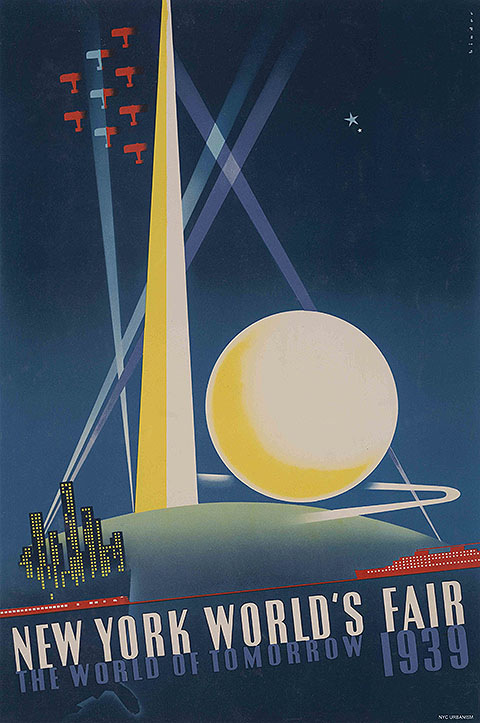
The New York World’s Fair 1939-1940 was held at Flushing Meadows-Corona Park in Queens under the theme “Building the World of Tomorrow.” Conceived during the Depression as a spur to civic and economic renewal, it was organized by a private corporation headed by Grover Whalen and timed to open on the 150th anniversary of George Washington’s first inauguration. It ran across two seasons: April 30 to October 31, 1939, and May 11 to October 27, 1940. The transformation of the site itself was part of the story — a former ash dump and tidal marsh that Robert Moses had reclaimed, later to become permanent parkland.
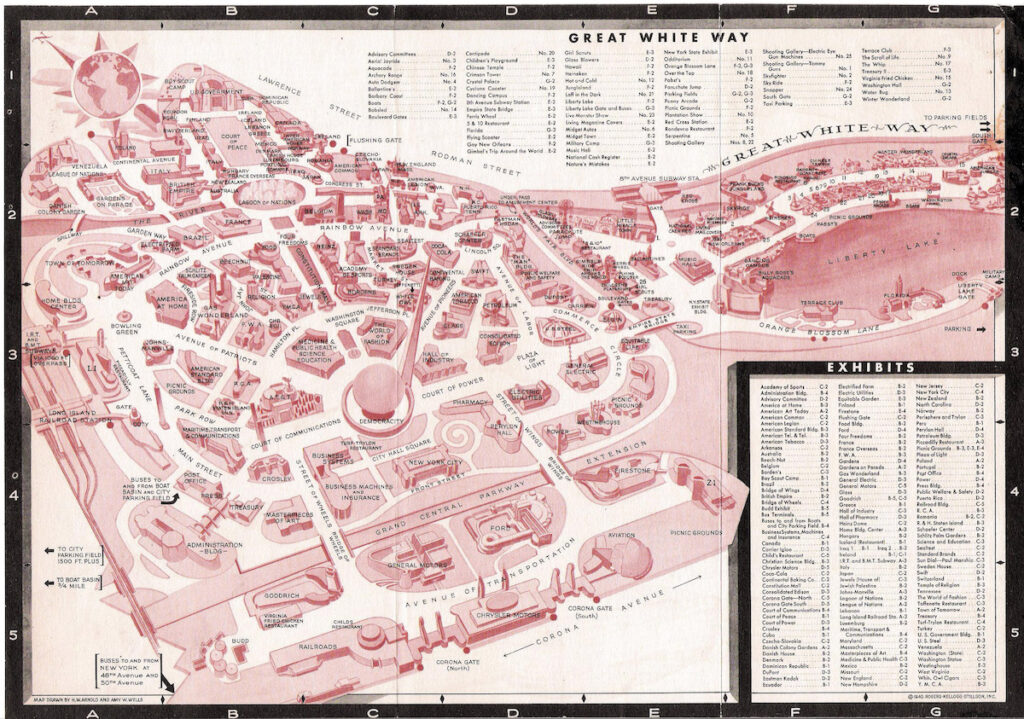
In scale it was among the largest fairs ever mounted, covering roughly 1,200 acres organized into color-coded thematic zones radiating from the fair’s centerpiece, the 610-foot Trylon and 180-foot Perisphere designed by Wallace Harrison and Max Abramovitz. Participation was broad: depending on how national exhibitors are counted, between 54 and 62 nations took part, alongside some three dozen U.S. states and territories and well over a thousand corporate and civic exhibitors. Company pavilions were given prominence over national ones, reflecting the organizers’ faith in industry and consumer technology as engines of progress — General Motors’ Futurama, which conveyed visitors over a model of the America of 1960, became the fair’s defining attraction. The 1940 season was reshaped by the outbreak of war in Europe, with several national pavilions withdrawing and the tone shifting from utopian futurism toward a more defensive celebration of American life.
Financially the fair was a disappointment. Against an original master-plan estimate of about $125 million, the total cost of developing and running the exposition rose to roughly $156 million, and the corporation ultimately recovered only about a third of its outlay. When the World’s Fair Corporation was wound up, shareholders were left with losses on the order of $18–19 million. Attendance, though large, fell well short of the roughly 50 million Whalen had projected: just over 45 million people passed through the gates across both seasons, about 25.8 million in 1939 and 19.1 million in 1940, at a general admission of 75 cents.
Despite the deficit, the fair left a lasting cultural and physical legacy. It introduced a mass public to television, nylon, fluorescent lighting, and a confident vision of a streamlined technological future, and its imagery became emblematic of late-1930s American design. Work on converting the grounds into Flushing Meadows-Corona Park began as the fair closed, and the site would host a second World’s Fair in 1964-1965. The only building that survives from the 1939-1940 World’s Fair in its original location is the New York City Building, designed by Aymar Embury II. It housed the UN General Assembly from 1946 to 1950, was reused for the 1964 fair, and has been the Queens Museum since 1972.
The Baby Incubator Exhibit
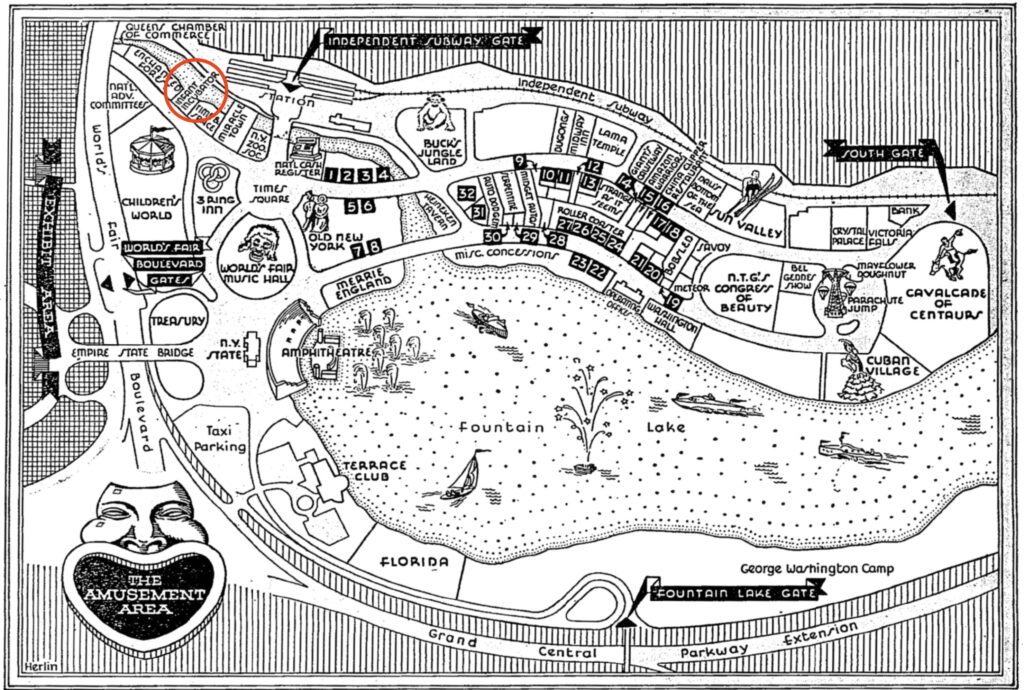
Of all the attractions in the mile-long amusement zone at Flushing Meadows — Billy Rose’s Aquacade, the Parachute Jump, Frank Buck’s Jungleland, Salvador Dalí’s diving girls — one of the most popular sat behind glass in a pink U-shaped building and charged twenty-five cents to look at living premature babies. It was billed in the Fair’s own price lists alongside the roller coaster and the freak shows: “Infant Incubator: Live babies in a scientific nursery with all the latest appliances. 25 cents.” This was Martin Couney’s last and largest incubator show, and it opened, a couple of weeks behind schedule, in the spring of 1939.
Couney had written to the Fair as early as January 1937, and from the start his relations with the concessions committee were strained. He wanted this exhibit grander than any he had mounted before, and he intended to pay for the whole thing himself, planning afterward to give the building and equipment to the City of New York as a permanent hospital in memory of his late wife, Maye. His early estimate of $80,000 had climbed to $100,000 by February 1938; the marshy, rat-infested ground ran everything over budget, and by March 1939 an internal memo noted six carpenters laboring “on a job that could easily stand twenty men.” He hired the firm Skidmore & Owings — architects for several of the Fair’s major buildings — to design an extravagant structure with a nursery, a glass-bricked solarium where babies who had gained weight could take the sun, a room for baby-care talks, a reception room for visiting doctors, and nine rooms of living quarters for himself, his daughter, his head nurse, the other nurses, wet nurses, a cook, and a chauffeur. A thousand-pound reproduction of Andrea della Robbia’s swaddled-infant bas-relief sat on the roof; over the door hung the sign that had followed his shows for decades, “All the World Loves a Baby.” Forced to sell stocks in a bad market to cover the overruns, Couney fought the committee over everything from the width of his outdoor sign to an order to install an electric dishwasher, and — pointedly — over a required fire alarm, submitting a two-page letter arguing it was “absolutely unnecessary” because his building was semi-fireproof, his nurses ran nightly fire drills, and, he added, “my babies do not play with matches.” (That summer Steeplechase Park burned; his infants were spared only because he had closed his Coney Island concession to come to the Fair.)
Inside, the operation was run with real rigor. Sixteen babies were typically on view at once, each in a glass-fronted incubator, while an attendant explained the child’s progress to the crowd filing along a railed corridor. A staff of fifteen trained nurses worked in eight-hour shifts, joined by five wet nurses who lived on the premises with their own nursing infants; the veteran Madame Louise Recht, Couney’s principal aide for some four decades, was head nurse, and his daughter Hildegarde — herself a former incubator baby — was a registered nurse on the staff. The babies were fed mother’s milk, tube- or nasal-spoon-fed when they were too weak to swallow; the milk was tested and stored in four Servel Electrolux gas refrigerators, a detail the gas industry publicized heavily in syndicated features that ran in papers from West Virginia to Minnesota. Incubators were kept warm — accounts variously cite 85 to 92 degrees — with filtered air and supplemental oxygen. Babies came from hospitals around the region, referred by obstetricians and often delivered in Couney’s specially built ambulance, described as the only one in the world made to carry premature infants: a glass case on a sponge-rubber-cushioned spring, an oxygen supply, and a thermostat-controlled copper coil holding 85 to 90 degrees. In one widely reported dash, the ambulance carried a three-and-a-quarter-pound baby, John Christopher Royle, 150 miles from Wilmington to the Fair in under three hours. The exhibit cared for infants free of charge; admissions were its only revenue, and a quarter of the gross went back to the Fair, so that Couney needed roughly seven hundred paying visitors a day merely to break even.
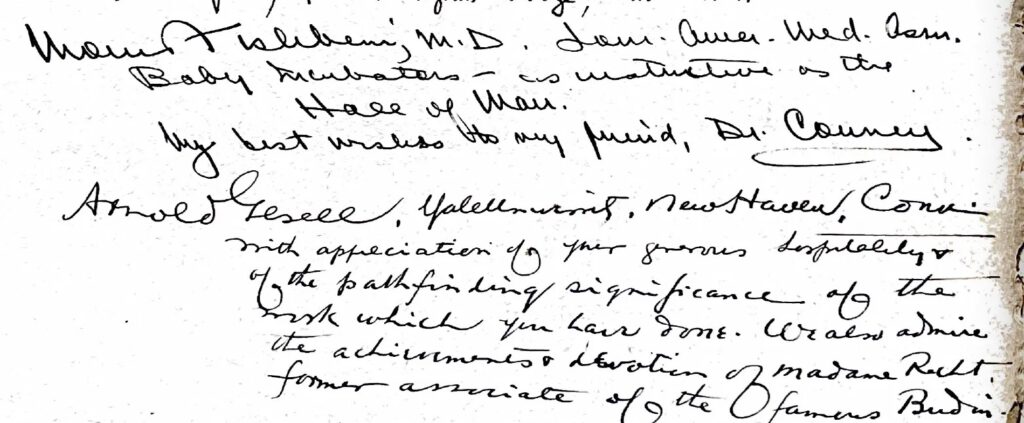
However carnival its setting, the exhibit drew serious medical attention, and the visitors’ guestbook that survives from the building bears witness to it. The first name in the book is that of Julius Hess of Chicago — the leading American authority on premature care and Couney’s friend — who signed on opening day, April 30, 1939, and inscribed a tribute calling Couney “the pioneer in the successful care of the premature infant” and praising Recht by name. Among the other signatures are those of Morris Fishbein, the editor of the Journal of the American Medical Association, who wrote that the baby incubators were “as instructive as the Hall of Man” and sent “best wishes to my friend, Dr. Couney”; and Arnold Gesell of Yale, who thanked Couney for his hospitality and for the “pathfinding significance” of his work, again singling out Recht as a “former associate of the famous Budin.” Gesell’s interest was more than ceremonial: he and his cameraman filmed Couney’s infants at the Fair in 1939 and again in 1940 for his studies of infant behavioral development, work he acknowledged in The Embryology of Behavior (1945). The three inscriptions — from the era’s foremost clinician, its most powerful medical editor, and a pioneering academic researcher — are a striking measure of the regard the exhibit commanded, and a rare contemporary record, in their own hands, of the esteem in which Louise Recht in particular was held.
The population of the nursery skewed heavily female — reporters repeatedly noted stretches with no boys at all — and the season produced a run of small celebrities: three sets of premature twins at once in August 1939, said to be a first in Couney’s experience; a one-pound Brooklyn girl called Regina, 800 grams at birth, in June 1940; and Patricia Beverly Preston, “exhibit 15,” whose mother saw her for the first time through the incubator glass. Couney kept careful statistics. His own compiled report on the two seasons records 96 premature infants admitted over 1939 and 1940, of whom 86 lived and 10 died — an overall mortality of 10.4 percent — with 66 girls to 30 boys, and 49 infants treated in the oxygen chamber. (The figure squares with the 23 requiring oxygen that Couney reported to Health Commissioner John L. Rice for the 1939 season alone, of 50 received that year, 45 sent home, and 5 lost.) These are the numbers later summarized in the Journal of the American Medical Association in November 1940.
Those figures deserve the caveat that William Silverman would later stress, and Couney’s own report quietly concedes it: the babies arrived at the exhibit days after birth, having already survived the highest-risk early hours elsewhere. His tables track survival at 24, 48, and 96 hours before graduation, and express the success rate as a percentage of infants “surviving [the] first 48 hours” — an acknowledgment, in the document itself, that the show’s low mortality reflects a selected group of hearty survivors rather than the true odds of prematurity.
The Fair leaned into the pageantry of it. On June 14, 1940, Couney staged an “alumni reunion” for the “Class of ’39”; the babies, most of them not yet a year old, were brought back with their parents, and each received an engraved silver cup and a diploma signed by Couney and by Grover Whalen, president of the Fair, declaring that the child had gained its start in life at the incubator station. The nursery was closed to the public that day, and pediatricians attending the American Medical Association’s meeting in New York were invited to inspect the babies.
For all its popularity, the venture was a financial disaster. Couney sank somewhere between $75,000 and $100,000 into it, told a reporter he had “lost his shirt,” and never recovered enough to make the gift to the city he had envisioned. The crowds preferred Billy Rose’s swimmers at the other end of the midway; the incubator babies, after four decades of exhibition, had become “old hat”; and the health department kept up a steady stream of inspections. Over it all hung the coming war. Found at his exhibit by a New York World-Telegram reporter, the old showman wondered aloud what his life’s work had been for: “If we go into this war, God knows how many hundreds of my kiddies will be crippled on the battlefields, or die.” After the Fair closed, his summers at Coney Island dwindled, and when New York finally opened a premature-infant station at Cornell’s New York Hospital, he shut the show for good, telling his nephew, “I made propaganda for the preemie. My work is done.”
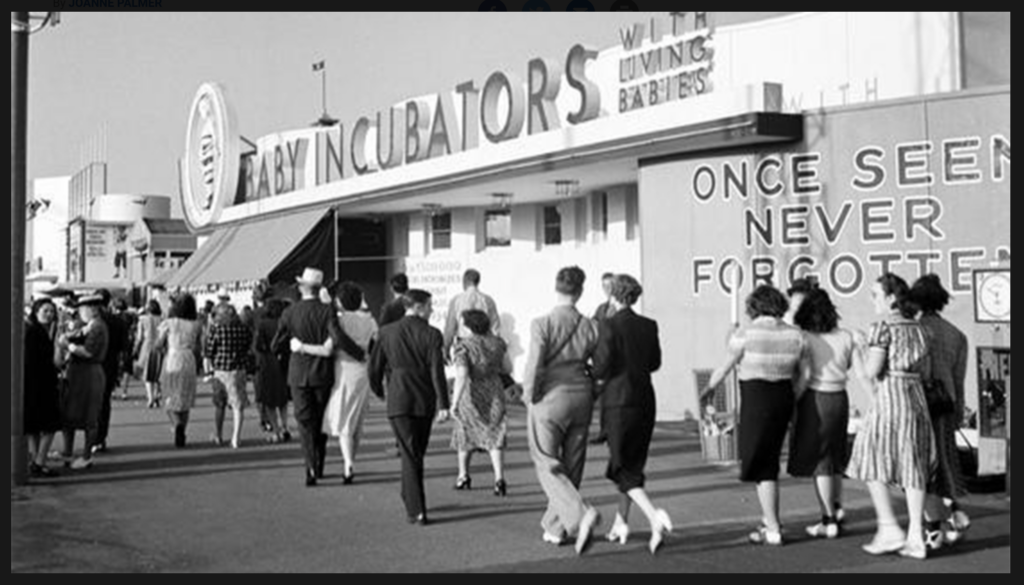
Above: Facade of Martin Couney’s exhibit at the New York World’s Fair.
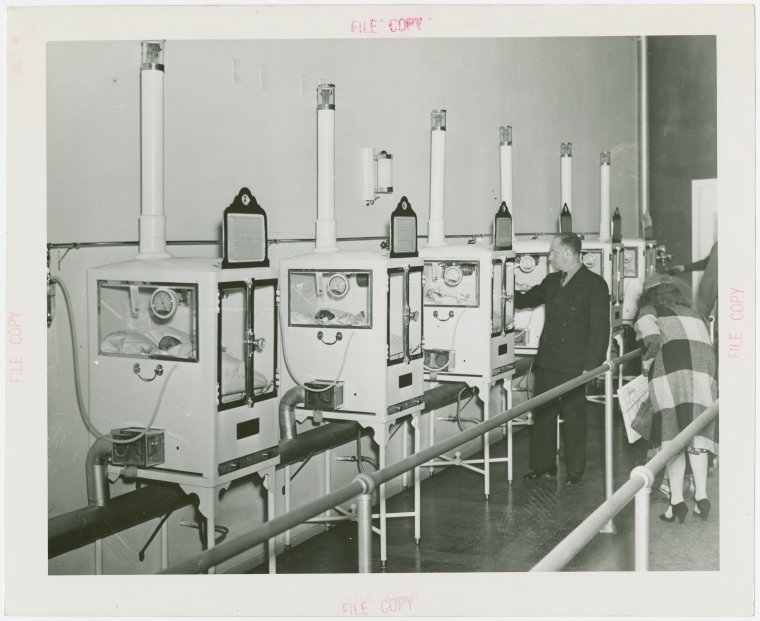
Above: Incubators in the exhibit. Source: New York Public Library.
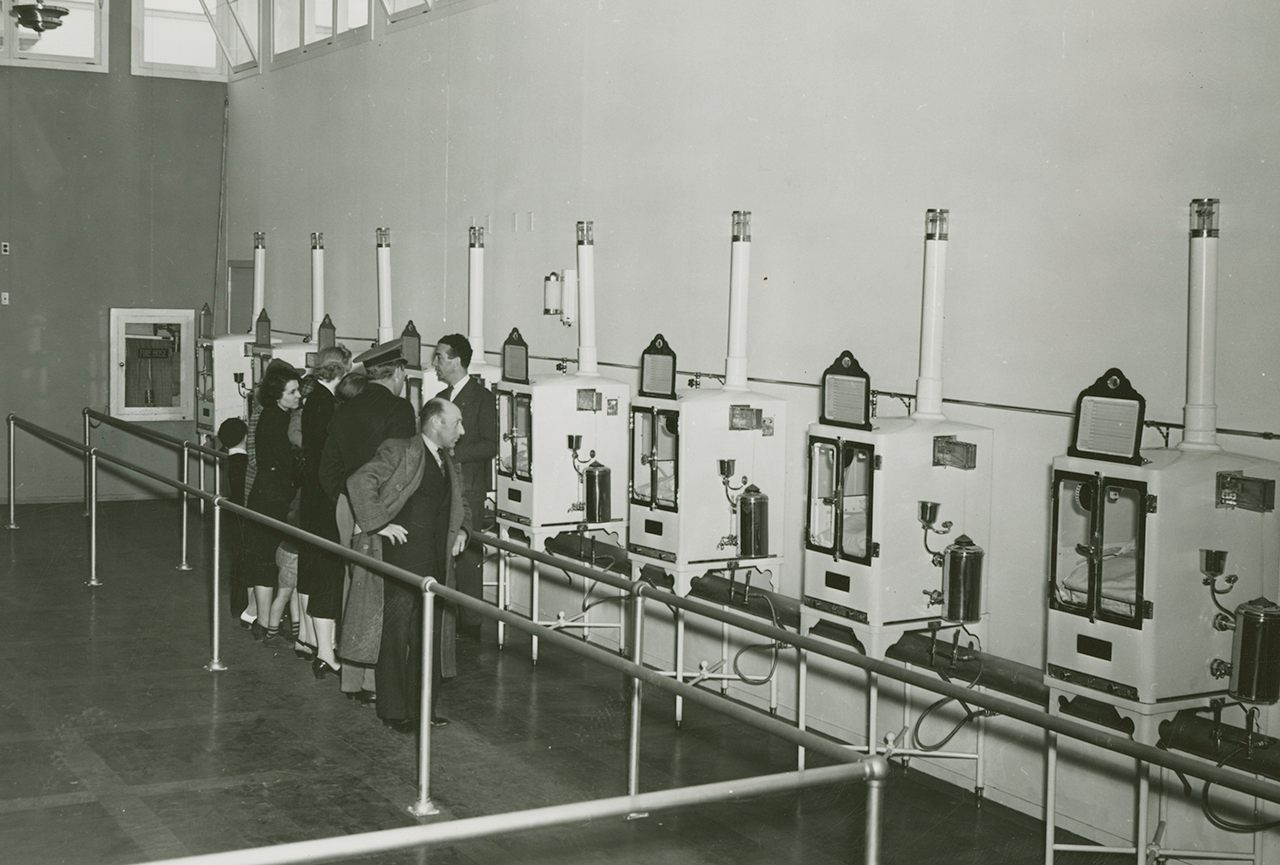
Above: Incubators in the exhibit. Source: New York Public Library.
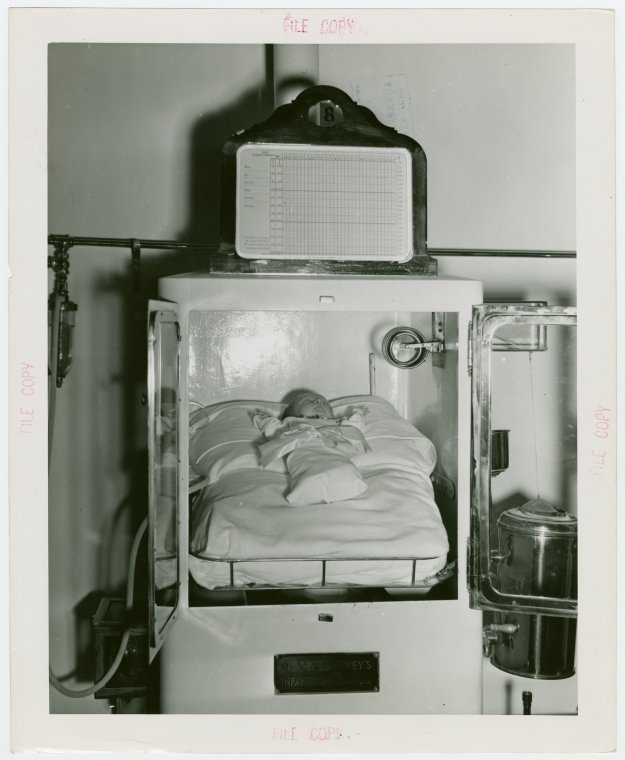
Above: Baby in an incubator. Source: New York Public Library.
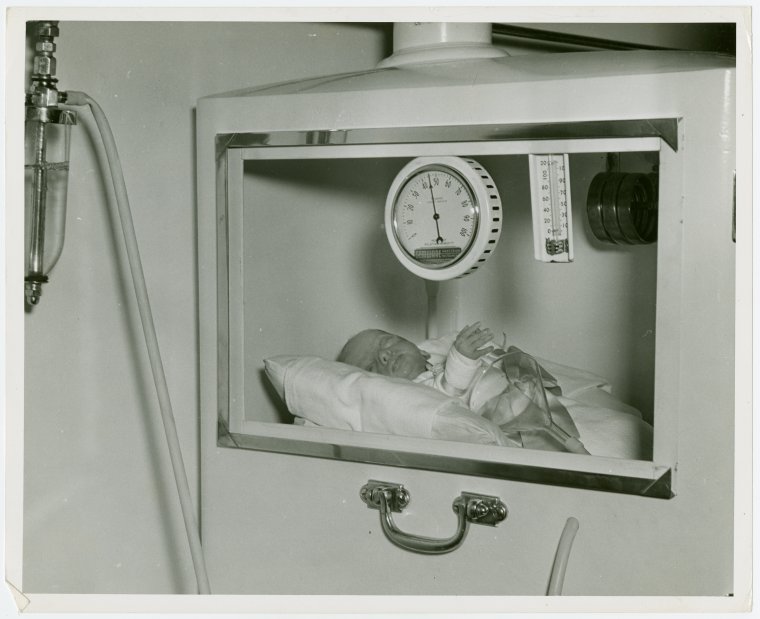
Above: Baby in an incubator. Source: New York Public Library.
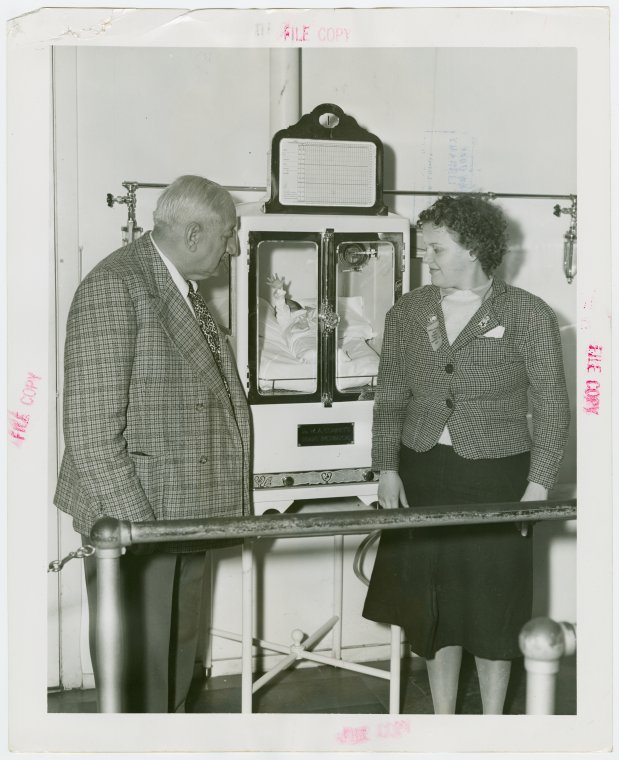
Above: Martin Couney and guest looking at a baby. Source: New York Public Library.
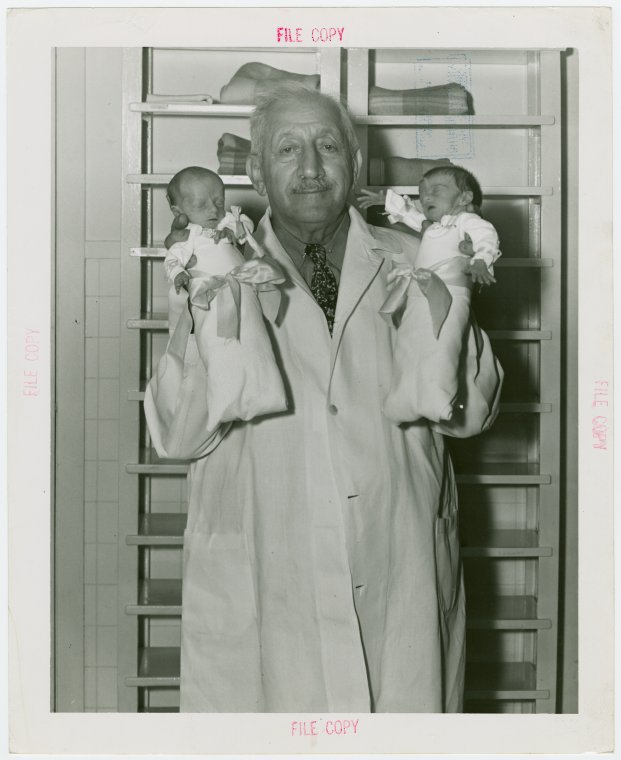
Above: Martin Couney and two infants. Source: New York Public Library.
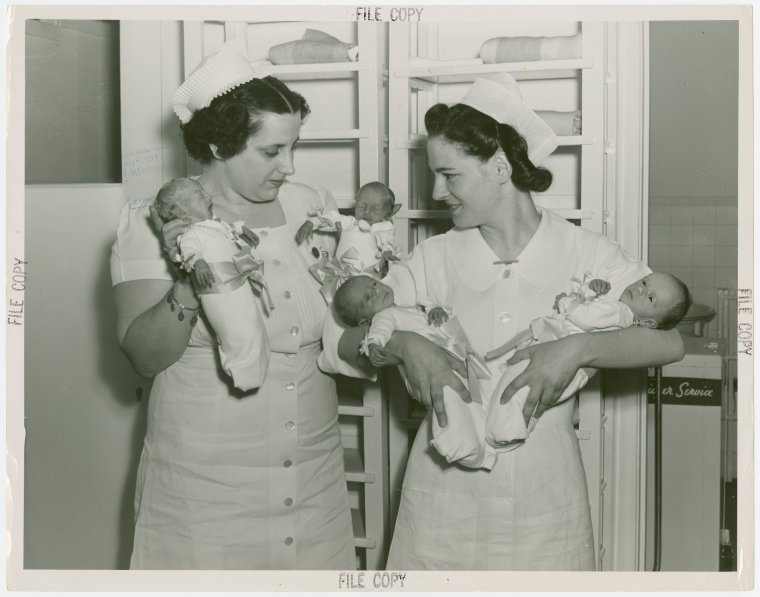
Above: Hildegard Couney and another nurse with babies. Source: New York Public Library.
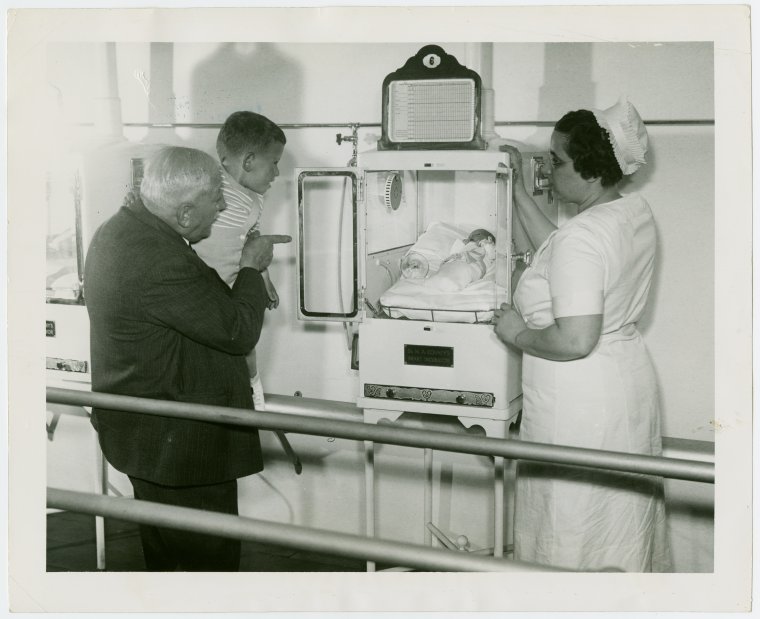
Above: Martin Couney and Hildegard Couney with boy looking into incubator.
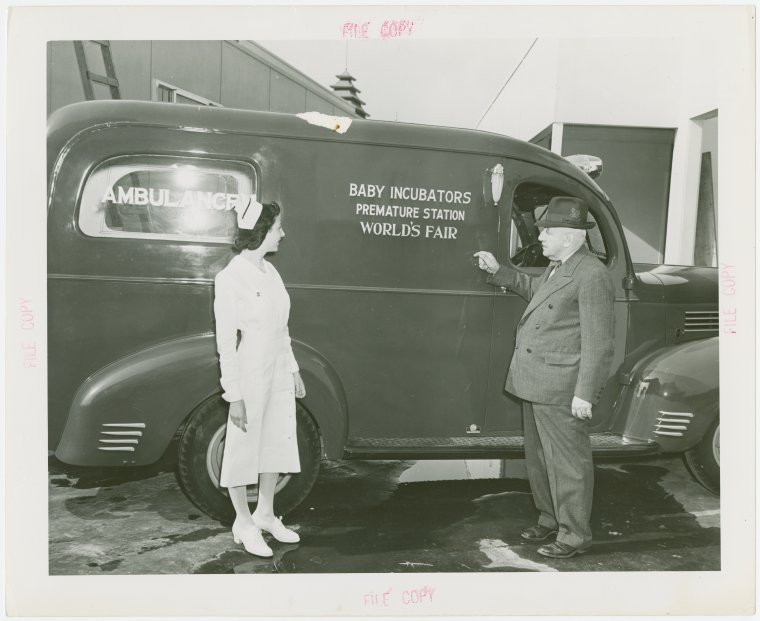
Above: Martin Couney and ambulance used to transport premature infants to the exhibit at the New York World’s Fair. Source: New York Public Library.
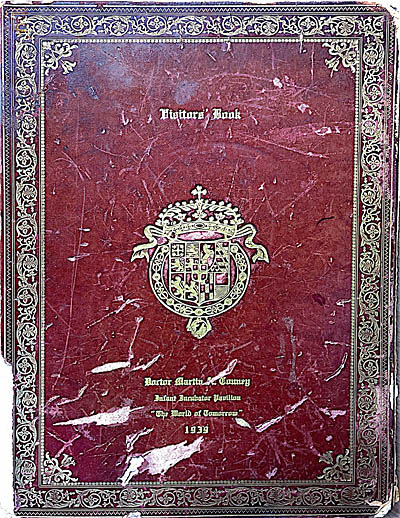
Guest book from Couney’s exhibit at the New York World’s Fair, 1939. Only 43pages were used for signatures. The rest of the book is blank, except for a few pages where snapshots have been removed at some point in the past.
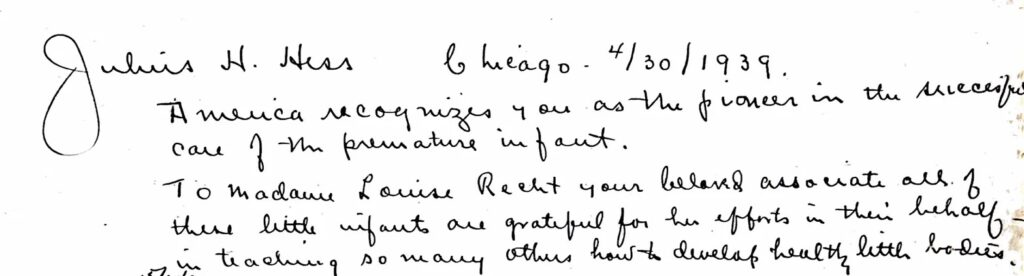
Julius Hess — “Julius H. Hess — Chicago — 4/30/1939. America recognizes you as the pioneer in the successful care of the premature infant. To Madame Louise Recht your beloved associate all of these little infants are grateful for her efforts in their behalf — in teaching so many others how to develop healthy little bodies…”
Morris Fishbein — “Morris Fishbein, M.D., [Jour.] Amer. Med. Assn. Baby Incubators — as instructive as the Hall of Man. My best wishes to my friend, Dr. Couney.”
Arnold Gesell — “Arnold Gesell, Yale University, New Haven, Conn. With appreciation of your generous hospitality & of the pathfinding significance of the work which you have done. We also admire the achievements & devotion of Madame Recht, former associate of the famous Budin…”
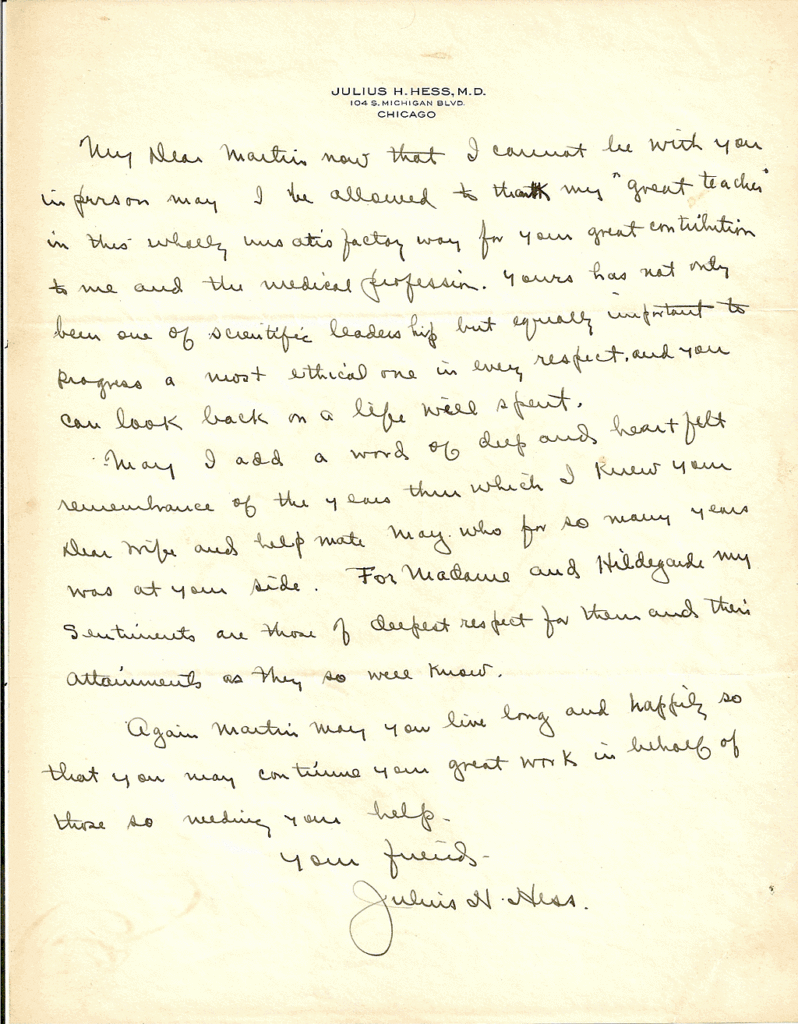
Letter from Julius H. Hess to Martin Couney, date uncertain but around the time of the Couney’s exhibit at the New York World’s Fair. Found in the guest book of the exhibit.
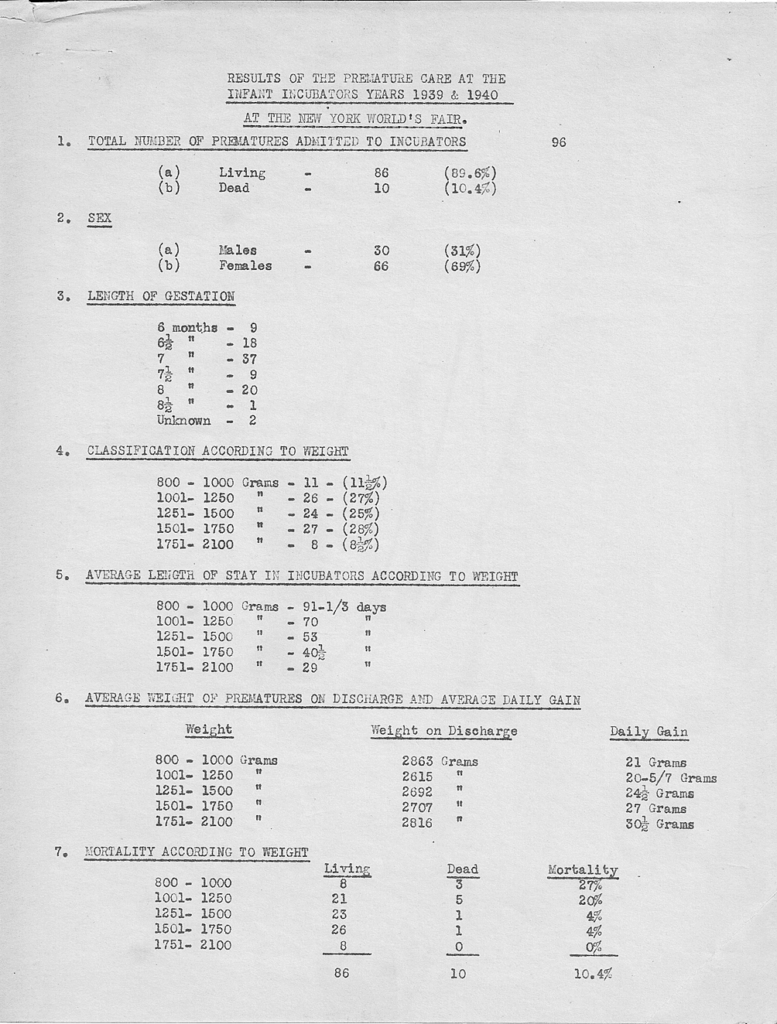
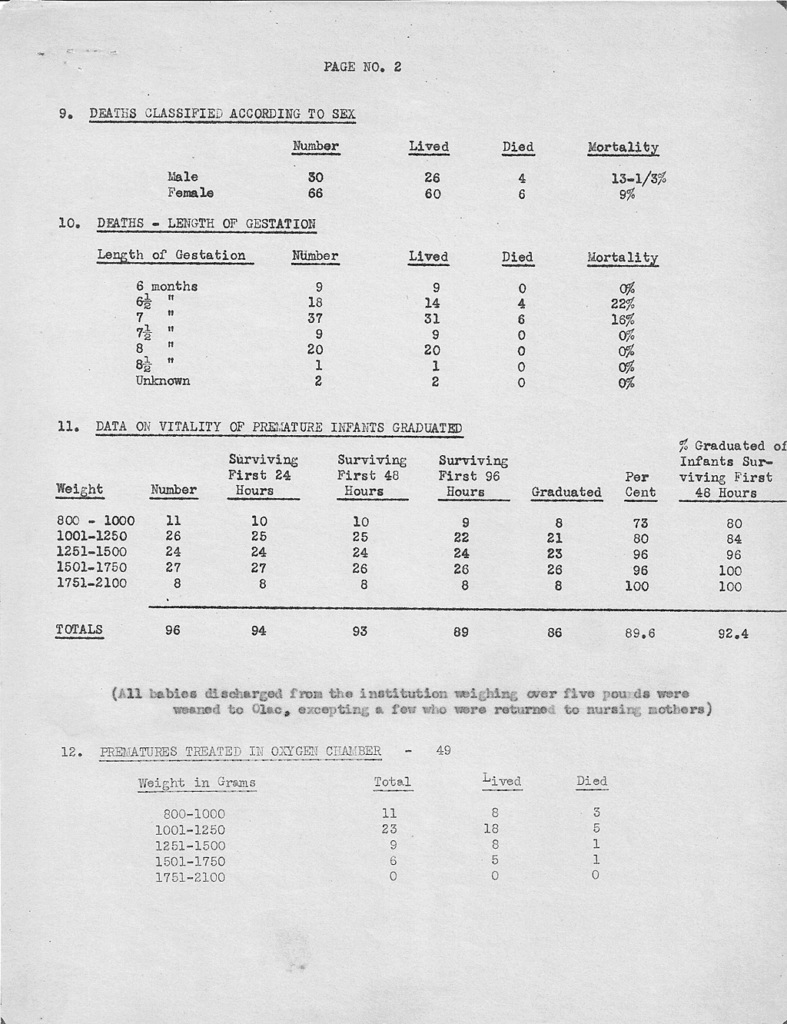
Outcome statistics from Couney’s incubator baby exhibit at the New York World’s Fair.
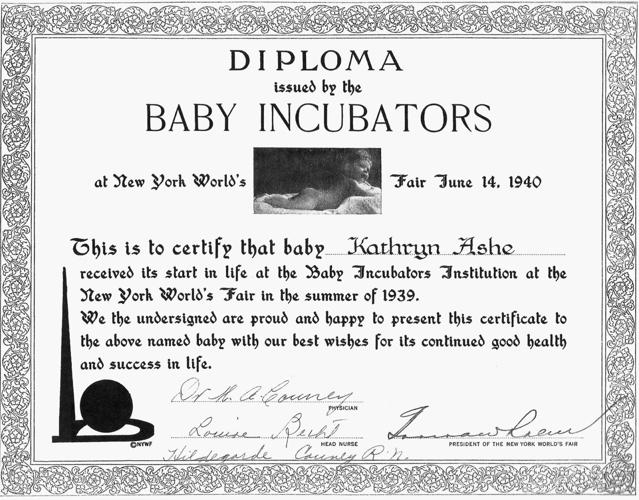
“Diploma” presented to parents by Martin Couney’s “Incubator Baby Institution” at the New York World’s Fair, 1939.
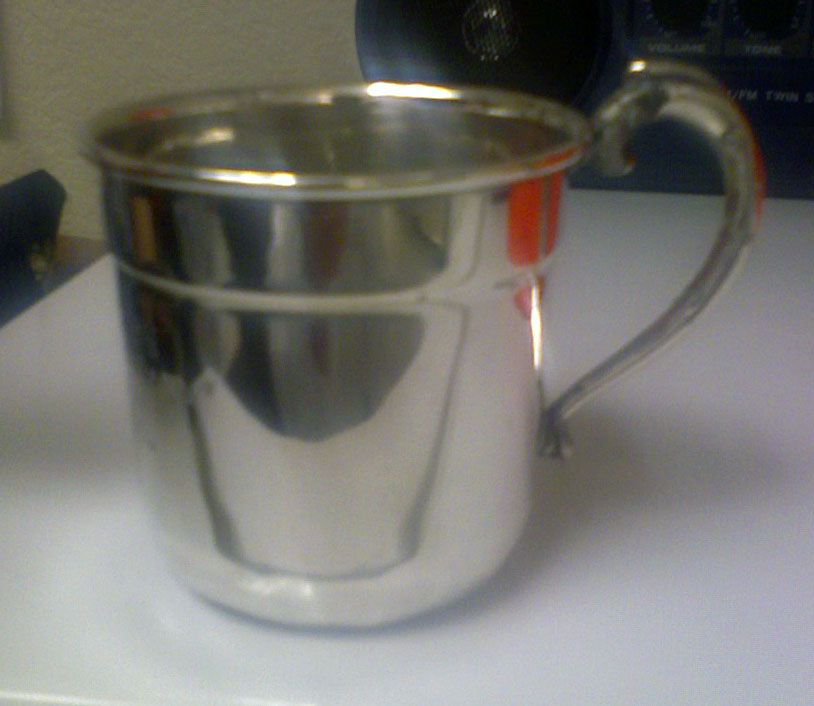
Engraved silver cup presented to parents by Martin Couney’s “Incubator Baby Institution” at the New York World’s Fair, 1939. Engraving on the back is nearly unreadable because the photo is blurry, but appears to say “[Baby Name] Incubator Baby New York World’s Fair 1939.”
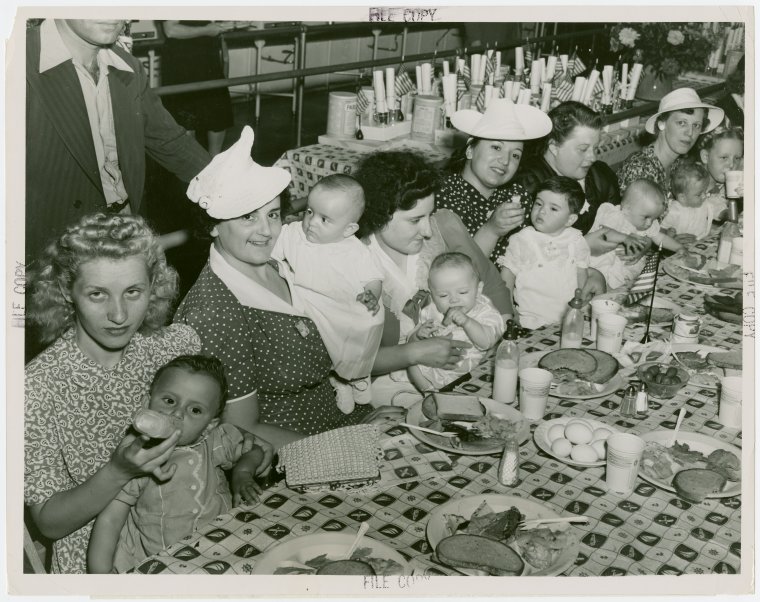
“Incubator’s Class of ’39 Lifts Cups to Old Times
“In keeping with the current commencement and reunion activites at the nation’s institutions of learning, it was alumni reunion day at the World’s Fair yesterday for forty-one members of the “Class of ’39” — most of them under 1- year old. Their alma mater is Dr. Martin A. Couney’s Baby Incubators, where last Summer they got a start in life following their premature births.”
“No one was quite sure whether the “old grads” recognized the scene of their incubator curricula, although their occasional howls sounded very much like the reunion shouts of college alumni forty or fifty years their senior.”
“When all the incubator alumni had gathered, each accompanied by at least one proud parent, belated graduation ceremonies were held, at which the now big and healthy babies received diplomas, signed by Dr. Couney and Grover A. Whalen, President of the Fair Corporation, and engraved silver cups.” — The New York Times, June 15, 1940.
Sources
Primary — periodicals
A. J. Liebling, “A Patron of the Preemies,” The New Yorker, June 3, 1939, pp. 20–24. [Contemporaneous profile; building, staff, admission, Couney’s self-told career legend.]
Official Guide Book of the New York World’s Fair 1939 (New York World’s Fair Corporation, 1939). [Infant Incubator building description, Skidmore & Owings/John Moss, Della Robbia statue, 25-cent admission.]
Primary — newspapers
New York Times, Mar. 12, 1939. [Incubator exhibit pre-opening.]
New York Times, Apr. 30, 1939. [Amusement-area attraction/price listing, 25 cents.]
New York Times, June 15, 1940, “Incubator’s Class of ’39 Lifts Cups to Old Times.” [June 14 alumni reunion; 41 alumni; silver cups and diplomas signed by Couney and Whalen.]
Brooklyn Eagle, Aug. 31, 1939, p. 11. [Baby count reaches 18.]
Brooklyn Eagle, Sept. 12, 1939, p. 8. [All-female population; smallest 1 lb 14 oz.]
Brooklyn Eagle, Sept. 15, 1939, p. 2. [Nursery population note.]
Brooklyn Eagle, Oct. 6, 1939, p. 17, Jane Corby, “Babies Must Live.” [Feature; career totals; $45,000 building; Recht 41 years; Couney age 71.]
Brooklyn Eagle, Nov. 2, 1939, p. 13, “Guards Find Incubator Babes Aren’t ‘Merchandise’ at Fair.” [1939 season-end report to Health Commissioner Rice: 50 received / 45 home / 5 died / 23 oxygen; $80,000 building and equipment, equipment ~$35,000.]
Brooklyn Eagle, May 19, 1940, p. 14, Katherine Blanck, “Fair Puzzles Doctor With Baby Ambulance.” [Ambulance; back-gate dispute; $45,000 station; reunion planning; capacity 45.]
Brooklyn Eagle, Aug. 2, 1940, p. 10, “Steeplechase Officials Saddened by Loss of 20-Year Hoard of Publicity Clippings.” [Steeplechase fire; Couney had closed the Coney Island concession for the Fair.]
Brooklyn Eagle, Dec. 12, 1940, p. 18, Jo Ranson, “Radio Dial Log.” [Tangential: “Uncle Don” Carney once a lecturer for Couney’s Luna Park incubators.]
Daily News (New York), Oct. 3, 1939, p. 516, “3¼-Lb. Baby Rushed 150 Miles to Fair Incubator in 3 Hours.” [John Christopher Royle ambulance transport from Wilmington.]
Daily News (New York), [date not confirmed], Julia McCarthy, “Sees Her Baby First Time at Fair.” [Charlotte/Patricia Beverly Preston, “exhibit 15”; ~8,000 career; 15 min out of incubator at 92°. Date not visible on file — verify before print.]
Daily Worker, Aug. 22, 1939, p. 4, W. A. S. Douglas, “Rollin’ Along” (copyright Times-Herald). [$75,000 invested; 41 years / 29 expositions / 18 triplet sets / 300 twin pairs; milk and laundry costs; Chicago 1934 reunion; WWII lament.]
Omaha World-Herald, Sept. 24, 1939, p. 36, “Dr. Couney’s Question.” [New York World-Telegram interview; Omaha 1898 recollection; ~8,000 cared for; war anxiety.]
Findlay Republican-Courier, May 20, 1939, p. 16, “Designer of World’s Fair Buildings Had First Job as School Teacher in Findlay.” [Louis Skidmore profile; Skidmore & Owings, John Moss associate; incubator as amusement-zone concession, “20 to 30” babies.]
Elizabethtown Chronicle, Aug. 11, 1939, p. 13, August Loeb [amusement-area survey]. [Incubator show “one of the indispensables of a fair,” functionalist building; amusement admissions 10–40 cents.]
The Record, Aug. 1, 1939, p. 7, “3 Pairs of Twins in Incubator.” [Six babies / 12 lb; 16 nurses; 19 infants present.]
The Morning Call (Allentown), Aug. 12, 1939, p. 8, Frank Catton, “Private Life of the 2 lb. Twins” (King Features Syndicate). [U-shaped building; apartment; 15 nurses + 5 wet nurses; “peanut roaster”; private care ~$60/day.]
Scrantonian Tribune, Sept. 10, 1939, p. 47 [amusement-area rundown]. [“Infant Incubator: Live babies in a scientific nursery… 25 cents.”]
Times Herald (Olean, N.Y.), Oct. 8, 1939, p. 43, Virginia R. Eyerly, “The Passing Throng.” [Eyewitness: 13 babies, one set of twins, all girls; smallest ~2½ lb; late-season price cuts.]
Star Weekly (Toronto), Apr. 20, 1940, pp. 5 and 9, Philip A. Novikoff, “Babies in Glass Houses.” [U-shaped pink-and-blue building; five wet nurses on premises; 15 nurses; Kinderbrutanstalt origin narrative; career 8,000 / ~6,500.]
The Brooklyn Citizen, May 21, 1940, p. 17, “45 Incubator Babies Will Have Graduating Exercises.” [June 14 reunion preview; silver cup and diploma; AMA pediatricians invited.]
Toledo Blade, “peach section,” May 17, 1940, “Going to the Fair this summer?” [Investment $100,000; incubators $700 each; oxygen $5/day; 1939 milk $1,300; 33 adults for 20 babies.
Primary — newspapers (syndicated items, representative printing with reprints)
Abilene Reporter-News (Tex.), Sept. 6, 1940, p. 30, “Life Begins at Seven Months” (AP Feature Service). [First-person-baby feature on John Christopher Royle; Hildegarde Frances Couney identified.] Widely published in multiple outlets.
“Baby Incubator Exhibit Attracts Crowds at New York World’s Fair,” Bluefield Daily Telegraph (W.Va.), Sept. 26, 1939, p. 2. [Photo feature; 16 babies; four Servel Electrolux gas refrigerators; “largest ever conducted.”] Also published in The Morning Press, Sept. 15, 1939, p. 4 and multiple others.
“Incubator Babies Get Especial Care” / “Gas Cooling Saves Lives of Children” / “Gas Exhibit Attracts Much Attention at Fair” (gas-industry release), The News of Cumberland County (Bridgeton, N.J.), Aug. 10, 1939, p. 2. [Four Servel Electrolux units; diet kitchen; nurses lodged on premises; Couney age 70; 36 yrs Atlantic City / 32 yrs Coney Island.] Also published, under varying local sponsor bylines, in Waynesboro Record-Herald (Pa.), Aug. 24, 1939, p. 7; and The Owensboro Messenger (Ky.), Sept. 22, 1939, p. 15. and multiple others. A related staff version ran as George E. Morris, “Gas Exhibit Attracts Much Attention at Fair,” Brooklyn Eagle, Sept. 22, 1940, p. 44.
“Incubator Ambulance Carries Babies to Fair” / “Ambulance for Newly Born Is a Unique Feature” (syndicated ambulance feature), The Buffalo News, July 1, 1939, p. 32. [Streamlined ambulance; sponge-rubber-and-spring bassinet; thermostat copper coil 85–90°; oxygen valves.] Also published in The Liberty Press, May 23, 1940, p. 4 and multiple others.
“Six of a Kind at World’s Fair” (United Feature Syndicate), Moorhead Daily News (Minn.), Aug. 30, 1939, p. 2 and multiple others. [Photo; three sets of premature twins.]
“‘Incubator’ Saves Infant Weighing Only One Pound” / “Pound Baby at Fair” (Associated Press), Duluth News-Tribune, June 3, 1940, p. 2. [Baby “Regina,” 800 g at birth, tube-fed.] Also published in Uniontown Morning Herald (Pa.), June 4, 1940, p. 15 and multiple others.
Secondary — books and scholarship
Dawn Raffel, The Strange Case of Dr. Couney: How a Mysterious European Showman Saved Thousands of American Babies (New York: Blue Rider Press, 2018), esp. ch. “Playing with Matches.” [Dated cost escalation $80,000→$100,000; Skidmore & Owings building program; fire-alarm dispute; concessions-committee correspondence; credentials.]
William A. Silverman, “Incubator-Baby Side Shows,” Pediatrics 64, no. 2 (Aug. 1979): 127–141. [1939–40 exhibit on pp. 137–140; Skidmore & Owings; staff; reunion; JAMA table and the “transferred-in” sampling caveat; Gesell filming.]
Arnold Gesell, The Embryology of Behavior (New York: Harper & Bros., 1945). [Acknowledges Couney and staff for access to film the Flushing infants, 1939–1940.]
Reference — Fair background
Bureau International des Expositions, “Expo 1939 New York” (bie-paris.org). [Official designation, dates, participants, attendance, deficit.]
“1939 New York World’s Fair” and “1939 New York World’s Fair pavilions and attractions,” Wikipedia (consulted [date]). [Theme, zones, ~375 buildings, 62 nations / 35 states / 1,400+ organizations, attendance ~45 million, cost, post-Fair demolition and survivals. Recommend citing the underlying sources rather than Wikipedia for publication.]
Queens Museum, “History” (queensmuseum.org). [New York City Building as the surviving 1939 structure.]
Primary — manuscript and archival (author’s collection)
Results of the Premature Care at the Infant Incubators, Years 1939 & 1940, at the New York World’s Fair [unpublished typescript, 2 pp., n.d.], laid in to the original visitors’ guestbook of the Infant Incubators exhibit, New York World’s Fair; Ray Duncan private collection. [Two-season compiled outcomes: 96 admitted, 86 living / 10 dead (10.4%); breakdowns by sex, gestation, and birth weight; average length of stay, discharge weight, and daily gain; survival at 24/48/96 hours and to graduation; 49 treated in oxygen chamber. Apparent source for the summary published as “Medical News: New York City,” Journal of the American Medical Association 115 (1940): 1648.]
Julius H. Hess, inscription dated April 30, 1939 [opening day], in the visitors’ guestbook of the Infant Incubators exhibit, New York World’s Fair; Ray Duncan private collection. [First entry in the book; names Couney “the pioneer in the successful care of the premature infant” and praises head nurse Louise Recht.]
Morris Fishbein, undated inscription, in the visitors’ guestbook of the Infant Incubators exhibit, New York World’s Fair; Ray Duncan private collection. [The JAMA editor calls the baby incubators “as instructive as the Hall of Man” and sends “best wishes to my friend, Dr. Couney.”]
Arnold Gesell, undated inscription, in the visitors’ guestbook of the Infant Incubators exhibit, New York World’s Fair; Ray Duncan private collection. [Yale researcher praises the “pathfinding significance” of Couney’s work and Recht as “former associate of the famous Budin.”]
Note on the guestbook: mostly blank, with a short run of signed pages beginning on opening day (Hess, 4/30/1939) and the next entry dated 5/14/1939, indicating intermittent use through the exhibit’s run rather than at a single event; several pages retain evidence of photographs formerly tipped in and removed by prior owner.
More Information about Martin Couney
Martin Arthur Couney
- Short biography of Martin Couney
- Martin Couney, Wikipedia – contains outdated information
- Martin Couney’s Obituary, from The New York Times, March 2, 1950 – contains outdated information
Primary Source Documents
- Gellert Ship Manifest, 1888
- US 1910 Census
- US 1920 Census
- US 1940 Census
- Marriage Certificate 1903
- Passport Application 1904
Business and Associates
Martin Couney Exhibits in World’s Fairs and National Expositions
- Victorian Era Exhibition at Earl’s Court, 1897
- Trans-Mississippi Exposition, Omaha, 1898
- Pan-American Exposition, Buffalo, 1901
- Lewis and Clark Centennial Exposition, Portland, 1905
- Panama-Pacific International Exposition San Francisco, 1915
- Century of Progress International Exposition, Chicago, 1933-34
- New York World’s Fair, New York, 1939-1940
Martin Couney Sideshows in Amusement Parks
- Asbury Park Boardwalk, New Jersey
- Coney Island Sideshow at Luna Park
- Coney Island Sideshow at Dreamland
- Lakeside Amusement Park, Denver.
- Luna Park, Pittsburgh
- Wonderland – Minneapolis and St. Paul
- Wonderland – Revere Beach
- Boardwalk – Atlantic City
- White City Amusement Park – Chicago
- White City Amusement Park, Indianapolis, Indiana
- White City Amusement Park, Cleveland, Ohio
Recent Books
- The Strange Case of Dr. Couney, by Dawn Raffel, Blue Rider Press, ISBN 0399175741
- Buy on Amazon (your purchase will support “Neonatology on the Web”)
- Miracle at Coney Island, by Claire Prentice (Kindle or audiobook)
- Buy on Amazon (your purchase will support “Neonatology on the Web”)
General Articles
General articles about Martin Couney and his exhibits are linked below. Additional links may be found in specific posts about his participation in expositions or sideshows.
Reader beware: many of these were written before the full facts about Martin Couney’s background became known, or have not incorporated that new information, so they include information from his self-invented background legend.
- Incubator Baby Sideshows, by William Silverman, from Pediatrics.
- Postscript to Incubator-Baby Sideshows, by William. Silverman, from Pediatrics
- Martin Couney’s Story Revisited, by AAP Perinatal Section Ad Hoc Committee on Perinatal History, from Pediatrics
- Martin Couney’s Obituary, from The New York Times, March 2, 1950.
- A Patron of the Premies, by A. J. Liebling, from The New Yorker
- The Coney Island Baby Laboratory, by Gary R. Brown, from American Heritage Invention and Technology Magazine
- American Characters: Martin Couney, by Richard Snow, from American Heritage Magazine
- The Man Who Ran a Carnival Attraction… by Claire Prentice, from Smithsonian Magazine
- Life under Glass, audio documentary by Claire Prentice, from the BBC
- Martin Couney and Incubator Exhibits from 1896 to 1943, from the Embryo Project
- The Incubator Baby and Niagara Falls, by Arthur Brisbane, from The Cosmopolitan
- Babies on Display, from NPR
- Beginner’s Luck, from Family Circle Magazine 1993
- Coney Island’s Incubator Babies, by Rebecca Rego Barry, from JSTOR Daily
- The Infantorium, by Katie Shornton, from 99% Invisible
- How One Man Saved a Generation of Premature Babies, from BBC News
- Baby Incubators: From Boardwalk Sideshow to Medical Marvel, by Erin Blackmore, from History.Com
- Babies in Sideshows, by Julie Andreson, from Engines of our Ingenuity
- Dr. Martin Couney, from Coney Island History Project
- “The Use of Incubators for Infants,” The Lancet, May 29, 1897.
- “The Victorian Era Exhibition at Earl’s Court,” The Lancet, July 17, 1897.
- Incubator Baby Shows: A Medical and Social Frontier, by Hannah Lieberman, from The History Teacher 35.1, November, 2001.
- The Child Hatchery, from City Pages.
- Good Old Coney Island, by Edo McCullough, excerpt from the book
- “And Next to the Bearded Ladies…” from The New York Times (captured as PDF)

- Kinderbrutanstalt: Leisure Space and the Coney Island Baby Incubators, by Scott Webel, Text, Performance, Practice, 2003. (captured PDF)
- Premie Road Shows from Hippocrates (captured PDF)
- Transferring the Incubator: Fairs and Freak-Shows as Agents of Change, by Katie Proctor, 2004. (captured PDF)
- Pan-American Exposition Baby Incubator Exhibit in Buffalo, New York, 1901 (from the U. of Buffalo Library web site)
Last Updated on 07/07/26