Martin Arthur Couney (1869-1950)
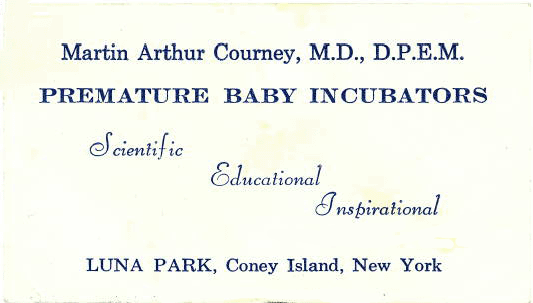
A controversial figure in the history of neonatology, Martin Couney made a career of exhibiting and caring for premature infants at world fairs, expositions, and amusement parks from 1897 until the 1940’s. He claimed to have trained with Pierre Budin, to have taught Julius Hess how to take care of premies, and to have invented the incubators used in his exhibits (they were actually Alexandre Lion’s Incubators manufactured under license). Many of the popular press articles about him then and into current times, some of which are linked below, propagated this legend that he built for himself. Although he was good friends with Julius Hess, as attested by the letter below, he remained outside the mainstream of newborn medicine until his death.
The first well-documented attribution of an incubator exhibit by Martin Couney was the Victorian Era Exhibition in Earl’s Court in August, 1897, where he partnered with a promoter named Samuel Schenkein. He subsequently had an incubator exhibit at the 1898 Trans-Mississippi Exposition in Omaha, Nebraska, followed by an exhibit at the 1901 Pan-American Exposition in Buffalo, New York, the 1905 Lewis and Clark Exposition in Portland, Oregon, the 1915 Pan-Pacific Exposition in San Francisco, the 1933-34 Century of Progress Exposition in Chicago, Illinois, and the 1939-1940 New York World’s Fair. There may have been others. One source says that he also exhibited in Mexico City in 1905, Rio de Janeiro in 1910, and Denver in 1913, although I have not been able to locate any pictures or documentation for any of these as yet.
Beginning around 1903, he started more permanent incubator baby sideshows at Luna Park and Dreamland on Coney Island, followed by the Atlantic City Boardwalk, Chicago’s White City amusement park, the Minneapolis Wonderland amusement park, and several others (linked at the end of this page).The last of these, the Luna Park exhibit, closed in 1943.
Couney was a businessman as well as a showman, and formed the Infant Incubator Company to market and sell incubators manufactured by Kny-Scheerer and to supply equipment for his various exhibits. The business was incorporated in 1905 in Albany, New York, and the directors included Solomon Fischel, H. H. Kaufman, and Samuel Schenkein.
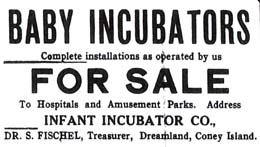
Interest in these “incubator baby” sideshows and exhibitions, which had faded from memory as neonatology training and neonatal intensive care units were established in the 1960s and ’70s, was revived by Dr. William Silverman’s 1979 article “Incubator-Baby Side Shows” and its follow-up articles in Pediatrics. Since then, others continued to research Couney and understand the extent of his ventures.
More recently, the excellent book “The Strange Case of Dr. Couney: How a Mysterious European Saved Thousands of American Babies” by Dawn Raffel and other research by Claire Prentice has brought many details of Martin Couney’s origins to light. Born Michael Cohn or Cohen in 1869 in the town of Krotoszyn, then part of the Prussian Empire and now in Poland, he left for England to become a carnival showman, and then immigrated to the United States, with several name changes along the way. Research by Claire Prentice found that according to his passport application, he immigrated to the US in 1888 onboard the Gellert, which sailed from Hamburg on October 30 and arrived November 12, which was confirmed by the passenger list. He was naturalized on November 2, 1898 in the Douglas County district court in Omaha, claiming to have resided in the US uninterruptedly since 1888 in Nebraska, although another source states that he did not move to the US permanently until 1903. Records of the New York Supreme Court show that he changed his name legally to Martin Couney on October 1, 1905. In any event, construction of his “legend” was already in progress. On the Gellert passenger list, he gave his occupation as merchant, in the 1910 census, he listed his profession as inventor in the surgical instruments industry, and in the 1930 and 1940 censuses, he described himself as a “physician.”
His legend undoubtedly mixed some truth with self-serving fiction. He claimed to have studied medicine in Germany and to have received a degree, but no evidence of that degree or a thesis has been found. He also claimed to have apprenticed under Pierre Budin and to have worked with him at the Berlin Exposition in 1896, but contemporary news accounts and the official show program credit the incubators at the Berlin exhibition to Alexandre Lion. The records of his immigration to the United States in 1888 at the age of 19 make both the medical degree and the apprenticeship unlikely, but it is known that he obtained babies from Paris for the Earl’s Court Exposition and that a French nurse who trained at the Maternité Paris, Louise Recht, assisted him at the Earl’s Court Exhibit in 1897, and later functioned as his “head nurse” at Luna Park and the New York World’s Fair. Solomon Fischel’s obituary indicates that Couney and Fischel already knew each other in the 1890s, and that Fischel and Recht were friends, and knew each other in Paris. So it seems plausible that Couney’s connection with FIschel, and Fischel’s connection with Recht, was sufficient to be entrusted with some of the Maternité’s patients and later to have recruited one of Budin’s nurses.
Among the nurses Couney recruited for his pavilion at the Pan-American Exposition in 1901 was 26-year-old Annabelle Maye Segner of Lafayette, Indiana, who trained at Purdue University. Annabelle became a permanent part of Couney’s enterprise, and they were married in a civil ceremony on September 26, 1903. They had a daughter Hildegarde who was born 6 weeks premature at a weight of 1.4 Kg and was cared for in his exhibit. She grew up to become a nurse and would later manage Couney’s exhibits in Atlantic City. He lived most of his life in a house in Seagate, near the Coney Island exhibits, Couney’s wife passed away in 1936, and he died in 1950 at the age of 73, survived by his daughter Hildegard. After a period of ill health, Hildegard died six years later at the age of 37. She was unmarried and had no children.
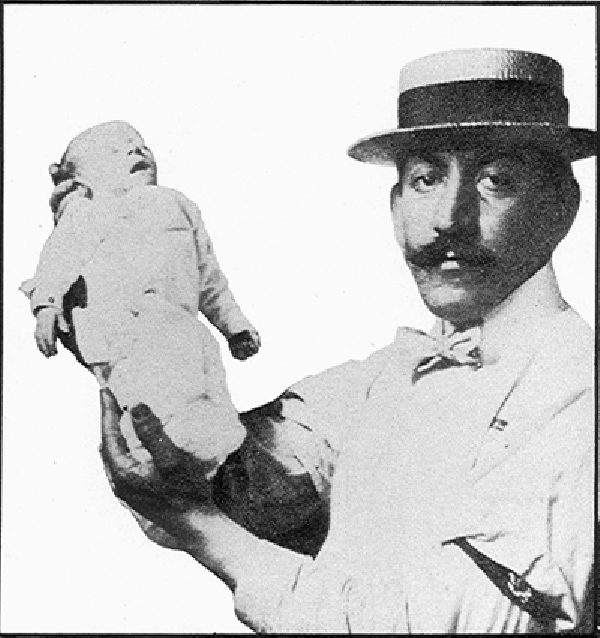
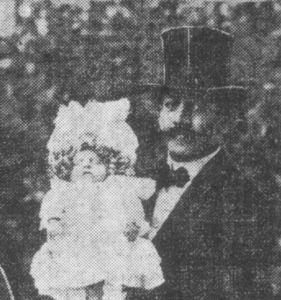
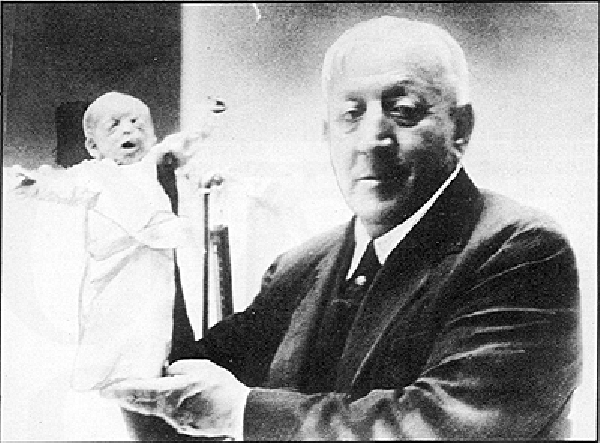
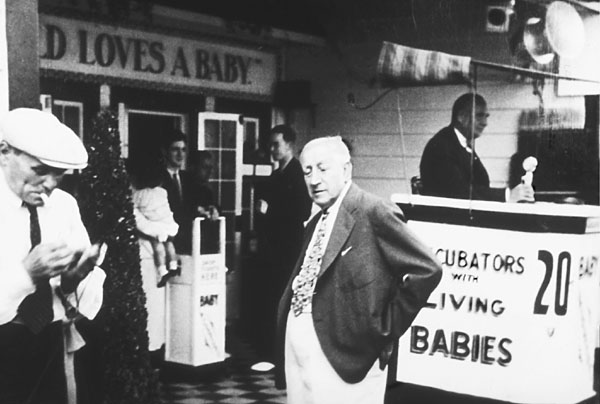
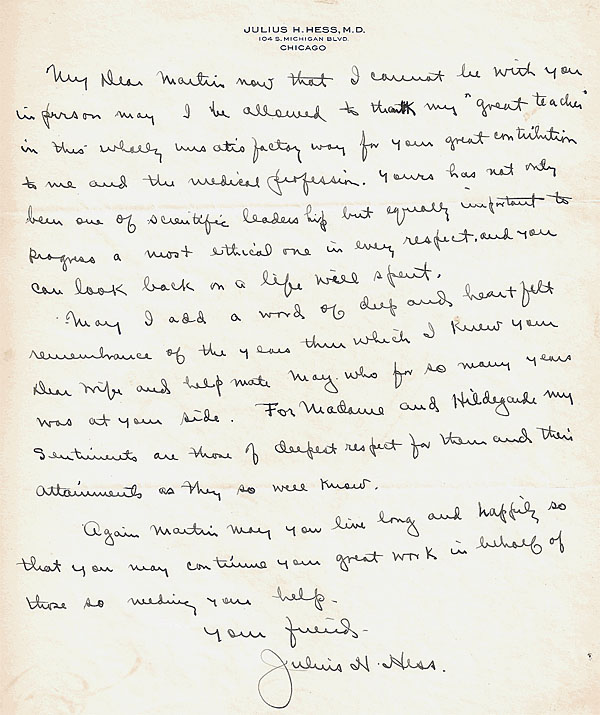
Continuing research has cast doubt upon much of Couney’s self-created legend, but there’s little question about the number of babies he cared for and the respect he enjoyed from physicians of his day, including the renowned pediatrician Julius Hess, Hess’s head nurse Evelyn Lundeen, Dr. Morris Fishbein, and Arnold Gesell, the famous pediatrician, psychologist, and professor at Yale University. The letter below, from Julius Hess to Martin Couney, was discovered in the visitor’s book for Couney’s exhibit at the 1939 New York World’s Fair.
My Dear Martin
Now that I cannot be with you in person may I be allowed to thank my “great teacher” in this wholly unsatisfactory way for your great contribution to me and the medical profession. Yours has not only been one of scientific leadership but equally important to progress a most ethical one in every respect, and you can look back on a life well spent.
May I add a word of deep and heartfelt remembrance of the years thru which I knew your Dear Wife and helpmate who for so many years was at your side. For Madame and Hildegarde my sentiments are those of deepest respect for them and their attainments as they so well know.
Again Martin may you live long and happily so that you may continue your great work in behalf of those so needing your help.
Your friend,
Julius H. Hess
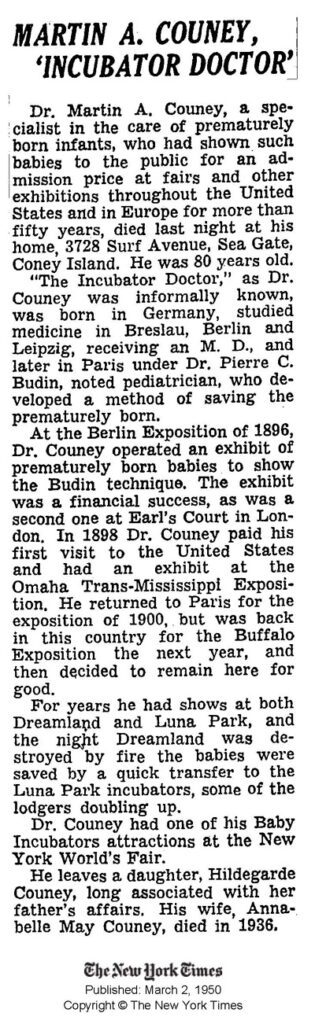
Couney’s obituary appeared in the New York Times, March 2, 1950, and it mixes facts and legend. We now know that much of his early history described in the obituary, such as the MD granted in Germany and his training with Budin, was fictitious, and the contemporary accounts of the Berlin Exhibition attribute the incubator exhibit to Dr. Alexandre Lion. However, his exhibitions at Omaha and later are well documented, and over the years he saved thousands of babies that would have otherwise perished.
| The Martin Couney Legend | The Martin Couney Facts |
| Born Martin Arthur Couney | Born Michael Cohn or Cohen |
| Born in Alsace, France or Germany | Born in Krotoszyn, Prussian Empire (now in Poland) |
| Studied medicine in Breslau, Berlin, and Leipzig, received a medical degree | No record exists of him studying medicine or receiving a degree in medicine. |
| Trained with Pierre Budin in Paris | No record exists of him working with Pierre Budin in Paris |
| Operated the incubator exhibit at the Berlin Exposition (Berliner Gewerbeausstellung) of 1896 | Contemporary newspaper accounts and the official show program attribute the incubator exhibit to Alexandre Lion |
| Operated the incubator exhibit at the Paris Exposition Universelle in Paris, 1900. | The 1900 Paris Exposition incubator exhibit is well documented to be the work of Alexandre Lion. |
| Obtained babies from the Maternité for the Victorian Era Exposition through his connection to Pierre Budin | Solomon Fischel, Couney’s associate, was friends with Louise Recht, a nurse at the Maternité, and it seems likely that this was the source of the babies for exhibit at the Victorian Era Exhibition. Louise Recht later worked for Couney and Fischel in their incubator baby exhibits in the US. |
| Invented the incubator used in his exhibits | Couney’s incubators were invented by Alexandre Lion, patented in France, and manufactured by Paul Altmann in Berlin and Kny-Scheerer Co. in the U.S., using Alexandre Lion’s design |
Martin Arthur Couney
- Short biography of Martin Couney
- Martin Couney, Wikipedia – contains outdated information
- Martin Couney’s Obituary, from The New York Times, March 2, 1950 – contains outdated information
Primary Source Documents
- Gellert Ship Manifest, 1888
- US 1910 Census
- US 1920 Census
- US 1940 Census
- Marriage Certificate 1903
- Passport Application 1904
Business and Associates
Martin Couney Exhibits in World’s Fairs and National Expositions
- Victorian Era Exhibition at Earl’s Court, 1897
- Trans-Mississippi Exposition, Omaha, 1898
- Pan-American Exposition, Buffalo, 1901
- Lewis and Clark Centennial Exposition, Portland, 1905
- Panama-Pacific International Exposition San Francisco, 1915
- Century of Progress International Exposition, Chicago, 1933-34
- New York World’s Fair, New York, 1939-1940
Martin Couney Sideshows in Amusement Parks
- Asbury Park Boardwalk, New Jersey
- Coney Island Sideshow at Luna Park
- Coney Island Sideshow at Dreamland
- Lakeside Amusement Park, Denver.
- Luna Park, Pittsburgh
- Wonderland – Minneapolis and St. Paul
- Wonderland – Revere Beach
- Boardwalk – Atlantic City
- White City Amusement Park – Chicago
- White City Amusement Park, Indianapolis, Indiana
- White City Amusement Park, Cleveland, Ohio
Recent Books
- The Strange Case of Dr. Couney, by Dawn Raffel, Blue Rider Press, ISBN 0399175741
- Buy on Amazon (your purchase will support “Neonatology on the Web”)
- Miracle at Coney Island, by Claire Prentice (Kindle or audiobook)
- Buy on Amazon (your purchase will support “Neonatology on the Web”)
General Articles
General articles about Martin Couney and his exhibits are linked below. Additional links may be found in specific posts about his participation in expositions or sideshows.
Reader beware: many of these were written before the full facts about Martin Couney’s background became known, or have not incorporated that new information, so they include information from his self-invented background legend.
- Incubator Baby Sideshows, by William Silverman, from Pediatrics.
- Postscript to Incubator-Baby Sideshows, by William. Silverman, from Pediatrics
- Martin Couney’s Story Revisited, by AAP Perinatal Section Ad Hoc Committee on Perinatal History, from Pediatrics
- Martin Couney’s Obituary, from The New York Times, March 2, 1950.
- A Patron of the Premies, by A. J. Liebling, from The New Yorker
- The Coney Island Baby Laboratory, by Gary R. Brown, from American Heritage Invention and Technology Magazine
- American Characters: Martin Couney, by Richard Snow, from American Heritage Magazine
- The Man Who Ran a Carnival Attraction… by Claire Prentice, from Smithsonian Magazine
- Life under Glass, audio documentary by Claire Prentice, from the BBC
- Martin Couney and Incubator Exhibits from 1896 to 1943, from the Embryo Project
- The Incubator Baby and Niagara Falls, by Arthur Brisbane, from The Cosmopolitan
- Babies on Display, from NPR
- Beginner’s Luck, from Family Circle Magazine 1993
- Coney Island’s Incubator Babies, by Rebecca Rego Barry, from JSTOR Daily
- The Infantorium, by Katie Shornton, from 99% Invisible
- How One Man Saved a Generation of Premature Babies, from BBC News
- Baby Incubators: From Boardwalk Sideshow to Medical Marvel, by Erin Blackmore, from History.Com
- Babies in Sideshows, by Julie Andreson, from Engines of our Ingenuity
- Dr. Martin Couney, from Coney Island History Project
- “The Use of Incubators for Infants,” The Lancet, May 29, 1897.
- “The Victorian Era Exhibition at Earl’s Court,” The Lancet, July 17, 1897.
- Incubator Baby Shows: A Medical and Social Frontier, by Hannah Lieberman, from The History Teacher 35.1, November, 2001.
- The Child Hatchery, from City Pages.
- Good Old Coney Island, by Edo McCullough, excerpt from the book
- “And Next to the Bearded Ladies…” from The New York Times (captured as PDF)

- Kinderbrutanstalt: Leisure Space and the Coney Island Baby Incubators, by Scott Webel, Text, Performance, Practice, 2003. (captured PDF)
- Premie Road Shows from Hippocrates (captured PDF)
- Transferring the Incubator: Fairs and Freak-Shows as Agents of Change, by Katie Proctor, 2004. (captured PDF)
- Pan-American Exposition Baby Incubator Exhibit in Buffalo, New York, 1901 (from the U. of Buffalo Library web site)
Last Updated on 09/05/26