Berliner Gewerbeausstellung 1896
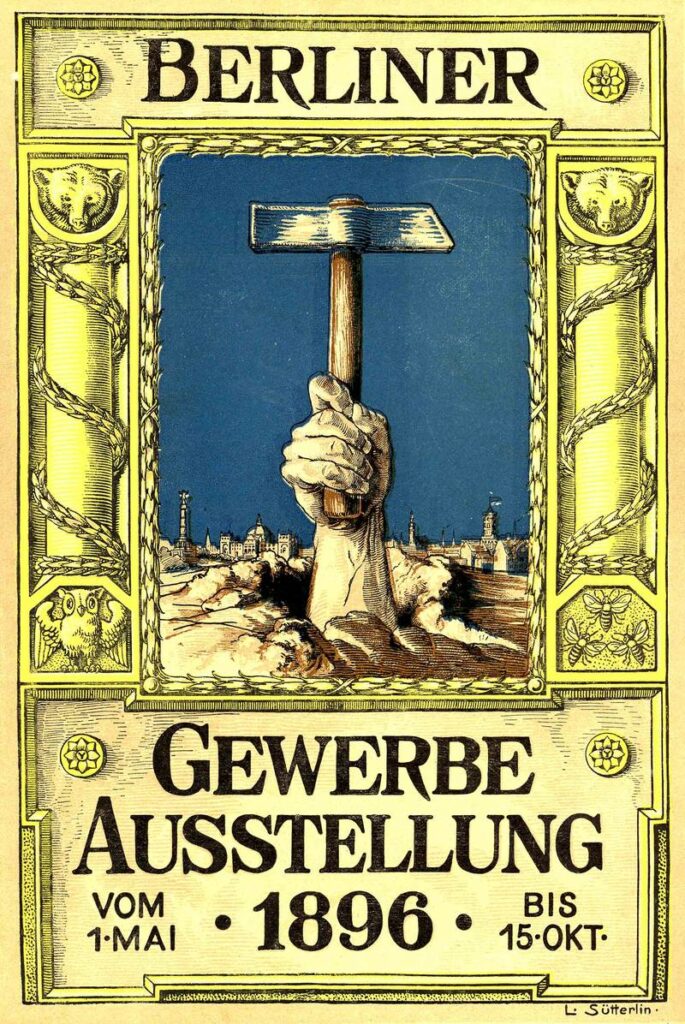
Origins. After the world’s fairs of London (1851), Paris, Vienna, and Chicago (1893), Berlin’s commercial elite — led by the Verein Berliner Kaufleute und Industrieller — pressed for years to host a world’s fair of their own, but the plan collapsed. In August 1892 the Reichsanzeiger announced that the Reich would not pursue a world’s fair in Berlin, and Kaiser Wilhelm II was openly opposed, dismissing the idea and contrasting Berlin unfavorably with Paris. The organizers scaled back to a nominally local event — the Berliner Gewerbeausstellung — though with an expanded remit covering any firm producing or represented in Berlin, and staged it partly to mark the 25th anniversary of the city as imperial capital. The city of Berlin provided the Treptower Park site on the condition that the grounds be fully restored to their original state afterward, and the guarantee fund was raised largely within Berlin’s business community. Because of this history it became known as the “verhinderte Weltausstellung” — the world’s fair that never was.
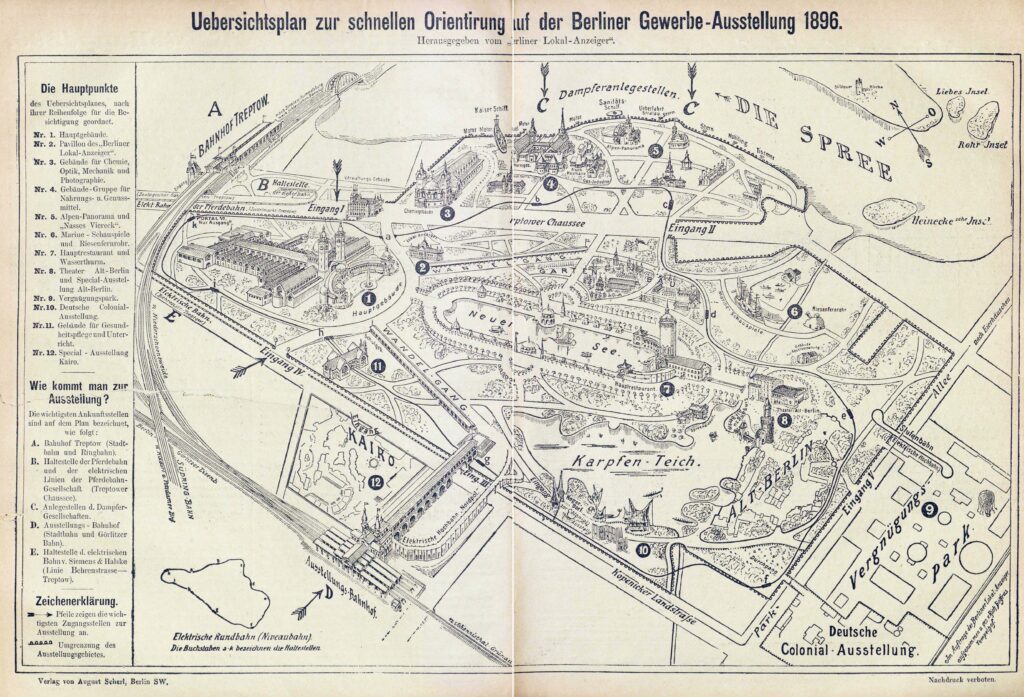
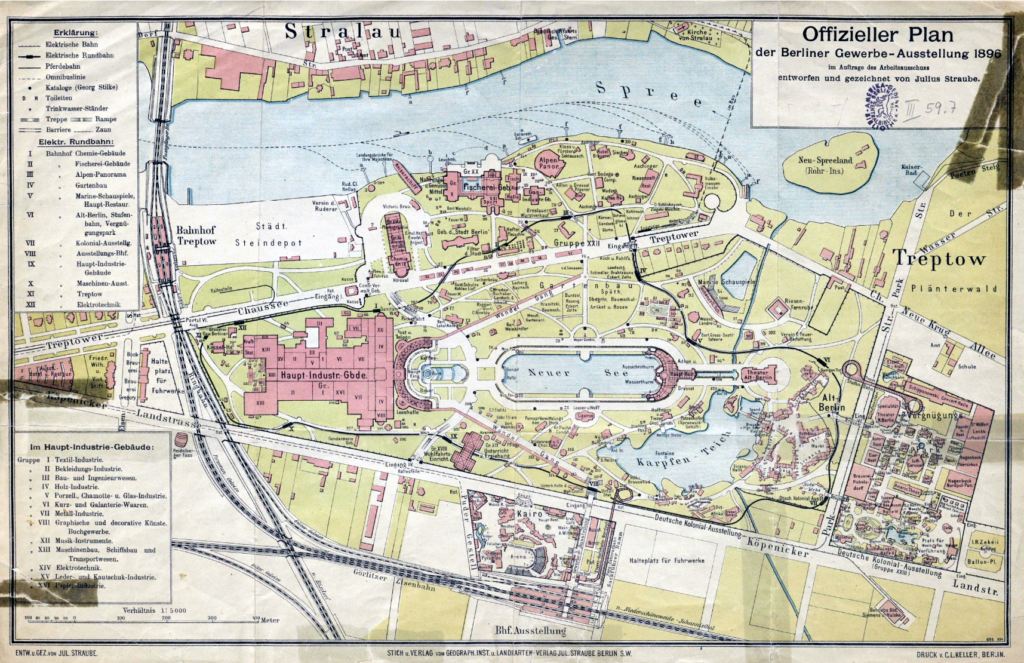
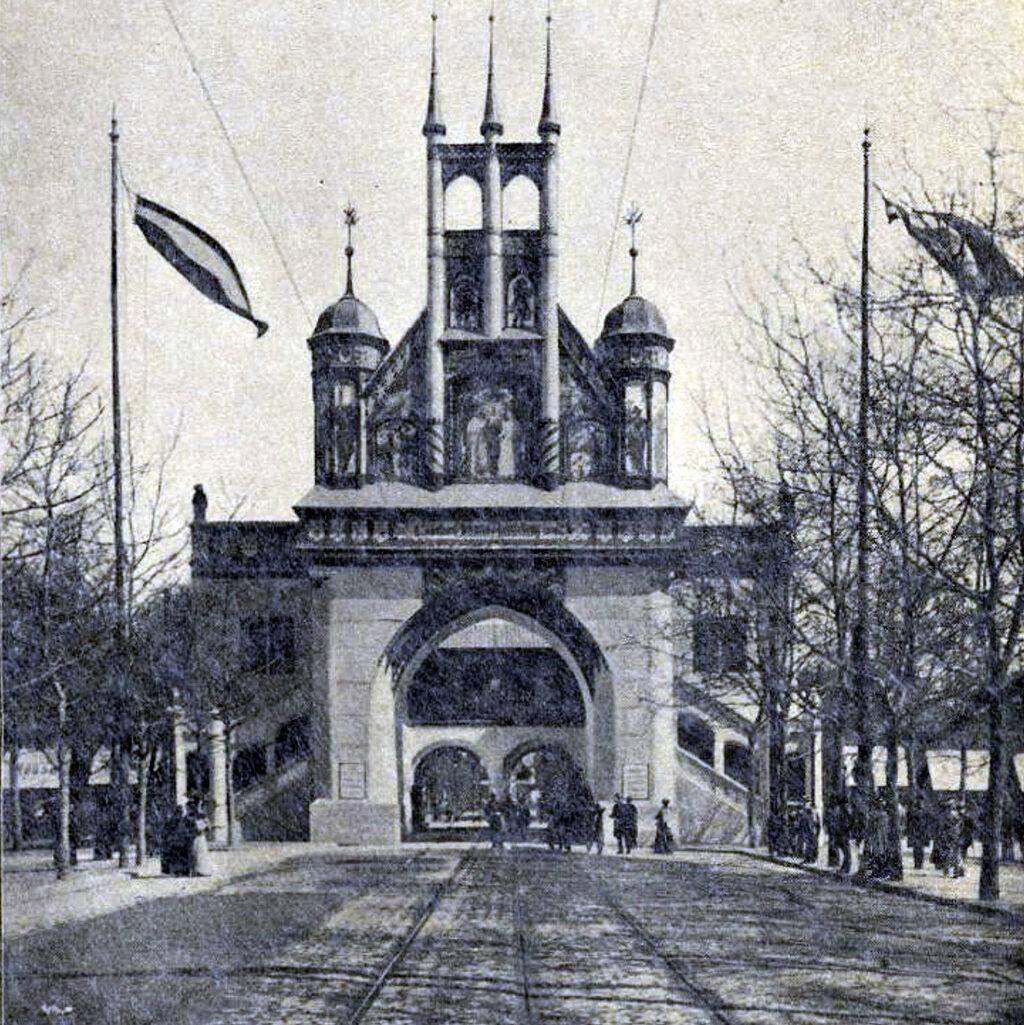
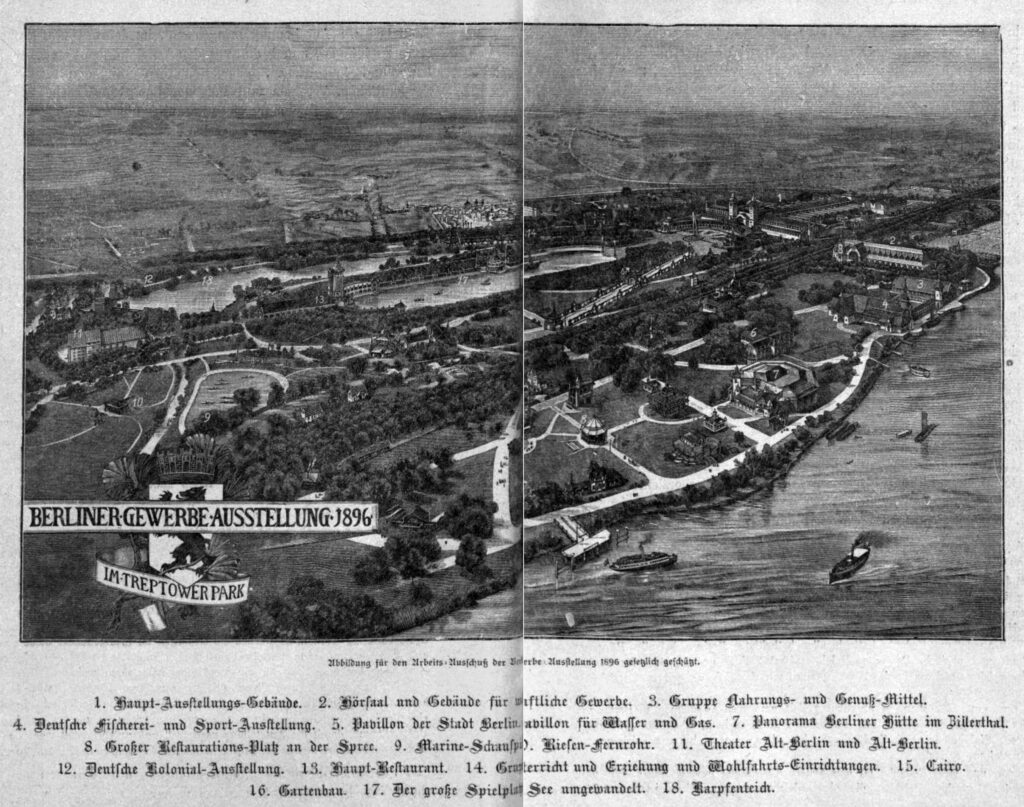
History and scale. The exhibition ran from 1 May to 15 October 1896, with construction having begun in 1894 under overall site planner Karl Hoffacker; Bruno Schmitz designed the vast main building and the main restaurant on the lake. The full grounds — including the adjacent “Cairo” and the amusement-park/colonial-exhibition annexes — covered roughly 1,100,000 m², exceeding the area of the 1889 Paris world’s fair, while the core exhibition area is usually given as about 900,000 m². An artificial lake (the “Neuer See”) of 10,000 m² was dug at the center, and the run drew roughly 7.4 million visitors over about 165 days. The buildings were mostly iron frames clad in wire-mesh plaster (Rabitz), designed for a single summer, and — apart from the Archenhold telescope, which survives as an observatory — everything was dismantled, leaving essentially no trace in the park. Preparations also drove lasting infrastructure change, including the electrification of Berlin’s tramways to move visitors out to Treptow.
Attractions. Alongside industrial halls showing textiles, chemicals, machinery, and electrical technology, the exposition offered spectacle and consumer entertainment: Wilhelm Conrad Röntgen publicly demonstrated the medical use of X-rays, Otto Lilienthal lectured on flight experiments, and the Edison pavilion showed the Lumière cinematograph. A Siemens & Halske electric locomotive carried 90,000 passengers along a circular track, and there were naval mock-battles with model warships, a North Pole panorama, an Alpine panorama, gondolas on the lake, a tower ride, a water slide, and a dirigible/balloon ascent. Two reconstructed “cities” anchored the amusement side — “Alt-Berlin,” a plaster recreation of the seventeenth-century town, and a “Cairo” special exhibition with bazaars, a mosque, and a 38-meter concrete pyramid fitted with an electric elevator to a viewing platform. Most troubling to modern eyes, the concurrent First German Colonial Exhibition displayed reconstructed African and Pacific villages with roughly 100 people brought to Berlin as living exhibits — a practice contemporaries already found dehumanizing, and now a major subject of colonial-history scholarship.
The Incubator Exhibit at the Berlin Exposition
The incubator baby exhibit (“Der Kinder-Brutanstalt”) received more international publicity than its predecessors in Lyon (1894) and Amsterdam (1895), and it quickly spawned many imitators, including the sideshows at the Victorian Era Exhibition (1897), the Trans-Mississippi Exposition (1898), the Paris Exposition Universelle (1900), and many others to follow during the early 1900s.
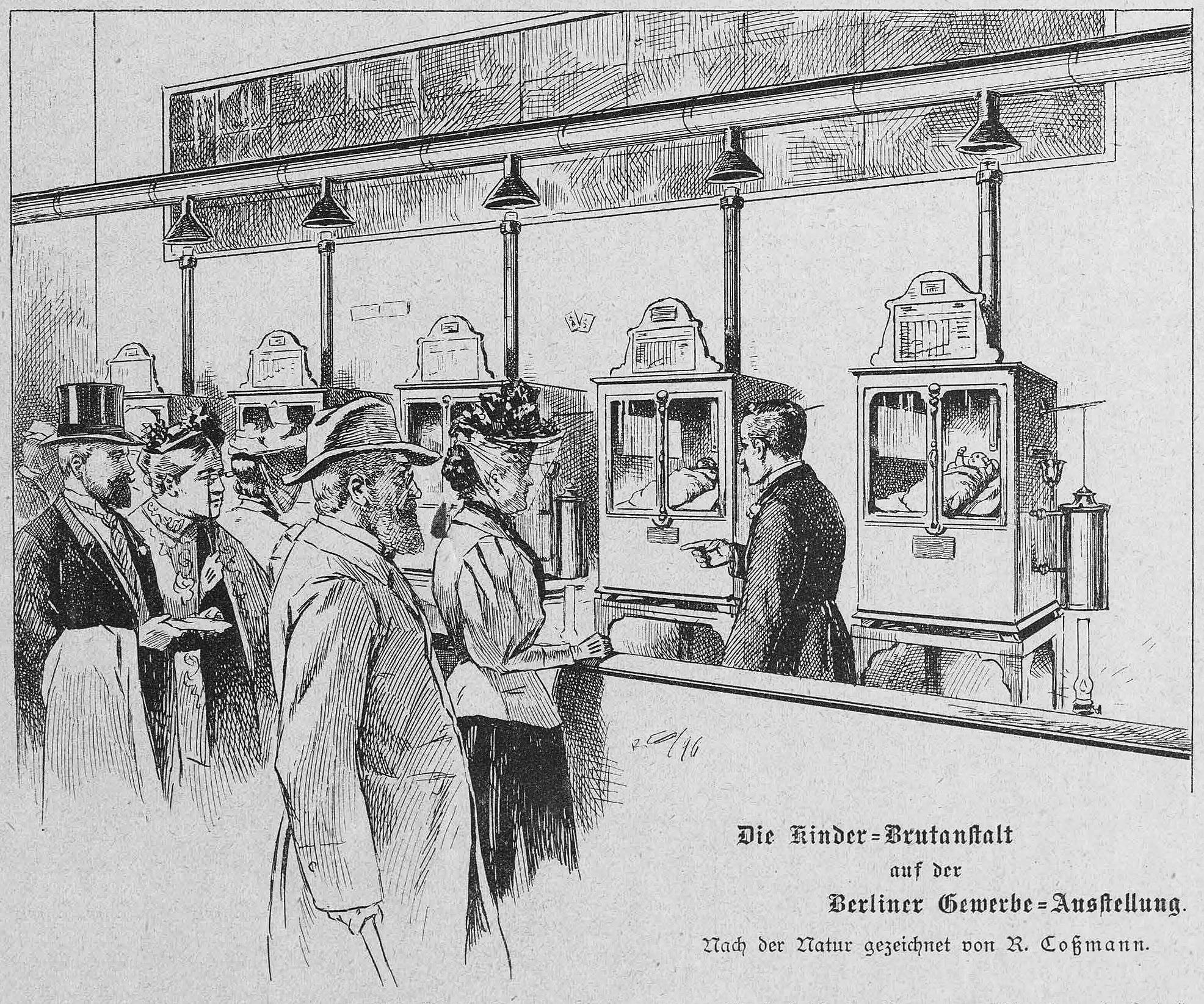
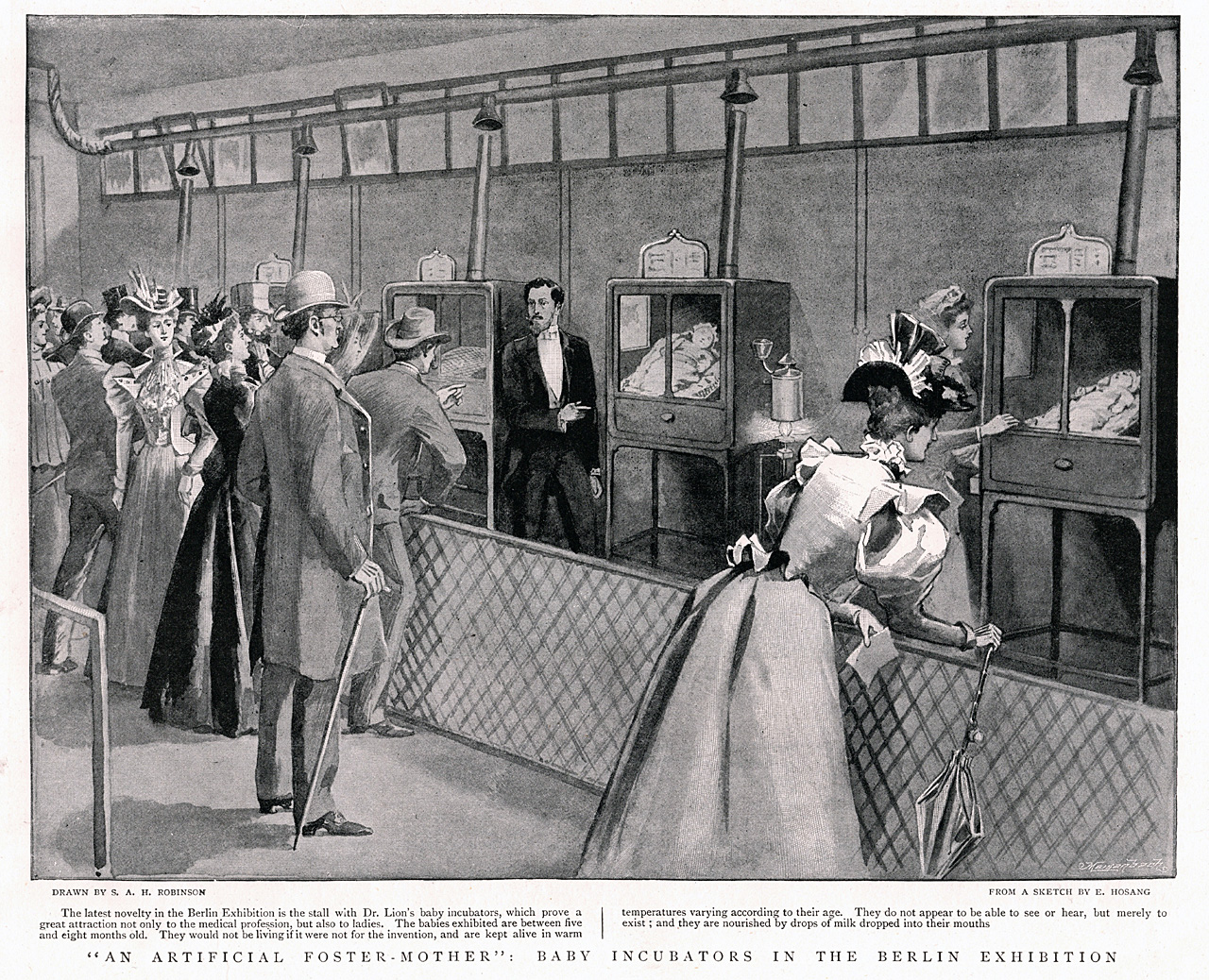
The exhibit was organized by Alexandre Lion, who had been caring for premature infants in incubators of his own design and charging admission to subsidize his nurseries in Nice, Paris, Lyons, Marseilles, and Bordeaux since at least 1891. Although Martin Couney claimed in later years that he had managed the exhibit on behalf of Pierre Budin, multiple contemporary news items, including coverage in the Official Exhibit News (Officielle Ausstellungs-Nachrichtung) and a figure in the London Graphic indicate that the exhibitor was Alexandre Lion, and do not mention either Budin or Couney.
The 1896 exhibit also marks the appearance of two other characters on the incubator exhibit scene that we will encounter again later, Paul Altmann, a successful Berlin manufacturer and distributor of surgical instruments, who is mentioned in the Exhibition’s final report as adding the Lion incubator to his product line, and Mr. Albert Leotardi, who is documented as managing the Berlin 1896 exhibit for Lion and later branches out on his own but continues to use Lion incubators.
Press Coverage
The incubator exhibit initially encountered some resistance from the civic authorities, as recounted in the Berliner Börsen-Zeitung on June 28, 1896:
Nachdem Herr Leotardi, der in Vertretung des Erfinders der „couveuse”, Herrn Lion, nach Berlin gekommen war, lange Zeit vergeblich versucht hatte, auf dem Ausstellungsterrain einen Platz zur Aufstellung seiner Apparate zu erhalten, wandte er sich an Professor Rudolf Virchow, um ihm seine Angelegenheit vorzutragen und sich sein Gutachten zu erbitten. Virchow, der sich vor ungefähr 25 Jahren selbst mit dem Gedanken näher beschäftigt hatte, wie schwächlich oder frühgeborene Kinder am besten zu erhalten wären, brachte dem Gedanken des Herrn Leotardi über die Errichtung eines Musterinstituts für die Pflege von Neugeborenen in Berlin, lebhaftes Interesse entgegen. Virchow schrieb Herrn L. für den Arbeitsausschuß der Gewerbe-Ausstellung einen Brief, in dem er die Erbauung des Pavillons auf das Wärmste empfahl, ebenso die Aufnahme von Säuglingen darin. Der Arbeitsausschuß, dem das Interesse des Gelehrten genügende Garantie für den Werth der Sache war, gab hierauf seine Einwilligung zum Bau eines Pavillons in Gruppe 18, und genehmigte den ihm von Herrn Leotardi vorgelegten Bauplan. Nachdem der Bau des Pavillons bereits vollendet war und die Eröffnung bevorstand, erhielt Herr Leotardi von dem Gruppenvorstand die Mittheilung, daß es nothwendig sei, bevor sein Pavillon eröffnet werde, ihn einer Anzahl hervorragender Berliner Aerzte vorzuführen und ihr Gutachten zu hören. Herr Leotardi, der mittlerweile der Charité zwei seiner Apparate gratis zur Verfügung gestellt hatte, lud hierauf die Professoren Virchow, Gusserow, Martin, Senator, die beiden Physiologen Munk und den medicinischen Director der Charité, Generalarzt Schaper ein. Die Herren haben nach eingehender Besichtigung der Apparate und des Pavillons, glänzende Zeugnisse ausgestellt und erklärt, daß die baldigste Eröffnung des Pavillons, der allen Anforderungen der modernen Hygiene entspricht, nur wünschenswerth sei. Virchow erklärte in einem nochmaligen Schreiben an den Vorstand der Gruppe XVIII die „baldigste Eröffnung des Pavillons als höchst wünschenswerth.” Nach dieser Beurtheilung der „couveuse” durch Berlins hervorragendste Fachmänner, kommt — ein Blitzstrahl aus heiterem Himmel — das „polizeiliche Verbot” zur Eröffnung des Pavillons in der gedachten Weise und zwar erfolgte dieses Verbot durch den Amtsvorsteher von Treptow, allerdings etwas spät, denn der Pavillon ist vollendet und die Aussteller haben eine große Summe dafür geopfert. Herr Leotardi will sein Recht bei dem Landrath eventuell bei dem Regierungspräsidenten suchen, wobei ihm der Französische Botschafter seine Hilfe zugesagt hat. Die Herren hoffen, daß die genannten Instanzen sich über das Urtheil so vieler namhafter Gelehrter nicht hinwegsetzen werden und daß es ihnen doch noch möglich sein wird, den Berlinern zu zeigen, wie sie sich eine Musteranstalt für Neugeborene denken.
After Herr Leotardi, who had come to Berlin as representative of the inventor of the “couveuse,” Herr Lion, had long tried in vain to obtain a place on the exhibition grounds for setting up his apparatus, he turned to Professor Rudolf Virchow to lay his matter before him and to request his expert opinion. Virchow, who about 25 years ago had himself occupied his mind more closely with the question of how weakly or prematurely born children might best be preserved, took a lively interest in Herr Leotardi’s idea of establishing a model institute for the care of newborns in Berlin. Virchow wrote Herr L. a letter for the working committee of the Trade Exhibition, in which he warmly recommended the construction of the pavilion, and likewise the admission of infants into it. The working committee, for whom the scholar’s interest was sufficient guarantee of the value of the matter, thereupon gave its consent to the construction of a pavilion in Group 18, and approved the building plan submitted to it by Herr Leotardi. After the construction of the pavilion was already completed and the opening was imminent, Herr Leotardi received from the group board the communication that it was necessary, before his pavilion be opened, to present it to a number of eminent Berlin physicians and to hear their opinion. Herr Leotardi, who had meanwhile placed two of his apparatus at the Charité’s disposal free of charge, thereupon invited Professors Virchow, Gusserow, Martin, Senator, the two physiologists Munk, and the medical director of the Charité, Surgeon-General Schaper. The gentlemen, after a thorough inspection of the apparatus and the pavilion, gave glowing testimonials and declared that the earliest possible opening of the pavilion, which meets all the requirements of modern hygiene, was only to be wished for. Virchow declared in a further letter to the board of Group XVIII the “earliest possible opening of the pavilion to be most highly desirable.” After this assessment of the “couveuse” by Berlin’s most eminent experts, there comes—like a bolt of lightning from a clear sky—the “police prohibition” of the opening of the pavilion in the said manner; and indeed this prohibition was issued by the district administrator (Amtsvorsteher) of Treptow, admittedly somewhat late, since the pavilion is completed and the exhibitors have sacrificed a large sum for it. Herr Leotardi intends to seek his right with the Landrat and, if necessary, with the Regierungspräsident, in which the French ambassador has promised him his help. The gentlemen hope that the said authorities will not set themselves over the judgment of so many notable scholars, and that it will yet be possible for them to show the Berliners how they envisage a model institution for newborns.
Two prestigious citizens quickly came to the exhibit’s defense, as documented in the Saale-Zeitung on July 1, 1896:
Die Kinderbrutöfen und die berliner Polizei. Zu dem Streitfall über den Kinderofen auf der Berliner Gewerbe-Ausstellung, dessen Vorführung mit Säuglingen bekanntlich untersagt wurde, ergreifen jetzt Geheimrath Prof. Gusserow, der Direktor der Universitäts-Frauenklinik an der Charité, und Geheimrath Prof. Virchow in zwei Zuschriften das Wort, welche lauten:
„Herrn Leotardi bescheinige ich auf seinen Wunsch nochmals, daß die von ihm der geburtshilflichen Klinik der Charité zur Verfügung gestellte Couveuse sich ausgezeichnet bewährt hat und daß von allen ähnlichen Apparaten sich der seinige als bester und zweckmäßigster durch die Einfachheit der Konstruktion herausgestellt hat. Diese Apparate stellen unzweifelhaft einen großen Fortschritt in der Pflege unreifer oder zu früh geborener Kinder dar, indem es mit Hilfe dieser Vorrichtung gelingt, eine große Anzahl dieser Neugeborenen am Leben zu erhalten, die nach unseren bisherigen Erfahrungen zu Grunde gingen. Es wäre sehr erwünscht, wenn das größere Publikum in die Lage gesetzt würde, sich selbst eine Vorstellung resp. ein Urtheil über den Werth dieses so hervorragenden Humanitätswerkes zu bilden. Zu diesem Zwecke dürfte nichts geeigneter sein als eine Ausstellung dieser Apparate in Thätigkeit, wie dies in dem Pavillon der Gewerbe-Ausstellung beabsichtigt wird. Diesen Pavillon habe ich eingehend besichtigt und kann ihn meiner Ansicht nach nur als vollkommen geeignet für seine Zwecke bezeichnen. Für das Wohlergehen der etwa dort befindlichen Kinder sind alle Vorrichtungen auf das denkbar beste getroffen worden.
Berlin, den 28. Juni 1896. Prof. Dr. Gusserow, Geh. Med.-R., Direktor der Universitäts-Frauenklinik an der Charité.”
„Indem ich bemerke, daß ich schon am 21. d. meine günstige Meinung über die gegenwärtige Einrichtung des Herrn Leotardi in einem demselben zur Verfügung gestellten Schriftstücke ausgesprochen habe, erkläre ich hierdurch, daß ich mich den Ausführungen des Herrn Geheimrath Gusserow in seinem Atteste vom 28. d. völlig anschließe. Ich bin der Meinung, daß kein berechtigter Grund vorliegt, die wirkliche Belegung mit lebenden Kindern zu verbieten, falls Herr Leotardi den Nachweis liefert, daß er das Personal besitzt, um die ärztliche Kontrolle und Pflege in genügender Weise zu stellen.
Dr. Rudolf Virchow.”
The Child-Incubators and the Berlin Police. On the dispute over the child-incubator at the Berlin Trade Exhibition, whose demonstration with infants was, as is known, forbidden, Privy Councillor Prof. Gusserow, the director of the University Women’s Clinic at the Charité, and Privy Councillor Prof. Virchow now take the floor in two letters, which read:
“At Herr Leotardi’s request I again certify that the couveuse placed by him at the disposal of the obstetric clinic of the Charité has proven outstandingly effective, and that of all similar apparatus his has shown itself to be the best and most practical by reason of the simplicity of its construction. These apparatus undoubtedly represent a great advance in the care of immature or prematurely born children, since with the aid of this device it is possible to keep alive a large number of these newborns who, according to our previous experience, would have perished. It would be very desirable if the wider public were put in a position to form their own idea, or rather a judgment, about the value of this so outstanding humanitarian work. For this purpose nothing could be more suitable than an exhibition of these apparatus in operation, as is intended in the pavilion of the Trade Exhibition. I have inspected this pavilion thoroughly and can, in my view, describe it only as perfectly suited to its purposes. For the wellbeing of the children who may be housed there, all arrangements have been made in the best conceivable manner.
Berlin, 28 June 1896. Prof. Dr. Gusserow, Privy Medical Councillor, Director of the University Women’s Clinic at the Charité.”
“In noting that I already on the 21st of this month expressed my favourable opinion of Herr Leotardi’s present installation in a document placed at his disposal, I hereby declare that I fully concur with the remarks of Privy Councillor Gusserow in his attestation of the 28th of this month. I am of the opinion that no legitimate ground exists for prohibiting the actual occupation with living children, provided Herr Leotardi furnishes proof that he possesses the personnel to ensure medical supervision and care in sufficient measure.
Dr. Rudolf Virchow.”
The exhibit did indeed eventually open to the public on August 9, 1896. “From today until the close of the exhibition, all physicians, members of the press, university students, and midwives are granted free admission upon presentation of a business card or other form of identification (Berliner Tageblatt, August 9, 1896), and by August 15, coverage in the Officielle Ausstellungs-Nachrichten (Official Exhibit News) shows that the exhibit was in full swing:
Die Kinderbrutanstalt in der Gewerbe – Ausstellung ist seit Mittwoch Abend um einen Bewohner reicher. Der sieben Monate alte Knabe war allerdings schon zwei Wochen in Pflege (1) seiner Mutter, welche — da ihr sehr zurückgebliebener Sprössling in der Zimmerluft sichtlich fror, sich keinen anderen Rath wusste, als den Knaben in Watte zu verpacken und in den Badeofen zu stecken. Aber auch das nutzte nichts und die liebevolle Mutter war der Verzweiflung nahe, ais die Kunde von dernenen Couveuseinder Ausstellung ihr zu Ohren kam. Sofort brachte sie das Kind, das nur 2½ Pid. wiegt, hierher, und nun wurde ihm eines der gläsernen Appartements, neben dem wackeren acht Monate alten Walther, der seit den fünf Tagen bereits um 140 gr. zugenommen hat, als Aufenthalt ange-wiesen. – Das Interesse des Publikums für die segensreiche Wohlfahrtseinrichtung ist nach wie vor sehr lebhaft. Die Apparate sind den ganzen Tag von Lernbegierigen umgeben, welchen der über-waehende Vertreter Lion’s Herr Leotardi auf das liebenswürdigste Auskünfte ertheilt. Sehr zahlreich sieht man unter den Besuchern der Couveuse Damen, viele dason mit Handtäschehen verselen, da Frauen »vom Berufe freien Eintritt haben.
Since Wednesday evening, the infant incubator exhibit at the Trade Exhibition has gained a new resident. The seven-month-old boy had already been in the care of his mother for two weeks; seeing her severely underdeveloped offspring visibly shivering in the ambient room air, she knew no other recourse than to wrap the boy in cotton wool and place him inside the bathroom water heater. Yet even this proved futile, and the loving mother was on the verge of despair when she heard news of the incubators at the exhibition. She immediately brought the child—who weighs only 2½ pounds—here, and he has now been assigned one of the glass compartments next to the sturdy eight-month-old Walther, who has already gained 140 grams in just five days. Public interest in this beneficial welfare facility remains very keen. Throughout the day, the apparatuses are surrounded by inquisitive onlookers, to whom Mr. Leotardi—the representative overseeing the Lion’s exhibit—courteously provides information. A great many ladies are seen among the visitors to the incubator display, many carrying handbags, as women in the profession are granted free admission.
And within a week thereafter, the pavilion was fully occupied, as told in the Hannoverscher Kurier on 18-Aug-1896:
(Die fünf Brutapparate der Lionschen Couveuse) auf der Berliner Ausstellung sind jetzt sämmtlich besetzt; zu den bisher vorhandenen zwei Pärchen (zwei Knaben und zwei Mädchen) hat sich noch ein fünfter Sprößling gesellt. Weil das Ersuchen um Aufnahme von schwächlich geborenen Kindern nicht nachläßt, hat sich Herr Lion veranlaßt gesehen, weitere Brutapparate zu beschaffen. Sie sind bereits unterwegs und werden, da die Räumlichkeiten des Pavillons die Aufstellung von weiteren Brutkästen nicht gestattet, an Aerzte, Anstalten und Privatpersonen verliehen werden.
(The five incubating apparatus of the Lion couveuse) at the Berlin Exhibition are now all occupied; to the two little pairs present so far (two boys and two girls) a fifth offspring has now been added. Because the requests for admission of weakly-born children do not let up, Herr Lion has seen himself prompted to procure further incubating apparatus. They are already on their way and, since the pavilion’s space does not permit the setting up of further incubators, will be lent out to physicians, institutions, and private persons.
On September 1, 1896, the Officielle Ausstellungs-Nachrichten (Official Exhibit News) shared the following story:
Blinder Feuerlärm verursachte gestern wieder gegen
3 Uhr grosse Aufregung unter den Besuchern des Hauptgebäudes und der angrenzenden Pavillons. Die Feuerwehr hatte sich auf die Meldung, dass die Kinderbrutanstalt brenne, sofort mit der Dampfspritze dahin begeben, doch erwies sich die Meldung glücklicherweise als ebenso falsch, wie die Mittheilung, dass Feuer im Hauptgebäude ausgebrochen sei. Man vermuthet, dass Kurzschluss am Feuermelder die unnütze Alarmirung verursacht habe.
A false fire alarm caused considerable commotion again yesterday, around 3 o’clock, among visitors to the main building and the adjacent pavilions. Upon receiving a report that the children’s incubator facility was on fire, the fire brigade immediately rushed there with their steam fire engine; fortunately, however, the report proved to be just as false as the earlier claim that a fire had broken out in the main building. It is suspected that a short circuit in the fire alarm system triggered the unnecessary alert.
On September 9, 1896, the following news story appeared in the Berlin newspaper Vorwärts:
Ueber die bisherige Wirksamkeit des Lion’fcheu Kinderbrut-Apparates auf der Berliner Gewerbe-Ausstellulung liegt jetzt die Erfahrung vor, die man dort im Verlaufe des ersten Monats mit vier Kindern gemacht hat. Das erstaufgenommene Kind, der kleine Walter, welcher mit einem Körpergeiwicht von 2080 Gramm in die Conveuse kam nnd der in den ersten vier Tagen bis zu 2200 Gramm zugenommen, bist nach drei Wochen an den Folgen eines Darmkatarrhs in der Couveuse zu gründe gegangen. Das zweite Kind, ein Mädchen namens Selma, das mit einem Körpergewicht von 1470 Gramm 4 Wochen nach der Geburt in die Couveuse kam und angeborene Lungendefekte hatte, wurde von der Mutter wieder fortgeholt. Die zwei übrigen von den anfgenommenen vier Kindern haben sich im Verlauf von vier Wochen gut entwickelt. Das eine, ein Mädchen namens Charlotte, ist mit einem Gewicht von 1410 Gramm aufgenommen worden und wiegt jetzt 2555 Gramm. Das andere Kind, ein Knabe, wiegt 2925 Gramm; er hat in den vier Wochen seines Aufenthalts in der Couveuse, in welcher er eine Zahnung durch gemacht hat, 535 Gramm zugenommen. Am 12. und 13. Sept. ist je ein Kind in den Pavillon eingeliefert worden. Beide Kinder sind Mädchen; das eine ist am 1. Sept. geboren und wiegt 2320 Gramm, das zweite, welches ein paar Stunden nach der Geburt vom Vater in den Pavillon gebracht wurde, wiegt 1560 Gramm. Es wird vorläufig vermiitels des von Lion konstruirten Löffels durch die Nase ernährt. Der Pavillon wurde seit dem 9. Angust, dem Tage seiner Eröffnung, bis Sonntag, den 13.
Experience regarding the performance to date of Lion’s infant incubator at the Berlin Trade Exhibition is now available, based on observations made there over the course of the first month involving four infants. The first child admitted—little Walter, who entered the incubator weighing 2,080 grams and gained up to 2,200 grams during his first four days—succumbed after three weeks within the incubator to complications arising from intestinal catarrh. The second child—a girl named Selma, who entered the incubator four weeks after birth weighing 1,470 grams and suffered from congenital lung defects—was subsequently removed by her mother. The remaining two of the four admitted infants have developed well over the course of four weeks. One of them—a girl named Charlotte—was admitted weighing 1,410 grams and now weighs 2,555 grams. The other child—a boy—weighs 2,925 grams; during his four-week stay in the incubator—during which time he also went through a period of teething—he gained 535 grams. On September 12th and 13th, one infant was admitted to the pavilion on each day. Both infants are girls; one was born on September 1st and weighs 2,320 grams, while the second—who was brought to the pavilion by her father just a few hours after birth—weighs 1,560 grams. For the time being, she is being fed via the nose using a special spoon designed by Lion. The pavilion remained open from August 9th—the day of its inauguration—until Sunday, the 13th.
The following story appeared in Officielle Ausstellungs-Nachrichtung (Official Exhibit News) on September 30, 1896, page 12:
Die Kinderbrutanstalt, welche sich noch immer des regsten Interesses seitens der Besucher der Gewerbe-Ausstellung erfreut, hat, wie man uns mittheilt, die Anregung zu einer bleibenden Einrichtung in Berlin gegeben. Ein Comité, das in der Bildung begriffen ist und dem neben einigen bekannten Professoren einer der bedeutendsten Gynäkologen Berlins angehört, hat es sich zur Aufgabe gemacht, die zur Errichtung eines solchen Säuglingsasyls nothwendigen Mittel aufzubringen. Dasselbe soll nach dem Muster der Kinder-brutanstalt auf der Ausstellung errichtet werden und in ihm sollen hauptsächlich schwächlich und zu früh geborene Kinder in der von Herrn Lien construirten Couveuse Unterkunft finden. Herr Lion hat dem Comité bereits erklärt, dass er gerne bereit sei, diesem Säuglingsasyle die nöthigen Couveusen unentgeltlich zur Verfügung zu stellen.
— Von gestern: Nachmittag ab gelangt übrigens in dem Kinderbrutpavillon eine Brochure zur Verteilung, die neben interessanten Daten über die Kennzeichen des zu früh geborenen Kindes eine genaue Beschreibung der Lion’ schen Couveuse und ihrer Handhabung enthält. Weiter enthält die Brochure Gutachten des Geheimrath Professor Grusserow, des Directors der Universitäts – Frauenklinik und Protessor Rudolf Virchow’s. Beide Gelehrte sprechen sich in diesen speciell für die Brochure ausgestellten Gutachten in äusserst günstigem Sinne über den Werth der Lion’schen Couveuse aus, ebenso der bekannte Berliner Neurologe Professor Albert Eulenburg, der gelegentlich eines Riviera-Aufenthaltes die „Maternité Lion” in Nizza kennen gelernt hat.
The infant incubator exhibit, which continues to attract keen interest from visitors to the Industrial Exhibition, has—we are informed—inspired the creation of a permanent facility in Berlin. A committee currently being formed—comprising several prominent professors and one of Berlin’s leading gynecologists—has set itself the task of raising the funds necessary to establish such an infant care center. It is to be modeled after the incubator exhibit at the fair and will primarily provide care for frail and premature infants using the incubators designed by Mr. Lion. Mr. Lion has already informed the committee that he is willing to provide the necessary incubators to this center free of charge.
From yesterday: As of yesterday afternoon, a brochure is being distributed at the incubator pavilion; in addition to interesting data regarding the characteristics of premature infants, it contains a detailed description of the Lion incubator and its operation. The brochure also includes expert opinions from Privy Councilor Professor Gusserow (Director of the University Women’s Clinic) and Professor Rudolf Virchow. In these statements—prepared specifically for the brochure—both scholars speak very favorably of the value of the Lion incubator, as does the renowned Berlin neurologist Professor Albert Eulenburg, who became acquainted with the “Maternité Lion” in Nice during a stay on the Riviera.
A final story appeared in Vorwärts on October 13, 1896:
Trotz des schlechte Wetters war die Ausstellung vor- gestern, als am letzten Sonntage ihres Daseins sehr gut besucht. Ob der Theil des Publikums, der sich am äußerlichen Eindruck erfreuen wollte, auf seine Kosten gekommen ist, mag dahingestellt bleiben. Die Bauwerke, die dereinst in ihrer weißen Pracht so protzig leuchteten, machen schon einen überaus tristen Eindruck und legen an mehr als einer Stelle von der Vergänglichkeit alles Irdischen Zengniß ab. Der bedenkliche Verfall des Rabitzputzes erleichtert immerhin den Abschied von der Ausstellung, die am Donnerstag bestimmt geschlossen werden soll. Vom Kinder – Brutapparat. Von den letzten vier in den Pavillon aufgenommenen Kindern hat eines, ein Mädchen Klara, die Conveuse nach einem IStägigen Aufenthalt, während welchem es 530 Gramm zunahm, völlig gesund verlassen. Von den drei übrigen Kindern ist das eine, Johanna, am 20. September mit 2020 Gramm ausgenommen worden; es wiegt heute bereits 2480 Gramm. Das zweite Kind, Frieda genannt, ist am Tage seiner Geburt, 13. September, eingeliefert. Es wog damals 1560 Gramm, hat, wie dies gewöhnlich geschieht, in den ersten Tagen abgenommen, und zwar bis zu 1420 Gramm. Das Kind, das seit dem 10. Tage wieder zugenommen hat, wiegt heute 1760 Gramm. Das dritte Kind, ein Knabe namens Max, ist 3 Tage alt am 15. September mit 1400 Gramm aufgenommen worden. Es hatte bei seiner Einlieserung am ganzen Körper wassersüchtige Anschwellungen, die in der Conveuse jedoch binnen 5 Tagen verschwanden. Sein Körpergewicht sank infolge dessen auf 1210 Gramm. Seit dem achten Tage seines Conveufen- aufenthaltes nimmt der Kleine, der gegenwärtig 1430 Gramm wiegt, konstant zu. Zwei von den Kindern, Frieda und Max. waren bei ihrer Einlieserung so schwach, daß sie aus künstlichem Wege ernährt werden mußten. Frieda mußte vier Tage vermittelst eines kleinen Löffels ernährt werden, mit welchem dem zum Saugen zu schwachen Kinde die Milch tropfen- weise eingeflößt wurde. Der kleine Max trinkt erst seit einer Woche selbständig an der Brust, er wurde bis dahin vermittelst des Milchziehers ernährt, durch welchen die Milch dem Kinde gleichsam in den Mund gepumpt wird. Uebrigens hat die Lion’sche Couveuse auch die Anregung zu einer interessanten statistischen Arbeit gegeben, welche die Zahl der Frühgeburten in Deutschland feststellen soll. Darauf bezügliche Publikationen stehen bevor.
Despite the poor weather, the exhibition was very well attended the day before yesterday—on the final Sunday of its existence. Whether that portion of the public seeking merely to enjoy the outward spectacle truly got their money’s worth remains an open question. The structures, which once gleamed so ostentatiously in their white splendor, now present an exceedingly dismal appearance and bear witness—in more places than one—to the transience of all earthly things. The alarming deterioration of the wire-lath plasterwork does, at any rate, make it easier to bid farewell to the exhibition, which is scheduled to close permanently this Thursday. Regarding the Infant Incubator: Of the last four infants admitted to the pavilion, one—a girl named Klara—has left the incubator in perfect health after an 18-day stay, during which she gained 530 grams. Of the remaining three infants, one—Johanna—was admitted on September 20th weighing 2,020 grams; today, she already weighs 2,480 grams. The second infant—named Frieda—was admitted on the very day of her birth, September 13th. At that time, she weighed 1,560 grams; as is typically the case, she lost weight during the first few days, dropping to 1,420 grams. The infant, who has been gaining weight again since her tenth day, currently weighs 1,760 grams. The third infant—a boy named Max—was admitted on September 15th at the age of three days, weighing 1,400 grams. Upon admission, he presented with edematous swelling over his entire body; however, these symptoms vanished within five days of his placement in the incubator. Consequently, his body weight dropped to 1,210 grams. Since the eighth day of his stay in the incubator, the little one—who currently weighs 1,430 grams—has been gaining weight steadily. Two of the children—Frieda and Max—were so weak upon admission that they had to be fed artificially. Frieda required feeding by means of a small spoon for four days; using this method, milk was administered drop by drop to the infant, who was too weak to suckle. Little Max has only been nursing independently at the breast for the past week; prior to this, he was fed using a breast pump—a device through which milk is, as it were, pumped directly into the infant’s mouth. Incidentally, the Lion incubator has also inspired an interesting statistical study aimed at determining the number of premature births in Germany. Publications regarding this subject are forthcoming.
After the exposition, a news item appeared in the Saale-Zeitung on November 27, 1896:
Die Wärmekammern für lebensschwache Neugeborene, die sog. Lion’schen Couveusen, sind jetzt im Medizinischen Waarenhause in Berlin ausgestellt und werden im Auftrage des Vereins zur Begründung einer „Couveusenanstalt” unter folgenden Bedingungen vermiethet: 1. Die Vermiethung einer Couveuse in Berlin erfolgt auf Antrag eines praktischen Arztes. Derselbe verpflichtet sich, dafür Sorge zu tragen, daß der Apparat unbeschädigt zurückgeliefert wird, und das Ergebniß der Behandlung des Kindes in der Couveuse mitzutheilen. Uebernimmt der beantragende Arzt diese Verpflichtung nicht, so tritt an dessen Stelle hinsichtlich der Kontrolle und Berichterstattung ein durch den Ausschuß namhaft zu machender Arzt. 2. Hin- und Rücktransport des Apparats geschieht auf Kosten der Familie, welche den Apparat benöthigt. Ein Betrag von 10 Mark ist unter allen Umständen bei der Meldung einzuzahlen und verfällt, auch wenn der Apparat nach einigen Tagen wieder zurückgestellt wird. 3. Für die Benutzung werden für den Monat je nach den Verhältnissen der Familie 30–60 Mark berechnet. Der Reinertrag ist zur Gründung einer Couveusenanstalt bestimmt.
The warming chambers for weakling newborns, the so-called Lion incubators, are now on display at the Medical Warehouse (Medizinisches Waarenhaus) in Berlin and are being rented out on behalf of the Society for the Founding of a “Couveuse Institution” under the following conditions: 1. The rental of a couveuse in Berlin is arranged upon application by a practising physician. He undertakes to ensure that the apparatus is returned undamaged and to report the outcome of the child’s treatment in the couveuse. If the applying physician does not assume this obligation, a physician to be named by the committee takes his place with respect to supervision and reporting. 2. Transport of the apparatus to and fro is at the expense of the family requiring it. An amount of 10 marks is to be paid in all cases upon registration and is forfeited even if the apparatus is returned after only a few days. 3. For use, 30–60 marks per month are charged depending on the family’s circumstances. The net proceeds are designated for the founding of a couveuse institution.
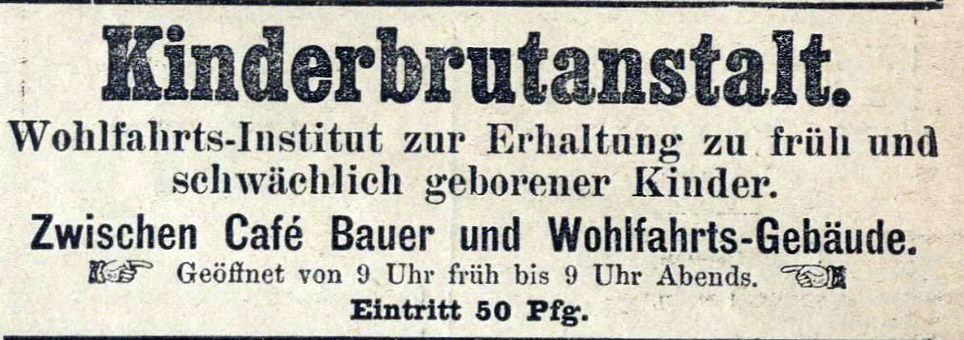
Display advertisements in various formats ran continually in the “Official Exhibition News” (Officielle Ausstellungs-Nachrichtung) from August 15 through October 15, 1896:
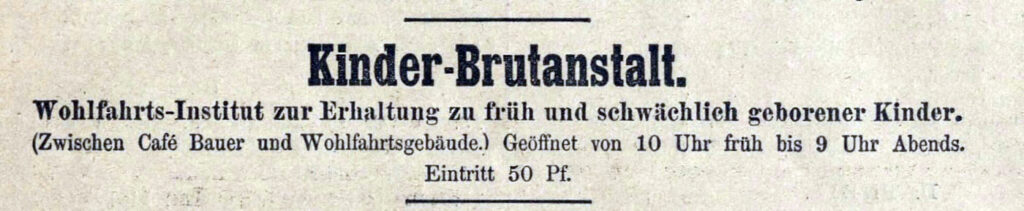
Welfare institution for the preservation of prematurely and weakly born infants.
(Between Café Bauer and the Welfare Building.) Open from 10 a.m. to 9 p.m.
Admission 50 Pfennigs.
The Official Exhibition Report
After the close of the exhibition, the official 1896 exhibition report (“Berlin und seine Arbeit,” published in1898) included a 3 page report titled “Bericht ǔber die Couveuse (Lion) oder Kinderbrutanstalt” about the the incubator (couveuse) display. The following is a summary of its contents, translated from the original German:
Medical framing. The report opens by defining a “mature” newborn as one weighing 3,000–3,600 g; lighter infants are considered poorly developed or premature. Infants from the eighth month of gestation (about 1,500 g) can be kept alive, while survival below roughly that weight (seventh month, ~1,000 g) had not been reliably demonstrated. The two central problems in caring for infants born between 1,400 and 2,500 g are feeding (they usually cannot suckle) and maintaining body temperature, since in the premature infant heat loss exceeds heat production. The report concerns itself only with the second problem.
The Lion apparatus. Earlier warming methods (wrapping, double-walled warm-water beds) lacked reliable self-regulation, and the report credits the Lion couveuse as the first to solve this. It is a box of sheet iron and nickel-plated copper, with glass on the front and left side for observation; the infant rests on a freely suspended iron grate. Filtered outside air enters through an 8 cm tube at the base and exits via a 1 m draft chimney. Heating comes from hot water circulating in a copper coil beneath the infant, fed from a side reservoir and heatable by any fuel. The distinguishing feature is automatic upward temperature regulation: a spirit-filled copper spiral drives a two-armed lever and a double-cone float set (via a screw) for any target between 30 and 37 °C; if the air rises even 0.1 °C above the setpoint, the spiral expands, the float lifts, and excess heat vents past it, cooling the water and lowering the temperature. A thermometer and hygrometer (with a water vessel to maintain humidity) allow constant monitoring.
The exhibition institution. Reported by Dr. Alfred Marcuse, the supervising physician, the display opened only on 9 August 1896 after various difficulties, equipped with five Lion couveuses. It served a dual purpose: publicizing the apparatus and providing free incubator care to premature or weak infants for the exhibition’s duration. The pavilion (wood and magnesite board), sited between the main building and the welfare building, let visitors approach within 80 cm of the incubators behind a barrier, with adjacent rooms for feeding, kitchen, and sleeping. Over 100,000 people visited, and many requests to admit infants had to be refused for lack of space. Because the incubators could only be occupied from 9 August, just eight infants were admitted — five girls, three boys; five legitimate, three illegitimate; all premature and under 2,400 g at admission (the smallest at 1,210, 1,420, and 1,470 g). One died of intestinal catarrh, one was withdrawn by its mother against advice, and the remaining six survived and were discharged healthy. All reached normal body temperature within a day (some had arrived 4–6° below normal), and infants without serious disturbance gained 20–40 g daily; one admitted at 1,710 g was discharged after 35 days at 2,725 g. Five infants received exclusively breast milk, three cow’s milk. Staffing was substantial — a physician, a Frenchwoman who headed a Paris maternité, mothers, wet-nurses, a nurse, night watch, plus two or three staff dedicated solely to explaining the apparatus to visitors.
Charité data. Professor Dr. Gusserow, Director of the University Women’s Clinic, appended some of his own data from the obstetric clinic at the university’s Charité to the report for comparison: 23 infants were cared for in the incubator at the clinic, one (1,265 g) was excluded from the statistics as it had congenital syphilis and died on day 11. Of the remaining 22 (all fed mother’s or wet-nurse’s milk), fifteen died, with admission weights ranging from 935 to 1,980 g; only about six to eight were truly “viable” in his judgment. The seven that survived ranged from 1,285 to 2,760 g at admission, discharged after 10–11 days at broadly similar weights, all fed on mother’s milk. Gusserow concludes that the couveuse is an important means of saving infants who would otherwise likely die, and that the Lion model’s particular merit is its absolutely reliable upward self-regulation; downward regulation, though desirable, is easily dispensed with, since maintaining temperature depends only on the heating source, which poses no difficulty with, e.g., gas heating.
Primary Sources
- Berliner Gewerbe-Ausstellung 1896 Officieller Haupt-Katalog [Official Catalog of the Berlin Industrial Exhibition] — Die Zentral- und Landesbibliothek Berlin (ZLB)
- Berlin und seine Arbeit – Amtlicher Bericht der Berliner Gewerbe-Ausstellung 1896. Herausgegeben vom Arbeits-Ausschuss. Verlag Dietrich Reimer (Ernst Vohsen), Berlin 1898. [Berlin and Its Industry. Official Report of the Berlin Trade Exhibition, 1896. Published by the Working Committee. Publisher: Dietrich Reimer (Ernst Vohsen), Berlin, 1898]
- “Bericht ǔber die Couveuse (Lion) oder Kinderbrutanstalt” [Report about the Lion Incubator] English Translation.
Press Sources
- Berliner Börsen-Zeitung, June 28, 1896: Opening of the pavilion has been prohibited by the district administrator (Amtsvorsteher) of Treptow.
- Saale-Zeitung, July 1, 1896: Letters in support of the incubator pavilion by Drs. Gusserow and Virchow.
- Berliner Börsen-Zeitung, August 5, 1896. Initial ban of the incubator exhibit by the Treptow District Commissioner will be lifted.
- Berliner Tageblatt, August 9, 1896. Incubator exhibit is open, free admission for physicians, members of the press, university students, and midwives.
- Officielle Ausstellungs-Nachrichten, August 15, 1896: Incubator exhibit has two infants, public interest is keen, Leotardi managing the exhibit for Lion.
- Hannoverscher Kurier, 18-Aug-1896: Incubator pavilion is fully occupied.
- Officielle Ausstellungs-Nachrichten, September 1, 1896. False fire alarm.
- Vorwärts, September 9, 1896. Descriptions of care of four named infants.
- Officielle Ausstellungs-Nachrichtung, Sept. 30, 1896, p. 12. Incubator exhibit inspires establishment of infant asylum, Lion will donate incubators. Brochure is being distributed that includes expert endorsements.
- Berliner Illustrirte Zeitung, October 11, 1896. Lengthy description of the incubator and widely reproduced drawing of the incubator exhibit.
- Vorwärts, October 13, 1896. Summary of infants cared for during the exhibition and their outcomes.
- Deutscher Reichsanzeiger und Preußischer Staatsanzeige, November 21, 1896. Lion incubators from the exhibition can now be viewed at the “Medical Goods House” and are available for rent.
Other Sources
- Great Industrial Exposition of Berlin — English Wikipedia: https://en.wikipedia.org/wiki/Great_Industrial_Exposition_of_Berlin
- Berliner Gewerbeausstellung — German Wikipedia: https://de.wikipedia.org/wiki/Berliner_Gewerbeausstellung
- Alexander C. T. Geppert, “Weltstadt für einen Sommer” — Verein für die Geschichte Berlins: https://www.diegeschichteberlins.de/geschichteberlins/berlin-abc/stichworteag/975-weltstadt-fuer-einen-sommer-die-berliner-gewerbeausstellung-1896-im-europaeischen-kontext.html
- “Die verhinderte Weltausstellung” — Wissenschafts-Thurm: https://wissenschafts-thurm.de/die-verhinderte-weltausstellung-die-berliner-gewerbeausstellung-von-1896/
- “The Great Berlin Industrial Exhibition (1896)” (with translated text from Lindenberg’s 1896 Pracht-Album and budget detail) — German History in Documents and Images: https://germanhistorydocs.org/en/wilhelmine-germany-and-the-first-world-war-1890-1918/the-great-berlin-industrial-exhibition-1896
- “Die Anlage und die Bauten der Berliner Gewerbe-Ausstellung des Jahres 1896” (verbatim reprint of the 1896 Deutsche Bauzeitung architectural series) — lokalgeschichte.de: https://lokalgeschichte.de/die-anlage-und-die-bauten-der-berliner-gewerbe-ausstellung-des-jahres-1896
- Marcel Piethe, “450 Jahre Treptow (Teil II): Die Gewerbeausstellung von 1896” — Maulbeerblatt: https://maulbeerblatt.com/mbbarch/die-gewerbeausstellung-1896-im-treptower-park/
- “Gewerbeausstellung 1896: Berlins Sprung in die Moderne” — tip Berlin: https://www.tip-berlin.de/stadtleben/geschichte/gewerbeausstellung-1896-berlins-sprung-in-die-moderne/
German sources were translated with mechanical assistance, then edited and verified by the author.
More information about Alexandre Lion
- General Information
- Alexandre Lion
- The Lion Incubator
- The Engineer and the Newborns, by W. A. Nelson and Paul L. Toubas
- Lion Patents (France)
- Patent 201550, 1889, Couveuse électro-automatique
- Patent 221716, 1892, Couveuse automatique
- Patent 262090, 1896, Chambre vivifiante
- Patent 281687, 1898, Système de filtration de l’air
- Patent 287557, 1899, Système de filtration des fumées, de l’air et de toutes masses gazeuses avec tirage et ventilation
- Patent 189989, 1899, Appareil pour le filtrage et la purification de l’air et des fumées
- Maternité Lion Institutes and City Exhibits
- Alexandre Lion’s first incubator baby exhibit in Marseille, 1890.
- Œuvre Maternelle des Couveuses d’Enfants, Nice
- Œuvre Maternelle des Couveuses d’Enfants, Lyon
- Œuvre Maternelle des Couveuses d’Enfants, Paris
- Œuvre Maternelle des Couveuses d’Enfants, Toulouse
- Œuvre Maternelle des Couveuses d’Enfants, Amiens
- Œuvre Maternelle des Couveuses d’Enfants, New York
- Œuvre Maternelle des Couveuses d’Enfants, Barcelona
- Œevre Maternelle des Couveuses d’Enfants, Brussels
- Maternité Lion Souvenir Booklets
- Œuvre Maternelle des Couveuses d’Enfants , Paris Institute, Booklet Version #1 (appears to be ~1896)
- Œuvre Maternelle des Couveuses d’Enfants , Paris Institute, Booklet Version #2 (appears to be ~1901)
- Pamphlet from Alexander Lion’s exhibit at the 1898 exhibition in Torino, Italy. (PDF supplied by Dr. Thijs Gras, Amsterdam)
- Press Coverage
- La Maternité “Lion de Nice” pour Enfants Nés Avant Terme ou Débiles, by Dr. Ciaudo, 1895. Source: gallica.bnf.fr.

- Presentation d’Appareil, by M. A. Pinard, Bulletin de l’Académie nationale de médecine, 1893. Source: gallica.bnf.fr.
- Les couveuses d’enfant et le gavage, by César-A Queirolo, Includes discussion of Lion incubator and comparison to other types. Thèse de doctorat: Univ. Genève, 1897.
- Les Couveuses pour Enfants, Gazette Médicale de Paris, No. 40, October 6, 1900
- Couveuses d’Enfants, La Maternité Lion, Paris, La Patrie, 1897
- Paris Letter: An Improved System of Incubators, by O. Jennings, Pediatrics 1:427-428, 1896
- Baby Incubators, The Strand Magazine, 1896, by James Walter Smith
- Human Infant Incubation: A True Fairy-Tale of Modern Science from Leslie’s Weekly, 1897
- The Saving of Human Life, Maternité Lion in NYC, The Literary Digest, 1898
- Immature Infants in France, from The Lancet, January 16, 1897, page 196.
- De Lion Incubator at Low Maternity Hospital, by Francis H. Stuart, Brooklyn Medical Journal, 1901
- Alexandre Lion’s Incubator Charities in Europe (1894–1898) (The Embryo Project)
- La Maternité “Lion de Nice” pour Enfants Nés Avant Terme ou Débiles, by Dr. Ciaudo, 1895. Source: gallica.bnf.fr.
- Worlds Fairs and Expositions
- Maternité Lion at the Lyon Exposition Universelle et Coloniale, 1894
- Maternité Lion at the Lyon Exposition Universelle – Le Monde Illustré, 1894
- Maternité Lion at the Bordeaux Exposition of 1895.
- “La Maternité Lion,” by Louis Énault, Journal of the Bordeaux Exposition, 1895
- Maternité Lion at the Amsterdam World Exposition, 1895
- Maternité Lion at the Berliner Gewerbeausstellung, 1896
- “Bericht ǔber die Couveuse (Lion) oder Kinderbrutanstalt” [Report about the Lion Incubator] from Berlin und seine Arbeit – Amtlicher Bericht der Berliner Gewerbe-Ausstellung 1896. English Translation.
- Maternité Lion at the Exposition National Suisse, Geneva, Switzerland, 1896
- “Quelques Réflexions sur le Fonctionnement et les Résultats des Couveuses Lion pendant l’Exposition Nationale,” by Dr. Hector Maillart, Revue Médicale de La Suisse Romande, 1896. English translation.
- Internationale Ausstellung für Körperliche Erziehung, Gesundheitspflege und Sport, Innsbruck, 1896
- Maternité Lion at the Tennessee Centennial Exposition, 1897
- Maternité Lion at the Brussels International Exposition, 1897
- Maternité Lion at the Turin L’Esposizione Generale Italiana, 1898
- Maternite Lion at the Ghent Provincial Exposition of 1899
- Maternité Lion at the Greater Britain Exhibition of 1899
- Maternité Lion at the Paris Exposition Universelle of 1900
- Maternité Lion at the Woman’s Exhibition in Earls Court, London, 1900
- Maternité Lion at the Lille Exposition of 1902
- Maternité Lion at the Exposition Internationale de Reims, 1903
- Maternité Lion at the Nantes Exposition of 1904
- Maternité Lion at the Exposition du Nord de la France, 1904
- Maternité Lion at the Liège Exposition Universelle et Internationale, 1905.
- Maternité Lion at the Marseille Colonial Exposition of 1906
- Maternite Lion at the Bordeaux International Maritime Exposition of 1907
- Maternité Lion at the Marseille Exposition Internationale d’Électricité, 1908
- Maternité Lion at the Exposition Internationale de l’Est de la France, Nancy, France, 1909
- Maternité Lion at the Brussels Exposition Universelle et Internationale, 1910
- Maternite Lion at the Exposition du Centre de la France, Clermont-Ferrand, 1910
- Maternité Liion at the Rome International Exposition of 1911
- Maternité Lion at the Turin International Exposition of 1911
- Maternité Lion at the Exposition Internationale de Dunkerque, 1912
- Maternité Lion at the Ghent International Exposition of 1913
- Maternité Lion at the Exposition Internationale Urbaine de Lyon, 1914
- Maternité Lion at the Lyon Exposition Universelle et Coloniale, 1894
Last Updated on 09/04/26