Trans-Mississippi and International Exposition, Omaha, 1898
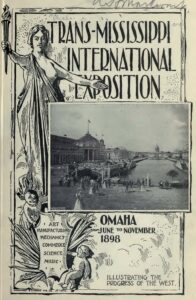
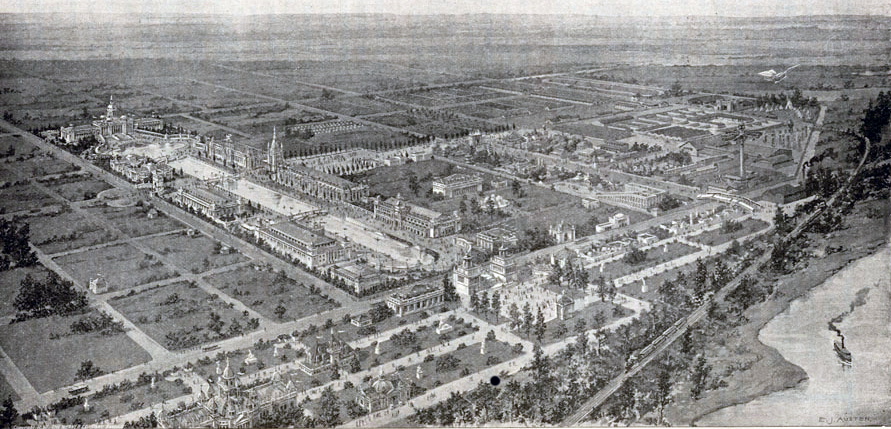
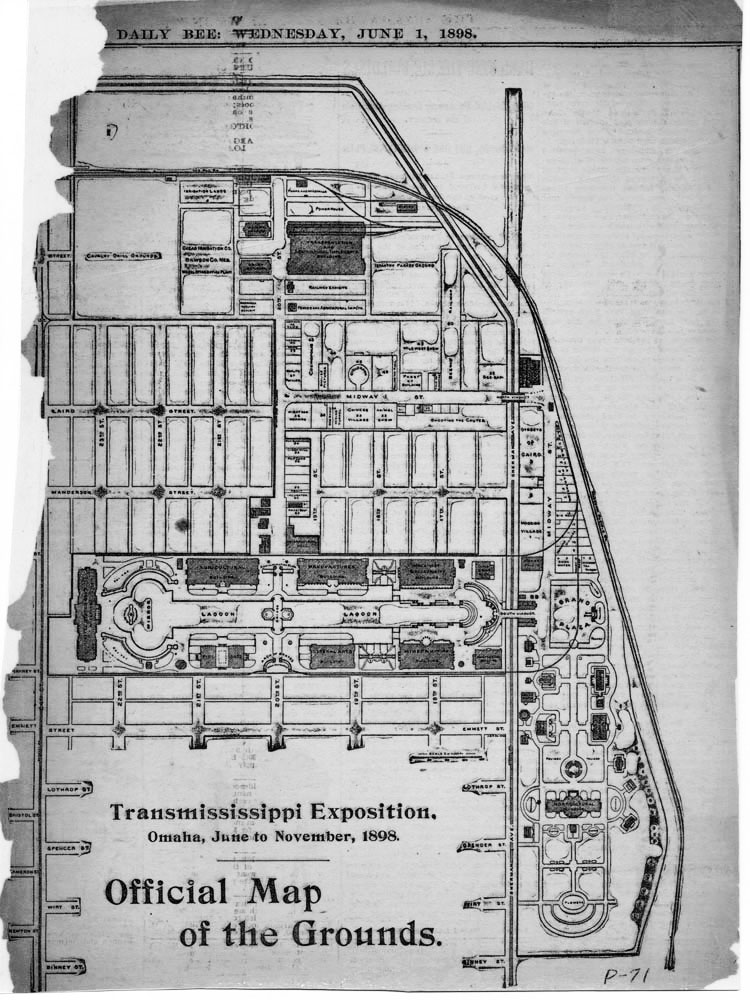
The Trans-Mississippi and International Exposition opened in Omaha, Nebraska on June 1, 1898, and ran through November 1 of that year. Inspired by the success of the Chicago World’s Fair of 1893, Omaha civic leaders organized the Expo across 184 acres at the northern edge of the city, near the Missouri River. Over 2.6 million visitors came to view more than 4,000 exhibits during the five months of the Exposition, with President William McKinley and William Jennings Bryan among the dignitaries in attendance. The Grand Court, modeled on Chicago’s classical “White City,” featured majestic but temporary structures, lush gardens, and a canal with fountains and gondolas — all in stark contrast to Omaha, still regarded by much of the nation as a frontier town even as it grew into a major Midwestern business center. In addition to the main exhibition buildings, the Expo included a Midway of carnival rides and traveling attractions, and the Indian Congress, attended by more than 500 members of 35 different Native American tribes.
Origins of the Incubator Exhibit
The incubator exhibit’s origins at Omaha can be traced to a reconnaissance trip to Europe by Exposition Commissioner Dudley Smith. The Leonardville Monitor (Kansas), reporting in early January 1898, noted that Commissioner Smith had cabled from England with a proposition from “responsible parties in London who want space for the exhibition of the baby incubator,” and that the Exposition management was inclined to grant favorable terms.
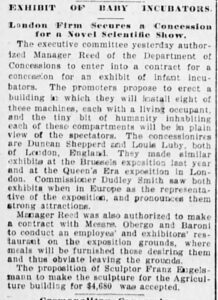
By February 21, 1898, the Omaha Daily Bee reported that the exposition’s executive committee had formally authorized the concession: the promoters were identified as Duncan Shepperd and Louis Luby, both of London, England. They proposed to erect a building housing eight incubators, each with a living occupant, in full view of spectators. The paper noted that Shepperd and Luby had previously mounted comparable exhibits at the Brussels Exposition and at the Victorian Era Diamond Jubilee Exhibition in London — the same Earl’s Court exhibition at which Couney and Schenkein are well documented as the named operators in both the contemporary press and the medical literature. Commissioner Smith had personally inspected both prior exhibits and pronounced them “strong attractions.” Searches of British newspaper archives have produced no record of Shepperd or Luby in connection with these or any other incubator exhibitions. Whether they were independent agents holding the concession paper on behalf of Couney and Schenkein, or whether their names served some other purpose in the contracting process, remains unresolved.
The Arkansas Democrat (March 28, 1898) previewed the coming exhibit for readers across the region, emphasizing that “since 1891, when it was first introduced, it has saved several thousand human creatures by forcing pure ozone into their lungs, providing an even temperature for their sensitive little bodies, and protecting them against the thousand and one dangers to which these tiny newcomers in this world are exposed.” The paper reported that the London parties proposed to erect a suitable building containing six incubators, with the process of nurturing the weaklings shown step by step, and noted that “several medical societies of importance have fixed upon Omaha for their annual meetings this year” — suggesting the incubator exhibit was actively deployed as an argument for the exposition’s scientific legitimacy. The Leonardville Monitor similarly noted that the Exposition management was inviting the London promoters to make “the first great bona fide exhibit of the baby incubator in America.”
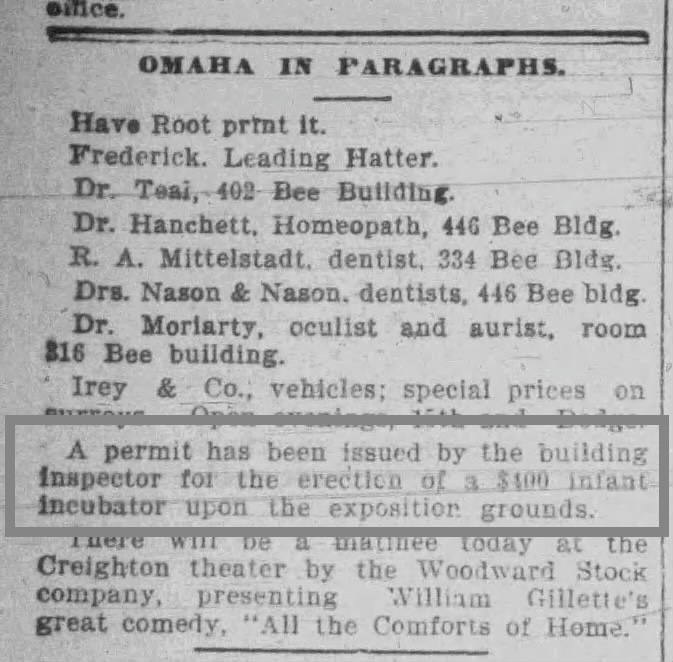
The Omaha Evening Bee of July 27, 1898 reported that the city building inspector had issued a permit for the erection of a $400 infant incubator building on the exposition grounds. By the time the fair was under way, Martin Couney had emerged as the physician publicly associated with the operation, while Shepperd and Luby recede from the contemporary record. The precise contractual relationship between the London concessionaires and the Infant Incubator Company principals — Martin Couney, Samuel Schenkein, and Solomon Fischel — has not yet been established from primary sources.
The Incubator Exhibit Opens
The Omaha Daily Bee and Omaha Evening Bee of August 12, 1898 reported that the incubator exhibit had opened and was already “attracting considerable attention,” with members of the medical profession “becoming interested in its workings.” On the opening day two prematurely born infants had been placed in incubators, and the attending physician expressed confidence they would survive. A brief notice in the Omaha World-Herald of the same date placed the exhibit “in a handsome little building at the juncture of East and West Midway,” noting that the management had received three infants and was expecting two more. The incubator was described in these opening reports as “the patent of a German physician” and a claim was made that 85 percent of infants placed in incubators had lived and become healthy children. The paper was at pains to note that the concern was “operated more for scientific than for exhibition purposes.”
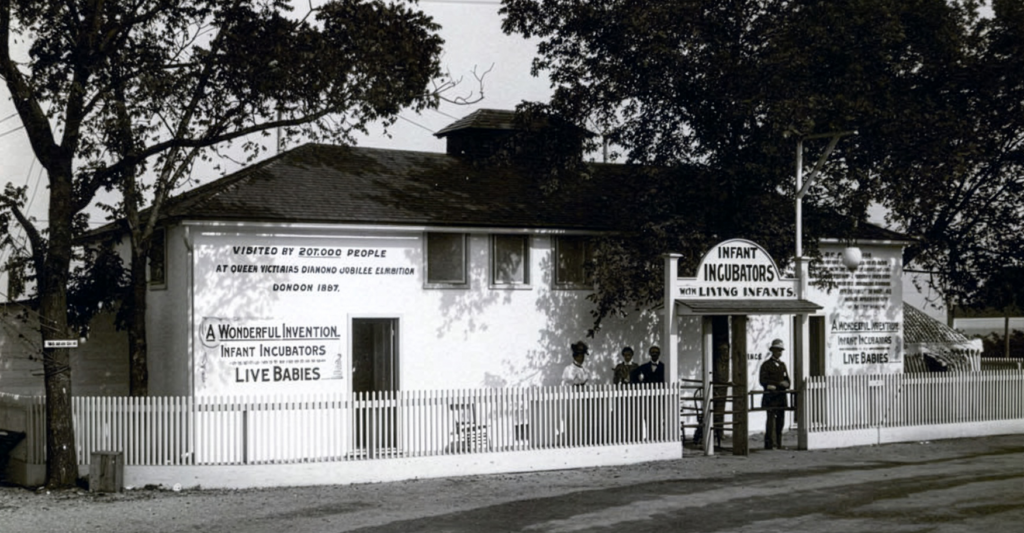
The Daily Nonpareil of Council Bluffs (August 15, 1898) offered a reporter’s-eye view of the building itself: a simple wooden affair painted pale green and white, located near the power house, its interior “marvelously clean, resembling in this respect a hospital — and indeed, it is a hospital in miniature.” The reporter considered the Midway an incongruous setting for an exhibit of such scientific merit.
The Facility and Staff
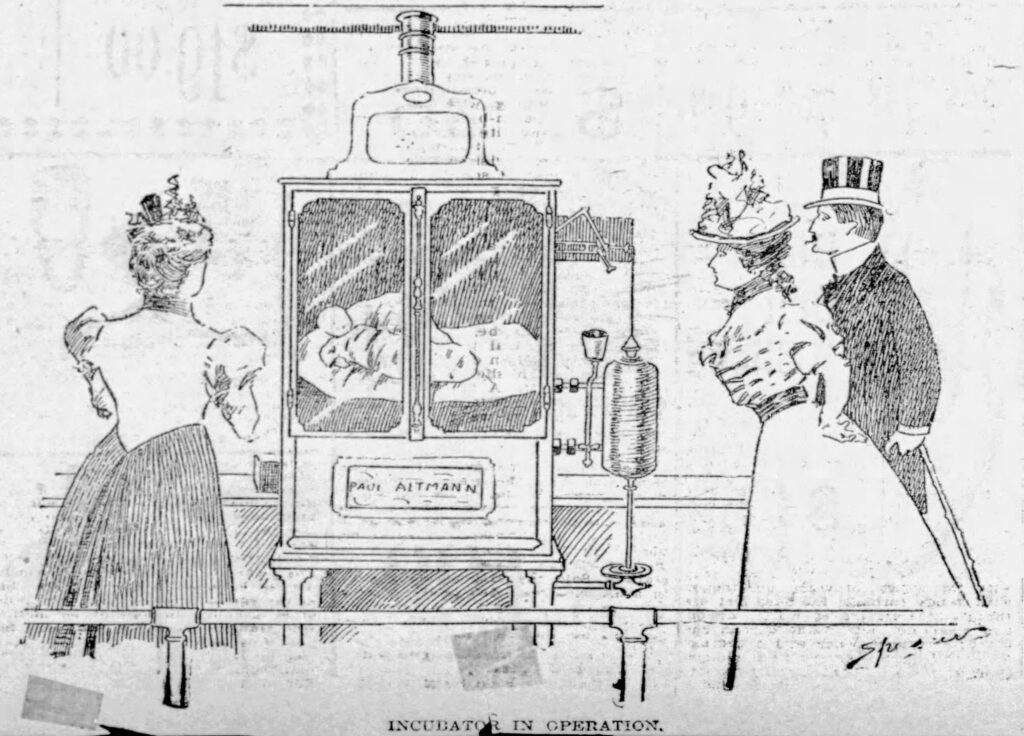
The incubators on display were publicly attributed throughout the exposition’s run to Paul Altmann of Berlin, described in the Morning World-Herald of September 18, 1898 as the inventor of the apparatus. The Los Angeles Evening Express (October 1, 1898) specified that five Altmann incubators were in operation, describing them as “magnificent little cages of glass and aluminum.” This attribution, however, was incomplete. The incubator was in fact the invention of Alexandre Lion of Nice, France, whose design Altmann manufactured under license; credit accrued to a German name rather than a French one, a distinction that carried real commercial weight in an era when German medicine was widely regarded as the most advanced in the world and American physicians who could afford it routinely traveled to Germany to study. Couney, Schenkein, and Fischel were alert to this cultural reality and consistently foregrounded the German connection in their public-facing materials. In later years Couney would go further still, eliding both Lion and Altmann from the historical record and claiming the invention of the incubator as his own — a piece of self-mythologizing that went largely unchallenged for decades.
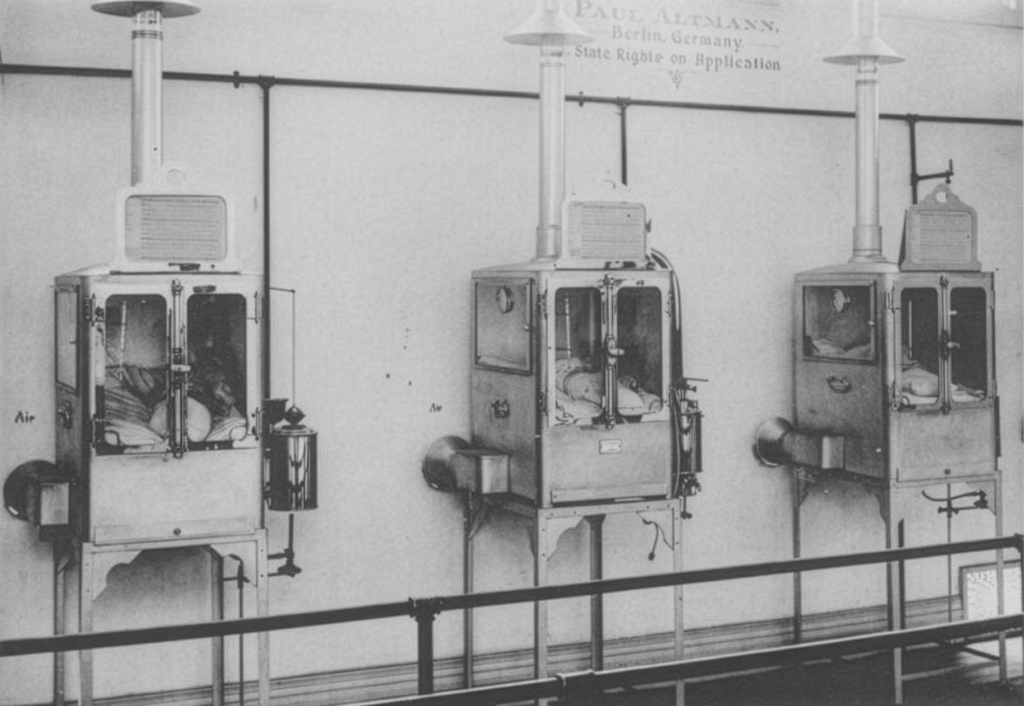
Warmth was produced by hot water circulating through a copper pipe running beneath a small mattress, connected to a gas-heated boiler on the outside. In each incubator a thermostat with a system of levers and chains worked automatically to maintain an even temperature; a thermometer and hygrometer were visible through the glass door at all times. Air was drawn in through a pipe, passed through a sheet of antiseptic absorbent wool suspended in antiseptic water — to humidify and filter it — then through dry wool to remove soot and atmospheric impurities, and finally distributed evenly throughout the unit by means of a disc at the mouth of the inner pipe. A small chimney on top expelled exhausted air. The Leonardville Monitor‘s January 1898 advance account — drawn from the London promoters’ own materials — noted a detail absent from later coverage: mounted on top of each incubator case was a chart recording the child’s name, date of birth, daily weight, and “complete and minute history of its brief existence,” available for inspection by nurses, attending physicians, and medical students.
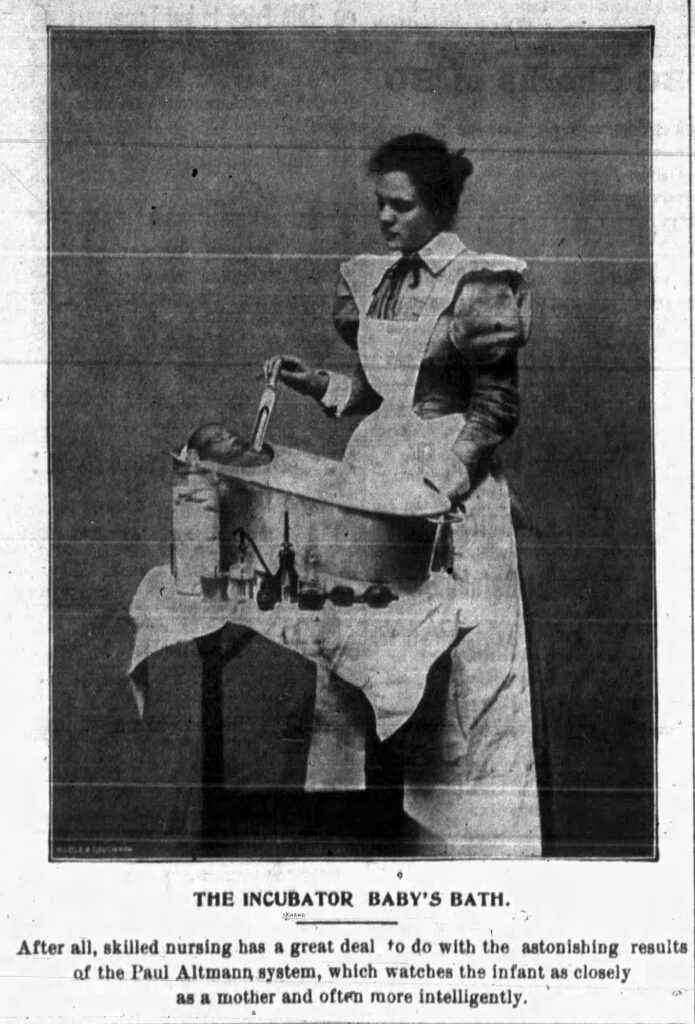
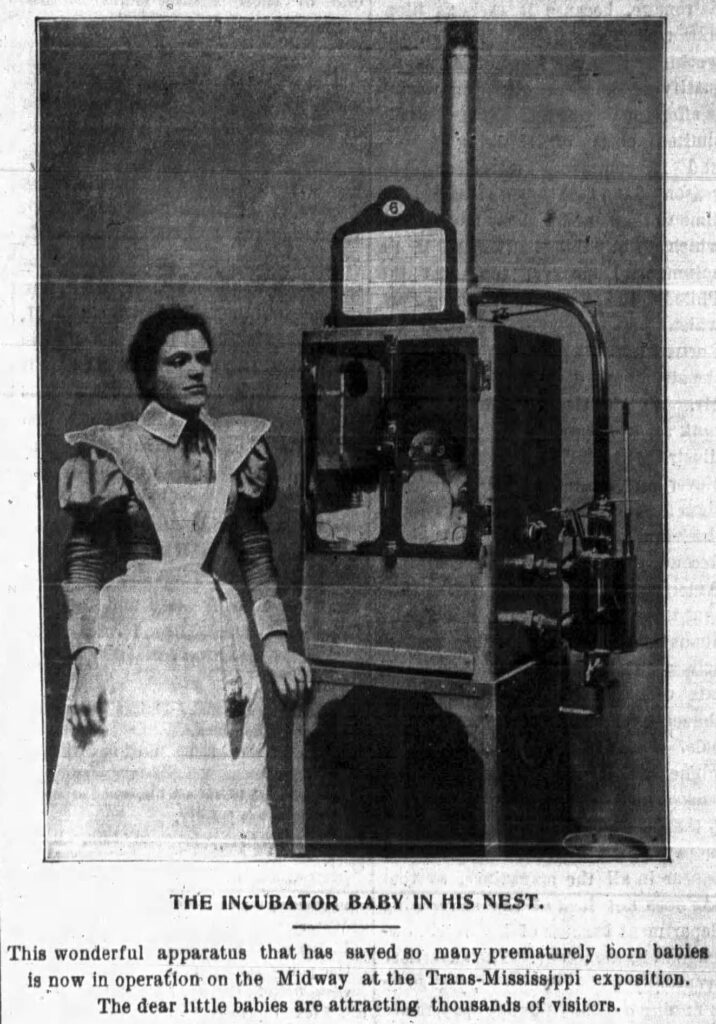
The Omaha Excelsior, August 20, 1898.
The entire apparatus was designed to require minimal attendance: the Los Angeles Evening Express noted that it “works automatically, hence requires no care after once set going, except the filling up with water every twenty-four hours of a little cup on the outside of the incubator.”
Each infant was weighed before and after every feeding to ensure that the physician-prescribed quantity had been consumed. Feedings occurred every two hours during the day and every three hours at night; nourishment was always human milk. A head nurse sat in a central room throughout the night with a schedule of every infant’s feeding times. For the weakest infants, a specially curved spoon designed to allow food to pass by the act of breathing was used; the Los Angeles Evening Express noted that one infant was so fragile that only a single drop of nourishment was given at a time, administered through the nostrils.
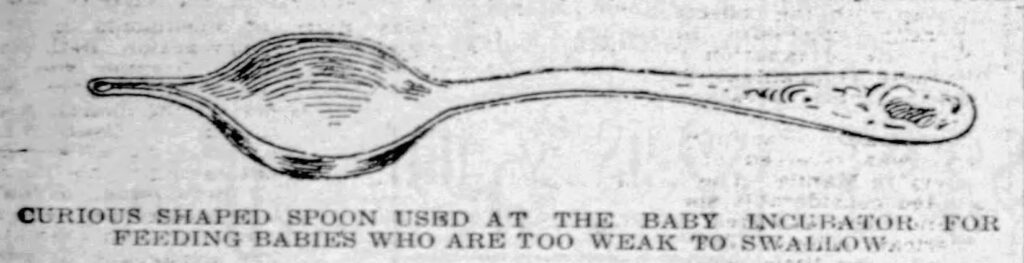
The Daily Nonpareil observed that the infants themselves looked like “dolls taken from a German workshop” — swathed from the waist down in blankets of marseilles cloth, wrapped at the foot and tied with dainty ribbons, with no skirts or bands of any kind employed.
The physician publicly identified with the exhibit was Dr. Martin Couney, described in the Nebraska State Journal of October 30, 1898 as “the physician in charge of the Infant Incubators at the Exposition, who has had wide experience.” The Morning World-Herald‘s September feature refers to “Drs. Coney and Schenkkein” as those in charge — identifying Samuel Schenkein as co-director. The Omaha Excelsior of August 20 identified Dr. Samuel Sax as the physician supervising the exhibit on the grounds, possibly serving as the local attending physician while Couney retained overall medical direction, but this may simply have been a reporter’s garbling of Schenkein’s name. Although both Couney and Schenkein routinely identified themselves to reporters as physicians, there is no evidence that either of them had medical degrees or any medical training.
The Babies
Named infants mentioned in coverage included “Irene,” also called “The Mascot” — a six-and-a-half-month-gestation infant who arrived at two pounds fifteen ounces and after twenty-three days weighed three pounds eight ounces — and “Samson,” so nicknamed for his size despite being described as very small, with black hair and blue eyes. The children were kept in the incubators day and night, removed only for feedings every two hours during the day and every three hours during the night.
The Omaha Daily Bee of August 30, 1899 provides the only figure for the exhibit’s total caseload: fourteen infants were treated at the Trans-Mississippi Exposition, of whom only two were lost. The paper reported that the exhibit was visited by over 6,000 people daily and that “a deep interest was taken in the institution by the local and visiting physicians.”
History Presented to the Public
Multiple newspapers offered readers historical context for the technology. Antecedents were traced to peasant practices in Silesia and Westphalia — placing weak infants in jars of feathers or warming them at the hearth — and to early incubator-box experiments attributed to a physician at the University of Leipzig some forty years earlier. The decisive modern development, as presented in coverage, came when Dr. Tarnier visited couveuses at the Jardin d’Acclimatation in Paris in 1878 and, consulting the engineer M. Odile Martin, designed a larger and properly ventilated apparatus that was introduced at the Paris Maternity Hospital before 1880. A report by Dr. Vallin to the Academy of Medicine of France on November 12, 1895, was cited in the 1899 revival coverage as the authoritative statement of outcomes: infants were to be regarded as prematurely born if they weighed less than two kilogrammes 500 grammes at birth, a population estimated at fifteen to thirty per cent of all births.
This historical account, as presented to the public, stopped well short of crediting Alexandre Lion — whose design the Altmann incubator actually embodied — and made no mention of the French origins of the apparatus beyond the Tarnier/Martin couveuse work of the 1870s. The consistent emphasis on German science and German manufacture, and a German background for Couney and his associates, was a deliberate rhetorical strategy, calibrated to American medical culture of the 1890s, in which German training and German technology carried an authority that French equivalents did not. The Leonardville Monitor offered the broadest international picture in its January 1898 account, noting that incubators were then in operation in hospitals for children in Paris, London, Vienna, Brussels, Berlin, Geneva, Bordeaux, Marseilles, Nice, and other cities in Europe — framing the Omaha exhibit as an introduction of well-established European medical technology to American audiences. This much, at least, was accurate — incubators of the Lion design were widely used in hospitals and at expositions across Europe.
The Commercial Dimension
The 10-cent admission fee charged to visitors was the mechanism by which operating costs were met — a practice Couney employed consistently throughout his exhibition career.
Two versions of a paid advertisement — one in English in the Nebraska State Journal (October 30), another in German in the Nebraska Staats-Anzeiger (November 24) — endorsed Krug Cabinet Bottled Beer for nursing mothers under Couney’s name, stating that the product had been “used constantly” at the Infant Incubators building and that “for milk-producing qualities we can cheerfully recommend it to all nursing mothers.”
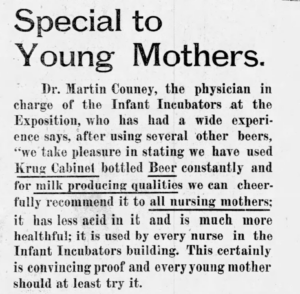
The German-language version targeted Omaha’s substantial German-speaking readership, and in it Couney’s name appears as “Martin Conner.” The practice of recommending beer to lactating women was not uncommon in this period, reflecting a then-current belief that malt beverages stimulated milk production — a claim now known to be false and counterproductive.
Closing and Aftermath
The Evening World-Herald of October 25, 1898 — six days before the exposition’s official close — carried a classified advertisement offering the “Infant Incubator building at exposition” for sale, suggesting the operators were already winding down the physical plant. The Omaha Daily Bee of November 5 reported that after the exposition closed, employees who had not been paid attached the incubators — and the babies in them — as security for unpaid wages, bringing suit in justice court. Before the case came to trial, the proprietors filed the required bond and regained possession of the equipment. The workers were reported to feel confident of receiving their pay. The babies were returned to “the people to whom they belonged.”

The exhibit’s public resonance outlasted the exposition itself. A nostalgic poem, “Dreams,” by Will Maupin, published in the Omaha World-Herald and reprinted in the Humphrey Democrat (November 4, 1898), placed the “Infant Incubator, where they raise the babes by steam” alongside the Streets of Cairo, Hagenbach’s lions, and the Wild West show among the Midway attractions that would live on in memory.
The 1899 Revival
The following summer, when many of the same Midway operators reassembled for the Greater America Exposition of 1899, the incubator exhibit returned. The Omaha Daily Bee of August 30, 1899 headlined its coverage “A Revival of Last Year’s Most Attractive Show”, reiterating both the historical background of the technology and the claimed survival statistics. The article noted that at the Diamond Jubilee exhibition in London in 1897 the Altmann apparatus had first been shown to British physicians, and that it was subsequently exhibited in New York, “where the physicians met with unparalleled success and saved eighty-five per cent of the children placed in their charge.” The exhibit was visited by more than 297,000 people during the Greater America Exposition.
Legacy
The Omaha exhibit occupied a grey zone between medical demonstration and sideshow attraction. Contemporary press coverage consistently stressed its scientific legitimacy — the interest of the medical profession, the precision of its instrumentation, the clinical record-keeping mounted on each incubator, the rigor of its nursing protocols — while acknowledging that its funding mechanism was public admission and its venue was the Midway.
The exhibit also illustrates the layers of historical revision that Couney and his associates introduced from the outset. The incubator was presented to the American public as a German invention, manufactured by a German firm, and championed by physicians operating within the tradition of German medical science — the most prestigious medical tradition in the eyes of the American professional class of the 1890s. That the underlying technology was French, originating with Alexandre Lion of Nice, was nowhere acknowledged. That Couney himself would eventually displace even Altmann from the story, claiming the invention as his own work conducted under the tutelage of Pierre Budin in Paris, represents a further and bolder revision, one that shaped popular and even scholarly accounts of the incubator’s history for generations. The Omaha newspaper record, taken together, captures the exhibit at an early stage of this mythopoetic process — when the German attribution was still intact, when Shepperd and Luby were still named as concessionaires, and when Schenkein’s name still appeared alongside Couney’s in the press.
Fourteen premature infants were treated over the course of the five-month exposition, of whom twelve survived — an outcome that, whatever the commercial context and however constructed the surrounding narrative, represented real clinical benefit in a city where no hospital-based alternative existed.
Newspaper Sources
- “The Baby Incubator” [Dudley Smith cable notice]. Leonardville Monitor (Kansas), January 6, 1898.
- “Exhibit of Baby Incubators: London Firm Secures a Concession for a Novel Scientific Show.” Omaha Daily Bee, February 21, 1898.
- “Baby Incubators” [advance preview]. Arkansas Democrat, March 28, 1898.
- [Building permit notice]. Omaha Evening Bee, July 27, 1898.
- “Saves the Weakly Born Babies: Infant Incubator and Its Place in the Economy of Life.” Omaha Daily Bee and Omaha Evening Bee, August 12, 1898.
- “The Infant Incubators” [brief notice]. Omaha World-Herald, August 12, 1898.
- “Along the Midway” [incubator notice]. Daily Nonpareil (Council Bluffs, IA), August 15, 1898.
- “The Incubator Baby’s Bath” / “The Incubator Babies Meet.” Omaha Excelsior, August 20, 1898.
- “Baby Incubators: A Description of a Very Interesting Exhibit at the Trans-Mississippi Exposition.” Morning World-Herald (Omaha), September 18, 1898.
- “Incubators for Babies: Delicate Infants Transformed Into Hearty Children.” Los Angeles Evening Express, October 1, 1898.
- [Incubator building for sale, classified advertisement]. Evening World-Herald (Omaha), October 25, 1898.
- “Special to Young Mothers” [Krug Beer advertisement, Dr. Martin Couney]. Nebraska State Journal, October 30, 1898.
- “Baby Incubators Are Released: Bond Given to Indemnify the Claimants in Justice Court.” Omaha Daily Bee, November 5, 1898.
- Maupin, Will. “Dreams.” Humphrey Democrat (Nebraska), November 4, 1898 [reprinted from Omaha World-Herald].
- “Speziell an junge Mütter” [Krug Beer advertisement, Dr. Martin Conner]. Nebraska Staats-Anzeiger (Omaha), November 24, 1898.
- “A Live Exhibit: A Revival of Last Year’s Most Attractive Show.” Omaha Daily Bee, August 30, 1899.
Other Sources
- Wikipedia, Trans-Mississippi Exposition. https://en.wikipedia.org/wiki/Trans-Mississippi_Exposition
- America’s Best History, “Trans-Mississippi International Exposition.” https://americasbesthistory.com/wfomaha1898.html
- University of Nebraska, “Trans-Mississippi and International Exposition.” https://trans-mississippi.unl.edu/ includes photographs
- Nebraska State Historical Society, The Worlds Fair of the Midwest. https://history.nebraska.gov/the-worlds-fair-of-the-midwest/
- Plains History, “Omaha’s 1898 World’s Fair.” https://plainshistory.org/items/show/46
- Omaha History, “A History of the Trans-Mississippi and International Exposition.” https://northomahahistory.com/2019/05/18/a-history-of-the-trans-mississippi-and-international-exposition/
Portions of this page were drafted with machine assistance; the final text was reviewed, verified, and edited by the author.
Martin Arthur Couney
- Short biography of Martin Couney
- Martin Couney, Wikipedia – contains outdated information
- Martin Couney’s Obituary, from The New York Times, March 2, 1950 – contains outdated information
Primary Source Documents
- Gellert Ship Manifest, 1888
- US 1910 Census
- US 1920 Census
- US 1940 Census
- Marriage Certificate 1903
- Passport Application 1904
Business and Associates
Martin Couney Exhibits in World’s Fairs and National Expositions
- Victorian Era Exhibition at Earl’s Court, 1897
- Trans-Mississippi Exposition, Omaha, 1898
- Pan-American Exposition, Buffalo, 1901
- Lewis and Clark Centennial Exposition, Portland, 1905
- Panama-Pacific International Exposition San Francisco, 1915
- Century of Progress International Exposition, Chicago, 1933-34
- New York World’s Fair, New York, 1939-1940
Martin Couney Sideshows in Amusement Parks
- Asbury Park Boardwalk, New Jersey
- Coney Island Sideshow at Luna Park
- Coney Island Sideshow at Dreamland
- Lakeside Amusement Park, Denver.
- Luna Park, Pittsburgh
- Wonderland – Minneapolis and St. Paul
- Wonderland – Revere Beach
- Boardwalk – Atlantic City
- White City Amusement Park – Chicago
- White City Amusement Park, Indianapolis, Indiana
- White City Amusement Park, Cleveland, Ohio
Recent Books
- The Strange Case of Dr. Couney, by Dawn Raffel, Blue Rider Press, ISBN 0399175741
- Buy on Amazon (your purchase will support “Neonatology on the Web”)
- Miracle at Coney Island, by Claire Prentice (Kindle or audiobook)
- Buy on Amazon (your purchase will support “Neonatology on the Web”)
General Articles
General articles about Martin Couney and his exhibits are linked below. Additional links may be found in specific posts about his participation in expositions or sideshows.
Reader beware: many of these were written before the full facts about Martin Couney’s background became known, or have not incorporated that new information, so they include information from his self-invented background legend.
- Incubator Baby Sideshows, by William Silverman, from Pediatrics.
- Postscript to Incubator-Baby Sideshows, by William. Silverman, from Pediatrics
- Martin Couney’s Story Revisited, by AAP Perinatal Section Ad Hoc Committee on Perinatal History, from Pediatrics
- Martin Couney’s Obituary, from The New York Times, March 2, 1950.
- A Patron of the Premies, by A. J. Liebling, from The New Yorker
- The Coney Island Baby Laboratory, by Gary R. Brown, from American Heritage Invention and Technology Magazine
- American Characters: Martin Couney, by Richard Snow, from American Heritage Magazine
- The Man Who Ran a Carnival Attraction… by Claire Prentice, from Smithsonian Magazine
- Life under Glass, audio documentary by Claire Prentice, from the BBC
- Martin Couney and Incubator Exhibits from 1896 to 1943, from the Embryo Project
- The Incubator Baby and Niagara Falls, by Arthur Brisbane, from The Cosmopolitan
- Babies on Display, from NPR
- Beginner’s Luck, from Family Circle Magazine 1993
- Coney Island’s Incubator Babies, by Rebecca Rego Barry, from JSTOR Daily
- The Infantorium, by Katie Shornton, from 99% Invisible
- How One Man Saved a Generation of Premature Babies, from BBC News
- Baby Incubators: From Boardwalk Sideshow to Medical Marvel, by Erin Blackmore, from History.Com
- Babies in Sideshows, by Julie Andreson, from Engines of our Ingenuity
- Dr. Martin Couney, from Coney Island History Project
- “The Use of Incubators for Infants,” The Lancet, May 29, 1897.
- “The Victorian Era Exhibition at Earl’s Court,” The Lancet, July 17, 1897.
- Incubator Baby Shows: A Medical and Social Frontier, by Hannah Lieberman, from The History Teacher 35.1, November, 2001.
- The Child Hatchery, from City Pages.
- Good Old Coney Island, by Edo McCullough, excerpt from the book
- “And Next to the Bearded Ladies…” from The New York Times (captured as PDF)

- Kinderbrutanstalt: Leisure Space and the Coney Island Baby Incubators, by Scott Webel, Text, Performance, Practice, 2003. (captured PDF)
- Premie Road Shows from Hippocrates (captured PDF)
- Transferring the Incubator: Fairs and Freak-Shows as Agents of Change, by Katie Proctor, 2004. (captured PDF)
- Pan-American Exposition Baby Incubator Exhibit in Buffalo, New York, 1901 (from the U. of Buffalo Library web site)
Last Updated on 07/20/26