Victorian Era Exhibition at Earl’s Court
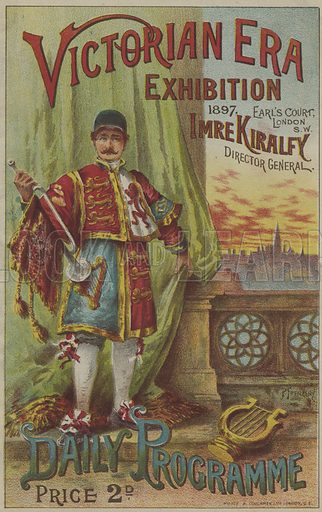
The Victorian Era Exhibition was held at Earl’s Court, London S.W., from May 24 to October 30, 1897, timed to commemorate the sixtieth anniversary of Queen Victoria’s accession, her “Diamond Jubilee.” It was the work of The London Exhibitions, Ltd. under the direction of the impresario Imre Kiralfy, the self-styled “Director-General,” with the Duke of Cambridge serving as its ceremonial President. The Duke formally opened it shortly after noon on 24 May (the Queen’s seventy-eighth birthday) in the Empress Theatre, which had been converted into a concert-hall for the occasion. The ceremony featured a commemorative ode by Clifton Bingham set to music by Frederick H. Cowen and sung by a chorus of five hundred, an address by Crémieu-Javal, and the presentation of a commemorative gold medal to the Duke. The season proved successful enough that in late September the management announced an extension, prolonging the run from its originally intended close (probably the end of September) to 30 October.
Like Kiralfy’s other Earl’s Court productions, the exhibition combined a commemorative and educational program with large-scale popular entertainment, laid out across a series of interlinked courts, palaces, and gardens threaded by the exhibition railway. The commemorative core occupied the principal buildings: a new Scientific Section by the Warwick Road entrance, the Ducal Hall of industrial and commercial exhibits, and the Queen’s Palace housing the Historical and Commemorative and Fine Art sections. A substantial Woman’s Work Section, with historical, nursing, fine-art, applied-art, education, and industrial divisions, was among the more notable features. A Sports section filled the model town of “Picturesque England.” The catalog was so large that it was published in several volumes: fine art, historical/commemorative, women’s work, music/drama, and scientific/industrial/commercial/economic sections.
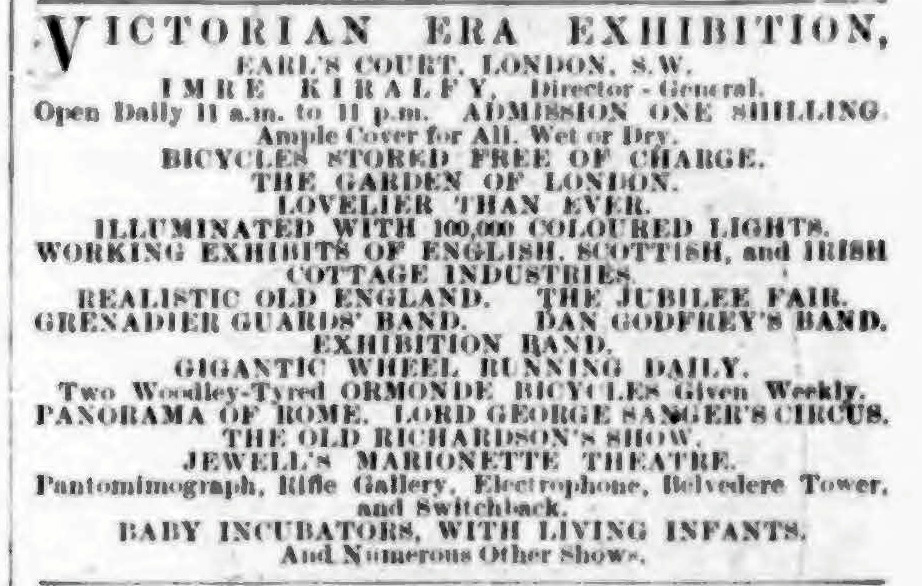
And of course there were the entertainments and concessions. The Queen’s Court with its lake, illuminated music pavilion, and electric boats; the Jubilee and Victoria Gardens; the roughly 200-foot Belvedere Tower and the 284-foot Gigantic Wheel (whose cars could hold up to 30 people each); and, in the Western Gardens, Sanger’s Circus, a panorama of Ancient Rome, a switchback railway, and an infant-incubator display that seems to have been the first such in the English-speaking world. The grounds were open daily 11 a.m. to 11 p.m., admission one shilling.
Note: Remarkably little information exists online about this exhibition, so the account above is based on the official guide and daily programs (which are available from the Internet Archive), together with my searches of the contemporary English and American press.
The Incubator Exhibit
The infant incubator display was a late and separately-developed addition to the exhibition rather than an opening-day feature. It followed on the heels of the incubator exhibit at the Berliner Gewerbeausstellung (Berlin Industrial Exhibition) in 1896, and it is (to my knowledge) the first documented attribution of such an exhibit to Martin Couney and his partner Samuel Schenkein (his other early partner Solomon Fischel is not named in any of the contemporary coverage). Although the incubators were named as a billed attraction in advertisements as May 30, 1897, two infants were not placed in the machines until roughly June 26, and the live display opened to the public around July 12 or 13. That opening was reported by the Morning Post on July 13 and witnessed by a Coventry Times correspondent describing crowds on the same day.
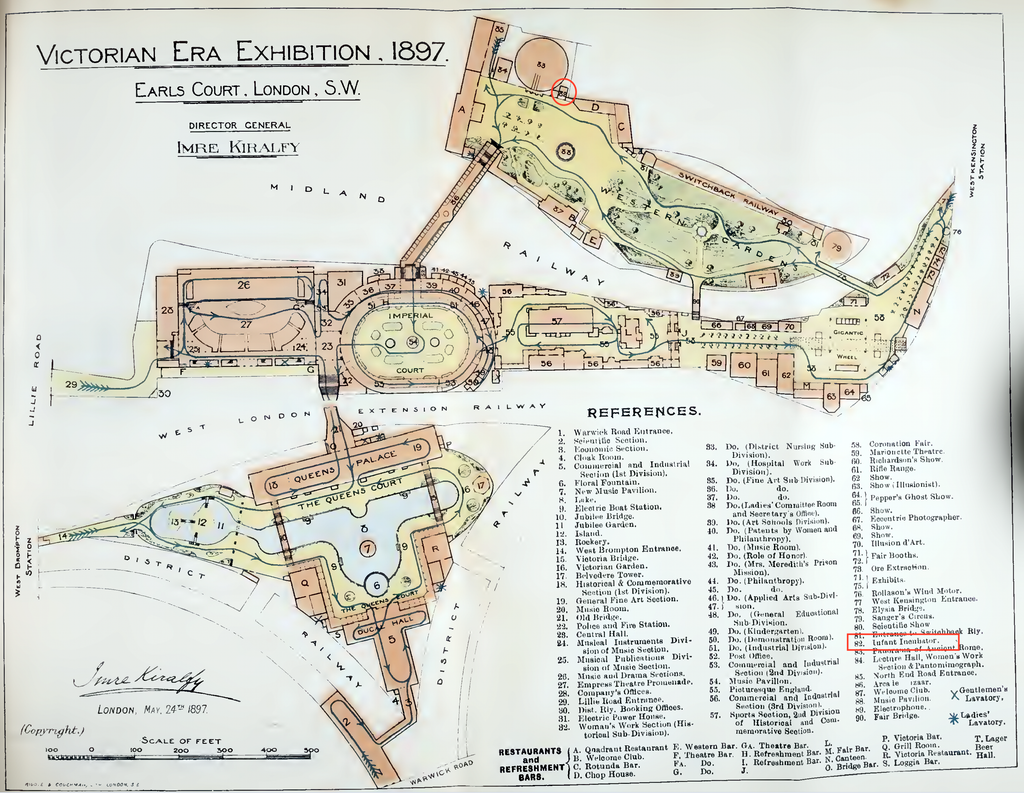
The incubator pavilion, with a frontage of 60 feet and a depth of 25 feet, stood in the Western Gardens amusement zone, directly opposite the Old Welcome Club and adjacent to the Panorama of Ancient Rome. According to Claire Prentice’s research, the exhibit was visited by 3,600 people on the first day, By the end of the summer, some 207,000 people had seen the incubator babies. Among the luminaries who visited the exhibit was Baron Rothschild and the famous Shakespearean actress Ellen Terry.
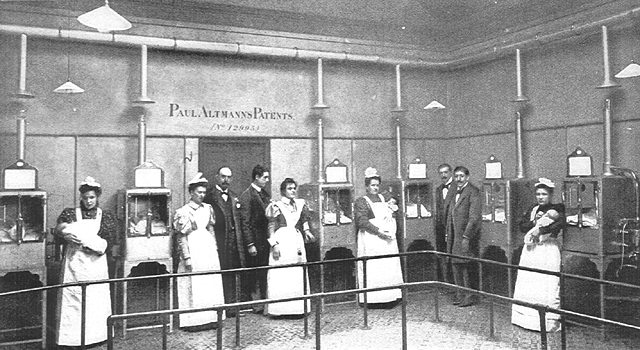
The medical press took notice of the exhibit, in particular, the highly regarded journal The Lancet published two articles about the exhibit on May 29, 1897 and July 17, 1897.
“On Monday members of the press were invited to a private view of the incubators for infants at the Victorian Era Exhibition, Earl’s-court. These are exhibited in a building facing the Welcome Club, and divided into three compartments. On one side there is sleeping accommodation for two wet nurses and for Mdlle. Louise Recht, who has been specially trained at the Paris Maternity Hospital to look after debilitated and prematurely born infants reared in incubators. A special service for this purpose was established at the Maternité in 1893, and here some 400 children, born under most unfavourable circumstances, are received annually. On the other side of the building there is a nursery, where the infants are taken to be fed and washed. The public are admitted to the central room, and here they can view the infants lying within the incubators, and are shown how the apparatus is ventilated and warmed and the temperature automatically maintained. The mechanism employed for this purpose has already been fully explained in these columns. [1] Its efficiency is now put to a practical test. Messrs. Coney and Schenbein, who are the representatives in England of this the “Altmann Incubator,” invite the criticism of the medical profession, and will supply every possible facility for the fullest investigation. They are ready to take in their charge any prematurely born child, and, apart from the trained nurse and the wet nurses, they have retained the services of two physicians, who attend three or four times a day to watch over the health of the infants. At night the watchman awakes the nurses every three hours so that they may feed the infants, and in the day time the babies are fed, generally from the breast, every two hours. In the nursery there is a small pharmacy, contrivances for sterilising milk, ingenious feeding bottles, and scales so that the infants may be weighed and their progress daily observed. A very large number of persons have already visited this exhibit, including many trained nurses. Much interest is manifested by the visitors. The incubators and the ventilating tubes are silvered, which gives them a bright and cheerful appearance, while the infants within look clean and comfortable, so that altogether it is a pleasant as well as an interesting sight.”
— The Lancet 2:161-162, July 17, 1897.
The most authoritative popular press account is the Morning Post‘s (July 13), which gives the apparatus’s dimensions, traces the system’s genealogy from Tarnier of Paris to Paul Altmann of Berlin (but was evidently not aware that Altmann was a manufacturer of Alexandre Lion’s incubator design), and candidly raises the question of whether an amusement exhibition was the right venue for a serious medical demonstration. There were two identifiable London parent features that were syndicated widely: a comic Daily Mail piece (reprinted verbatim in the Grantham Journal, Leeds Times, Northern Guardian, and Colonies and India, among others) and a more technical London Standard account (the source of the detailed mechanism descriptions and of the “Prof. Coney, of Heidelberg” attribution). Genuinely independent descriptions with their own observation include the Shetland Times (July 31, with a sketch of the apparatus) and the Eastern Morning News (July 16).

The tone of the popular press covered a broad spectrum of sentiment, satire, sober reservation, and social-reform advocacy. The Illustrated Sporting and Dramatic News ran a “Mrs Gamp visits the baby incubators” cartoon tying the exhibit to the exhibition’s Victorian-literary theme; the Dalry & Kilbirnie Herald set it within a serious argument for a state medical service and against baby-farming; and a recurring “mother-versus-machine” motif appears in several papers, sometimes uneasy, sometimes sentimental. By late September the Western Morning News recorded that professional medical opinion was itself divided, “both favouring and condemning the system” — the clearest evidence that the exhibit provoked genuine controversy within the profession, not merely lay comment. Survival claims circulated in unstable, evidently promotional forms: figures of 50%, 72%, 73%, and 80% are seen in various press accounts.


Sources: Left, Shetland Times, July 31, 1897. Right: Illustrated Sporting and Drama, August 7, 1897.
Couney and Schenkein’s legend-creation and litigious natures, which we will see plenty more of during later expositions in the US, surfaced early here. Schenkein claimed to hold “the sole concession in England for the Paul Altmann patent,” and he and “Martin Coney” (“Prof. Coney of Heidelberg”) wrote jointly to the press as its controllers, warning against “unscrupulous imitators.” Second, that warning had a concrete target — a rival incubator show at the Blackpool Winter Gardens under C. R. Brighten, which Schenkein publicly repudiated as an imitation (noting its promotional copy had been lifted word-for-word from the exhibition guide). The exhibition’s Press Manager, Austin Brereton, actively facilitated media access, arranging at least one specially-taken photograph. Coverage also crossed the Atlantic, circulating in the American regional press from August into late November 1897 (after the London exhibition had closed), which forms part of the background to Martin Couney’s later American career.
Sources
Primary — Official exhibition publications
- Victorian Era Exhibition, 1897, Earl’s Court, London, S.W. General Guide. London: Riddle & Couchman, 1897. Getty Research Institute copy, digitized via Internet Archive / HathiTrust.
- Victorian Era Exhibition, 1897, Earl’s Court, London, S.W. Daily Programme. London, 1897. [Includes folding site plan, reference 82 “Infant Incubator.”] Internet Archive.
Primary – Medical publications
- “The Use of Incubators for Infants,” The Lancet, May 29, 1897.
- “The Victorian Era Exhibition at Earl’s Court,” The Lancet, July 17, 1897.
Primary — Newspaper reports and letters (chronological)
- “The People.” The People (London), 30 May 1897, p. 13. [General exhibition survey; earliest naming of the incubator as an attraction.]
- “The Victorian Era Exhibition: The Duke of Cambridge at the Opening Ceremony.” Westminster Budget, 28 May 1897, p. 6.
- “Infant Incubators at Earl’s-court.” Morning Post, 13 July 1897.
- “A Machine Foster-Mother.” Coventry Times, 14 July 1897, p. 3.
- “Baby Incubators.” Eastern Morning News (Hull), 16 July 1897, p. 7.
- “Incubating Babies: Funny Victorian Era Exhibit.” Grantham Journal, 17 July 1897, p. 7. [Reprint of a Daily Mail feature, credited.]
- “Incubating Babies at the Victorian Era Exhibition.” Leeds Times, 17 July 1897. [Same Daily Mail feature, uncredited.]
- [Untitled incubator notice.] Colonies and India, 17 July 1897, p. 14. [Daily Mail–derived text.]
- [Incubator report, “Altmann’s patent infant incubator.”] Northern Guardian (Hartlepool), 24 July 1897, p. 3. [Daily Mail–derived text.]
- “Baby Incubators.” Illustrated Sporting and Dramatic News, 7 August 1897, p. 26. [Includes cartoon, “Mrs Gamp visits the baby incubators.”]
- “Infant Incubators: A Successful Machine for Raising Weakly British Babies.” Cincinnati Commercial Tribune, 8 August 1897, p. 13. [Credited “London Standard”; names “Prof. Coney, of Heidelberg.”]
- “Infant Incubators.” Blackpool Gazette and Herald, 10 August 1897. [The C. R. Brighten / Winter Gardens display.]
- “Scottish Industries.” Glasgow Herald, 15 July 1897, p. 5.
- [Incubator feature, “From accounts which reach us from La Belle France.”] Dalry & Kilbirnie Herald and Vale of Garnock News, 20 August 1897, p. 4.
- Schenkein, S. “Infant Incubators” [letter to the editor], dated Earl’s Court, 17 August 1897. Blackpool Gazette and Herald, 20 August 1897.
- Coney, Martin, and Samuel Schenkein. “Infant Incubators” [letter to the editor], dated Earl’s Court, 8 September 1897. Morning Leader, 10 September 1897, p. 8.
- [Exhibition report noting divided medical opinion.] Western Morning News, 28 September 1897, p. 5.
- “The Baby Incubator.” Shetland Times, 31 July 1897, p. 3. [Includes sketch of the apparatus.]
- [Incubator illustrated notice, acknowledging Press Manager Austin Brereton.] Black and White, 24 July 1897, p. 12.
- “Woman and Home: Baby Incubators.” [Savannah paper], 19 November 1897, p. 1. [Size of the incubator paviliion. Credited “Chicago Inter Ocean”; London Standard–derived.]
- “Babies in Incubators: How the Youngsters Are Made to Grow by Science.” Corvallis (Oregon) Union, 12 November 1897, p. 4.
- “Babies in Incubators: How the Youngsters Are Made to Grow by Science.” Akron Tribune, 25 November 1897, p. 5.
Advertisements
- Victorian Era Exhibition [display advertisement]. The Times (London), 24 May 1897. [Names Henry J. Wood as director of the Grand Promenade Concerts.]
- “The Baby Incubator” [display advertisement]. The Times (London), 16 July 1897.
- Victorian Era Exhibition [display advertisement]. The Star (London), 22 October 1897. [“Last two weeks. Closing day, 30 Oct.”]
- Victorian Era Exhibition [display advertisement], Illustrated London News, September 11, 1897.
Secondary Sources
- Raffel, Dawn. [Attendance at the incubator pavilion. Research on Martin Couney — birth as Michael Cohn/Cohen, Prussia, 1869; immigration as Martin Cohn aboard the Gellert, 1888; legal name change to Martin Couney, New York, 1 October 1905.] The Strange Case of Dr. Couney, by Dawn Raffel, Blue Rider Press, ISBN 0399175741.
More Information about Martin Couney
Martin Arthur Couney
- Short biography of Martin Couney
- Martin Couney, Wikipedia – contains outdated information
- Martin Couney’s Obituary, from The New York Times, March 2, 1950 – contains outdated information
Primary Source Documents
- Gellert Ship Manifest, 1888
- US 1910 Census
- US 1920 Census
- US 1940 Census
- Marriage Certificate 1903
- Passport Application 1904
Business and Associates
Martin Couney Exhibits in World’s Fairs and National Expositions
- Victorian Era Exhibition at Earl’s Court, 1897
- Trans-Mississippi Exposition, Omaha, 1898
- Pan-American Exposition, Buffalo, 1901
- Lewis and Clark Centennial Exposition, Portland, 1905
- Panama-Pacific International Exposition San Francisco, 1915
- Century of Progress International Exposition, Chicago, 1933-34
- New York World’s Fair, New York, 1939-1940
Martin Couney Sideshows in Amusement Parks
- Asbury Park Boardwalk, New Jersey
- Coney Island Sideshow at Luna Park
- Coney Island Sideshow at Dreamland
- Lakeside Amusement Park, Denver.
- Luna Park, Pittsburgh
- Wonderland – Minneapolis and St. Paul
- Wonderland – Revere Beach
- Boardwalk – Atlantic City
- White City Amusement Park – Chicago
- White City Amusement Park, Indianapolis, Indiana
- White City Amusement Park, Cleveland, Ohio
Recent Books
- The Strange Case of Dr. Couney, by Dawn Raffel, Blue Rider Press, ISBN 0399175741
- Buy on Amazon (your purchase will support “Neonatology on the Web”)
- Miracle at Coney Island, by Claire Prentice (Kindle or audiobook)
- Buy on Amazon (your purchase will support “Neonatology on the Web”)
General Articles
General articles about Martin Couney and his exhibits are linked below. Additional links may be found in specific posts about his participation in expositions or sideshows.
Reader beware: many of these were written before the full facts about Martin Couney’s background became known, or have not incorporated that new information, so they include information from his self-invented background legend.
- Incubator Baby Sideshows, by William Silverman, from Pediatrics.
- Postscript to Incubator-Baby Sideshows, by William. Silverman, from Pediatrics
- Martin Couney’s Story Revisited, by AAP Perinatal Section Ad Hoc Committee on Perinatal History, from Pediatrics
- Martin Couney’s Obituary, from The New York Times, March 2, 1950.
- A Patron of the Premies, by A. J. Liebling, from The New Yorker
- The Coney Island Baby Laboratory, by Gary R. Brown, from American Heritage Invention and Technology Magazine
- American Characters: Martin Couney, by Richard Snow, from American Heritage Magazine
- The Man Who Ran a Carnival Attraction… by Claire Prentice, from Smithsonian Magazine
- Life under Glass, audio documentary by Claire Prentice, from the BBC
- Martin Couney and Incubator Exhibits from 1896 to 1943, from the Embryo Project
- The Incubator Baby and Niagara Falls, by Arthur Brisbane, from The Cosmopolitan
- Babies on Display, from NPR
- Beginner’s Luck, from Family Circle Magazine 1993
- Coney Island’s Incubator Babies, by Rebecca Rego Barry, from JSTOR Daily
- The Infantorium, by Katie Shornton, from 99% Invisible
- How One Man Saved a Generation of Premature Babies, from BBC News
- Baby Incubators: From Boardwalk Sideshow to Medical Marvel, by Erin Blackmore, from History.Com
- Babies in Sideshows, by Julie Andreson, from Engines of our Ingenuity
- Dr. Martin Couney, from Coney Island History Project
- “The Use of Incubators for Infants,” The Lancet, May 29, 1897.
- “The Victorian Era Exhibition at Earl’s Court,” The Lancet, July 17, 1897.
- Incubator Baby Shows: A Medical and Social Frontier, by Hannah Lieberman, from The History Teacher 35.1, November, 2001.
- The Child Hatchery, from City Pages.
- Good Old Coney Island, by Edo McCullough, excerpt from the book
- “And Next to the Bearded Ladies…” from The New York Times (captured as PDF)

- Kinderbrutanstalt: Leisure Space and the Coney Island Baby Incubators, by Scott Webel, Text, Performance, Practice, 2003. (captured PDF)
- Premie Road Shows from Hippocrates (captured PDF)
- Transferring the Incubator: Fairs and Freak-Shows as Agents of Change, by Katie Proctor, 2004. (captured PDF)
- Pan-American Exposition Baby Incubator Exhibit in Buffalo, New York, 1901 (from the U. of Buffalo Library web site)
Portions of this page were drafted with machine assistance; the final text was reviewed, verified, and edited by the author. Click here to learn more.
Last Updated on 09/16/26