Paris Exposition Universelle of 1900
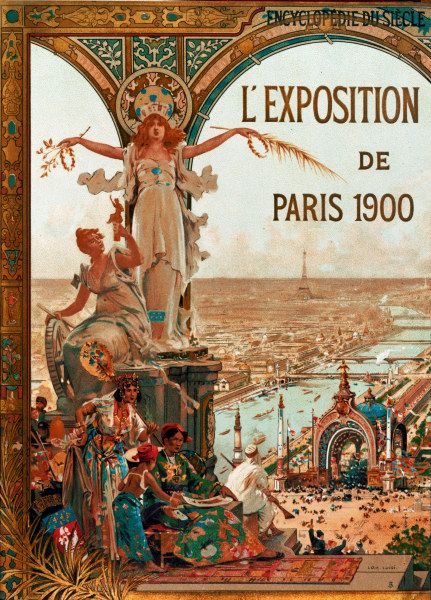
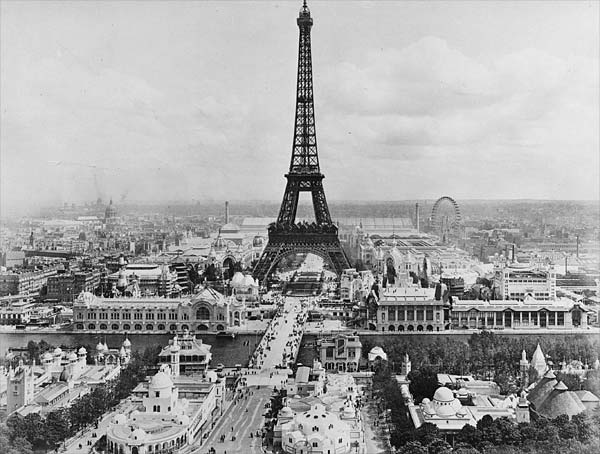
The Exposition Universelle of 1900 was held in Paris, France from April 14 until November 10, 1900, and celebrated the achievements of the last century in an Art Nouveau style. Over 50,000,000 people attended this worlds fair, which had some 76,000 exhibitors and spanned 1.2 square kilometres. Buildings that survive from the 1900 Exposition include the Gare de Lyon, the Gare d’Orsay (now the Musée d’Orsay), the Pont Alexandre III, the Grand Palais, La Ruche, and the Petit Palais. The Eiffel Tower, which many people associate with the 1900 Exposition, was actually constructed for the 1889 Exposition that celebrated the 100th anniversary of the French Revolution.
Alexandre Lion operated a rather sizeable exhibit of incubators and premature newborns at the Exposition, using the equipment and techniques he developed for his “Baby Incubator Charity” at 26, Boulevard Poissonière, Paris.
His exhibit at the Exposition was mentioned in an article in the Gazette Médicale de Paris, October 6, 1900 (Volume 11, No,. 3):
Chronique Médicale de L’Exposition
613.1
Les Couveuses pour Enfants
… Le principe de la couveuse, qui est de maintenir l’enfant dans une atmosphère de température convenable et uniforme, tout en permettant de le retirer, lorsqu’il est nécessaire, pour le nettoyer et l’alimenter, ce principe a été respecté. Mais les modifications qui ont été réalisées résident dans l’application la plus parfaite de ce principe, avec la réalisation de tous les desiderata qu’avaient fait naître les appareils antérieurs. C’est pourquoi la Couveuse Lion, qui est actuellement la plus parfaite, comporte dans sa construction un grand luxe de détails, mais en raison même de ce fait, tous les éléments qui concourent à assurer à l’enfant les meilleures conditions matérielles, y sont réunis. Aussi voulons-nous aujourd’hui présenter à nos lecteurs cette Couveuse (Fig. 130) qui fonctionne à l’Exposition et attire chaque jour un grand nombre de personnes (Fig. 131) …
Medical Chronicle of the Exhibition
613.1
Incubators for Infants
… The principle of the incubator, which is to maintain the infant in an atmosphere of suitable and uniform temperature, while permitting the child to be removed when necessary for cleaning and feeding — this principle has been respected. But the modifications that have been carried out reside in the most perfect application of this principle, with the realization of all the desiderata that the earlier apparatuses had brought to light. This is why the Couveuse Lion, which is currently the most perfect, incorporates in its construction a great wealth of details, but, by this very fact, all the elements that work together to provide the infant with the best material conditions are united in it. So today we wish to present to our readers this Couveuse (Fig. 130), which is operating at the Exposition and attracts a great number of people every day (Fig. 131) …
His combination souvenir/entry ticket postcards from the Paris Exposition are ubiquitous on eBay, so a great many of them must have been distributed at the time.
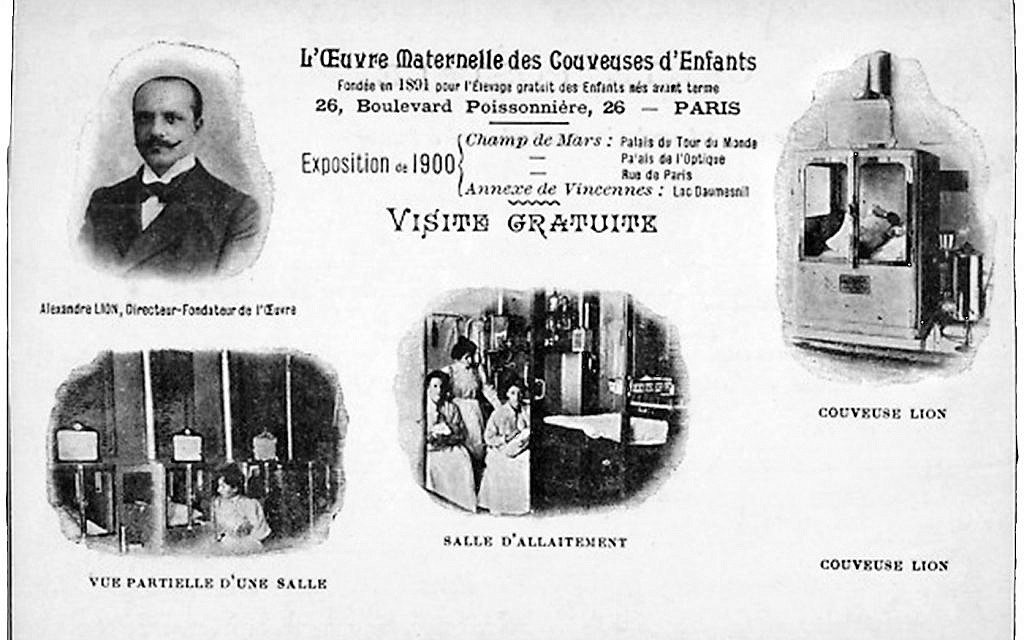
The souvenir card indicates that Lion had incubators (or some kind of presence) at four locations within the Exposition, as well as his well-known permanent location at 26, Boulevard Poissonnière. The fourth location on the postcard I found documented in the Repport Général Administratif et Technique, Tome Quatrième, Section Française, below. But I have not found any snapshots of any of Lion’s exhibits at the Paris Exposition up until now, and the pictures on the souvenir postcard may just be stock photos he uses for all his postcards.
Classe 112. Assistance publique. — L’OEuvre maternelle des conseuses d’enfants disposait de 36o mètres carrés sur la rive nord-ouest du lac, à proximité du pavillon d’administration et de l’entrée Daumesnil. Elle y avait élevé une construction à rez-de-chaussée comprenant : 1° une galerie circulaire, où le public avait accès et voyait des couveuses aver bébés vivants; 2° une partie centrale occupée par les services de la pouponnière.
Class 112. Public Assistance. — The Œuvre maternelle des couveuses d’enfants occupied an area of 360 square meters on the northwest shore of the lake, near the administration pavilion and the Daumesnil entrance. It had erected a single-story structure comprising: 1) a circular gallery accessible to the public, where visitors could view incubators containing live infants; and 2) a central section housing the nursery facilities.
— Repport Général Administratif et Technique, Tome Quatrième, Section Française, p. 304
The final reports from the Exposition record that Lion’s exhibit was awarded a Bronze Medal at the Exposition.
12° Mentionnons enfin l’OEuvre maternelle des couveuses d’enfants, qui a également obtenu une médaille de bronze.
— Rapports du Jury International, Group XVI – Économie sociale – Hygiène Assistance publique, Quatrième Partie – Classe 112 , page 129
In addition to Lion’s exhibit, there was an incubator exhibit at the Exposition from the Maternité Sainte-Anne Bruxelles (Maternity Hospital of Saint Anne in Brussels) adjacent to the Eiffel Tower. The incubators are rather odd and quite unique, I have not seen that design anywhere else, and more likely derived from the Tarner/Auvard/Budin design than the Lion design. The ticket also appears to be associated with this exhibit.
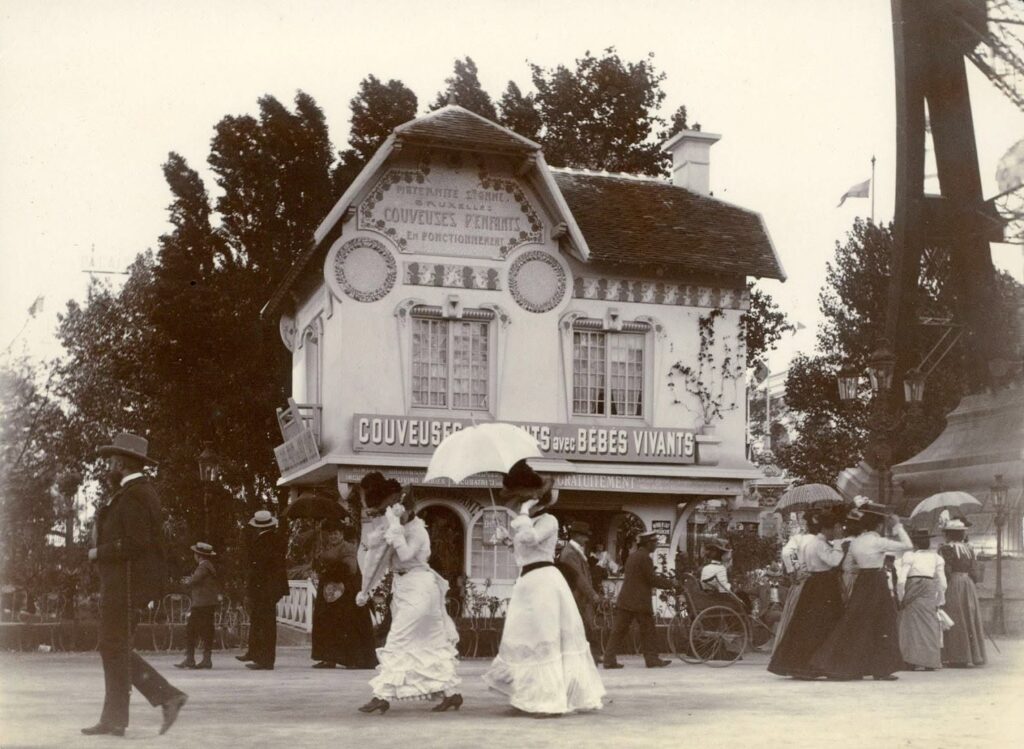
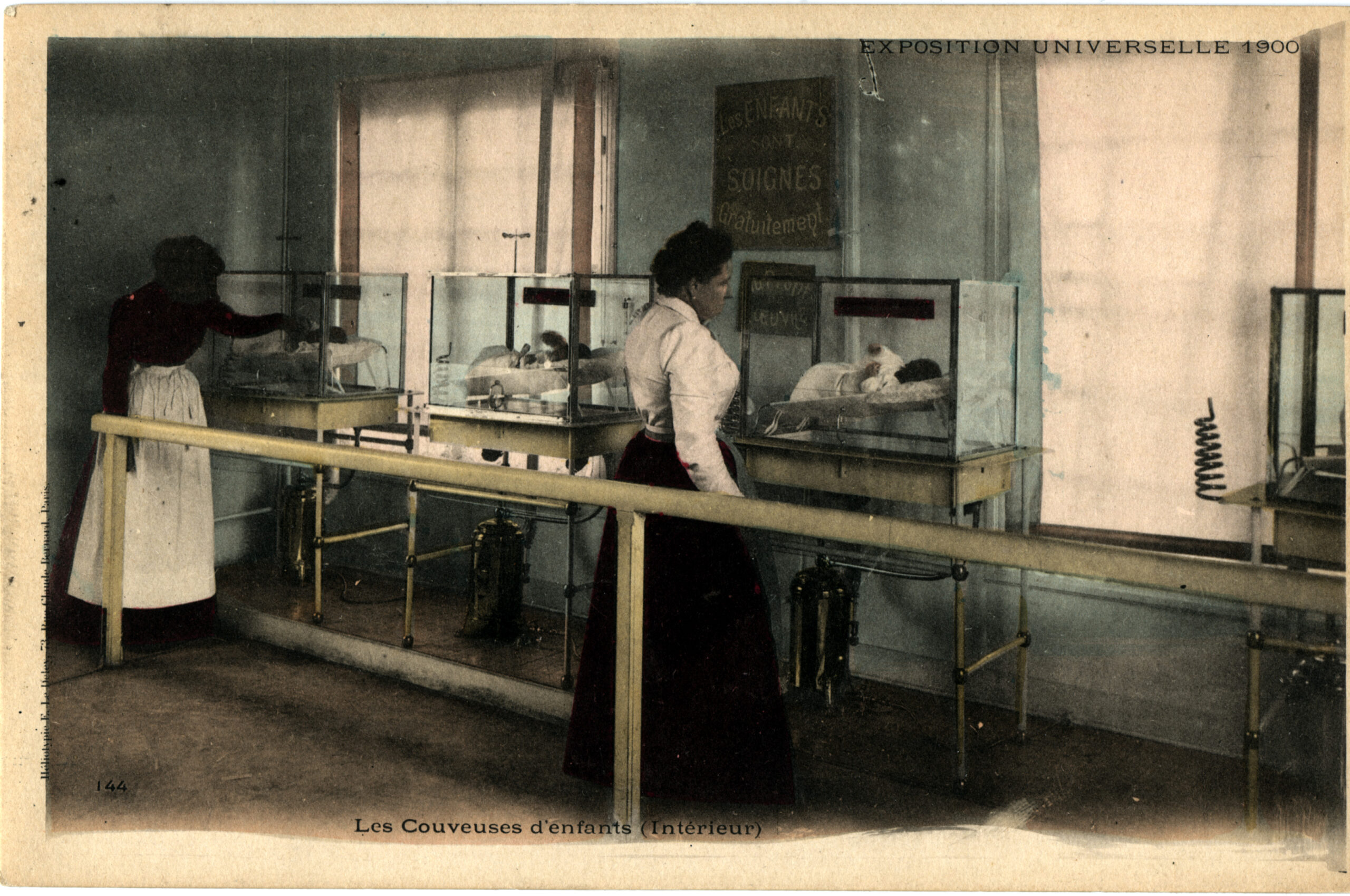
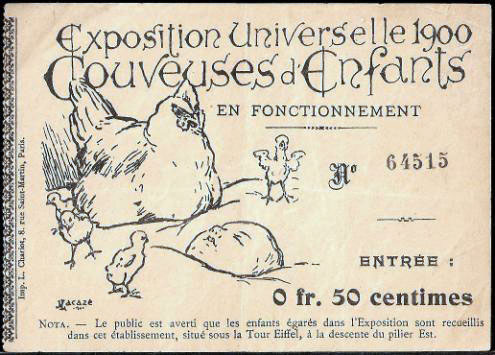
Page 66 of the “Official General Catalog” of the exposition has the following description:

Which Google translate renders as: “Worth noting is the exhibition of the Sainte-Anne Maternity Hospital, which displays—within a charming pavilion—infant incubators and the medical equipment used in this institution, which performs such invaluable work.”
Belgique. — La Belgique avait. sous la Tour de 3oo mètres, côté La Bourdonnais. un pavillon dit «de la Maternité Sainte-Anne». dans lequel devait ètre montrée au public l’œuvre de celle société philantropique. Aux termes du contrat de concession, la société était investie du droit: 1° de percevoir une redevance sur les visiteurs: 2° de vendre le lait pasteurisé par ses appareils.
De faibles dimensions, le batiment ne couvrait que 48 mètres carrés. Il comprenait une cave. un rez-de-chaussée pour le débit du lait. un étage abritant des couvenses d’enfants.
La construction élait en bois et plàtre. Un ton bleu pàle avait été appliqué sur les bois apparents. Quelques appliques en blen au pochoir, se rattachant à l’art nouveau. rehaussaient le blanc du plàtre.
Belgium. — Belgium had a pavilion known as the “Sainte-Anne Maternity” located beneath the 300-meter tower on the La Bourdonnais side, where the work of this philanthropic society was to be displayed to the public. Under the terms of the concession agreement, the society held the right to: 1) collect a fee from visitors; and 2) sell milk pasteurized using its own equipment.
The building was small, covering an area of only 48 square meters. It comprised a cellar, a ground floor for milk sales, and an upper floor housing infant incubators.
The structure was made of wood and plaster. A pale blue tone had been applied to the exposed woodwork. Blue stenciled decorative motifs, in the Art Nouveau style, accented the white plaster.
– Repport Général Administratif et Technique, Tome Septiéme,, p. 254
Interestingly, in later years, Martin Couney claimed to have exhibited at the Paris Exposition (for example, see A Patron of the Premies, by A. J. Liebling, The New Yorker, 1939). It appears, however, that this was just more of the “alternate facts” in Couney’s self-created legend. We have found no evidence in the program of the Exposition or the subsequent Repport Général that Couney was actually an exhibitor at the Paris Exposition.
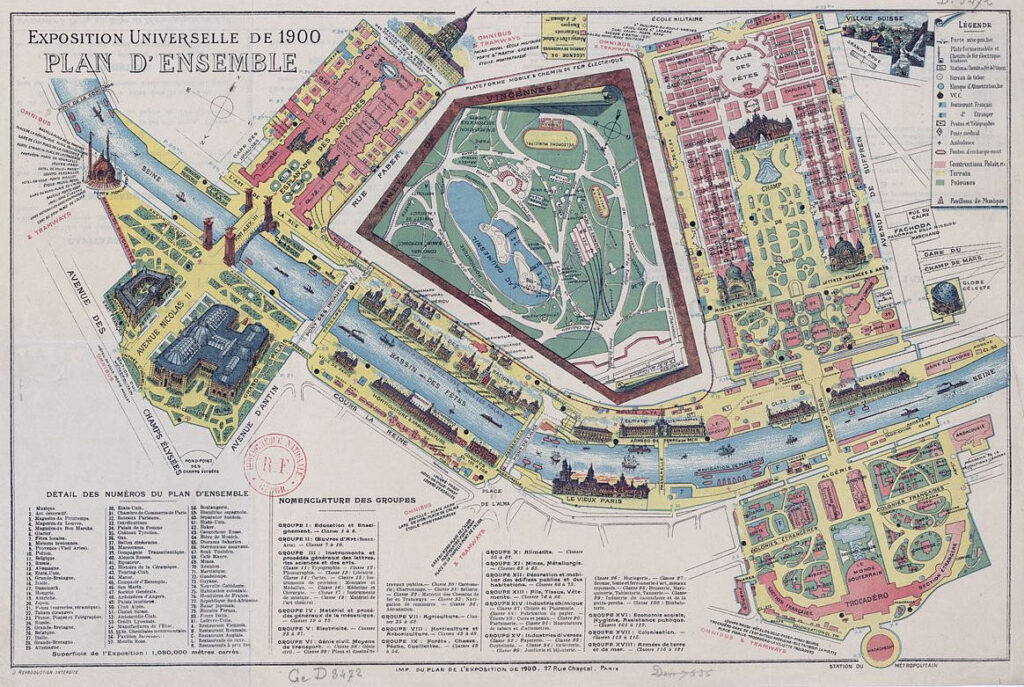
A map of the exposition is shown below.
More Information about Alexandre Lion
- General Information
- Alexandre Lion
- The Lion Incubator
- The Engineer and the Newborns, by W. A. Nelson and Paul L. Toubas
- Lion Patents (France)
- Patent 201550, 1889, Couveuse électro-automatique
- Patent 221716, 1892, Couveuse automatique
- Patent 262090, 1896, Chambre vivifiante
- Patent 281687, 1898, Système de filtration de l’air
- Patent 287557, 1899, Système de filtration des fumées, de l’air et de toutes masses gazeuses avec tirage et ventilation
- Patent 189989, 1899, Appareil pour le filtrage et la purification de l’air et des fumées
- Maternité Lion Institutes
- Alexandre Lion’s first incubator baby exhibit in Marseille, 1890.
- Œuvre Maternelle des Couveuses d’Enfants, Nice
- Œuvre Maternelle des Couveuses d’Enfants, Lyon
- Œuvre Maternelle des Couveuses d’Enfants, Paris
- Œuvre Maternelle des Couveuses d’Enfants, Toulouse
- Œuvre Maternelle des Couveuses d’Enfants, New York
- Œuvre Maternelle des Couveuses d’Enfants, Barcelona
- Œevre Maternelle des Couveuses d’Enfants, Brussels
- Maternité Lion Souvenir Booklets
- Œuvre Maternelle des Couveuses d’Enfants , Paris Institute, Booklet Version #1 (appears to be ~1896)
- Œuvre Maternelle des Couveuses d’Enfants , Paris Institute, Booklet Version #2 (appears to be ~1901)
- Pamphlet from Alexander Lion’s exhibit at the 1898 exhibition in Torino, Italy. (PDF supplied by Dr. Thijs Gras, Amsterdam)
- Press Coverage
- La Maternité “Lion de Nice” pour Enfants Nés Avant Terme ou Débiles, by Dr. Ciaudo, 1895. Source: gallica.bnf.fr.

- Presentation d’Appareil, by M. A. Pinard, Bulletin de l’Académie nationale de médecine, 1893. Source: gallica.bnf.fr.
- Les couveuses d’enfant et le gavage, by César-A Queirolo, Includes discussion of Lion incubator and comparison to other types. Thèse de doctorat: Univ. Genève, 1897.
- Les Couveuses pour Enfants, Gazette Médicale de Paris, No. 40, October 6, 1900
- Couveuses d’Enfants, La Maternité Lion, Paris, La Patrie, 1897
- Paris Letter: An Improved System of Incubators, by O. Jennings, Pediatrics 1:427-428, 1896
- Baby Incubators, The Strand Magazine, 1896, by James Walter Smith
- Human Infant Incubation: A True Fairy-Tale of Modern Science from Leslie’s Weekly, 1897
- The Saving of Human Life, Maternité Lion in NYC, The Literary Digest, 1898
- Immature Infants in France, from The Lancet, January 16, 1897, page 196.
- Alexandre Lion’s Incubator Charities in Europe (1894–1898) (The Embryo Project)
- La Maternité “Lion de Nice” pour Enfants Nés Avant Terme ou Débiles, by Dr. Ciaudo, 1895. Source: gallica.bnf.fr.
- Worlds Fairs and Expositions
- Maternité Lion at the Lyon Exposition Universelle et Coloniale, 1894
- Maternité Lion at the Bordeaux Exposition of 1895.
- “La Maternité Lion,” by Louis Énault, Journal of the Bordeaux Exposition, 1895
- Maternité Lion at the Amsterdam World Exposition, 1895
- Maternité Lion at the Berliner Gewerbeausstellung, 1896
- “Bericht ǔber die Couveuse (Lion) oder Kinderbrutanstalt” [Report about the Lion Incubator] from Berlin und seine Arbeit – Amtlicher Bericht der Berliner Gewerbe-Ausstellung 1896. English Translation.
- Maternité Lion at the Exposition National Suisse, Geneva, Switzerland, 1896
- “Quelques Réflexions sur le Fonctionnement et les Résultats des Couveuses Lion pendant l’Exposition Nationale,” by Dr. Hector Maillart, Revue Médicale de La Suisse Romande, 1896. English translation.
- Internationale Ausstellung für Körperliche Erziehung, Gesundheitspflege und Sport, Innsbruck, 1896
- Maternité Lion at the Tennessee Centennial Exposition, 1897
- Maternité Lion at the Brussels International Exposition, 1897
- Maternité Lion at the Turin L’Esposizione Generale Italiana, 1898
- Maternite Lion at the Ghent Provincial Exposition of 1899
- Maternité Lion at the Greater Britain Exhibition of 1899
- Maternité Lion at the Paris Exposition Universelle of 1900
- Maternité Lion at the Woman’s Exhibition in Earls Court, London, 1900
- Maternité Lion at the Lille Exposition of 1902
- Maternité Lion at the Exposition Internationale de Reims, 1903
- Maternité Lion at the Nantes Exposition of 1904
- Maternité Lion at the Exposition du Nord de la France, 1904
- Maternité Lion at the Liège Exposition Universelle et Internationale, 1905.
- Maternité Lion at the Marseille Colonial Exposition of 1906
- Maternite Lion at the Bordeaux International Maritime Exposition of 1907
- Maternité Lion at the Marseille Exposition Internationale d’Électricité, 1908
- Maternité Lion at the Exposition Internationale de l’Est de la France, Nancy, France, 1909
- Maternité Lion at the Brussels Exposition Universelle et Internationale, 1910
- Maternite Lion at the Exposition du Centre de la France, Clermont-Ferrand, 1910
- Maternité Liion at the Rome International Exposition of 1911
- Maternité Lion at the Turin International Exposition of 1911
- Maternité Lion at the Exposition Internationale de Dunkerque, 1912
- Maternité Lion at the Ghent International Exposition of 1913
- Maternité Lion at the Exposition Internationale Urbaine de Lyon, 1914
Last Updated on 09/01/26