Exposition National Suisse, Geneva, 1896
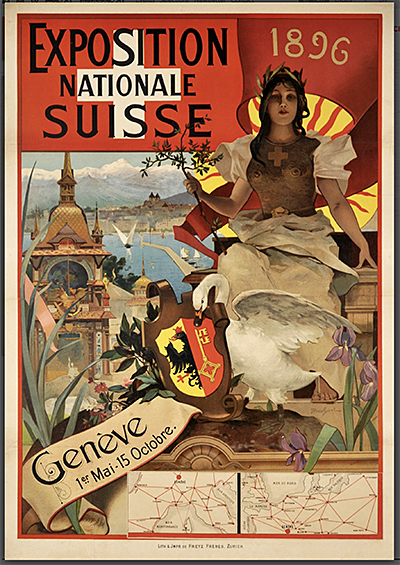
The second Swiss National Exhibition (Exposition nationale suisse) was held in Geneva from May to October 1896, following the inaugural 1883 Zurich exhibition. The exhibition aimed to present “un tableau d’ensemble de la capacité productive des populations suisses” and, unlike 1883, to stimulate the domestic market in particular. It became the birthplace of several enduring motifs, most famously the Village suisse — a fictitious national rural landscape of vernacular cantonal buildings (56 constructions representing all the cantons, arranged around a public square and “inhabited” by some 300 costumed villagers, complete with a church, bridge, shops, an artificial 40-metre mountain and a waterfall), which Bernard Crettaz identified as a root of the syncretic Heimatstil and which was later rebuilt at the 1900 Paris World Fair. Other innovations included cantonal days, the first federal defence pavilion, the first Swiss Congress for Women’s Interests (8–12 September), the ethnographic village noir/nègre, and the first public introduction of the automobile in Switzerland; electricity (“la fée électricité”) served as the exhibition’s emblem of industrial modernity.
Financially, the exhibition closed in deficit. Against a first budget of 22 June 1893 that balanced receipts and expenses at 2,835,000 francs, the final accounting of 22 November 1897 recorded expenses of roughly 7,430,000 francs and a shortfall of 270,000 francs, which was covered by supplementary subventions from the canton and city of Geneva (notably, the final balance sheet itself does not show this deficit). Principal funding sources were public subventions and private donations (1,872,000 fr., including a 1,000,000 fr. direct federal subvention), general entry-ticket sales (1,302,000 fr.), separate ticketing for the Village suisse (853,000 fr.), a lottery (800,000 fr. gross; 250,000 fr. net), and a guarantee capital raised through participation coupons (570,000 fr.). Organizers attributed the disappointing result largely to poor weather in the summer of 1896, which is thought to have depressed attendance. Total attendance nonetheless reached approximately 2,289,000 — equivalent to about 72 percent of Switzerland’s resident population of 3,182,880 — at a normal adult entry price of one franc.
The preparation and running of the exhibition were marked by recurring friction: scheduling had to be coordinated with the 1895 agricultural exhibition in Bern; a planned Swiss electricity exhibition was abandoned while the federal art exhibition was successfully brought to Geneva; Geneva voters rejected a proposed rail line, forcing a redesign of transport arrangements; and painters and plasterers struck shortly before opening over the recruitment of outside labour. Public reception was largely favourable, though exhibitors complained of organizational and technical defects, some entertainments were again deemed unworthy of a national event, and the labour movement regretted the scant attention paid to social problems. The Geneva parties nonetheless observed a “social peace” to preserve the image of national unity. Organizers recorded a largely self-congratulatory account in the Rapport administratif (1898), while Eduard Boos-Jegher published a more critical assessment in 1897 that would guide the planners of the 1914 Bern exhibition.
Baby Incubators at the Exhibition
Alexandre Lion’s incubator baby pavilion at the exhibition is well documented , although I have not been successful at finding any images of the pavilion or any of his usual souvenir postcards to date. Revue Médicale de La Suisse Romande had an extensive article by Dr. Hector Maillart about Lion’s exhibit in the 1896 issue that included a detailed description of the incubator, the infant care in the pavilion, and the outcome statistics.
“Visitors to the Exhibition all noticed the pavilion which housed the children’s incubators and which had been installed by the house of A. Lion of Paris to publicize its devices. Having been entrusted by this house with the medical supervision of the establishment for the duration of the Exhibition, I would like to share some thoughts that these five months of activity have suggested to me.
“I will not enter here into a long dissertation on the incubator for preterm infants; this is a subject that has become classic and perfectly known to all practitioners; the literature has been very rich in them since Tarnier’s first communications in 1880.
“Each lying-in hospital currently has devices that are more or less well constructed and more or less easy to handle. almost unique source of the many failures of baby incubators. We could see at the Exhibition that with the Lion incubators these disadvantages disappear…”
–– H. Maillart, Revue Médicale de la Suisse Romande, 1896.
Press Coverage
Press coverage of the incubator display was among the most sustained human-interest reporting the 1896 Geneva exhibition generated, appearing across at least five French-language Swiss papers. The installation was presented under the names Établissement Lion, Œuvre maternelle des couveuses d’enfants, or simply Maternité Lion — after its founder-director, “le Dr Lion de Paris,” whose charitable maternity work had been established at Nice in 1891 — and it exhibited living premature infants in working incubators, viewable through glass. Le National Suisse reported visiting five Geneva babies asleep in the apparatus, swaddled and tended, and framed the sight as something marvellous; Le Jura‘s walking tour of the grounds placed the incubator cabinet near the end of the visitor circuit, beside the Pictet pavilion and the food division, closing with the conceit that one “finishes where life begins.”
The reporting mixed admiring technical description with medical statistics. The incubator was described as a glass-fronted metal cabinet heated by a gas burner or oil lamp, with circulating warm water and a thermostatic regulator — a metal thermometer working a lever and an air current — holding the interior temperature steady to within half a degree, plus ventilation and a metal-cloth hammock, the infant lifted out every two hours for feeding. Papers traced the technique’s lineage to the Paris obstetricians Tarnier (credited with the first device, in 1880), Auvard and Budin, and further back to Charles Chossat’s thermal-physiology work; the Courrier de Genève noted the Lion model had reportedly reared an infant of 725 grams. The recurring headline figure — 185 premature infants admitted at the Nice maternity, 133 surviving, a 72 percent survival rate — appeared in both Le National Suisse and L’Impartial, set against the observation that these babies averaged only 800 grams against a normal 3–3½ kg. The framing was overtly pro-natalist, invoking France’s falling birth rate and the duty to save such infants and raise them for the nation.
The display was genuinely contested, and the press documented the quarrel directly. The Journal de Genève had campaigned against the couveuses; the Bulletin de l’Exposition answered in their defence, closing — as the Courrier de Genève reported on 23 June — with a satirical pastiche of Massillon’s sermon on the small number of the elect, ridiculing the notion that only the robust and well-born deserved to live. Reporters repeatedly pre-empted the obvious objection to putting sick babies on public show: L’Impartial‘s correspondent conceded one might imagine something distasteful, then urged readers to see for themselves and find, as he had, only sympathetic interest. Defenders cast the work as humanitarian rather than commercial, and pointedly anti-Malthusian, shaming the hard-hearted egoists who would let such infants die.
Reception was, on balance, favourable, and the exhibit left a concrete legacy in the city. In November, La Tribune de Genève carried Dr Vaucher’s public thanks (via Le Genevois): Dr Lion had donated one of the exhibited incubators to the Maternité de Genève, praised as the most perfected model then available and superior to the Tarnier and Auvard designs. The papers also noted the practical dimension — a domestic incubator could be rented for home use at 60 francs a month — and treated the couveuses, alongside Raoul Pictet’s cold-production pavilion and the Grimm electric kitchen, as among the modern “marvels” that defined the exhibition.
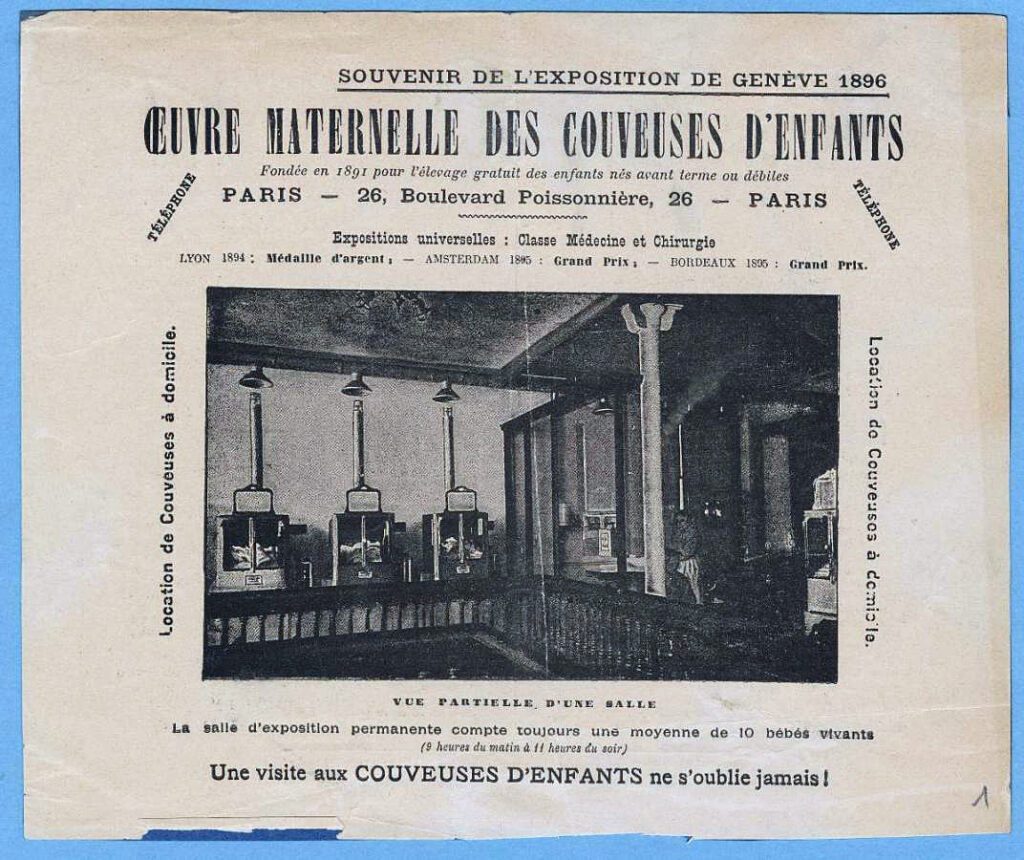
Drs. Thijs Gras kindly sent this scan of the cover of a souvenir booklet for Alexandre Lion’s exhibit at the exposition. The image is also available from the Bibliothèque de Genève at https://www.bge-geneve.ch/iconographie/oeuvre/rec-est-0398-f-186-01. A complete copy of the booklet has not been located.
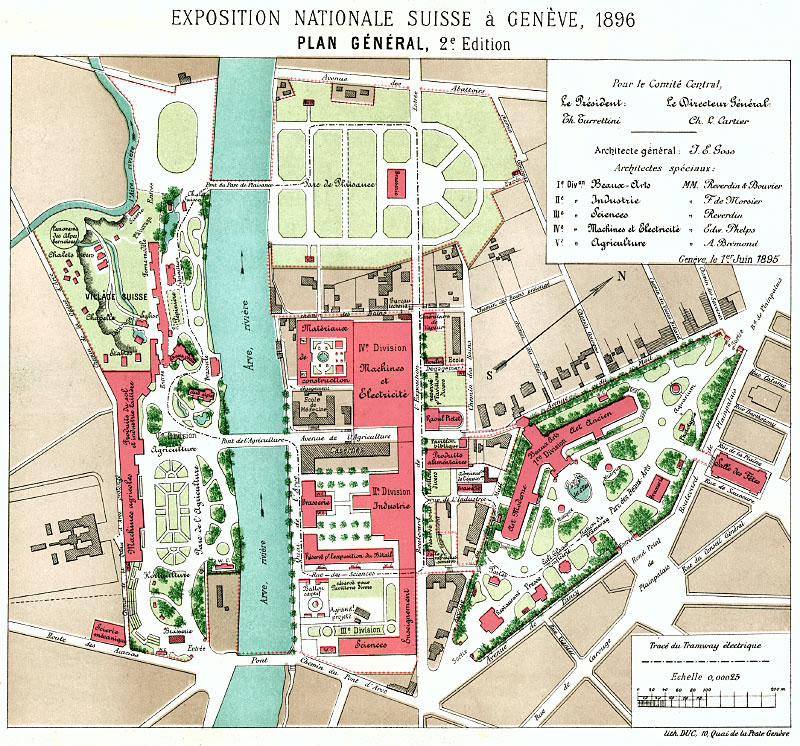
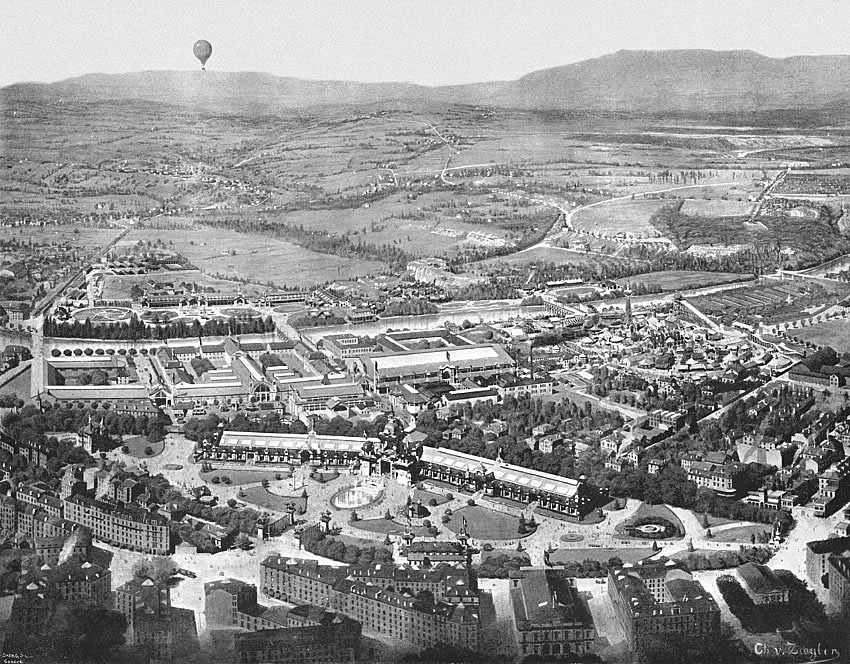
Map and overhead view of the exposition.
Sources
- U. Germann, Les expositions nationales de 1883, 1896, 1914, 1939 et 1964, Rapport à l’intention de la Commission de gestion du Conseil des Etats, Archives fédérales suisses, 056.3-07 (esp. §3 and synoptic table).
- Exposition nationale Suisse Genève 1896. Rapport administratif, Genève 1898 (primary financial and administrative source, as cited in Germann, notes 11–15).
- Eduard Boos-Jegher, Die Landesausstellungen in der Schweiz mit besonderer Berücksichtigung jener in Genf und einer später in Bern abzuhaltenden, Bern 1897.
- Ola Söderström, “Expo.02: Exhibiting Swiss Identity,” Ecumene, Vol. 8, No. 4 (October 2001), pp. 497–501, https://www.jstor.org/stable/44252198.
- Eric Storm, “World Fairs and (Inter)national Exhibitions,” in Encyclopedia of Romantic Nationalism in Europe, ed. Joep Leerssen (Amsterdam: SPIN, 2022), v. 1.1.2.1/b, https://ernie.uva.nl/viewer.p/21/56/object/122-275481.
- ex-expo.ch, “Geneva 1896: An Ideal World and Reality,” https://ex-expo.ch/en/detail/geneva-1896-an-ideal-world-and-reality.
- “Quelques Réflexions sur le Fonctionnement et les Résultats des Couveuses Lion pendant l’Exposition Nationale,” by Dr. Hector Maillart, Revue Médicale de La Suisse Romande, 1896.
- L’Exposition Nationale Suisse de 1896 from notreHistoire.ch
- “Swiss Village” at the National Exhibition in 1896 (Wikipedia).
- Bibliothèque de Genève, cover image of the Oeuvre Maternelle des Couveuses d’Enfants pavilion’s souvenir booklet at the Exhibition, https://www.bge-geneve.ch/iconographie/oeuvre/rec-est-0398-f-186-01
- Maillart, Dr. Hector, “Quelques réflexions sur le fonctionnement et les résultats des couveuses Lion pendant l’Exposition nationale,” Revue Médicale de La Suisse Romande, Genève, 1896, pages 644-655. English translation.
- “A l’Exposition nationale — Les couveuses d’enfants,” Le National Suisse (La Chaux-de-Fonds), 23 July 1896 (dispatch dated Geneva, 20 July), signed A.J.
- “A l’Exposition nationale — I,” Le National Suisse (La Chaux-de-Fonds), 22 July 1896 (dispatch dated Geneva, 19 July) — Part I of the same series.
- “Exposition nationale suisse — Couveuses d’enfants,” Courrier de Genève, 2 June 1896 (letter from A. Cordes to Le Genevois).
- “Exposition nationale suisse — Les couveuses d’enfants” (within “Fête des Autorités fédérales”), Courrier de Genève, 23 June 1896.
- “Exposition nationale — II,” Le Jura (Porrentruy), 14 July 1896.
- “Maternité” (Dr Vaucher, writing to Le Genevois), La Tribune de Genève, 10 November 1896.
- “A l’Exposition nationale — Le Pavillon Raoul Pictet; Les couveuses d’enfants; La cuisine électrique; Conclusion,” L’Impartial (La Chaux-de-Fonds), 9 September 1896 (dispatch dated Geneva, 7 September), signed Ch. Nicolet.
More Information about Alexandre Lion
- General Information
- Alexandre Lion
- The Lion Incubator
- The Engineer and the Newborns, by W. A. Nelson and Paul L. Toubas
- Lion Patents (France)
- Patent 201550, 1889, Couveuse électro-automatique
- Patent 221716, 1892, Couveuse automatique
- Patent 262090, 1896, Chambre vivifiante
- Patent 281687, 1898, Système de filtration de l’air
- Patent 287557, 1899, Système de filtration des fumées, de l’air et de toutes masses gazeuses avec tirage et ventilation
- Patent 189989, 1899, Appareil pour le filtrage et la purification de l’air et des fumées
- Maternité Lion Institutes and City Exhibits
- Alexandre Lion’s first incubator baby exhibit in Marseille, 1890.
- Œuvre Maternelle des Couveuses d’Enfants, Nice
- Œuvre Maternelle des Couveuses d’Enfants, Lyon
- Œuvre Maternelle des Couveuses d’Enfants, Paris
- Œuvre Maternelle des Couveuses d’Enfants, Toulouse
- Œuvre Maternelle des Couveuses d’Enfants, Amiens
- Œuvre Maternelle des Couveuses d’Enfants, New York
- Œuvre Maternelle des Couveuses d’Enfants, Barcelona
- Œevre Maternelle des Couveuses d’Enfants, Brussels
- Maternité Lion Souvenir Booklets
- Œuvre Maternelle des Couveuses d’Enfants , Paris Institute, Booklet Version #1 (appears to be ~1896)
- Œuvre Maternelle des Couveuses d’Enfants , Paris Institute, Booklet Version #2 (appears to be ~1901)
- Pamphlet from Alexander Lion’s exhibit at the 1898 exhibition in Torino, Italy. (PDF supplied by Dr. Thijs Gras, Amsterdam)
- Press Coverage
- La Maternité “Lion de Nice” pour Enfants Nés Avant Terme ou Débiles, by Dr. Ciaudo, 1895. Source: gallica.bnf.fr.

- Presentation d’Appareil, by M. A. Pinard, Bulletin de l’Académie nationale de médecine, 1893. Source: gallica.bnf.fr.
- Les couveuses d’enfant et le gavage, by César-A Queirolo, Includes discussion of Lion incubator and comparison to other types. Thèse de doctorat: Univ. Genève, 1897.
- Les Couveuses pour Enfants, Gazette Médicale de Paris, No. 40, October 6, 1900
- Couveuses d’Enfants, La Maternité Lion, Paris, La Patrie, 1897
- Paris Letter: An Improved System of Incubators, by O. Jennings, Pediatrics 1:427-428, 1896
- Baby Incubators, The Strand Magazine, 1896, by James Walter Smith
- Human Infant Incubation: A True Fairy-Tale of Modern Science from Leslie’s Weekly, 1897
- The Saving of Human Life, Maternité Lion in NYC, The Literary Digest, 1898
- Immature Infants in France, from The Lancet, January 16, 1897, page 196.
- De Lion Incubator at Low Maternity Hospital, by Francis H. Stuart, Brooklyn Medical Journal, 1901
- Alexandre Lion’s Incubator Charities in Europe (1894–1898) (The Embryo Project)
- La Maternité “Lion de Nice” pour Enfants Nés Avant Terme ou Débiles, by Dr. Ciaudo, 1895. Source: gallica.bnf.fr.
- Worlds Fairs and Expositions
- Maternité Lion at the Lyon Exposition Universelle et Coloniale, 1894
- Maternité Lion at the Lyon Exposition Universelle – Le Monde Illustré, 1894
- Maternité Lion at the Bordeaux Exposition of 1895.
- “La Maternité Lion,” by Louis Énault, Journal of the Bordeaux Exposition, 1895
- Maternité Lion at the Amsterdam World Exposition, 1895
- Maternité Lion at the Berliner Gewerbeausstellung, 1896
- “Bericht ǔber die Couveuse (Lion) oder Kinderbrutanstalt” [Report about the Lion Incubator] from Berlin und seine Arbeit – Amtlicher Bericht der Berliner Gewerbe-Ausstellung 1896. English Translation.
- Maternité Lion at the Exposition National Suisse, Geneva, Switzerland, 1896
- “Quelques Réflexions sur le Fonctionnement et les Résultats des Couveuses Lion pendant l’Exposition Nationale,” by Dr. Hector Maillart, Revue Médicale de La Suisse Romande, 1896. English translation.
- Internationale Ausstellung für Körperliche Erziehung, Gesundheitspflege und Sport, Innsbruck, 1896
- Maternité Lion at the Tennessee Centennial Exposition, 1897
- Maternité Lion at the Brussels International Exposition, 1897
- Maternité Lion at the Turin L’Esposizione Generale Italiana, 1898
- Maternite Lion at the Ghent Provincial Exposition of 1899
- Maternité Lion at the Greater Britain Exhibition of 1899
- Maternité Lion at the Paris Exposition Universelle of 1900
- Maternité Lion at the Woman’s Exhibition in Earls Court, London, 1900
- Maternité Lion at the Lille Exposition of 1902
- Maternité Lion at the Exposition Internationale de Reims, 1903
- Maternité Lion at the Nantes Exposition of 1904
- Maternité Lion at the Exposition du Nord de la France, 1904
- Maternité Lion at the Liège Exposition Universelle et Internationale, 1905.
- Maternité Lion at the Marseille Colonial Exposition of 1906
- Maternite Lion at the Bordeaux International Maritime Exposition of 1907
- Maternité Lion at the Marseille Exposition Internationale d’Électricité, 1908
- Maternité Lion at the Exposition Internationale de l’Est de la France, Nancy, France, 1909
- Maternité Lion at the Brussels Exposition Universelle et Internationale, 1910
- Maternite Lion at the Exposition du Centre de la France, Clermont-Ferrand, 1910
- Maternité Liion at the Rome International Exposition of 1911
- Maternité Lion at the Turin International Exposition of 1911
- Maternité Lion at the Exposition Internationale de Dunkerque, 1912
- Maternité Lion at the Ghent International Exposition of 1913
- Maternité Lion at the Exposition Internationale Urbaine de Lyon, 1914
- Maternité Lion at the Lyon Exposition Universelle et Coloniale, 1894
Last Updated on 07/12/26