Exposition Maritime Internationale de Bordeaux, 1907


Bordeaux is best known today for its wine, but at the beginning of the 20th century, it was a major port and industrial city. The Exposition Maritime Internationale de Bordeaux grew out of a December 1905 decision by the Ligue maritime française, under Admiral Alfred Gervais and with the naval engineer Louis-Émile Bertin as commissaire général, to mount a maritime exhibition open to all nations and to showcase each country’s investment in its merchant and war fleets. The event doubled as a celebration of the centenary of regular steam navigation; Robert Fulton’s Clermont steamboat first operated between New York and Albany in August 1807. The fair opened on April 27, 1907, with an official inauguration by colonies minister Raphaël Milliès-Lacroix on May 2, and ran through November.
“For six months, Bordeaux was the absolute centre of the maritime world,” Mr Guichoux comments. “The fair drew hundreds of thousands of visitors, including VIPs such as the Prince of Sweden and the King of Spain. Many people would pay return visits because it took so long to see everything there was to see! It was as if a whole town had been built from scratch!”
–– Invisible Bordeaux web site
The exposition occupied the Place des Quinconces and the adjoining allées de Chartres and d’Orléans, laid out by architect Albert Tournaire. The centerpiece was a massive Grand Palais, while the Venetian-style riverside façade was flanked by two 45-metre towers with elevators carrying visitors to panoramic viewing platforms. Officially international (Belgium, the United States, Greece and Russia took part as governments), the fair also drew numerous foreign exhibitors and in spite of its title was effectively a universal exposition, with dedicated palais for wine, food, graphic arts, horticulture, the automobile (Peugeot, Renault, the Bordeaux maker Motobloc) and the French colonies. Popular “attractions” included a cinematograph, a rotating “Aéroplane” ride, replica pavilions (Belgium’s Steen fortress, part of the White House for the U.S.), and like many other European expositions of that era, a colonial village displaying up to ninety North African men, women and children to daily crowds.
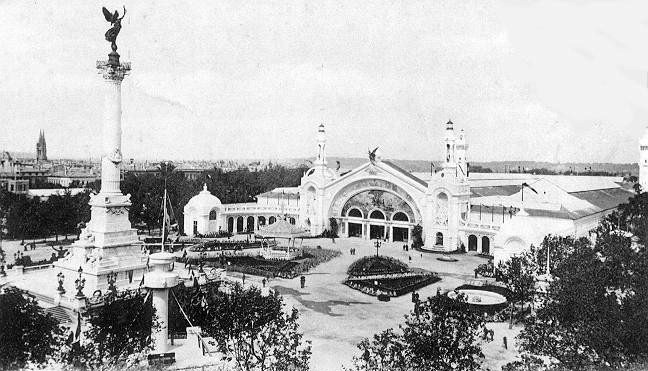
Sparse coverage of the event has survived in digitized form. In what little exists, attendance is recorded only impressionistically as “hundreds of thousands” of visitors, including dignitaries such as the Prince of Sweden and the King of Spain. The single best-attested crowd figure is the 100,000 spectators at the May 28, 1907 launch of the battleship Vérité, built in Bordeaux’s own shipyards. Precise financial results are not documented in the readily available sources either. The exposition left no trace in the city: by the end of 1907 everything had been dismantled and destroyed, leaving the Quinconces clear for Bordeaux’s next major event, the 1909 Fête des Vendanges. The event has since faded to a historical footnote, as the city reinvented itself around its wine identity and forgot its industrial and maritime past.
The infant-incubator exhibit
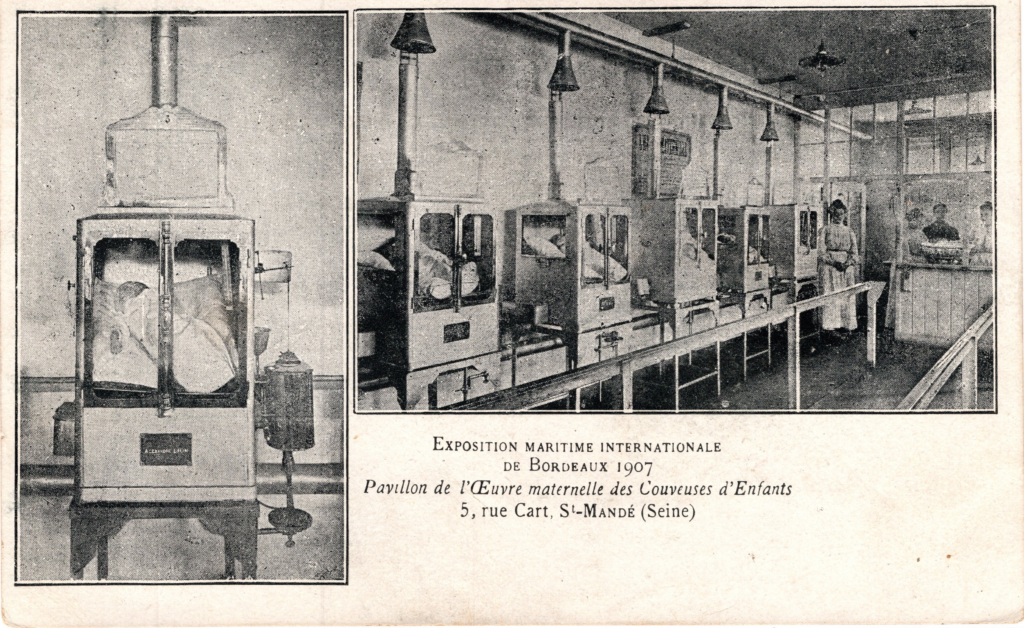
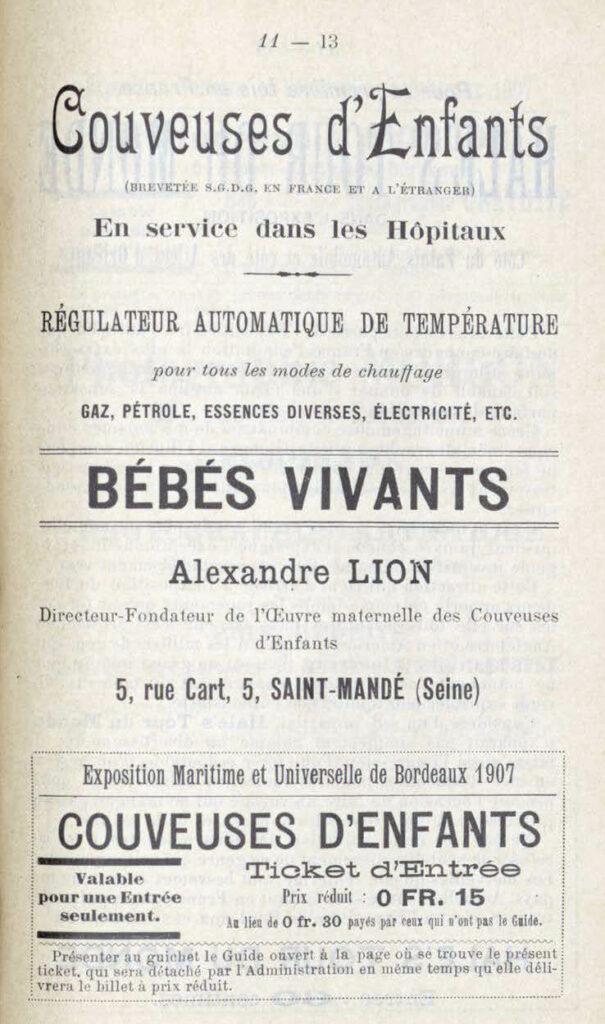
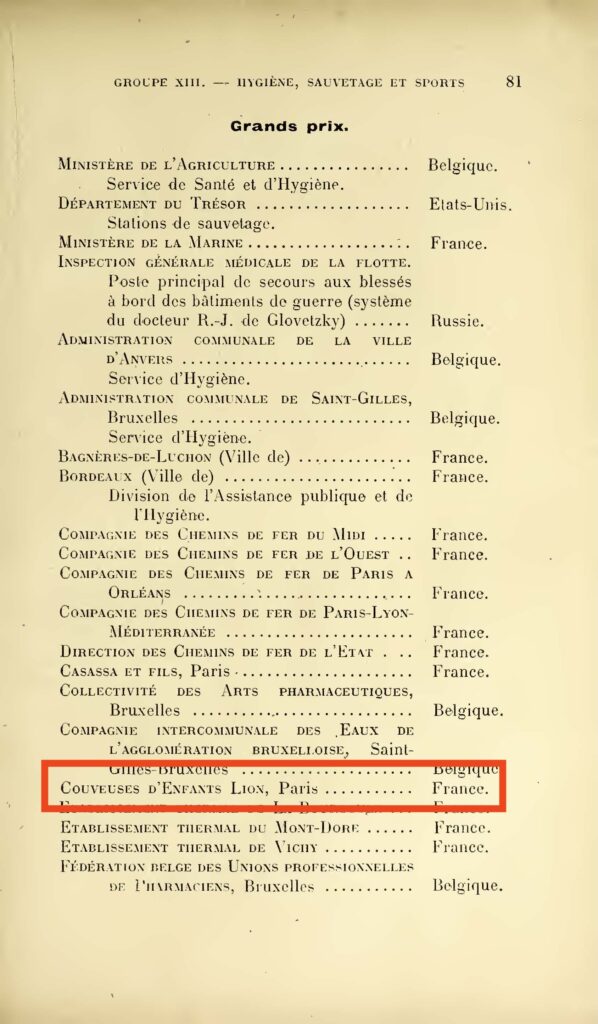
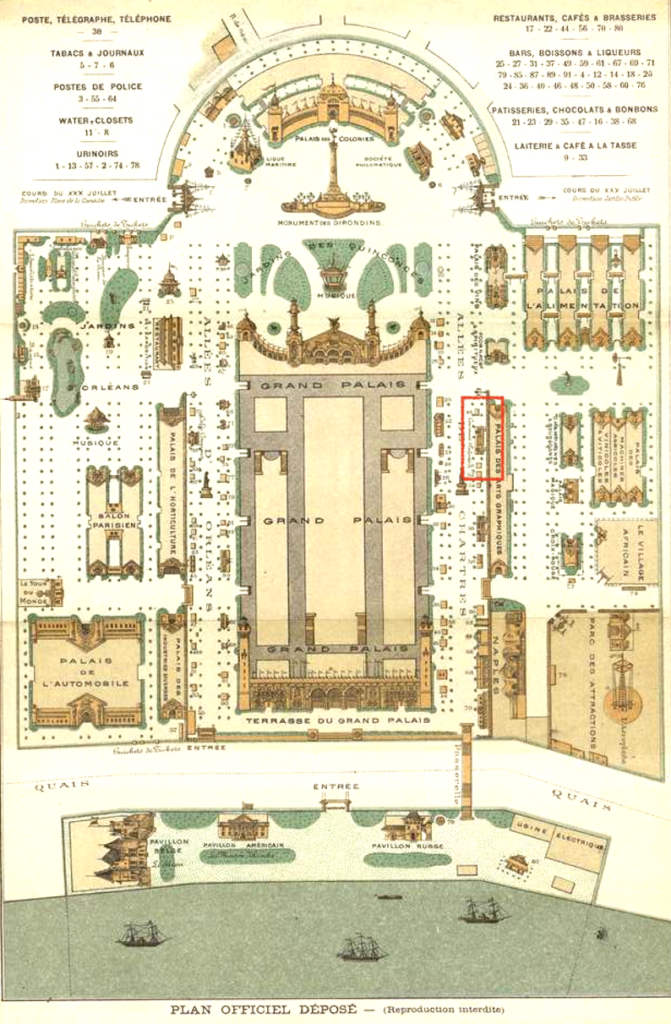
Alexandre Lion’s incubator exhibit at the 1907 Exposition Maritime Internationale de Bordeaux is one of the best documented of all of the expositions he participated in in the decades before World War One. Lion’s pavilion operated on the allées de Chartres, on the small block backing onto the Palais des Arts graphiques, a short distance from the fair’s other paying attractions. The organizing committee counted the pavilion among the exposition’s “attractions,” and admission was charged separately (0 fr. 15 to holders of the official guide, 0 fr. 30 otherwise). The exhibit was formally recognized by the exposition: in the official list of awards the “Couveuses d’Enfants Lion” received a Grand Prix in Groupe XIII (Hygiène, Sauvetage et Sports), the top award tier, in the general distribution of prizes presided over by the under-secretary of state Maujan on September 30, 1907.
The infants themselves were the draw. At opening the guide reported eight live babies on view; the local press through the run recorded a fluctuating census — five infants of roughly 6½ to 7 months’ gestation in late May, rising to eight in early June when recently admitted twin sisters, each said to weigh barely over one kilogram, were added, and standing at six in early October after two further premature admissions. Press coverage was steady but, with one exception, shallow. Most notices simply listed the couveuses among the fair’s attractions. For example, in the September and October announcements of the grand fête days, the pavilion appears in the same breath as the African village, the cinematograph, and the aeroplane ride. The few dedicated paragraphs, in La Petite Gironde and La Gironde, were short and admiring in tone, naming Lion directly on one occasion and dwelling on the smallness of the infants and the crowds of mothers gathered at the glass.
The sharpest contemporary notice came from outside France. A Madrid correspondent writing in El Globo in July 1907 condemned the display in explicitly moral terms, objecting to premature infants shown to a paying public late into the night beside a cinematograph organ, and bracketing the incubator pavilion with the exposition’s ethnographic “village” as spectacle made of human subjects.
A souvenir postcard from the Lion house series with stock photos carries the exposition name and the pavilion’s caption along with the Maternité Lion’s Paris address as of 1907, these postcards are readily available on eBay and other auction sites.
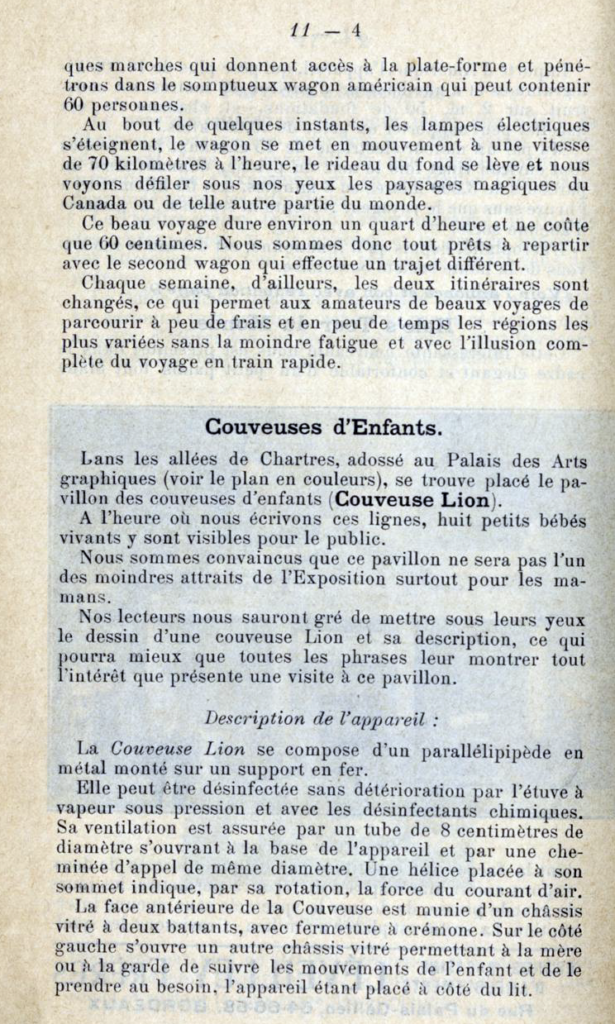
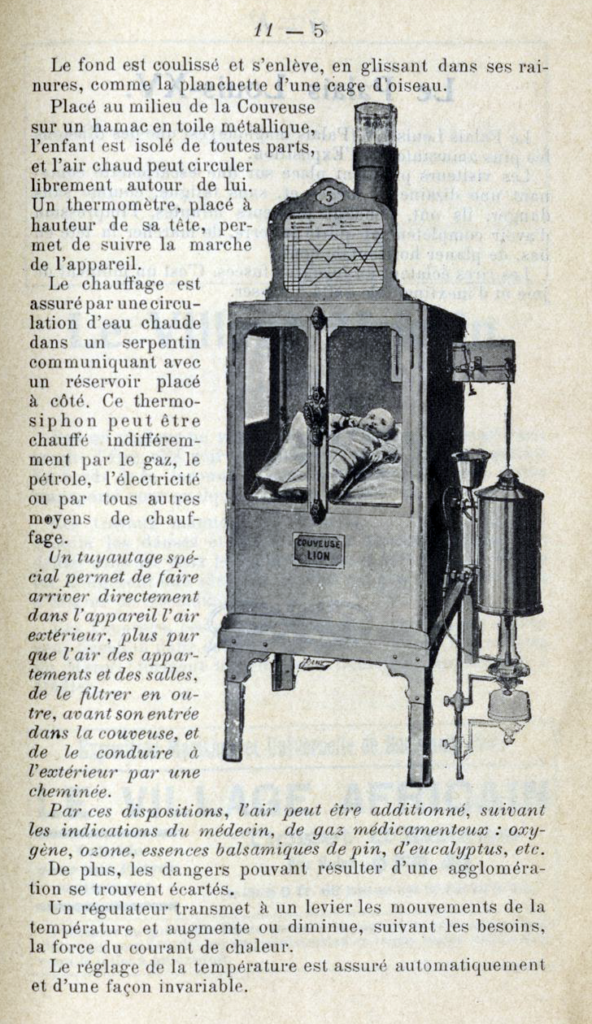
Source: Guide Officiel Illustré, p. 11-4 and 11-5.
Sources: General
- Arthur de Claparède, “La géographie à l’Exposition maritime de Bordeaux en 1907 : Souvenirs de deux Congrès,” Le Globe. Revue genevoise de géographie, tome 47, 1908, pp. 30–41. DOI: https://doi.org/10.3406/globe.1908.5038 — https://www.persee.fr/doc/globe_0398-3412_1908_num_47_1_5038 (uploaded PDF; primary/eyewitness source for the two congresses, the Vérité specifications, and the Juan de la Cosa insurance figure)
- “Exposition maritime internationale de 1907,” French Wikipedia. https://fr.wikipedia.org/wiki/Exposition_maritime_internationale_de_1907 (basis for origins, dates, Grand Palais dimensions, layout, attractions, the Vérité launch, and the dismantling/legacy)
- Tim Pike, “1907 International Maritime Fair: when Bordeaux was the maritime capital of the world,” Invisible Bordeaux (blog), 8 December 2012. https://invisiblebordeaux.blogspot.com/2012/12/1907-international-maritime-fair-when.html (basis for attendance impressions, the Guichoux interview, and the legacy/erasure framing)
- Hervé Guichoux, “L’exposition internationale et maritime de 1907” (with a preface by Antoine Lebègue), Bordeaux Maritime (musée virtuel), 2007/2011. http://bordeauxmaritime.free.fr/crbst_2.html (retrieved 3 September 2026) — the online summary of Guichoux’s centenary CD-ROM; corroborates origins, architecture, layout, attractions, the Vérité launch and the congresses, but supplies no attendance or financial data. The French Wikipedia article appears to derive substantially from this source, so the two are not fully independent.
Sources: Incubator Exhibit
- Exposition Maritime et Universelle, Bordeaux, Mai–Novembre 1907 : Guide Officiel illustré (Bordeaux: G. Delmas), cover and pp. 10–3, 11–4, 11–5, 11–13. Bibliothèque de Bordeaux, shelfmark 69.431 (Legs Auguste Brutails). Digitized copy: https://1886.u-bordeaux-montaigne.fr/s/1886/item/110970 — locating text and installation list (p. 10–3), editorial “Couveuses d’Enfants” article (pp. 11–4, 11–5), and Alexandre Lion’s full-page advertisement with detachable entry ticket naming the Œuvre maternelle des Couveuses d’Enfants, 5 rue Cart, St-Mandé (Seine) (p. 11–13).
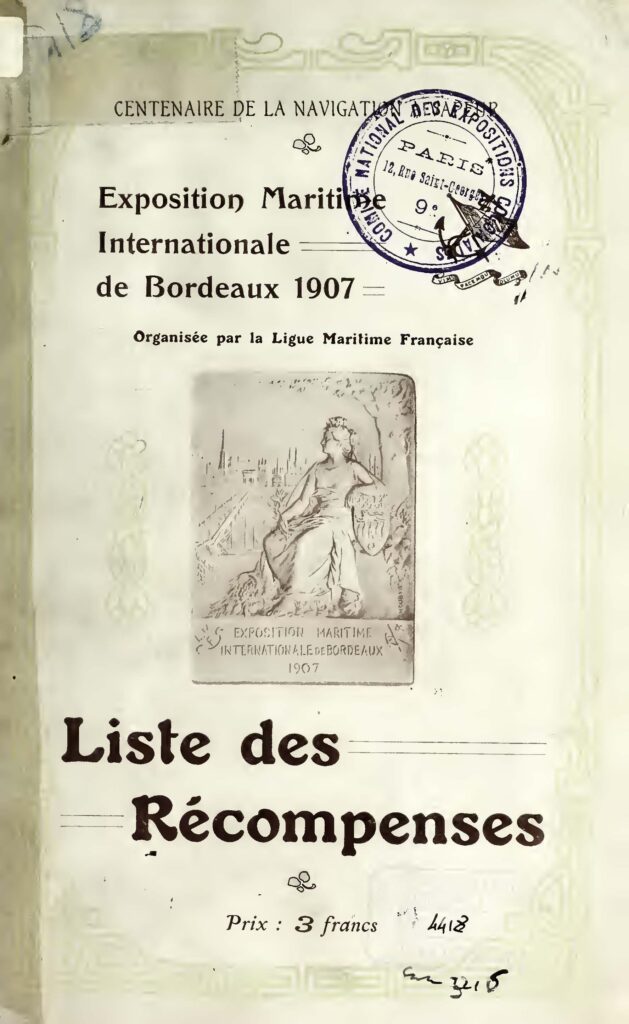
- Exposition Maritime Internationale de Bordeaux 1907 : Liste des Récompenses (Comité National des Expositions, Paris), title page and p. 81. Internet Archive: https://archive.org/details/expositionmariti00expo — official palmarès; “Couveuses d’Enfants Lion, Paris” listed among the Grands Prix of Groupe XIII (Hygiène, Sauvetage et Sports).
- Plan officiel déposé of the exposition (color plan; “Reproduction interdite”), 1907 — pavilion of the couveuses d’enfants marked on the allées de Chartres, adjoining the Palais des Arts graphiques, confirming the location given in the guide. Source: Guide Officiel Illustré, p. 3.
- Souvenir postcard, “Exposition Maritime Internationale de Bordeaux 1907 — Pavillon de l’Œuvre maternelle des Couveuses d’Enfants — 5, rue Cart, St-Mandé (Seine)” (Lion house-card series), recto with apparatus and interior views. Private collection. Caption names the organization and address. Photographs are stock images used in by Lion in souvenir postcards for multiple expositions.
- La Petite Gironde (Bordeaux), 26 May 1907 — “Spectacles et Attractions de l’Exposition : Les Couveuses d’Enfants”; five infants, 6½–7 months’ gestation; “milliers d’enfants” promotional claim.
- La Petite Gironde (Bordeaux), 2 June 1907 — “Les Couveuses d’Enfants”; names “M. Lion”; twin girls each barely over 1 kg; total of eight.
- La Gironde (Bordeaux), 8 October 1907 — “Couveuse d’Enfants”; two further premature admissions bringing the total to six.
- La France de Bordeaux et du Sud-Ouest and La Petite Gironde, both 5 September 1907 — “La Grande Fête de Jeudi”; couveuses listed among attractions for the free-ticket distribution.
- La France de Bordeaux et du Sud-Ouest and La Petite Gironde, both 30 October 1907 — “Les Fêtes à l’Exposition”; couveuses listed among attractions; records the 30 September 1907 récompenses ceremony under Maujan and 40,000+ visitors on the fête day (single-day fête figure, not a run total).
- Juan de Valtierra, “Por Europa: Burdeos y la Exposición,” El Globo (Madrid), 17 July 1907 — critical independent notice condemning the incubator display and the ethnographic village as spectacle; entry price of 30 céntimos corroborates the guide’s 0 fr. 30.
More Information about Alexandre Lion
- General Information
- Alexandre Lion
- The Lion Incubator
- The Engineer and the Newborns, by W. A. Nelson and Paul L. Toubas
- Lion Patents (France)
- Patent 201550, 1889, Couveuse électro-automatique
- Patent 221716, 1892, Couveuse automatique
- Patent 262090, 1896, Chambre vivifiante
- Patent 281687, 1898, Système de filtration de l’air
- Patent 287557, 1899, Système de filtration des fumées, de l’air et de toutes masses gazeuses avec tirage et ventilation
- Patent 189989, 1899, Appareil pour le filtrage et la purification de l’air et des fumées
- Maternité Lion Institutes and City Exhibits
- Alexandre Lion’s first incubator baby exhibit in Marseille, 1890.
- Œuvre Maternelle des Couveuses d’Enfants, Nice
- Œuvre Maternelle des Couveuses d’Enfants, Lyon
- Œuvre Maternelle des Couveuses d’Enfants, Paris
- Œuvre Maternelle des Couveuses d’Enfants, Toulouse
- Œuvre Maternelle des Couveuses d’Enfants, Amiens
- Œuvre Maternelle des Couveuses d’Enfants, New York
- Œuvre Maternelle des Couveuses d’Enfants, Barcelona
- Œevre Maternelle des Couveuses d’Enfants, Brussels
- Maternité Lion Souvenir Booklets
- Œuvre Maternelle des Couveuses d’Enfants , Paris Institute, Booklet Version #1 (appears to be ~1896)
- Œuvre Maternelle des Couveuses d’Enfants , Paris Institute, Booklet Version #2 (appears to be ~1901)
- Pamphlet from Alexander Lion’s exhibit at the 1898 exhibition in Torino, Italy. (PDF supplied by Dr. Thijs Gras, Amsterdam)
- Press Coverage
- La Maternité “Lion de Nice” pour Enfants Nés Avant Terme ou Débiles, by Dr. Ciaudo, 1895. Source: gallica.bnf.fr.

- Presentation d’Appareil, by M. A. Pinard, Bulletin de l’Académie nationale de médecine, 1893. Source: gallica.bnf.fr.
- Les couveuses d’enfant et le gavage, by César-A Queirolo, Includes discussion of Lion incubator and comparison to other types. Thèse de doctorat: Univ. Genève, 1897.
- Les Couveuses pour Enfants, Gazette Médicale de Paris, No. 40, October 6, 1900
- Couveuses d’Enfants, La Maternité Lion, Paris, La Patrie, 1897
- Paris Letter: An Improved System of Incubators, by O. Jennings, Pediatrics 1:427-428, 1896
- Baby Incubators, The Strand Magazine, 1896, by James Walter Smith
- Human Infant Incubation: A True Fairy-Tale of Modern Science from Leslie’s Weekly, 1897
- The Saving of Human Life, Maternité Lion in NYC, The Literary Digest, 1898
- Immature Infants in France, from The Lancet, January 16, 1897, page 196.
- De Lion Incubator at Low Maternity Hospital, by Francis H. Stuart, Brooklyn Medical Journal, 1901
- Alexandre Lion’s Incubator Charities in Europe (1894–1898) (The Embryo Project)
- La Maternité “Lion de Nice” pour Enfants Nés Avant Terme ou Débiles, by Dr. Ciaudo, 1895. Source: gallica.bnf.fr.
- Worlds Fairs and Expositions
- Maternité Lion at the Lyon Exposition Universelle et Coloniale, 1894
- Maternité Lion at the Lyon Exposition Universelle – Le Monde Illustré, 1894
- Maternité Lion at the Bordeaux Exposition of 1895.
- “La Maternité Lion,” by Louis Énault, Journal of the Bordeaux Exposition, 1895
- Maternité Lion at the Amsterdam World Exposition, 1895
- Maternité Lion at the Berliner Gewerbeausstellung, 1896
- “Bericht ǔber die Couveuse (Lion) oder Kinderbrutanstalt” [Report about the Lion Incubator] from Berlin und seine Arbeit – Amtlicher Bericht der Berliner Gewerbe-Ausstellung 1896. English Translation.
- Maternité Lion at the Exposition National Suisse, Geneva, Switzerland, 1896
- “Quelques Réflexions sur le Fonctionnement et les Résultats des Couveuses Lion pendant l’Exposition Nationale,” by Dr. Hector Maillart, Revue Médicale de La Suisse Romande, 1896. English translation.
- Internationale Ausstellung für Körperliche Erziehung, Gesundheitspflege und Sport, Innsbruck, 1896
- Maternité Lion at the Tennessee Centennial Exposition, 1897
- Maternité Lion at the Brussels International Exposition, 1897
- Maternité Lion at the Turin L’Esposizione Generale Italiana, 1898
- Maternite Lion at the Ghent Provincial Exposition of 1899
- Maternité Lion at the Greater Britain Exhibition of 1899
- Maternité Lion at the Paris Exposition Universelle of 1900
- Maternité Lion at the Woman’s Exhibition in Earls Court, London, 1900
- Maternité Lion at the Lille Exposition of 1902
- Maternité Lion at the Exposition Internationale de Reims, 1903
- Maternité Lion at the Nantes Exposition of 1904
- Maternité Lion at the Exposition du Nord de la France, 1904
- Maternité Lion at the Liège Exposition Universelle et Internationale, 1905.
- Maternité Lion at the Marseille Colonial Exposition of 1906
- Maternite Lion at the Bordeaux International Maritime Exposition of 1907
- Maternité Lion at the Marseille Exposition Internationale d’Électricité, 1908
- Maternité Lion at the Exposition Internationale de l’Est de la France, Nancy, France, 1909
- Maternité Lion at the Brussels Exposition Universelle et Internationale, 1910
- Maternite Lion at the Exposition du Centre de la France, Clermont-Ferrand, 1910
- Maternité Liion at the Rome International Exposition of 1911
- Maternité Lion at the Turin International Exposition of 1911
- Maternité Lion at the Exposition Internationale de Dunkerque, 1912
- Maternité Lion at the Ghent International Exposition of 1913
- Maternité Lion at the Exposition Internationale Urbaine de Lyon, 1914
- Maternité Lion at the Lyon Exposition Universelle et Coloniale, 1894
French primary sources were machine-translated, then checked against the originals and edited by the author. Portions of this page were drafted with machine assistance; the final text was reviewed, verified, and edited by the author. Click here to learn more.
Last Updated on 09/04/26