Exposition Internationale de Lille, 1902

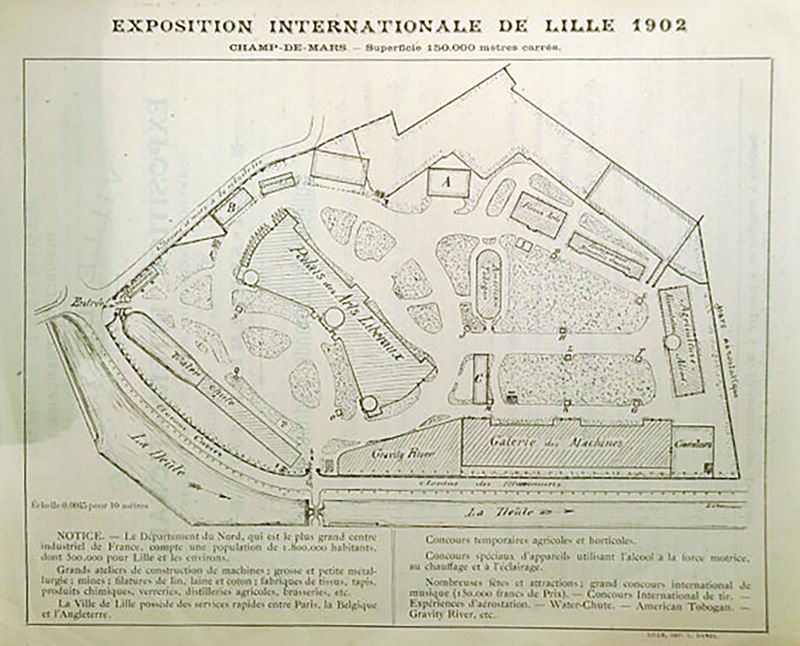
The Exposition internationale de Lille occupied the fifteen hectares of the Champ-de-Mars, the former parade ground beneath the Citadelle de Vauban, through the summer and autumn of 1902. It was a private venture, not a municipal one, promoted by Jean-Alfred Vigé and Raoul Saulay, who between 1898 and 1903 ran a circuit of provincial expositions, recycling structures from one to the next: the Lille pavilions of Agriculture, Beaux-Arts and Enseignement came from Brest in 1901, and much of the Lille fabric was re-erected at Reims the following year. The architect was Armand Lemay of Lille, then early in his career, responsible for the Palais des Arts Libéraux, the Galerie des Machines, the illuminated pavilion and the restaurants and kiosks. Because the venture was commercial and initially ill-regarded, its credibility rested on a Comité technique of local notables under Albert Dujardin, president of the Lille tribunal de commerce, which vouched for exhibitors, appointed half of each class jury, and extracted an undertaking that twenty per cent of profits would go to Nord charities; a parallel Comité Parisien under Jules Rotival recruited exhibitors in the capital.
The exposition opened in two stages, admitting visitors from about May 26 while still unfinished and being formally inaugurated on Sunday June 8. Closure was contractually set for September 15, but in late August the socialist mayor, Gustave Delory, demanded the site be vacated by the 31st against a 70,000-franc deposit for restoring the military ground, hostility the exposition’s journal attributed to a dinner Dujardin had given for Sir Wilfrid Laurier. The quarrel was settled by sharp cuts in the admission price, from one franc to fifty and then twenty-five centimes on Sundays and holidays, and the exposition ran to Sunday October 19, when the closing fêtes and the prize distribution were held together, an arrangement noticed as far away as the Paris press. The cuts transformed attendance: against Sunday crowds of twenty-five to thirty thousand earlier in the season, September 21 brought seventy thousand paying visitors and some eighty-five thousand entries in all.
Alongside the eighteen exhibiting groups came four temporary horticultural competitions and further contests in food, beer and alimentation; a Beaux-Arts salon assembled by Louis Prétet and juried in June under Henry Roujon, director of the Beaux-Arts; a poets’ congress in July under Auguste Dorchain; and a large recreational quarter — Casino, Water-Chute, American Toboggan, Rivière Styx, balloon ascents, a tightrope crossing of the grounds. The high point was the international music competition of August 15–17, which drew 165 societies and some ten thousand musicians under a jury presided over by Théodore Dubois of the Paris Conservatoire. The most conspicuous official visit was Laurier’s, on August 27. The Canadian prime minister was brought by Saulay, who had organised the French section at Toronto in 1898, and the journal noted pointedly that he had come before any French minister. No African village or ethnographic display appears anywhere in the fifteen issues of the official journal, despite claims to the contrary in later secondary accounts; the classification’s Group XVIII, “Colonisation,” covered colonial materials and methods rather than people.
Incubators at the Exposition
Alexandre Lion’s incubator installation at the Exposition internationale de Lille opened with the official inauguration on Sunday June 8, 1902, under the formal designation Pavillon des Couveuses Lion. Le Réveil du Nord announced it two days beforehand as the pavilion to be cited “en première ligne” among those opening to the public, describing small glazed booths in which infants born before term lay in soft cradles suspended hammock-fashion, and taking care to specify that Lion showed not cardboard dolls but living babies, a pre-emptive denial that is itself evidence of the suspicion such exhibits attracted. The paper framed the installation as a work of social charity and as an “œuvre toute maternelle,” language consistent with the Oeuvre Maternelle des Couveuses d’Enfants without naming the organisation.
The pavilion drew crowds throughout the season and did so, on the available evidence, from the beginning. Le Réveil du Nord reported on June 18 that the couveuses had been the object of unceasing visits; a survey notice carried by La Dépêche coloniale on June 19, and reprinted verbatim in the Journal de la ville de Saint-Quentin on the 21st, listed “les Couveuses Lion, œuvre maternelle par excellence” among the exposition’s principal attractions. Sir Wilfrid Laurier’s official tour of August 27 ended with a short visit to the couveuses, positioned last on the Champ-de-Mars circuit after the official pavilions. On Sunday September 21, the first great popular day, with 70,000 paying visitors, the exposition’s own weekly recorded that the fifty supplementary police had an easy time of it except at the Couveuses d’enfants, where the queue of the curious made the work of crowd control more difficult. Independent confirmation comes from outside France: a signed special correspondent’s report in the Gazette de Charleroi, published September 19 and written from a summer visit, opens on the crowd queuing at a small pavilion and identifies it as the premature-infant apparatus of “Léon de Paris” [sic]. The correspondent judged the success greater than at the operator’s own Paris premises or at the Exposition universelle of 1900.
That the pavilion held living infants for extended periods, and that some of them died there, is documented in the Lille état civil returns printed in Le Réveil du Nord, which give the pavilion as a place of death on three occasions: Jules Simoneau, on June 30; Marie Lamour, on August 19; and Pierre Marmignon, on September 22. Lion also functioned as a local subscriber, appearing as a donor to the exposition’s international shooting competition in September, styled “fondateur des couveuses à l’Exposition,” and to the Association de la Presse du Nord’s tombola in October as “directeur des Couveuses d’enfants.” However, the exposition’s Journal officiel is conspicuously silent: across its complete run of fifteen issues it carries no editorial article on the couveuses, no illustration, no naming of Lion or of any medical or nursing staff, and no award. The explanation is most likely contractual — Lion appears to have held a concession rather than an exhibitor’s stand.
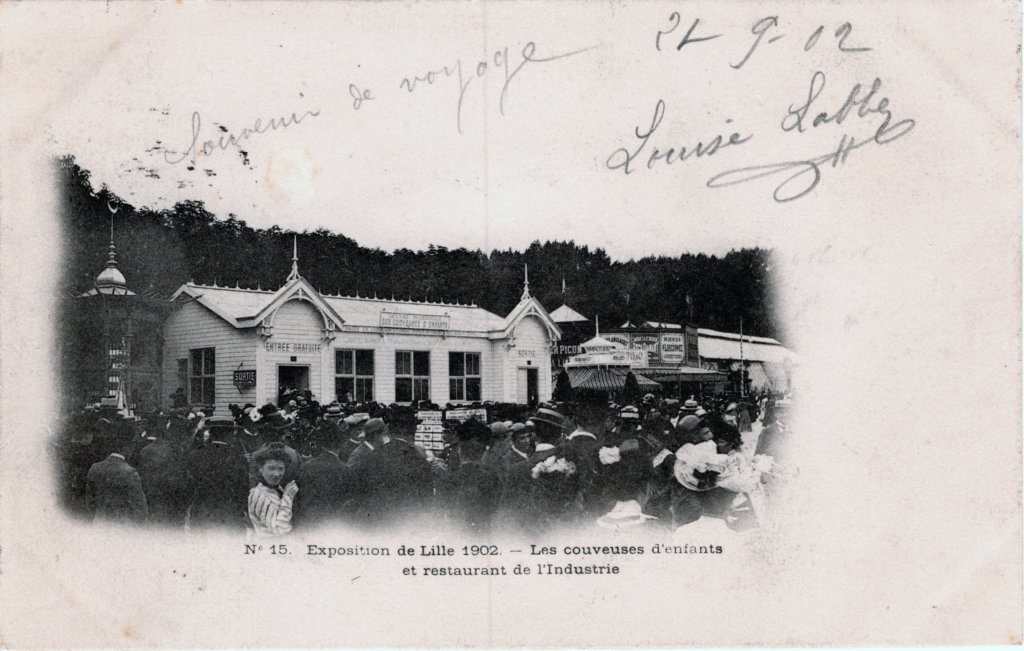
The souvenir postcard below is the only image I have located so far that shows the incubator pavilion; when zoomed in on a high resolution scan, “Oeuvre Maternelle des Couveuses d’Enfants” is clearly visible on the sign on the roof.
Sources – General
- Journal officiel de l’Exposition de Lille, n° 2, 6 juillet 1902 (Brest origin of the Agriculture, Beaux-Arts and Enseignement pavilions); n° 5, 27 juillet 1902 (Beaux-Arts pavilion “d’origine brestoise”); n° 14, 28 septembre 1902 (Vigé biography, Reims commission). For the Lille→Reims transfers, worldfairs.info forum, thread t=968, “Exposition internationale de Lille 1902” (amateur, uncorroborated in detail). Vigé’s circuit is corroborated by Sylvain Bertoldi, “Premières rencontres avec l’Afrique noire,” Vivre à Angers, n° 383, été 2014, Archives municipales d’Angers.
- Journal officiel, n° 1, 1er juillet 1902 (Palais des Arts Libéraux, dimensions and architect); n° 3, 13 juillet 1902 (Galerie des Machines); n° 15, 5 octobre 1902 (Lemay, portrait and notice).
- [Journal officiel, n° 1, 1er juillet 1902 (Comité technique composition, jury arrangements, the 20% undertaking, and “très décriée”).
- Journal officiel, n° 7, 10 août 1902 (“Comité parisien de l’Exposition de Lille”).
- Le Réveil du Nord (Lille), 6 juin 1902, “L’Exposition de Lille — L’inauguration officielle.” Mentions couveuses among the concessions opening on June 8.
- Journal officiel, n° 1, 1er juillet 1902; retrospectively n° 15, 5 octobre 1902.
- Journal officiel, n° 10, 31 août 1902 (“Messieurs, on ferme!”); n° 11, 7 septembre 1902.
- Journal officiel, n° 11, 7 septembre 1902; n° 13, 21 septembre 1902; n° 15, 5 octobre 1902. Le Soir (Paris), 17 octobre 1902, “Informations — L’Exposition de Lille.”
- Journal officiel, n° 2, 6 juillet 1902; n° 13, 21 septembre 1902; n° 14, 28 septembre 1902.
- Journal officiel, n° 2, 6 juillet 1902 (Beaux-Arts palmarès and jury); n° 4, 20 juillet 1902 and n° 15, 5 octobre 1902 (horticultural competitions); n° 5, 27 juillet 1902 (poets’ congress, reported by Léon Bocquet); n° 9, 24 août 1902 (Alzardès); n° 12, 14 septembre 1902 (Casino closure).
- Journal officiel, n° 8, 17 août 1902 (competition organisation, jury, programme); n° 9, 24 août 1902 (results and monument inaugurations).
- Journal officiel, n° 10, 31 août 1902 (Saulay biography); n° 11, 7 septembre 1902 (“Le Voyage de Sir Wilfrid Laurier”); n° 9, 24 août 1902 (“Nul n’est prophète en son pays”).
- Journal officiel, n° 11, 7 septembre 1902 (“après une courte visite aux couveuses d’enfants”); n° 14, 28 septembre 1902 (“le service d’ordre aux Couveuses d’enfants”).
- Journal officiel, n° 2, 6 juillet 1902 (Group XVIII contents); negative evidence across n° 1–15. The contrary claim appears at roubaix1911.blogspot.com, “Village sénégalais” (amateur secondary).
- Exposition Internationale de 1902, from Site dédié à l’histoire de Lille
- Exposition internationale de Lille 1902, from Worldsfair.info
Sources – Incubator Exhibit
- Le Réveil du Nord, 6 juin 1902, « L’Exposition de Lille — L’inauguration officielle ».
- Le Réveil du Nord, 18 juin 1902, « L’Exposition de Lille ».
- Le Réveil du Nord, 2 juillet 1902, « État civil de Lille au 30 juin 1902 ».
- Le Réveil du Nord, 21 août 1902, « État civil de Lille du 19 août 1902 ».
- Le Réveil du Nord, 24 septembre 1902, « État civil de Lille du 22 septembre 1902 ».
- Le Réveil du Nord, 26 septembre 1902, « L’Exposition de Lille » [concours international de tir, 8e liste de lots].
- Le Réveil du Nord, 9 octobre 1902, « La Fête de la Presse du Nord à l’Exposition — La tombola ».
- La Dépêche coloniale, 19 juin 1902, « Échos — L’Exposition de Lille ».
- Journal de la ville de Saint-Quentin et de l’arrondissement, 21 juin 1902, « Lille » [reprint of the preceding].
- Alfred Martin, « Notes de Vacances : Lille et son Exposition, II », Gazette de Charleroi, 19 septembre 1902 (correspondance spéciale).
- Journal officiel de l’Exposition de Lille, n° 11, 7 septembre 1902, « Le Voyage de Sir Wilfrid Laurier ». Bibliothèque municipale de Lille, Jx.163; numérisé, Gallica (BnF), ark:/12148/cb32802037v.
- Journal officiel de l’Exposition de Lille, n° 14, 28 septembre 1902, « Chronique du Jour ». Same holding and ark.
- Journal officiel de l’Exposition de Lille, n° 3, [1902], jury lists, Groupe XVI; and n° 1–15 passim for the absence of couveuse coverage and awards. Same holding and ark.
More Information about Alexandre Lion
- General Information
- Alexandre Lion
- The Lion Incubator
- The Engineer and the Newborns, by W. A. Nelson and Paul L. Toubas
- Lion Patents (France)
- Patent 201550, 1889, Couveuse électro-automatique
- Patent 221716, 1892, Couveuse automatique
- Patent 262090, 1896, Chambre vivifiante
- Patent 281687, 1898, Système de filtration de l’air
- Patent 287557, 1899, Système de filtration des fumées, de l’air et de toutes masses gazeuses avec tirage et ventilation
- Patent 189989, 1899, Appareil pour le filtrage et la purification de l’air et des fumées
- Maternité Lion Institutes and City Exhibits
- Alexandre Lion’s first incubator baby exhibit in Marseille, 1890.
- Œuvre Maternelle des Couveuses d’Enfants, Nice
- Œuvre Maternelle des Couveuses d’Enfants, Lyon
- Œuvre Maternelle des Couveuses d’Enfants, Paris
- Œuvre Maternelle des Couveuses d’Enfants, Toulouse
- Œuvre Maternelle des Couveuses d’Enfants, Amiens
- Œuvre Maternelle des Couveuses d’Enfants, New York
- Œuvre Maternelle des Couveuses d’Enfants, Barcelona
- Œevre Maternelle des Couveuses d’Enfants, Brussels
- Maternité Lion Souvenir Booklets
- Œuvre Maternelle des Couveuses d’Enfants , Paris Institute, Booklet Version #1 (appears to be ~1896)
- Œuvre Maternelle des Couveuses d’Enfants , Paris Institute, Booklet Version #2 (appears to be ~1901)
- Pamphlet from Alexander Lion’s exhibit at the 1898 exhibition in Torino, Italy. (PDF supplied by Dr. Thijs Gras, Amsterdam)
- Press Coverage
- La Maternité “Lion de Nice” pour Enfants Nés Avant Terme ou Débiles, by Dr. Ciaudo, 1895. Source: gallica.bnf.fr.

- Presentation d’Appareil, by M. A. Pinard, Bulletin de l’Académie nationale de médecine, 1893. Source: gallica.bnf.fr.
- Les couveuses d’enfant et le gavage, by César-A Queirolo, Includes discussion of Lion incubator and comparison to other types. Thèse de doctorat: Univ. Genève, 1897.
- Les Couveuses pour Enfants, Gazette Médicale de Paris, No. 40, October 6, 1900
- Couveuses d’Enfants, La Maternité Lion, Paris, La Patrie, 1897
- Paris Letter: An Improved System of Incubators, by O. Jennings, Pediatrics 1:427-428, 1896
- Baby Incubators, The Strand Magazine, 1896, by James Walter Smith
- Human Infant Incubation: A True Fairy-Tale of Modern Science from Leslie’s Weekly, 1897
- The Saving of Human Life, Maternité Lion in NYC, The Literary Digest, 1898
- Immature Infants in France, from The Lancet, January 16, 1897, page 196.
- De Lion Incubator at Low Maternity Hospital, by Francis H. Stuart, Brooklyn Medical Journal, 1901
- Alexandre Lion’s Incubator Charities in Europe (1894–1898) (The Embryo Project)
- La Maternité “Lion de Nice” pour Enfants Nés Avant Terme ou Débiles, by Dr. Ciaudo, 1895. Source: gallica.bnf.fr.
- Worlds Fairs and Expositions
- Maternité Lion at the Lyon Exposition Universelle et Coloniale, 1894
- Maternité Lion at the Lyon Exposition Universelle – Le Monde Illustré, 1894
- Maternité Lion at the Bordeaux Exposition of 1895.
- “La Maternité Lion,” by Louis Énault, Journal of the Bordeaux Exposition, 1895
- Maternité Lion at the Amsterdam World Exposition, 1895
- Maternité Lion at the Berliner Gewerbeausstellung, 1896
- “Bericht ǔber die Couveuse (Lion) oder Kinderbrutanstalt” [Report about the Lion Incubator] from Berlin und seine Arbeit – Amtlicher Bericht der Berliner Gewerbe-Ausstellung 1896. English Translation.
- Maternité Lion at the Exposition National Suisse, Geneva, Switzerland, 1896
- “Quelques Réflexions sur le Fonctionnement et les Résultats des Couveuses Lion pendant l’Exposition Nationale,” by Dr. Hector Maillart, Revue Médicale de La Suisse Romande, 1896. English translation.
- Internationale Ausstellung für Körperliche Erziehung, Gesundheitspflege und Sport, Innsbruck, 1896
- Maternité Lion at the Tennessee Centennial Exposition, 1897
- Maternité Lion at the Brussels International Exposition, 1897
- Maternité Lion at the Turin L’Esposizione Generale Italiana, 1898
- Maternite Lion at the Ghent Provincial Exposition of 1899
- Maternité Lion at the Greater Britain Exhibition of 1899
- Maternité Lion at the Paris Exposition Universelle of 1900
- Maternité Lion at the Woman’s Exhibition in Earls Court, London, 1900
- Maternité Lion at the Lille Exposition of 1902
- Maternité Lion at the Exposition Internationale de Reims, 1903
- Maternité Lion at the Nantes Exposition of 1904
- Maternité Lion at the Exposition du Nord de la France, 1904
- Maternité Lion at the Liège Exposition Universelle et Internationale, 1905.
- Maternité Lion at the Marseille Colonial Exposition of 1906
- Maternite Lion at the Bordeaux International Maritime Exposition of 1907
- Maternité Lion at the Marseille Exposition Internationale d’Électricité, 1908
- Maternité Lion at the Exposition Internationale de l’Est de la France, Nancy, France, 1909
- Maternité Lion at the Brussels Exposition Universelle et Internationale, 1910
- Maternite Lion at the Exposition du Centre de la France, Clermont-Ferrand, 1910
- Maternité Liion at the Rome International Exposition of 1911
- Maternité Lion at the Turin International Exposition of 1911
- Maternité Lion at the Exposition Internationale de Dunkerque, 1912
- Maternité Lion at the Ghent International Exposition of 1913
- Maternité Lion at the Exposition Internationale Urbaine de Lyon, 1914
- Maternité Lion at the Lyon Exposition Universelle et Coloniale, 1894
French primary sources were machine-translated, then checked against the originals and edited by the author. Portions of this page were drafted with machine assistance; the final text was reviewed, verified, and edited by the author. Click here to learn more.
Last Updated on 09/04/26