Ouevre Maternelle des Couveuses d’Enfants, Barcelona
Oeuvre Maternelle des Couveuses d’Enfants in Barcelona, or “Obra Maternal de Incubadoras para Criaturas” as it was known in Spain, was located at 34 Calle del Conde del Asalto. Based on contemporary press accounts it appears to have opened for business on December 6, 1902. We do not know how long it persisted there, but I could not find any mention of it in Spanish newspapers after January 1903.
Press Coverage
Coverage of the Barcelona Obra Maternal incubator institute clusters in three illustrated periodicals across December 1902–January 1903 (one item predates 1903), corroborated by a contemporary business directory. All treat the same Barcelona installation of Alexandre (“Alejandro”) Lion’s incubators, with Dr. Rodríguez Ruiz named consistently as its local medical director.
Alrededor del Mundo (Madrid), 19 Dec 1902, pp. 403–404 — by R. Mainar Lahuerta. Reports that the institution began operating on 6 December 1902 in Barcelona, presented as the “primera instalación española.” It stresses the charitable model: apparatus once affordable only to the wealthy are now offered free to the poor through Lion’s initiative. Credits Lion of Paris as inventor of the apparatus but explicitly not of the procedure (“aun cuando no del procedimiento”) — a framing consistent with an engineer’s role rather than a clinician’s, and notably it does not call him a physician. Describes the technical setup: a glass-walled chamber held at constant temperature by a water reservoir heated with a gas burner and metallic thermo-regulator, air renewal via two tubes, and an adjoining heated chamber (cámara-estufa) where wet-nurses breastfeed. Uses the term hidromadres for the devices. Notes endorsement by Dr. Martínez Vargas (professor of children’s diseases, Faculty of Medicine), an annexed free children’s dispensary, distribution of promotional postcards, and two premature infants then under treatment, both reportedly thriving.
Vida Galante (Barcelona), 7 Jan 1903 — “La Obra Maternal.” Frames the work as scientifically supplementing “an incomplete maternity.” Emphasizes institutional legitimacy: the Lion incubators are approved by France’s public-hygiene directorate and subsidized by the French government. States that Barcelona is the first Spanish city with such an installation, running with “perfect regularity.” Names Dr. Rodríguez Ruiz (described as a professor of the local Faculty of Medicine) as medical director — reserving the clinical authority for him rather than Lion. Predicts rapid spread of installations across Spain. Illustrated with photos of incubators in operation and technical staff (credited “Fot. P. Rodríguez”).
El Mundo Científico (Barcelona), no. 148, 31 Jan 1903, pp. 78–79 — “Las incubadoras Lion en España.” The most technical account. Notes the apparatus is not new, having won its first award in 1894 at a competition in Lyon, and gives the installation’s address: Calle del Conde del Asalto, 34. Identifies “Alejandro Lion” as director and founder of the Obra Maternal (not médico) and Dr. Rodríguez Ruiz as its medical director in Barcelona. Cites observations on more than 4,000 infants reared in Lion incubators, reproducing a table of average weights, lengths, and biparietal diameters by age. Includes an extended clinical discussion of prematurity (hypothermia below 37°, weight as the key index of debility, atelectasis, pneumonia risk, thrush) and closes with an appeal for public charity (“caridad profiláctica”).
Anuario Riera: Guía general de Cataluña (Barcelona), 1903, p. 338 — business directory, not press coverage, but an independent listing that fixes both the institution’s location and Lion’s stated profession in the 1903 Barcelona record: “Lion (Alejandro), médico y fundador de la Obra Maternal (incubadoras para niños), Conde Asalto, 34.” This corroborates the Conde del Asalto, 34 address given by El Mundo Científico. It is the outlier that explicitly labels Lion “médico” — a documented instance of the misattribution of a medical title to an engineer.
Points where the sources differ or add distinct detail:
- Lion’s title: El Mundo Científico and Alrededor del Mundo treat him as founder/inventor without calling him a physician; the Anuario Riera tags him “médico.” Since Lion was an engineer, the directory’s label is an error, and press use of “Dr. Lion” is honorific inflation. The clinical role belongs to Rodríguez Ruiz across all sources that name a medical director.
- Lion’s location: Alrededor del Mundo calls him “de París”; El Mundo Científico ties his 1894 prize to Lyon. Both hispanicize the name to “Alejandro.”
- Opening date: only Alrededor del Mundo gives one (6 Dec 1902); the others omit it.
- Address: El Mundo Científico and the Anuario Riera both give Calle del Conde del Asalto, 34.
- Institutional endorsements: Alrededor del Mundo cites Martínez Vargas; Vida Galante cites French government approval and subsidy; El Mundo Científico cites the 1894 Lyon award and the >4,000-infant dataset.
Dr. Lion distributed one of his typical postcards for the Barcelona branch, as he did for his other permanent storefronts and many of his pavilions in expositions. Unlike the Paris postcards, which are everywhere on eBay, the Barcelona Obra Maternal postcards are quite scarce, and it required several years of searches on Spain’s eBay site to acquire one.
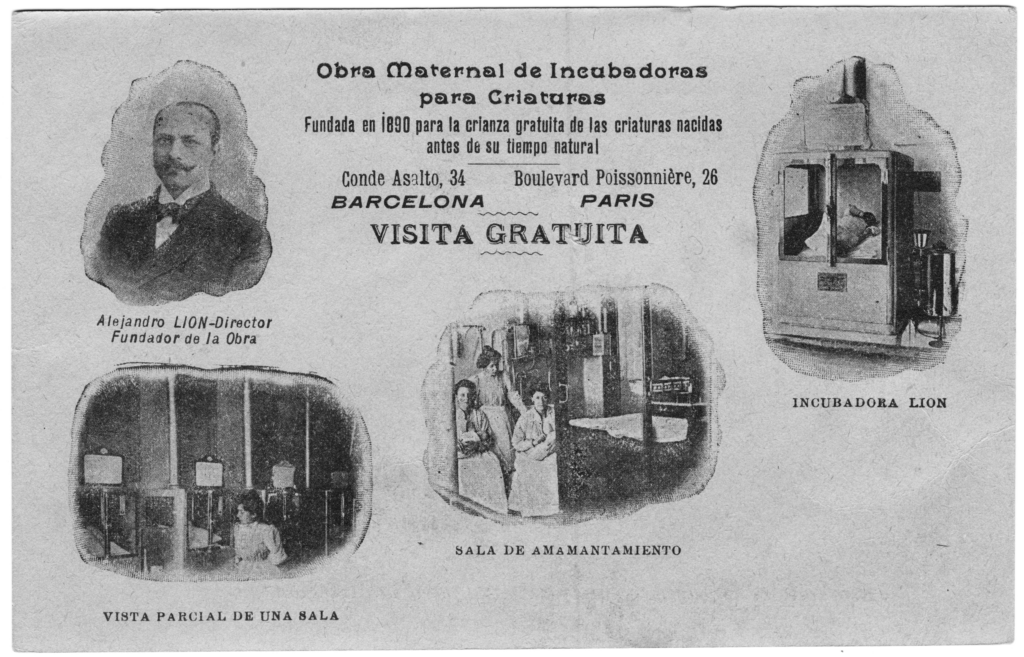
Sources
- Mainar Lahuerta, R. “Incubadoras para criaturas: Primera instalación española.” Alrededor del Mundo (Madrid), 19 December 1902, pp. 403–404.
- “La Obra Maternal.” Vida Galante (Barcelona), 7 January 1903.
- “Las incubadoras Lion en España.” El Mundo Científico (Barcelona), no. 148, 31 January 1903, pp. 78–79.
- Anuario Riera: Guía general de Cataluña, 1903, p. 338 (entry: “Lion, Alejandro”), Barcelona.
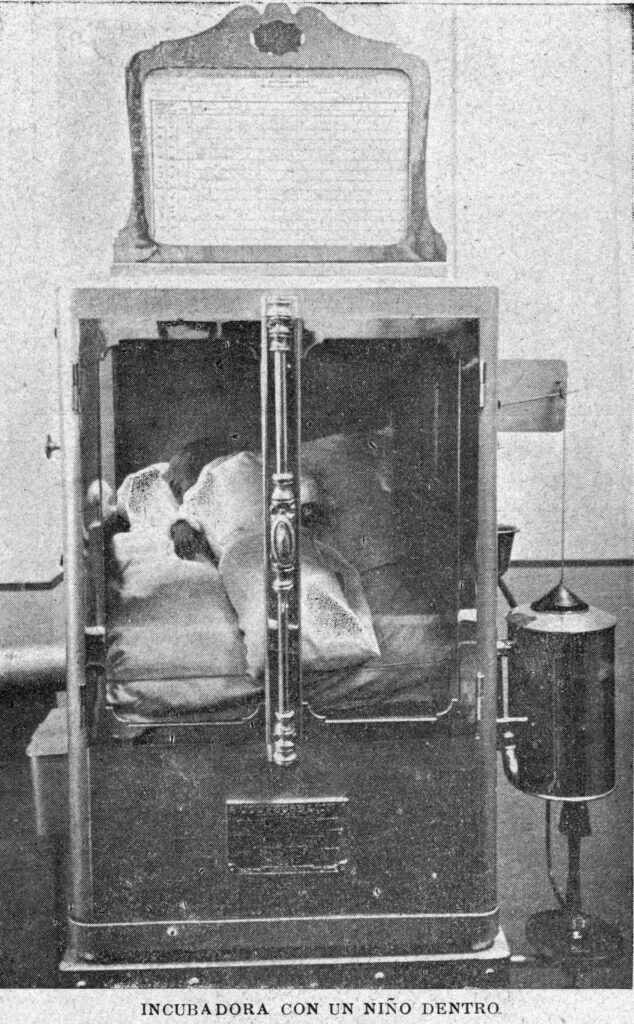
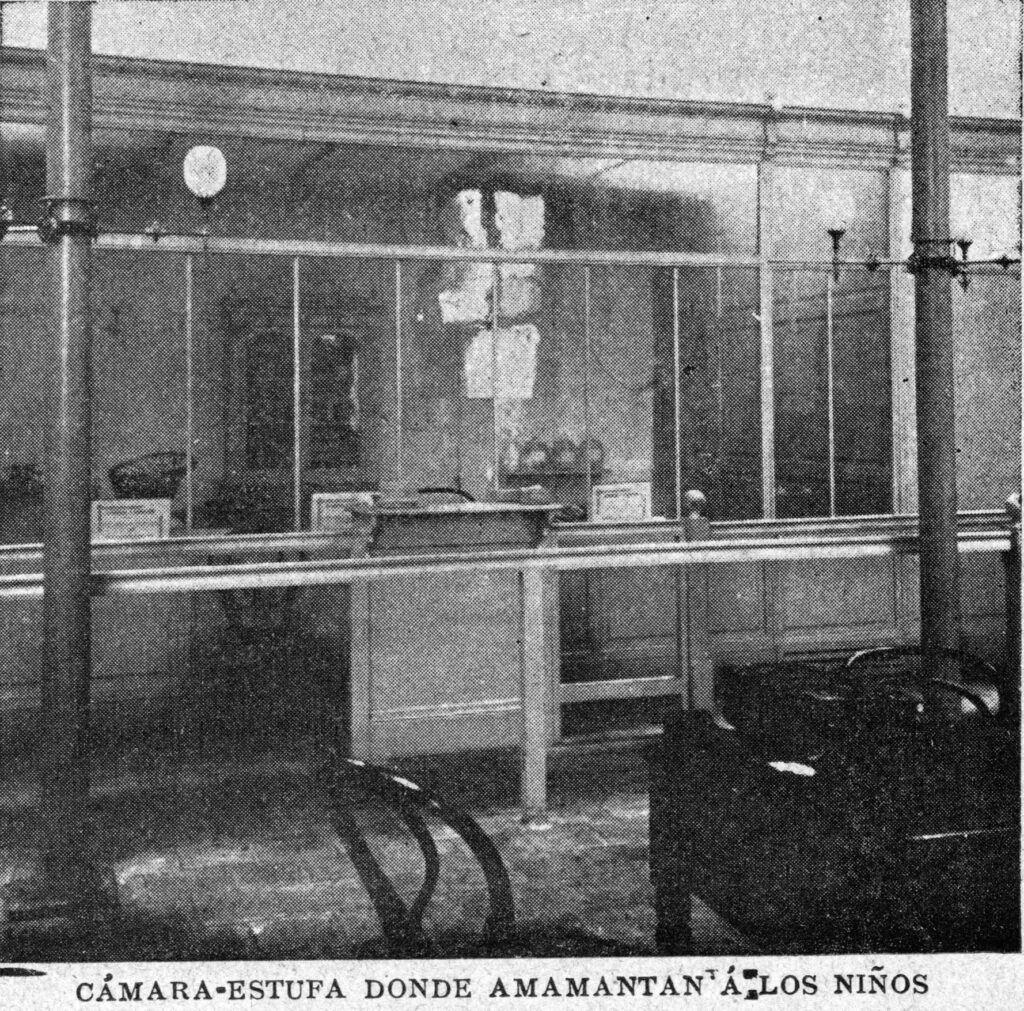
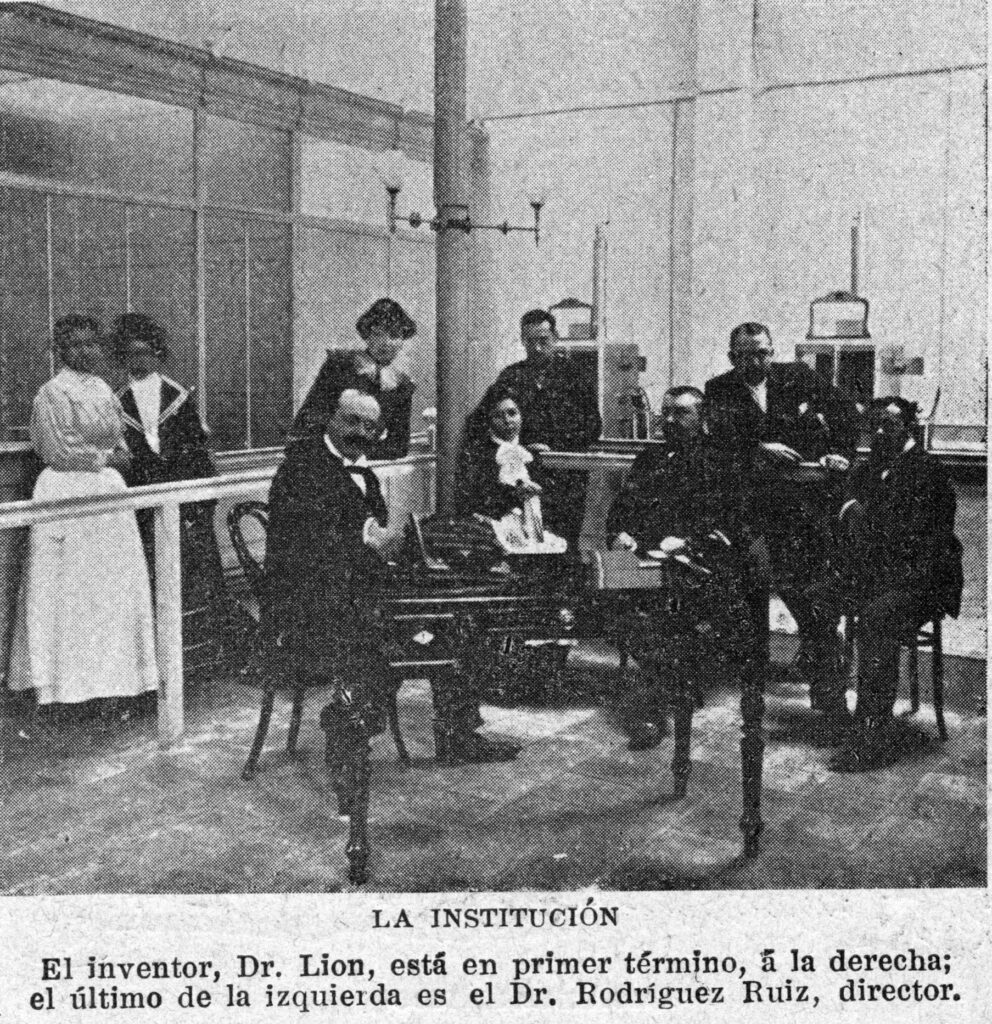


Source: Vida Galante (Barcelona), 7 January 1903.


Source: El Mundo Científico (Barcelona), no. 148, 31 January 1903, pp. 78–79
More Information about Alexandre Lion
- General Information
- Alexandre Lion
- The Lion Incubator
- The Engineer and the Newborns, by W. A. Nelson and Paul L. Toubas
- Lion Patents (France)
- Patent 201550, 1889, Couveuse électro-automatique
- Patent 221716, 1892, Couveuse automatique
- Patent 262090, 1896, Chambre vivifiante
- Patent 281687, 1898, Système de filtration de l’air
- Patent 287557, 1899, Système de filtration des fumées, de l’air et de toutes masses gazeuses avec tirage et ventilation
- Patent 189989, 1899, Appareil pour le filtrage et la purification de l’air et des fumées
- Maternité Lion Institutes and City Exhibits
- Alexandre Lion’s first incubator baby exhibit in Marseille, 1890.
- Œuvre Maternelle des Couveuses d’Enfants, Nice
- Œuvre Maternelle des Couveuses d’Enfants, Lyon
- Œuvre Maternelle des Couveuses d’Enfants, Paris
- Œuvre Maternelle des Couveuses d’Enfants, Toulouse
- Œuvre Maternelle des Couveuses d’Enfants, Amiens
- Œuvre Maternelle des Couveuses d’Enfants, New York
- Œuvre Maternelle des Couveuses d’Enfants, Barcelona
- Œevre Maternelle des Couveuses d’Enfants, Brussels
- Maternité Lion Souvenir Booklets
- Œuvre Maternelle des Couveuses d’Enfants , Paris Institute, Booklet Version #1 (appears to be ~1896)
- Œuvre Maternelle des Couveuses d’Enfants , Paris Institute, Booklet Version #2 (appears to be ~1901)
- Pamphlet from Alexander Lion’s exhibit at the 1898 exhibition in Torino, Italy. (PDF supplied by Dr. Thijs Gras, Amsterdam)
- Press Coverage
- La Maternité “Lion de Nice” pour Enfants Nés Avant Terme ou Débiles, by Dr. Ciaudo, 1895. Source: gallica.bnf.fr.

- Presentation d’Appareil, by M. A. Pinard, Bulletin de l’Académie nationale de médecine, 1893. Source: gallica.bnf.fr.
- Les couveuses d’enfant et le gavage, by César-A Queirolo, Includes discussion of Lion incubator and comparison to other types. Thèse de doctorat: Univ. Genève, 1897.
- Les Couveuses pour Enfants, Gazette Médicale de Paris, No. 40, October 6, 1900
- Couveuses d’Enfants, La Maternité Lion, Paris, La Patrie, 1897
- Paris Letter: An Improved System of Incubators, by O. Jennings, Pediatrics 1:427-428, 1896
- Baby Incubators, The Strand Magazine, 1896, by James Walter Smith
- Human Infant Incubation: A True Fairy-Tale of Modern Science from Leslie’s Weekly, 1897
- The Saving of Human Life, Maternité Lion in NYC, The Literary Digest, 1898
- Immature Infants in France, from The Lancet, January 16, 1897, page 196.
- De Lion Incubator at Low Maternity Hospital, by Francis H. Stuart, Brooklyn Medical Journal, 1901
- Alexandre Lion’s Incubator Charities in Europe (1894–1898) (The Embryo Project)
- La Maternité “Lion de Nice” pour Enfants Nés Avant Terme ou Débiles, by Dr. Ciaudo, 1895. Source: gallica.bnf.fr.
- Worlds Fairs and Expositions
- Maternité Lion at the Lyon Exposition Universelle et Coloniale, 1894
- Maternité Lion at the Lyon Exposition Universelle – Le Monde Illustré, 1894
- Maternité Lion at the Bordeaux Exposition of 1895.
- “La Maternité Lion,” by Louis Énault, Journal of the Bordeaux Exposition, 1895
- Maternité Lion at the Amsterdam World Exposition, 1895
- Maternité Lion at the Berliner Gewerbeausstellung, 1896
- “Bericht ǔber die Couveuse (Lion) oder Kinderbrutanstalt” [Report about the Lion Incubator] from Berlin und seine Arbeit – Amtlicher Bericht der Berliner Gewerbe-Ausstellung 1896. English Translation.
- Maternité Lion at the Exposition National Suisse, Geneva, Switzerland, 1896
- “Quelques Réflexions sur le Fonctionnement et les Résultats des Couveuses Lion pendant l’Exposition Nationale,” by Dr. Hector Maillart, Revue Médicale de La Suisse Romande, 1896. English translation.
- Internationale Ausstellung für Körperliche Erziehung, Gesundheitspflege und Sport, Innsbruck, 1896
- Maternité Lion at the Tennessee Centennial Exposition, 1897
- Maternité Lion at the Brussels International Exposition, 1897
- Maternité Lion at the Turin L’Esposizione Generale Italiana, 1898
- Maternite Lion at the Ghent Provincial Exposition of 1899
- Maternité Lion at the Greater Britain Exhibition of 1899
- Maternité Lion at the Paris Exposition Universelle of 1900
- Maternité Lion at the Woman’s Exhibition in Earls Court, London, 1900
- Maternité Lion at the Lille Exposition of 1902
- Maternité Lion at the Exposition Internationale de Reims, 1903
- Maternité Lion at the Nantes Exposition of 1904
- Maternité Lion at the Exposition du Nord de la France, 1904
- Maternité Lion at the Liège Exposition Universelle et Internationale, 1905.
- Maternité Lion at the Marseille Colonial Exposition of 1906
- Maternite Lion at the Bordeaux International Maritime Exposition of 1907
- Maternité Lion at the Marseille Exposition Internationale d’Électricité, 1908
- Maternité Lion at the Exposition Internationale de l’Est de la France, Nancy, France, 1909
- Maternité Lion at the Brussels Exposition Universelle et Internationale, 1910
- Maternite Lion at the Exposition du Centre de la France, Clermont-Ferrand, 1910
- Maternité Liion at the Rome International Exposition of 1911
- Maternité Lion at the Turin International Exposition of 1911
- Maternité Lion at the Exposition Internationale de Dunkerque, 1912
- Maternité Lion at the Ghent International Exposition of 1913
- Maternité Lion at the Exposition Internationale Urbaine de Lyon, 1914
- Maternité Lion at the Lyon Exposition Universelle et Coloniale, 1894
Last Updated on 07/12/26