Clermont-Ferrand Exposition du Centre de la France, 1910
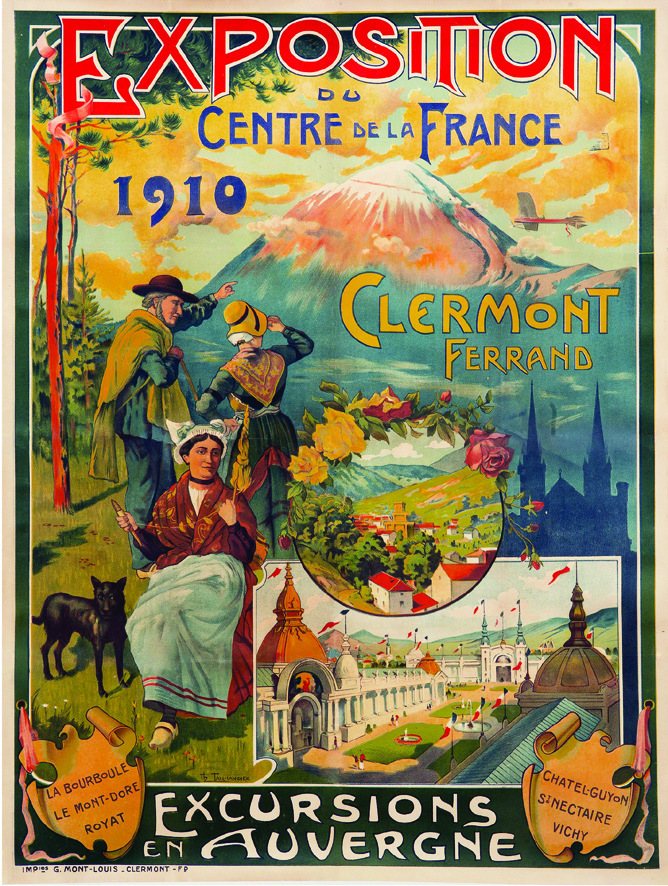
The Exposition du Centre de la France, also known as the Exposition de Clermont-Ferrand, ran from late spring to the end of September 1910. Its promoters described it as Clermont’s turn in the annual cycle of French cities mounting a large fair, and Gil Blas called it an “exposition internationale,” though in practice it was regional and national in scope. The grounds spanned three zones: the main palais of industries diverses, beaux-arts, and agriculture at Place Gambetta, with formal gardens; a reconstructed “Vieille-Auvergne” village off the rue de la Vieille-Auvergne; and the Jardin Lecoq, which held the paying attractions and the evening illuminations. It opened daily from 9 a.m., at 1 franc by day and 50 centimes in the evening, with season passes; a “Festival permanent de musique” rotated regional bands and the Casino ran the Cinéma Pathé. Attendance topped 10,000 on Sunday 12 June. President of France Fallières toured the fair, Royat, and the Hôtel-Dieu on July 3rd, and spoke at a municipal banquet of 300.
The Jardin Lecoq attractions are the best-documented and most historically fraught part of the fair. Its centerpiece was a “Village Noir,” a human zoo of roughly eighty men, women, and children billed as Senegalese and Sudanese, who embarked at Dakar on 21 May aboard the Formosa and performed staged dances (fétiches, sabre, lion, Sudanese wrestling) through the summer; it outlasted the main fair, closing around October 19. In the same amusement cluster stood a “Pavillon des couveuses d’enfants,” an Alexandre Lion infant-incubator concession advertising living babies, documented by contemporary postcards but unmentioned in the press accounts, which is consistent with the pattern of Lion’s later exhibits being treated as routine fixtures. A folklore competition of bourrées, vielles, musettes, and cornemuses was held on 28 August under the “section des industries rurales.” One durable legacy emerged: the Musée régional assembled by the Veillée d’Auvergne, singled out by Fallières, was preserved on mayor Fabre’s initiative and rehoused as a permanent folklore museum.
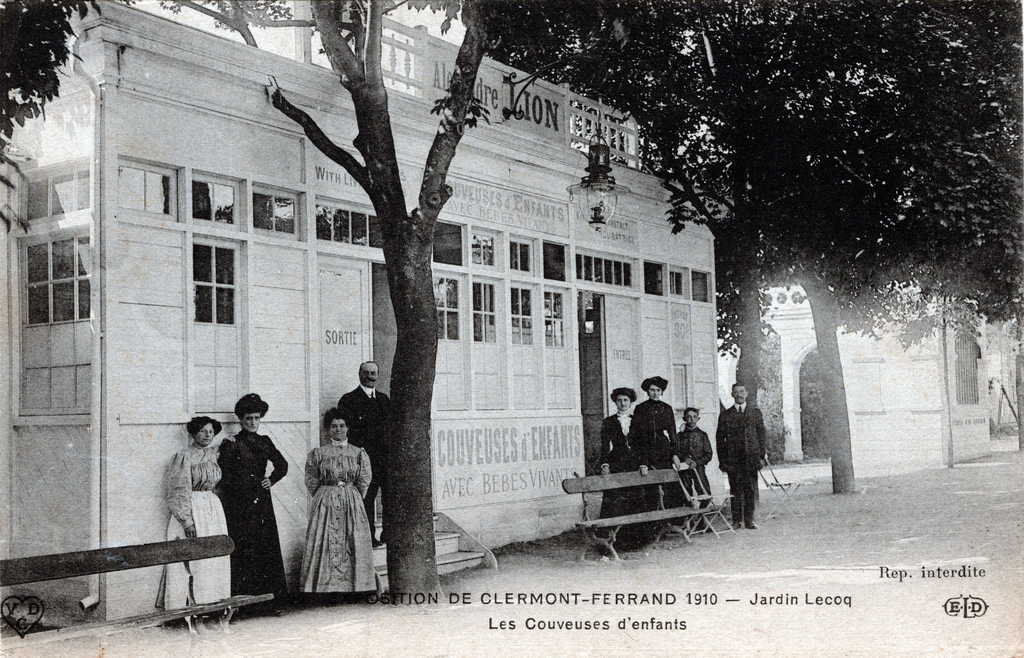
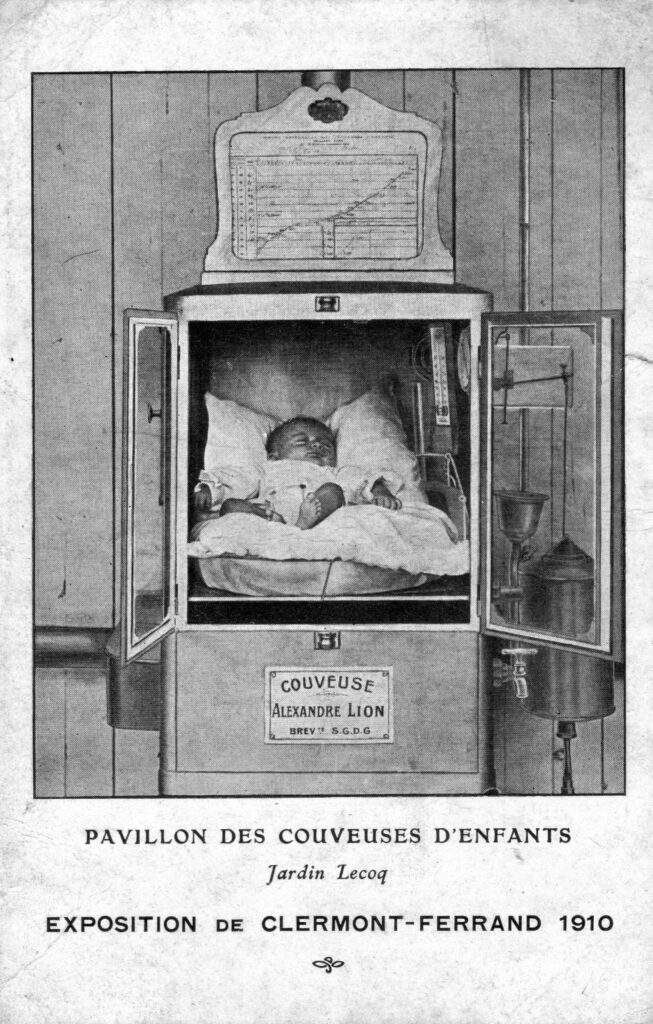
The online documentation of the 1910 Clermont-Ferrand Exposition is thin, with no official guide, catalog, or rapport found in the usual archives. What survives online is scattered stories in the 1910 national and regional press, a run of commercial postcards which can be found on the usual auction sites, and recent journalism. La bibliiotheque numérique du patrimoine of the Clermont-Auvergne Metropole has the Catalog Officiel and a number of photographs in its holdings for consultation on-site.
Press Sources
- Le Courrier du Puy-de-Dôme, 19 May 1910. Village Noir: eighty “indigènes,” embarkation at Dakar 21 May aboard the Formosa. Caveat: paper’s own ethnonyms are “sénégalaises et soudanaises.”
- La Démocratie cantalienne, 8 June 1910. Postponement of the presidential visit pending the Pluviôse funerals.
- La Croix d’Auvergne, 19 June 1910. Attendance over 10,000 on 12 June; hours and admission prices.
- Gil Blas, 28 June 1910, “Le Gil Blas visite l’Exposition de Clermont-Ferrand,” L. Begon. Framing and exhibitor coverage. Caveat: marked “à suivre”; the promised continuation naming further exhibitors has not been located.
- Le Mémorial de la Loire et de la Haute-Loire, 30 June 1910. Presidential programme for 2 and 3 July.
- Le Figaro, 4 July 1910. Vigé’s prior expositions; exhibitor notes.
- Le Courrier du Puy-de-Dôme, 10 July 1910. Village Noir programme; attractions roundup (which omits the couveuses).
- Le Courrier du Puy-de-Dôme, 24 July 1910; Journal du Cher, 28 July 1910. Announcement of the 28 August folklore concours.
- Le Voltaire, 4 September 1910, “Bourrées auvergnates,” Chassaigne de Neronde. Review of the concours; jury including Léon Melchissédec. Caveat: largely an ethnographic essay rather than fair reportage.
- L’Auvergnat de Paris, 17 September 1910. Preservation of the Musée régional on Fabre’s initiative; Musée d’Arles comparison.
- Le Mémorial de la Loire, 28 September 1910. Award to André Arlin (photogravure, Lyon).
- L’Écho de Paris, 30 September 1910; reprinted as Le Réveil, 1 October 1910 (L.B.). Near-closing notice; awards to Salmson, Thouvenin, Ruggieri. Caveat: Le Réveil is a reprint of the Écho de Paris text, not independent testimony.
- La Démocratie cantalienne, 1 October 1910 (fair “vient de prendre fin”; sapeurs-pompiers awards) and 12 October 1910 (awards to Landes et Vaurs, Barreau et Girad).
- L’Émancipateur, 2 October 1910. Award to La Capitalisation.
Online Sources
- Groupe de recherche Achac, “L’Exposition de Clermont-Ferrand 1910,” achac.com. Relays Le Moniteur du Puy-de-Dôme, 19 October 1910 (“sans tambour ni trompettes”) and Pierre Belin’s “La Ballade des Nègres.”
- France 3 Auvergne-Rhône-Alpes, “‘Village Noir’ au jardin Lecoq…”, 28 November 2025, france3-regions.franceinfo.fr. Cites AD Puy-de-Dôme 10 Fi 3628 and the Village Noir tracts; tied to the Histoires Crépues festival “Auvergne (Dé)coloniale”
- Ville de Clermont-Ferrand, “Historique” (Jardin Lecoq). Records the “Bonne Auberge” built at the Jardin Lecoq for the 1910 fair and later demolished.
Offline Sources
- Archives départementales du Puy-de-Dôme, Clermont-Ferrand (Croix-de-Neyrat). Iconographic “10 Fi” series (including 10 Fi 3628); ciné-photographique database (roughly 100,000 images); Village Noir advertising tracts; probable administrative file on the exposition. Finding aids at archivesdepartementales.puy-de-dome.fr.
- Bibliothèque du Patrimoine de Clermont Auvergne Métropole. Auvergne dépôt légal, affiches, cartes postales, and any surviving guide, programme, or rapport; digital library Overnia. Closed since 1 August 2025 for relocation, reopening autumn 2026 at the Bibliothèque Métropolitaine, Hôtel-Dieu. Remote reference and reproduction via SARA (bibliotheque.patrimoine@clermontmetropole.eu).
- Archives municipales de Clermont-Ferrand. Conseil municipal deliberations and municipal administration of the fair under mayor Fabre.
More Information about Alexandre Lion
- General Information
- Alexandre Lion
- The Lion Incubator
- The Engineer and the Newborns, by W. A. Nelson and Paul L. Toubas
- Lion Patents (France)
- Patent 201550, 1889, Couveuse électro-automatique
- Patent 221716, 1892, Couveuse automatique
- Patent 262090, 1896, Chambre vivifiante
- Patent 281687, 1898, Système de filtration de l’air
- Patent 287557, 1899, Système de filtration des fumées, de l’air et de toutes masses gazeuses avec tirage et ventilation
- Patent 189989, 1899, Appareil pour le filtrage et la purification de l’air et des fumées
- Maternité Lion Institutes and City Exhibits
- Alexandre Lion’s first incubator baby exhibit in Marseille, 1890.
- Œuvre Maternelle des Couveuses d’Enfants, Nice
- Œuvre Maternelle des Couveuses d’Enfants, Lyon
- Œuvre Maternelle des Couveuses d’Enfants, Paris
- Œuvre Maternelle des Couveuses d’Enfants, Toulouse
- Œuvre Maternelle des Couveuses d’Enfants, Amiens
- Œuvre Maternelle des Couveuses d’Enfants, New York
- Œuvre Maternelle des Couveuses d’Enfants, Barcelona
- Œevre Maternelle des Couveuses d’Enfants, Brussels
- Maternité Lion Souvenir Booklets
- Œuvre Maternelle des Couveuses d’Enfants , Paris Institute, Booklet Version #1 (appears to be ~1896)
- Œuvre Maternelle des Couveuses d’Enfants , Paris Institute, Booklet Version #2 (appears to be ~1901)
- Pamphlet from Alexander Lion’s exhibit at the 1898 exhibition in Torino, Italy. (PDF supplied by Dr. Thijs Gras, Amsterdam)
- Press Coverage
- La Maternité “Lion de Nice” pour Enfants Nés Avant Terme ou Débiles, by Dr. Ciaudo, 1895. Source: gallica.bnf.fr.

- Presentation d’Appareil, by M. A. Pinard, Bulletin de l’Académie nationale de médecine, 1893. Source: gallica.bnf.fr.
- Les couveuses d’enfant et le gavage, by César-A Queirolo, Includes discussion of Lion incubator and comparison to other types. Thèse de doctorat: Univ. Genève, 1897.
- Les Couveuses pour Enfants, Gazette Médicale de Paris, No. 40, October 6, 1900
- Couveuses d’Enfants, La Maternité Lion, Paris, La Patrie, 1897
- Paris Letter: An Improved System of Incubators, by O. Jennings, Pediatrics 1:427-428, 1896
- Baby Incubators, The Strand Magazine, 1896, by James Walter Smith
- Human Infant Incubation: A True Fairy-Tale of Modern Science from Leslie’s Weekly, 1897
- The Saving of Human Life, Maternité Lion in NYC, The Literary Digest, 1898
- Immature Infants in France, from The Lancet, January 16, 1897, page 196.
- De Lion Incubator at Low Maternity Hospital, by Francis H. Stuart, Brooklyn Medical Journal, 1901
- Alexandre Lion’s Incubator Charities in Europe (1894–1898) (The Embryo Project)
- La Maternité “Lion de Nice” pour Enfants Nés Avant Terme ou Débiles, by Dr. Ciaudo, 1895. Source: gallica.bnf.fr.
- Worlds Fairs and Expositions
- Maternité Lion at the Lyon Exposition Universelle et Coloniale, 1894
- Maternité Lion at the Lyon Exposition Universelle – Le Monde Illustré, 1894
- Maternité Lion at the Bordeaux Exposition of 1895.
- “La Maternité Lion,” by Louis Énault, Journal of the Bordeaux Exposition, 1895
- Maternité Lion at the Amsterdam World Exposition, 1895
- Maternité Lion at the Berliner Gewerbeausstellung, 1896
- “Bericht ǔber die Couveuse (Lion) oder Kinderbrutanstalt” [Report about the Lion Incubator] from Berlin und seine Arbeit – Amtlicher Bericht der Berliner Gewerbe-Ausstellung 1896. English Translation.
- Maternité Lion at the Exposition National Suisse, Geneva, Switzerland, 1896
- “Quelques Réflexions sur le Fonctionnement et les Résultats des Couveuses Lion pendant l’Exposition Nationale,” by Dr. Hector Maillart, Revue Médicale de La Suisse Romande, 1896. English translation.
- Internationale Ausstellung für Körperliche Erziehung, Gesundheitspflege und Sport, Innsbruck, 1896
- Maternité Lion at the Tennessee Centennial Exposition, 1897
- Maternité Lion at the Brussels International Exposition, 1897
- Maternité Lion at the Turin L’Esposizione Generale Italiana, 1898
- Maternite Lion at the Ghent Provincial Exposition of 1899
- Maternité Lion at the Greater Britain Exhibition of 1899
- Maternité Lion at the Paris Exposition Universelle of 1900
- Maternité Lion at the Woman’s Exhibition in Earls Court, London, 1900
- Maternité Lion at the Lille Exposition of 1902
- Maternité Lion at the Exposition Internationale de Reims, 1903
- Maternité Lion at the Nantes Exposition of 1904
- Maternité Lion at the Exposition du Nord de la France, 1904
- Maternité Lion at the Liège Exposition Universelle et Internationale, 1905.
- Maternité Lion at the Marseille Colonial Exposition of 1906
- Maternite Lion at the Bordeaux International Maritime Exposition of 1907
- Maternité Lion at the Marseille Exposition Internationale d’Électricité, 1908
- Maternité Lion at the Exposition Internationale de l’Est de la France, Nancy, France, 1909
- Maternité Lion at the Brussels Exposition Universelle et Internationale, 1910
- Maternite Lion at the Exposition du Centre de la France, Clermont-Ferrand, 1910
- Maternité Liion at the Rome International Exposition of 1911
- Maternité Lion at the Turin International Exposition of 1911
- Maternité Lion at the Exposition Internationale de Dunkerque, 1912
- Maternité Lion at the Ghent International Exposition of 1913
- Maternité Lion at the Exposition Internationale Urbaine de Lyon, 1914
- Maternité Lion at the Lyon Exposition Universelle et Coloniale, 1894
French primary sources were machine-translated, then checked against the originals and edited by the author. Portions of this page were drafted with machine assistance; the final text was reviewed, verified, and edited by the author. Click here to learn more.
Last Updated on 09/17/26