Exposition Internationale de l’Est de la France, 1909


The Exposition Internationale de l’Est de la France ran from May 1 to October 31, 1909 in Nancy, staged in the Parc Sainte-Marie and the adjacent Terrain Blandan along the rue du Sergent-Blandan in the city’s south-western “Nouveau Nancy” district, covering roughly 15 hectares. Organized by the municipality and the Chamber of Commerce, it brought together the twelve départements of eastern France in a great arc from Champagne to the Territoire de Belfort. Its purpose was political as much as commercial: to show that Lorraine had recovered from the 1870 defeat and the loss of Alsace and part of Moselle, and to display the region’s industrial, scientific, and artistic vitality. The Compagnie des chemins de fer de l’Est built a rail connection from Nancy’s station to the site, and three new tram lines were opened to serve it.
The layout centered on the Palais des fêtes, flanked by six main palaces of metal-framed construction clad in staff: Métallurgie, Électricité, Textiles, Arts libéraux, Alimentation, and Transports, opening onto a formal French garden with parterres, statuary, and fountains. The monumental entrance gate, an arch of triumph requiring some 20,000 hours of work, was made by the Pompey steelworks — the same firm that had cast ironwork for the Eiffel Tower. More than 2,000 exhibitors took part, organized into fourteen groups, presenting working machinery operated by skilled workers as a kind of didactic “leçon de choses”. The Palais de l’Électricité was a particular draw, with a dedicated power station feeding more than 600,000 bulbs that lit the site at night.
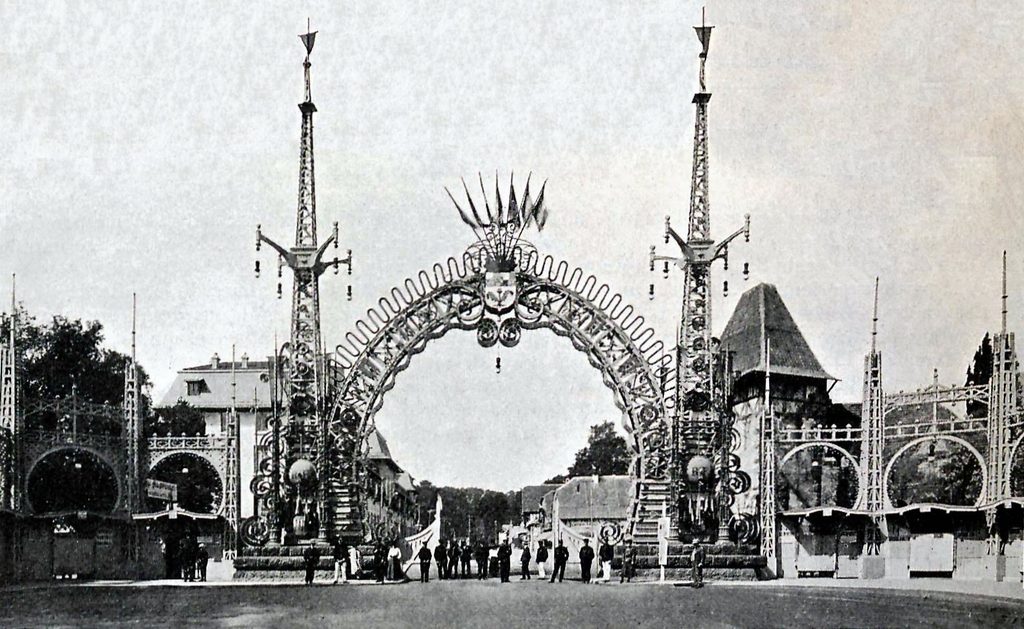
Beyond the palaces, the wooded park held diverse pavilions and attractions. Anglo-American concessionaire John Calvin Brown supplied fairground novelties including a popular water chute, a “grand huit” (roller coaster), and toboggan. A Lorraine farm conceived by 115 exhibitors, an Alsatian village rebuilt around an authentic transplanted house from Zutzendorf, and a reconstructed colonial section—including a “Senegalese village” featuring its own inhabitants—reflected the era’s regionalist nostalgia and colonial self-image. The Art Nouveau Ecole de Nancy featured prominently through its own pavilion and contributions to many others, alongside the Magasins Réunis’ “Maison Moderne”. The program was continuous and included concerts, an Alsatian festival, historical pageants, and 38 congresses, all covered by some 500 journalists.
The exposition drew well over two million visitors, making it a resounding success for a provincial city and the acknowledged apogee of Lorraine at the turn of the century. Almost every structure was demolished afterward. Only the Alsatian house survives, still in the parc Sainte-Marie.
The Incubator Exhibit
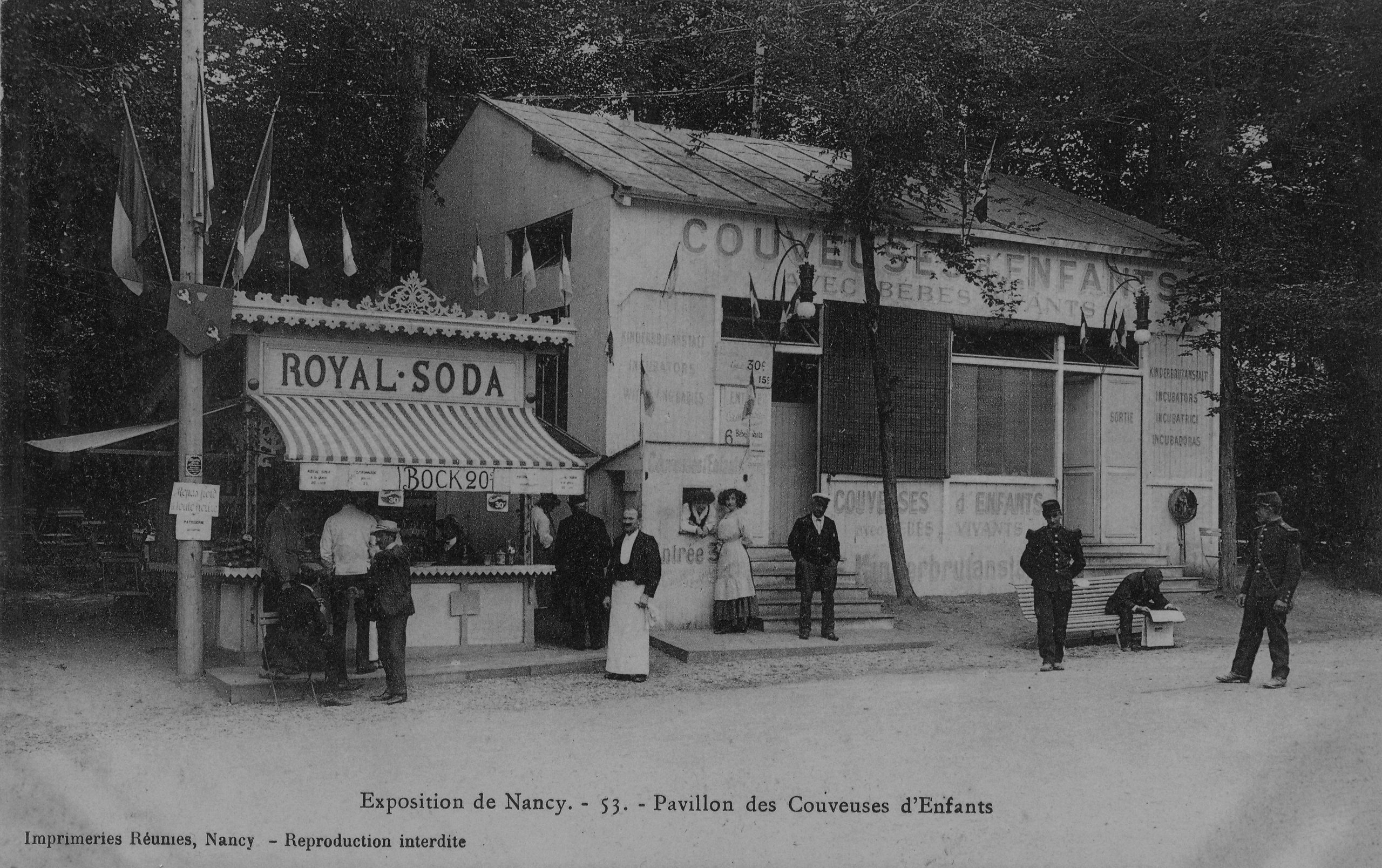
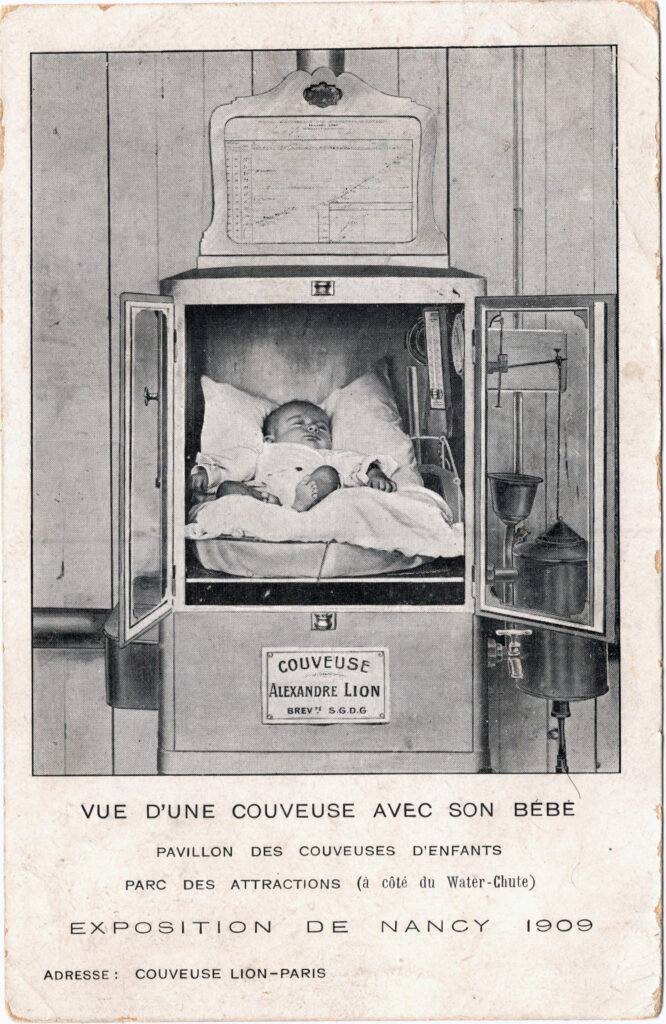
Among the concessions scattered through the Parc Sainte-Marie was a display of infant incubators operated by Alexandre Lion of Paris. Souvenir postcards show it as a purpose-built pavilion in the amusement zone at the south-western edge of the park, immediately beside the Water-Chute, its façade carrying the legend “Couveuses d’enfants avec bébés vivants,” a turnstile charging thirty and fifteen centimes, and signage in four languages — Kinderbrutanstalt, Incubators, Incubatrici, Incubadoras — pitched at the exposition’s international public. A second card, captioned “à côté du Water-Chute,” shows one of Lion’s incubators, plated “Couveuse Alexandre Lion, Breveté S.G.D.G.” and advertising six live infants on view.
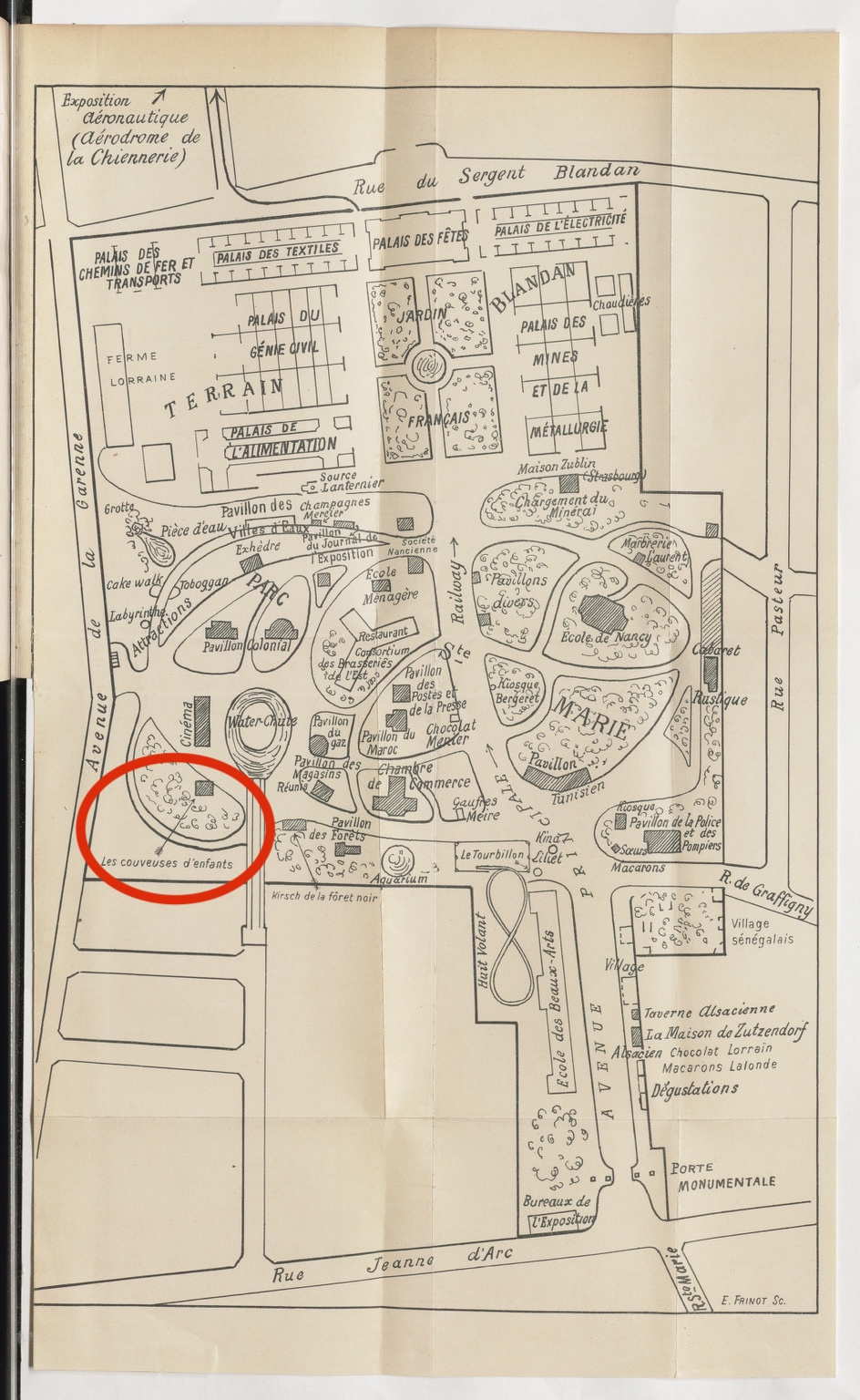
The guide’s plan confirms the paviion’s location, marking “Les couveuses d’enfants” among the cinéma, toboggan and cake-walk of the attractions park. In presentation the exhibit followed the pattern of Lion’s incubator-baby shows elsewhere: a paying spectacle of premature infants, staged as entertainment rather than as a clinical demonstration. Lenattier’s later description of it as “une couveuse pour prématurés,” recalls Nancy’s efforts against infant mortality and the puericulture movement.
The exposition’s official apparatus, however, registered the exhibit only in its welfare aspect. The exhibitors’ catalogue lists it in Classe 70 (Assistance — Hygiène sociale), within Groupe XIV (Économie sociale — Hygiène sociale — Assistance), as “Couveuses d’enfants (Lion, directeur), Paris. (Exposition individuelle)” — grouped with the municipal crèche, the anti-tuberculosis dispensary and the Red Cross rather than with the fairground concessions among which it physically stood. The jury awarded it a silver medal in the same class, recorded in Laffitte’s Rapport général as “Couveuses d’enfants [M. Lion, directeur].” Beyond these two entries — the catalogue listing and the lauréats table — Lion is absent from the official account.
After a thorough search, I have found only one mention of the incubator exhibit in the French and Belgian press. A correspondent to La Meuse (September 17, 1909) walks the reader through the Parc Sainte-Marie as the amusement zone. The writer describes the English garden as “the attractions where you go to unwind after the serious exhibition” [“les mille attractions indispensables où l’on viendra se dérider après la visite austère de l’exposition scientifique et industrielle]. It then describes the Water-Chute, the huit-volant, the cinématographe, the palais de la bonne aventure, the maison hantée, the toboggan, the cake-walk,, and in that same sequence, comes to “Les couveuses d’enfants, où des bébés dorment paisiblement, obtiennent toujours le même succès de curiosité” [The infant incubators, where babies sleep peacefully, always attract the same curious interest].
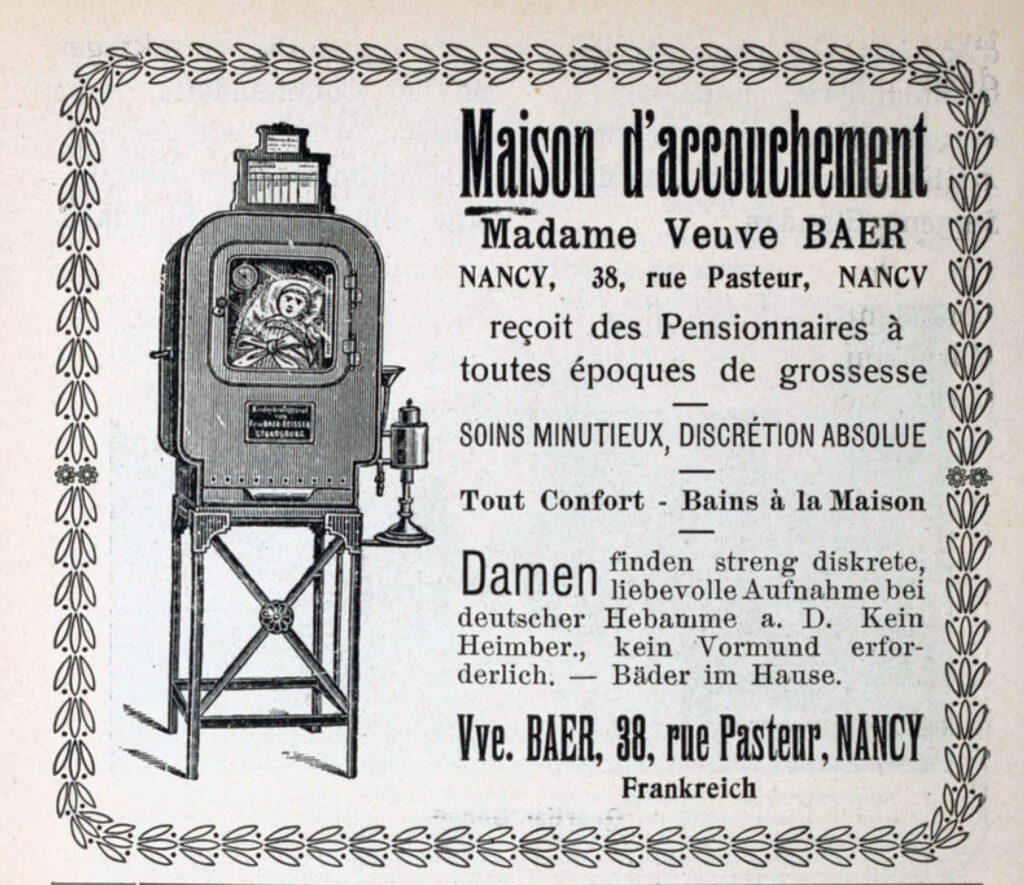
An odd discovery in the Exposition guidebook is this advertisement for (apparently) a retreat for unwed mothers, which includes a sketch that strongly resembles a Lion incubator complete with nameplate.
“Maternity Home
Widow Nancy Baer, 38 Rue Pasteur, Nancy
Accommodates expectant mothers at any stage of pregnancy
Meticulous care, absolute discretion.
All modern comforts – Baths on the premises.”
Sources
- Damamme-Gilbert, Béatrice. “The 1909 Nancy International Exhibition: Showcase for a Vibrant Region and Swansong of the Ecole de Nancy.” Art on the Line, 2007/1 (5). ISSN 1478-6818.
- Lenattier, Hélène. “L’Exposition Internationale de l’Est de la France” (conference intervention, text/PDF; delivered for the 1909 centenary), p. 5 [the “couveuse pour prématurés” characterisation].
- Laffitte, Louis. L’Essor économique de la Lorraine: Rapport général sur l’Exposition Internationale de l’Est de la France — Nancy 1909. Paris-Nancy: Berger-Levrault, 1912 (933 pp.). “Liste des membres du jury et des lauréats,” Groupe XIV, Classe 70, Médaille d’argent, p. 907: “Couveuses d’enfants [M. Lion, directeur].” Gallica, ark:/12148/bpt6k9643997q.
- Parfait, Isabelle, and Pierre Labrude. “La chimie et la pharmacie à l’exposition internationale de l’Est de la France (Nancy, 1909).” Revue d’histoire de la pharmacie 49, no. 329 (2001): 23–32. DOI 10.3406/pharm.2001.5180. [source of the attendance figure of 2,140,372 and the 180,000 m² site area]
- Archives municipales de Nancy. “1909 — L’Exposition internationale de l’Est de la France.” archives.nancy.fr.
- Exposition Internationale. Nancy 1909. Guide franco-allemand. Deutsch-Französischer führer durch Nancy und die Austellung. Edition 1. 1909. Gallica ark:/12148/bpt6k96306947. [source of the E. Frinot plan of the site]
- Catalogue des exposants, Groupe XIV (Économie sociale — Hygiène sociale — Assistance), Classe 70 (Assistance — Hygiène sociale), p. 188: “Couveuses d’enfants (Lyon [sic, = Lion], directeur), Paris. (Exposition individuelle.)”
- “L’Exposition Universelle de Nancy” (correspondance spéciale, signed Van Sittard). La Meuse (Liège), 17 September 1909. KBR (Bibliothèque royale de Belgique). [places “les couveuses d’enfants… succès de curiosité” within the Parc Sainte-Marie attractions circuit, beside the Water-Chute, huit-volant, cinématographe, toboggan and cake-walk]
More Information about Alexandre Lion
- General Information
- Alexandre Lion
- The Lion Incubator
- The Engineer and the Newborns, by W. A. Nelson and Paul L. Toubas
- Lion Patents (France)
- Patent 201550, 1889, Couveuse électro-automatique
- Patent 221716, 1892, Couveuse automatique
- Patent 262090, 1896, Chambre vivifiante
- Patent 281687, 1898, Système de filtration de l’air
- Patent 287557, 1899, Système de filtration des fumées, de l’air et de toutes masses gazeuses avec tirage et ventilation
- Patent 189989, 1899, Appareil pour le filtrage et la purification de l’air et des fumées
- Maternité Lion Institutes and City Exhibits
- Alexandre Lion’s first incubator baby exhibit in Marseille, 1890.
- Œuvre Maternelle des Couveuses d’Enfants, Nice
- Œuvre Maternelle des Couveuses d’Enfants, Lyon
- Œuvre Maternelle des Couveuses d’Enfants, Paris
- Œuvre Maternelle des Couveuses d’Enfants, Toulouse
- Œuvre Maternelle des Couveuses d’Enfants, Amiens
- Œuvre Maternelle des Couveuses d’Enfants, New York
- Œuvre Maternelle des Couveuses d’Enfants, Barcelona
- Œevre Maternelle des Couveuses d’Enfants, Brussels
- Maternité Lion Souvenir Booklets
- Œuvre Maternelle des Couveuses d’Enfants , Paris Institute, Booklet Version #1 (appears to be ~1896)
- Œuvre Maternelle des Couveuses d’Enfants , Paris Institute, Booklet Version #2 (appears to be ~1901)
- Pamphlet from Alexander Lion’s exhibit at the 1898 exhibition in Torino, Italy. (PDF supplied by Dr. Thijs Gras, Amsterdam)
- Press Coverage
- La Maternité “Lion de Nice” pour Enfants Nés Avant Terme ou Débiles, by Dr. Ciaudo, 1895. Source: gallica.bnf.fr.

- Presentation d’Appareil, by M. A. Pinard, Bulletin de l’Académie nationale de médecine, 1893. Source: gallica.bnf.fr.
- Les couveuses d’enfant et le gavage, by César-A Queirolo, Includes discussion of Lion incubator and comparison to other types. Thèse de doctorat: Univ. Genève, 1897.
- Les Couveuses pour Enfants, Gazette Médicale de Paris, No. 40, October 6, 1900
- Couveuses d’Enfants, La Maternité Lion, Paris, La Patrie, 1897
- Paris Letter: An Improved System of Incubators, by O. Jennings, Pediatrics 1:427-428, 1896
- Baby Incubators, The Strand Magazine, 1896, by James Walter Smith
- Human Infant Incubation: A True Fairy-Tale of Modern Science from Leslie’s Weekly, 1897
- The Saving of Human Life, Maternité Lion in NYC, The Literary Digest, 1898
- Immature Infants in France, from The Lancet, January 16, 1897, page 196.
- De Lion Incubator at Low Maternity Hospital, by Francis H. Stuart, Brooklyn Medical Journal, 1901
- Alexandre Lion’s Incubator Charities in Europe (1894–1898) (The Embryo Project)
- La Maternité “Lion de Nice” pour Enfants Nés Avant Terme ou Débiles, by Dr. Ciaudo, 1895. Source: gallica.bnf.fr.
- Worlds Fairs and Expositions
- Maternité Lion at the Lyon Exposition Universelle et Coloniale, 1894
- Maternité Lion at the Lyon Exposition Universelle – Le Monde Illustré, 1894
- Maternité Lion at the Bordeaux Exposition of 1895.
- “La Maternité Lion,” by Louis Énault, Journal of the Bordeaux Exposition, 1895
- Maternité Lion at the Amsterdam World Exposition, 1895
- Maternité Lion at the Berliner Gewerbeausstellung, 1896
- “Bericht ǔber die Couveuse (Lion) oder Kinderbrutanstalt” [Report about the Lion Incubator] from Berlin und seine Arbeit – Amtlicher Bericht der Berliner Gewerbe-Ausstellung 1896. English Translation.
- Maternité Lion at the Exposition National Suisse, Geneva, Switzerland, 1896
- “Quelques Réflexions sur le Fonctionnement et les Résultats des Couveuses Lion pendant l’Exposition Nationale,” by Dr. Hector Maillart, Revue Médicale de La Suisse Romande, 1896. English translation.
- Internationale Ausstellung für Körperliche Erziehung, Gesundheitspflege und Sport, Innsbruck, 1896
- Maternité Lion at the Tennessee Centennial Exposition, 1897
- Maternité Lion at the Brussels International Exposition, 1897
- Maternité Lion at the Turin L’Esposizione Generale Italiana, 1898
- Maternite Lion at the Ghent Provincial Exposition of 1899
- Maternité Lion at the Greater Britain Exhibition of 1899
- Maternité Lion at the Paris Exposition Universelle of 1900
- Maternité Lion at the Woman’s Exhibition in Earls Court, London, 1900
- Maternité Lion at the Lille Exposition of 1902
- Maternité Lion at the Exposition Internationale de Reims, 1903
- Maternité Lion at the Nantes Exposition of 1904
- Maternité Lion at the Exposition du Nord de la France, 1904
- Maternité Lion at the Liège Exposition Universelle et Internationale, 1905.
- Maternité Lion at the Marseille Colonial Exposition of 1906
- Maternite Lion at the Bordeaux International Maritime Exposition of 1907
- Maternité Lion at the Marseille Exposition Internationale d’Électricité, 1908
- Maternité Lion at the Exposition Internationale de l’Est de la France, Nancy, France, 1909
- Maternité Lion at the Brussels Exposition Universelle et Internationale, 1910
- Maternite Lion at the Exposition du Centre de la France, Clermont-Ferrand, 1910
- Maternité Liion at the Rome International Exposition of 1911
- Maternité Lion at the Turin International Exposition of 1911
- Maternité Lion at the Exposition Internationale de Dunkerque, 1912
- Maternité Lion at the Ghent International Exposition of 1913
- Maternité Lion at the Exposition Internationale Urbaine de Lyon, 1914
- Maternité Lion at the Lyon Exposition Universelle et Coloniale, 1894
French primary sources were machine-translated, then checked against the originals and edited by the author. Portions of this page were drafted with machine assistance; the final text was reviewed, verified, and edited by the author. Click here to learn more.
Last Updated on 09/11/26