Greater Britain Exhibition of 1899
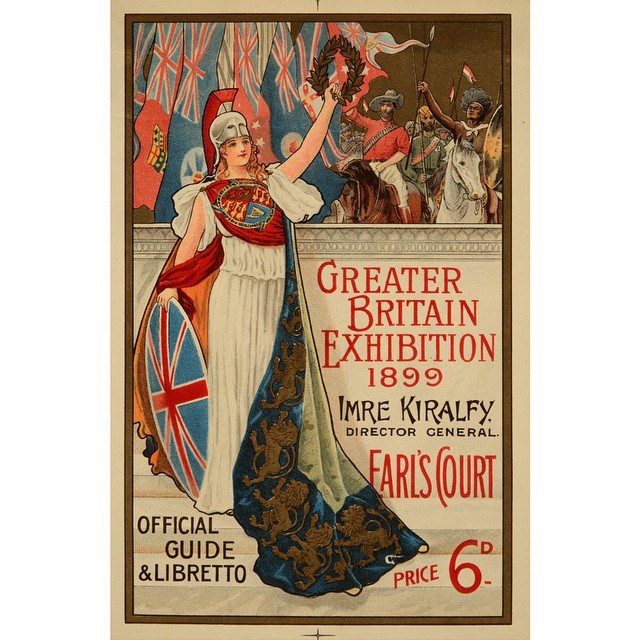
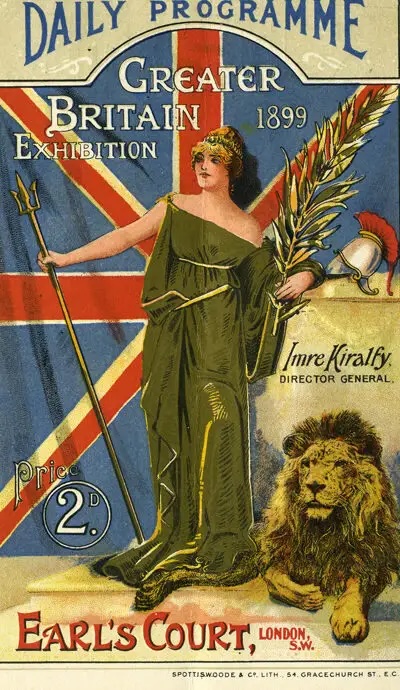
Held at Earl’s Court in West Brompton and West Kensington under Director-General Imre Kiralfy, the Greater Britain Exhibition opened on 8 May 1899 and ran through at least late August. Its stated purpose was to celebrate the commercial and imperial reach of Britain’s colonies, with displays representing Victoria, Queensland, Western Australia, Hong Kong, and other possessions. Visitors encountered an eclectic mix of attractions: colonial and Rhodesian ore-crushing mills, a working gold mine, an Egyptian street populated by natives, a Canadian water chute, a gravity railway, a bioscope, swan boats, and illuminated gardens.
The exhibition’s most theatrical draw was “Savage South Africa“ staged twice daily in the Empress Theatre by impresario Fillis. It depicted scenes from the recent Matabele wars using some 300 native performers — Matabele, Swazis, Basutos, Hottentots, and Malay drivers — along with horses, zebras, wildebeest, lions, leopards, and elephants. The climax featured a stagecoach plunging over a precipice into a torrent. One correspondent who visited described the spectacle approvingly, noting that audiences numbered in the hundreds and that the building could be emptied in minutes through its many exits. Alongside these entertainments were infant incubators — listed matter-of-factly in advertisements alongside the bicycle polo team, gold mine, and rifle range as visitor attractions.
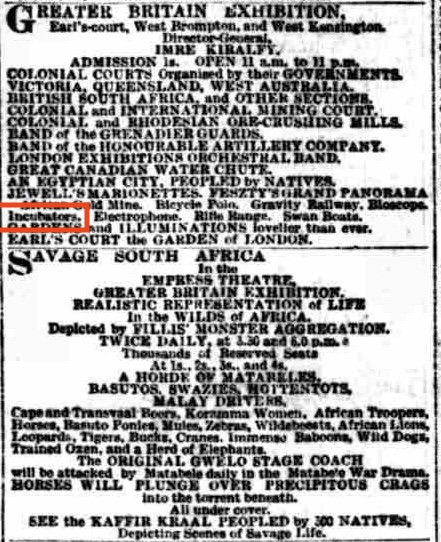
The incubator display was operated by the “Lion Incubator Company,” managed by a Mr. Seymour Bayley. By the company’s own admission, three infants had died in the incubators since the exhibition opened on 8 May. One of these deaths became the subject of a formal inquest. It is not clear from the news accounts whether there was any actual business relationship between Alexandre Lion and Seymour Bayley, or it was simply named after the type of incubators used in the exhibit. However, Alexandre Lion never operated any of his own permanent or exposition-based exhibits under the name “Lion Incubator Company.”
Philip Wolman, aged eleven weeks, was one of triplets born to Rachel and her husband, a tailor’s presser of 52 Hare Street, Bethnal Green. After the birth was reported in the papers, the Lion Incubator Company approached the family and, after considerable persuasion, obtained permission on 22 June to take the two boys to the Earl’s Court exhibition. Three weeks later, the mother was so dissatisfied with how the children were being treated that she wished to remove them, but the father alleged the company delayed his doing so. When the children were finally retrieved, witnesses described them as dirty, ill, and looking as though they had been starved; a neighbor confirmed they were “nothing but skin and bone.”
Philip died shortly after the family’s return. At the inquest held at Bethnal Green, Dr. Percy Goodman of Brick Lane testified that death was caused by marasmus (severe malnutrition) and inflammation of the bowels. He acknowledged the incubator’s unsuitability may have weakened the child generally, though he could not attribute the immediate cause of death directly to the incubator treatment — and notably, the child had not been clean when he first saw him at home either.
Bayley, for his part, disputed the family’s account entirely, claiming the children had received thorough nursing care and regular medical examination by Dr. Maitland Coffin, and that the father’s dissatisfaction was purely financial — the father had apparently been told that £4 per week was sometimes paid to families and had demanded money, threatening to “show the company up in the papers” when refused.
The jury returned a verdict of natural death and attached no blame to the incubator company. An inspector under the Infant Life Protection Act confirmed no prior complaints had been lodged against the institution.
Taken together, press stories reveal an exhibition that packaged empire, spectacle, and human novelty into a single commercial entertainment — one where African warriors, exotic animals, and premature infants occupied adjacent roles as objects of public curiosity. The Wolman inquest, with its three acknowledged deaths in three and a half months, suggests the incubator concession operated with minimal oversight. The jury’s exoneration left unanswered the question of whether families of modest means, recruited through newspaper birth announcements, were in any meaningful position to refuse the company’s “considerable persuasion.”
Unlike the other Lion incubator exhibits at Worlds Fairs and Expositions that we know about, this one does not seem to have been managed in a medically credible fashion, although we do not knowofor sure that whether the UK “Lion Incubator Company” was actually an arm of his business or simply named after the type of incubator. The “Lion Incubator Company” returned for the Women’s Exhibition at Earl’s Court in 1900, but I do not find references to that company in the UK after 1900; UK incubator exhibits thereafter were almost all staged by M. Ehrlich* (who used Lion Incubators).
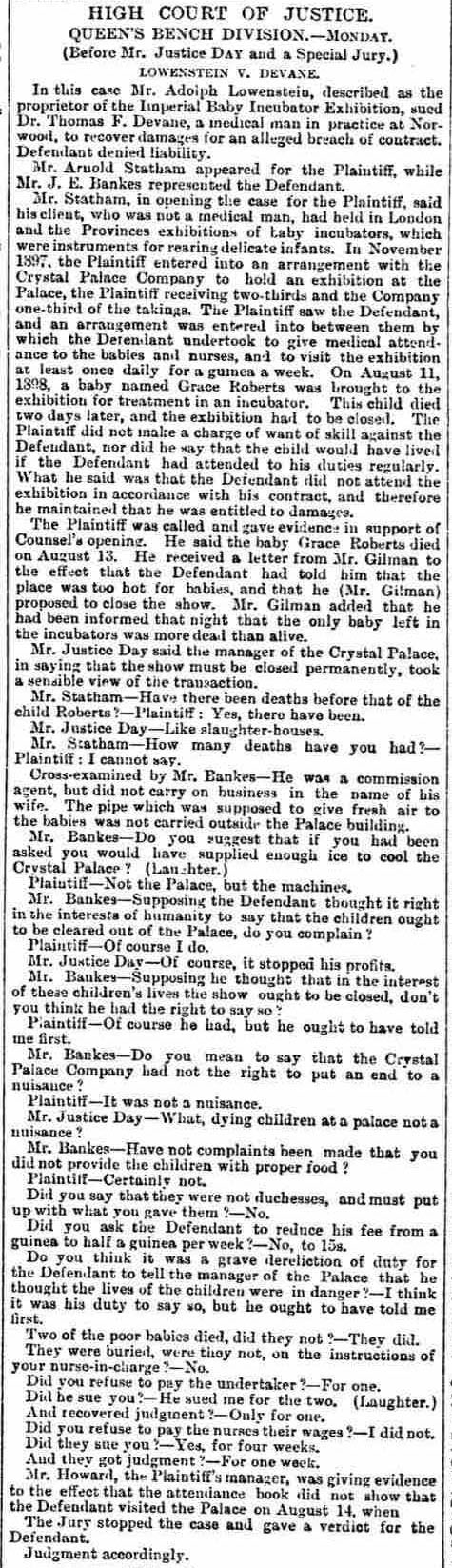
- The Paddington Times, 19 May 1899 — General description of the Greater Britain Exhibition, listing attractions including the “Savage South Africa” spectacle, infant incubators, Egyptian street, Canadian water chute, and other features.
- The Hampshire Post, 4 August 1899 — Firsthand visitor account of a day at the exhibition, describing the journey from Portsmouth, the Chute, the colonial displays, the Empress Theatre’s “Savage South Africa” performance, and various sideshows.
- The Daily Telegraph, 23 August 1899 — Advertisement for the Greater Britain Exhibition under Director-General Imre Kiralfy, and for “Savage South Africa” at the Empress Theatre, detailing performers, animals, and twice-daily showtimes.
- The Star, 18 August 1899 — Inquest report headlined “Incubator Baby’s Death,” covering testimony from Rachel Wolman, Dr. Percy Goodman, and Seymour Bayley, and recording the jury’s verdict of natural death with no blame attached to the incubator company.
- Lancashire Daily Post, 18 August 1899 — Inquest report headlined “An Echo of Earl’s Court: Baby Incubator Not to Blame,” summarizing testimony and the jury’s verdict of natural death.
- Lloyd’s Weekly Newspaper, 20 August 1899 — Inquest report headlined “An Incubated Baby’s Death,” providing the most detailed account of testimony from Rachel Wolman, Dr. Percy Goodman, Seymour Bayley, and the inspector under the Infant Life Protection Act.
- Exhibition Study Group (2004) — Historical overview of Earl’s Court exhibitions 1887–1914, providing institutional context on J. R. Whittey, the founding of London Exhibitions Limited, Kiralfy’s tenure, and the successive themed exhibitions leading up to and following 1899.
Portions of this page were drafted with machine assistance; the final text was reviewed, verified, and edited by the author.
* Moritz Ehrlich, referred to in most news accounts as M. Ehrlich, is a somewhat mysterious figure. I have not been able to find much information about him other than his claimed origin in Vienna and a later residence address at Lothringerstraße 59 in Berlin. He used Lion incubators, and his exhibits usually were named “Baby Incubator Institute” or some variation on that in the local language. He is known to have exhibited at Manchester in 1902 and 1903, Glasgow in 1903-1904, Bradford in 1904, Liege in 1905, Birmingham in 1905, Budapest in 1906, Dublin in 1907, Edinburgh in 1908, Motherwell Scotland in 1934, Brussels in 1910, and Brussels in 1935. Undoubtedly there were many others as yet unidentified. He also had some connection with Albert Leotardi, another entrepreneur on the incubator exhibit circuits, as evidenced by a lawsuit between them filed in Berlin on September 12th, 1899.
Last Updated on 07/20/26